
Oldboy is one of the key titles from a time in my life when I watched movies a lot. Not a breadth of movies, but a small selection over and over again. I was studying to be a moviemaker myself, so I was doing a lot of director commentaries, and I doubt I was absorbing much. Actually, there’s this lesson you learn early in film studies, that anything substantive can be gleaned from watching bad movies. False! Sure, it’s a kind of deconstruction, and it’s easy to see the mistakes. “I won’t make a mistake like that,” you say, and then dream about what you’d do instead. But it’s harder to visualize what you’d do, especially once you’re in it, suddenly realizing that this successful execution of a payoff doesn’t make for an actual scene, as that’s an entirely different step. First you set everything up inside the broader structure, and then you have to ask, “What might be cool?” It’s a process of construction, and this is a separate discipline.
Watching a movie like Oldboy with director Park Chan-wook’s Korean-language commentary was also “process,” but really, more of an ego boost. “Wow, who else but me does such a thing!” However, if you were to ask me about Oldboy, why it’s supposedly so great, so powerful, oh, man. I didn’t have the language as a film critic – filmgoer – to express the feelings it generated in me, nor did I understand that the feelings were the important part. My approach to movies then was informed by the Japanese director Mamoru Oshii, specifically his popular work like Ghost in the Shell and Avalon. I took what I saw in those very cold, inhuman films and reproduced them in the form of essays, basically retelling what I imagine the director was trying to impart. This is the issue: an assumption that a director’s foremost job is to “impart.” Park Chan-wook immediately captured my imagination with his imagery – the stunning compositions and use of color, and especially the ultraviolence – but I couldn’t interpret what he was saying.

So, naturally, the Park movie I magnetized to was Joint Security Area, the polar opposite of Oldboy within his first career phase – something we’ll touch on a little later. Where Oldboy is mystifying, Joint Security Area has a solid, concrete point. It’s about something, and it’s about something important. Sociopolitical, even. In addition, it’s a little more obscure. Not too many people have heard a this one, nyuk, nyuk, nyuk. I could study Joint Security Area in scholarly isolation, then return to society with my findings. Not to mention: it’s totally underrated. The few who have seen the movie frame it inside an all-too-easy narrative that it’s the more commercial product, a first-time director developing a style he achieved within the blank canvas of his next film before refinement in Oldboy. And finally, and most importantly, Oldboy was given to me. I didn’t discover it on my own like I did The Host, the first Korean movie I ever watched. It was my friend – non-Korean, by the way – who showed me the hammer fight on YouTube, and then brought over the DVD one day. Oldboy wasn’t mine.
As an aside, I’m glad this is how the insanity of my nerdness manifested, instead of, like, violent resentment of women or “my childhood is the only thing that matters!” It’s not great, but it’s not the worst.

Just as I’d love watching others watch the twist, someone else watched me first – and if I’m being 100% honest, I didn’t even put it together right away. “Wait, so he… with his…?” It wasn’t the “OH, NO” that Donovan gave me years later. This was back in the late 2000s, when Netflix was mostly a DVD-by-mail service, and sometimes a movie would be available to stream, with a nice blue “play” bar under the red or grey “rent.” Both Sympathy for Mr. Vengeance and Lady Vengeance were available then, if you can believe that, and I cleaved to both like I had with Joint Security Area. I was astonished by Sympathy. I thought – and still do – that it’s the most disturbing movie I’ve ever seen (that’s also still good and not a documentary). And then Lady Vengeance, my God, with its prison rape and dinner rape and its, like, general air of violence – toward women, children, animals. This Park Chan-wook guy is fucked!
Fucked but not too far gone. When I got his “Vengeance Trilogy” on Blu-Ray disc, it was under the Palisades Tartan “Asia Extreme” label, which carried other Korean titles like A Bittersweet Life (much sought-after and quite the letdown) but also Japanese material like Audition and Dead or Alive. In fact, Park contributed a segment of an anthology film which also featured Takashi Miike. And Miike was one of the directors I tried to get into during my exploratory film student days, but couldn’t get past his violence against women. And also, I didn’t get it. What he lacked was Park’s elegance, this “diamond-cutter’s eye” that imbued his violence with purpose. Miike was more like a troll, having a laugh at my expense. “Oh, you don’t like bruised women’s faces? Well, what do you think about this?!”

I loved the Vengeance Trilogy so much that I didn’t just watch it over and over again myself, I subjected all my friends to select episodes. I even watched Oldboy with my dad, which is one of the weirdest things anyone can do. To jump ahead to the very present, these are still some of the most depraved movies I’ve ever seen; they’re not scary in a traditional, fun way, but more like attacks on the psyche. And that’s what I liked. I’d refer to these movies as weapons. I actually got a similar thrill much later with Parasite, which is a movie I’ve never desired to watch alone because so much of its fun is the surprise. I want to feel what people feel when she goes down into that basement or the guy slowly peeks above the staircase. I don’t know, film as communal experience?
Which is exactly what an Oldboy rerelease would promise. Restored in 4K (with some pretty subpar subtitles), Park’s signature film was returning to theaters in August 2023, on the occasion of its 20th anniversary. I immediately shit a brick. The big screen is still special to me, and I have a mental list of movies I’d love to see in theaters (some now crossed off, like Jurassic Park and The Matrix), with Oldboy being an obvious candidate. But 20 years is a long time. Oh Dae-su’s montage would have to include countless additional world news items, as it did in the American remake. For one, there was that American remake, which I viewed recently, and you know what? It’s not as bad as I remembered ten years ago. Textbook case for studio interference, and it’s still appreciably darker than most stateside thrillers. The source material is just that strong.

For myself, while Oldboy was one of the first pieces of Korean media I ever saw, I’ve since become a full-blown Koreaboo. If I’m guarding a treasure vault and you need to distract me, just ask “Who’s your favorite K-pop idol?” and that’s a zero divide. It’s Dwight Shrute saying, “There are basically two schools of thought…” So at this point, Oldboy is like an old friend from my hometown. Our relationship has been complicated, with actual instances of regret, which I realize is a lot between a man and a movie. Certainly, by this point, I wasn’t interested in the old sadomasochistic pleasures. I didn’t want to sit near anyone at all, never mind know what they were feeling. And when the time came to actually drive an hour and a half to the closest screening, I barely wanted to go. It was days after my 30th birthday, when my family and friends surprised me by flying Donovan and Stella in from their respective parts of the globe. I needed to catch up on work, for my main job and for Collider, which was starting to slip away. For the first time in many years, I didn’t want anything out of Oldboy except for the film itself.
A few years ago, I revisited Lady Vengeance, which I’d later have to admit in my teenage years was the weakest of the trilogy – only more interesting than Oldboy because I had a massive crush on the lead actress Lee Young-ae. That hasn’t changed, but seeing the film through adult eyes, I was demolished. What had been the most confusing of the three (yet still not as confounding as I’m a Cyborg) suddenly clicked and it was one of the most powerful experiences I’ve ever had with a movie. Later, for a With Eyes East video, I watched Sympathy for Mr. Vengeance – somewhat reluctantly – and also felt like I could see it for what it was. I’d heard for years Park and various critics refer to it as a black comedy, but if this is black, it’s the blackest there’s ever been. And I found, yeah, that’s exactly what it is.
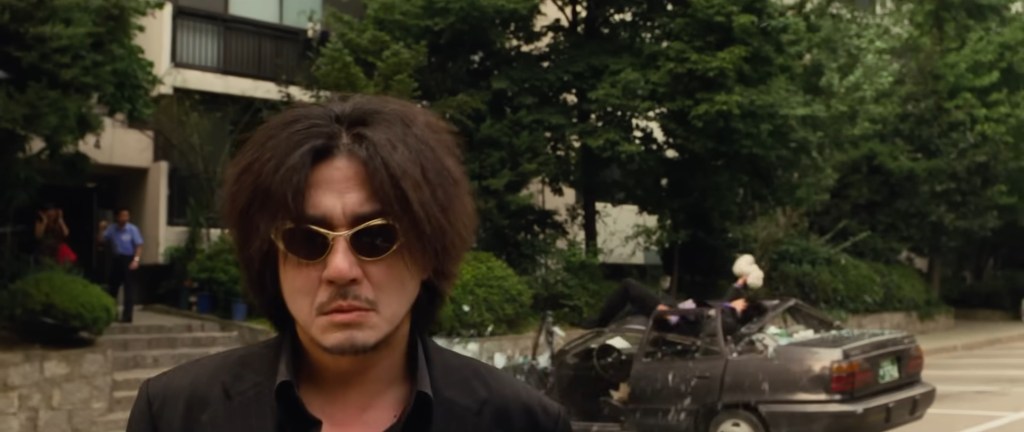
“Sometimes when you look at a sad or dark moment, it can be funny. Things that are very, very sad make people laugh.”
– Park Chan-wook to Martin Wong, Giant Robot
Not too unlike Takashi Miike after all, Park Chan-wook is having a laugh. Like my friend watching me and me watching my friends as Oh Dae-su flips through the photo album, Park is sitting there, fingers tented, anticipating my reaction. And the moments that generate the reaction hit with such a pummeling rhythm. In Sympathy, it’s a parade of awfulness, from the death of the little girl to the baseball bat to the torture and on and on, but Oldboy is far more inventive. It isn’t all gross-out scenes like the octopus or the dental work. There’s the hallway fight, of course, and the hotel montage, the guy smashing into the car, the dumplings, the flashbacks at the school, Joo-hwan’s death. Everything is shot in a new, unique way, or strung together in a clever sequence. I love Mi-do’s character introduction, with the ants, and the match-cut of her wiping tears away. Each of these scenes is also greatly boosted by Cho Young-wuk’s unforgettable score. The most horrible thing could be happening, and we’ll hear this beautiful, almost sneering violin.
That’s the best summation of my most recent experience with Oldboy. I was laughing through the entire movie, and not because of anyone else’s horrified reaction. From the moment we see Oh Dae-su in the police station at the beginning to the moment he sees that photo of Mi-do as a teenager – it is flat-out fucking funny. Like, dude. You totally fucked up, dude. And Choi Min-sik makes some of cinema’s greatest faces. His performance is so ranged not only psychologically but physically, where he’s moving his body in these strange ways and he’s screaming and cackling. He’s like an explosion.

I fundamentally disagree with Miike’s sick sense of humor, and am mostly terrorized by Park’s in Mr. Vengeance. But with Oldboy, I finally feel like I’m laughing with the director, like I can see the movie through his eyes. It’s the telepathy that all art aspires to, the abstracted communication through a medium. I’m reading Park’s mind, and yeah, as far as Oldboy’s concerned, there’s not a lot going on there.
Sure, there’s literary and mythical allusions – “Oh Dae-su” sounds like Oedipus – but what’s the revenge movie moral? Do we learn here, as we do every time, that Revenge is Bad? I mean, it pretty much worked out for the avenger. No, I don’t believe there’s an essay underneath the surface here. It’s a thriller, and it’s affecting and fun and shocking. And more than even later films like The Handmaiden and Decision to Leave, it really codifies Park’s role as a director.
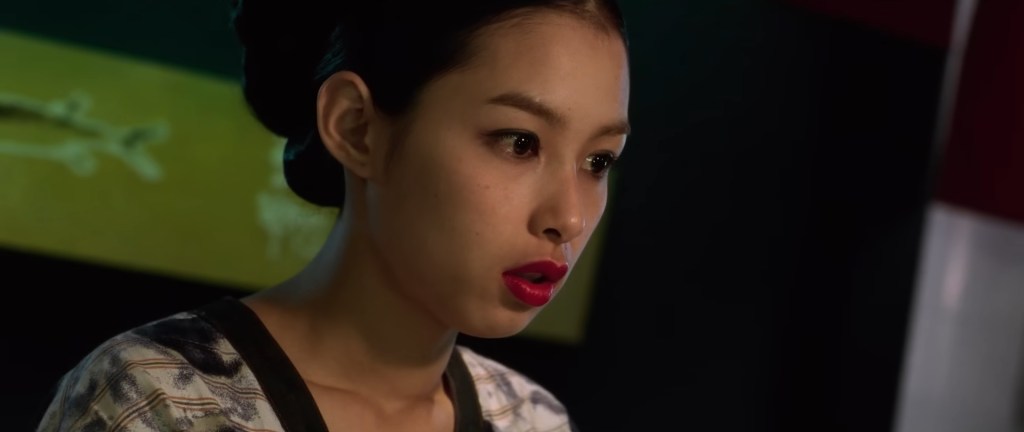
I didn’t find out until after this latest screening that Oldboy is a demarcating point in Park’s career. I always bristle at the bondage, with Mi-do and a cleaning woman both tied up for laughs. Apparently, Park felt some discomfort with the way he was doings things, and began to collaborate with a woman screenwriter, Chung Seo-kyung, who cowrote each of his Korean movies from Lady Vengeance onward.
In all these years, in all my devotion and scholarship, I never knew about Park’s closest creative collaborator. And a woman! Believe me, if I had known, I would’ve used her as a cudgel against whatever nonexistent criticism I felt creeping toward us (you know, him and I, best buds). I always felt that Lady Vengeance was the transitional film, from the ultraviolence to the surrealism, and maybe that’s still true, being sort of a legacy project with a new perspective. Chung describes her process with Park like it’s some kind of League of Legends competitive game, two laptops set up across from each other, the crew forming a crowd around them. And they go back and forth, never sure in the end who wrote what.

What I first loved about Park Chan-wook is still what impresses me now: the imagery, the movement of the camera, the sense of time and space. I didn’t like Decision to Leave, but I’m so glad he won Best Director for it at Cannes. Looking back at Oldboy now, as so many have – from Polygon to Vanity Fair – I can think of it now as a demonstration of the director’s artform. My interest in filmmaking began as the general “Well, I’ll be the director or whatever!” but quickly zeroed in on writing. As such, it was difficult for me to put the director on the same level as the writer/director, which is disrespectful to the latter discipline. Oldboy is a corrective. It’s beautifully directed, and these days, I find the greatest joy within the film, not just within the theater.
 With Eyes East