

Directed by Takao Okawara
Starring Masahiro Takashima, Ryoko Sano, Megumi Odaka
“This isn’t a summer camp for dinosaur freaks.”
By this point in the Godzilla chronicles, I feel a bit lost. Our feature tonight, Godzilla vs. Mechagodzilla II, is a perfect entry in the Heisei series. It checks all the boxes of everything that worked in the past, so what worries me is that when the boxes are checked, we’re still left with a mediocre film. And “mediocre” might be a funny word to use. I mean, these movies were produced practically nonstop, and for a young audience, whose chief and maybe only stipulation is that Godzilla appears. That’s a big check. But reviewing this movie positively – which I’d fully anticipated, having a brief idea of its general reputation – wouldn’t be very useful. Not that any of the lessons we might pull from Mechagodzilla II can be applied to future films, as they’ve already been made, but goddamn it – or Godzilla it – they could have.

Our first checkbox is that Godzilla vs. Mechagodzilla II hits the ground running. There’s a lot of table setting, like in Godzilla vs. King Ghidorah, but unlike that film, it’s compressed with voice-over and graphics. Right away, we learn that Mecha King Ghidorah has been repurposed into a weapon to kill Godzilla, overseen by an international anti-Godzilla bureaucracy. That means we have shots of people on a catwalk looking up at a giant mech under construction. This is all within the first five minutes, so we’ve skipped a fair number of steps. We didn’t have to first learn about an island, travel to the island, awaken the creature, ascertain the ship to take the creature and so on – although there isn’t none of that. On an island, scientists discover a giant egg and narrowly escape a battle between Godzilla and Rodan.
Rodan has taken on a more lithe appearance for his Heisei incarnation, losing the distinct silhouette. Now he’s much more like a Pteranodon than a bird, in keeping with what we’ll find is one of the film’s key themes. Godzilla makes one of his best entrances ever, blasting Rodan with atomic breath from under the sea. And then they fight, which is a classic matchup. It can’t be every time, because you need space monsters and mutants, but I’ll never say no to keeping it within the dinosaur family. If only Anguirus showed up in this era. Or the next one. In this fight, where Rodan’s pecking somehow generates sparks (not in a figurative, romantic sense), there’s a funny wide shot where Godzilla falls to the ground and he’s flailing his arms and legs. Come on, man. Even Gamera knows how to stand up.
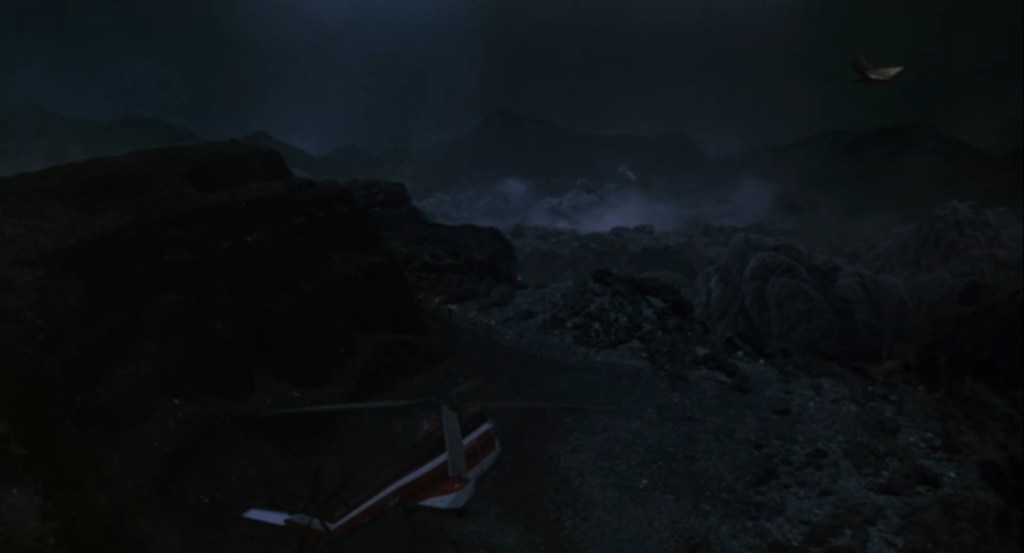
It’s a dark image, but he’s in that dust cloud
Our protagonist Kazuma Aoki is kind of a strange case. Now, I tend to think that daikaiju protagonists are better as dorks than anything else. In Return of Godzilla, you had the cool journalist guy, and in the 2014 American movie, you had the cool military guy. Aoki’s chief trait is that he’s a dinosaur fan. Even more specifically, a Pteranodon fan. This is what he tells the lady scientist charged with observing the egg, Dr. Azusa Gojo, when she’s all “Who are you and why are you trespassing in my laboratory?” Aoki as a character is able to express the audience’s enthusiasm for the subject matter, and being enthusiastic propels him into the plot. At the moment, he’s actually going AWOL, having been transferred to G-Force from his former post working on an anti-Godzilla machine rendered obsolete by Mechagodzilla: the Garuda.
He was not happy about joining G-Force, which seems to be the military component of the anti-Godzilla bureaucracy, and indeed, he’s put through the wringer. He’s tossed about in martial arts class, falls asleep in the classroom studying old Godzilla footage, and even whirls around in one of those NASA centrifuge devices. This is all preparation for operating Mechagodzilla, which is manned by a crew like the Space Battleship Yamato or, I suppose, the Final Wars Atragon. They even run a Star Trek simulation of the coming battle.
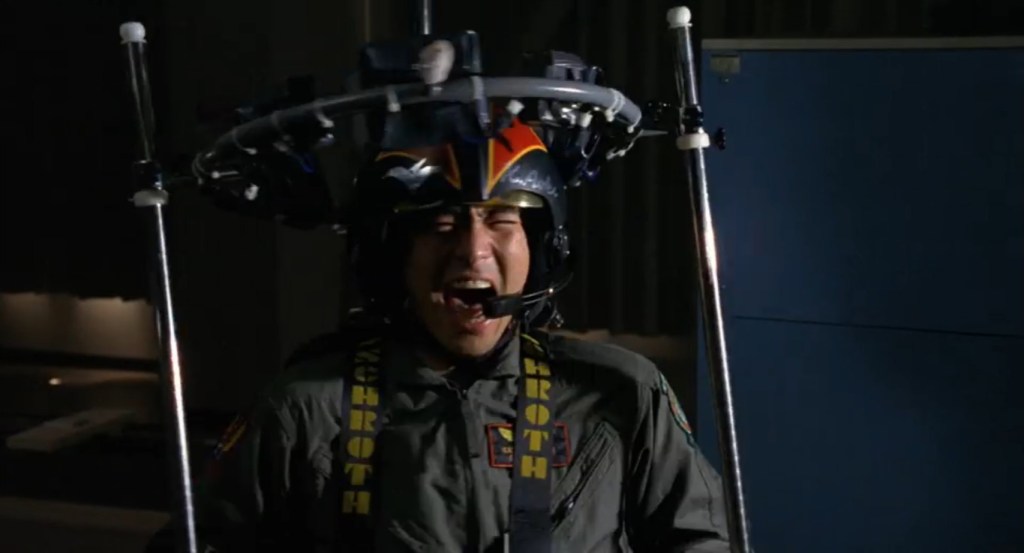
And right there, on paper, that sounds great. If we’re gonna have Godzilla action later, build up to it. Give us the training montage. Show us a character mastering the tools and the strategy, and all the better if he’s a hapless dork. When he’s finally facing off with Godzilla, we should feel this incredible pressure, because it’s different when it’s for real. He knows all the buttons, all the procedures, but now Godzilla is coming straight at him. Unfortunately, that just isn’t what happens here. See, the G-Force experience, an obvious device for escapism, is not expressed by a single character arc. We have Aoki, who’s whirling around, and we have the captain character who pilots Mechagodzilla (with everyone else taking up nebulous support roles), and in the eleventh hour, Miki Saegusa gets a uniform. Why spread a single role across three separate characters?
The egg hatches, and it isn’t a Pteranodon but a baby Godzillasaurus who imprints on Dr. Gojo. Easily, this creature is the best baby Godzilla until Kamata-kun twenty-two years later. Actually, I’ll admit a soft spot for the guys in the 1998 American movie. But unlike those little bastards, this Baby Godzilla is a plant eater. And Miki knows that because we live in a dinosaur world. Which is not, like, a big deal, it’s just a fact of life. So they take the child to a nice enclosure and it’s basically one of those viral videos of the pandas in the Chinese zoo. Baby Godzilla starts chewing on one of Dr. Gojo’s sneakers like a pet dog, and how could she be mad at that face? I don’t know, it’s kind of cute, but I wish Baby Godzilla was more active. Like Ghibli or Pixar energy. Let me see him chasing a lab rat in the corner while Gojo and Aoki talk in the foreground, and then in the next shot, the lab rat is chasing him. That sort of garbage.

When Godzilla squares off against Mechagodzilla, it’s in that green part of town we saw in Godzilla vs. King Ghidorah, and again I have to remember that Mothra: The Battle for Earth preceded this one. If that wasn’t enough, Mechagodzilla is backlit just like when Mecha King Ghidorah first shows up, although they are technically the same thing. As robots are always the toughest enemies, Mechagodzilla nearly kills Godzilla in the first bout. It’s an interesting moment, when Godzilla’s down, and his jaws start foaming up as Mechagodzilla shocks him with electrical currents. What are we supposed to be feeling here? I feel bad for Godzilla, and that’s validated in the end, but the human characters want to kill Godzilla. For them, this is… good?
It doesn’t help that, for me, Heisei Godzilla is the definitive Godzilla. I grew up watching these movies on TV (in bits and pieces), only arriving at the Showa era later. On top of that, this is how he was drawn in the Godzilla comics I read as a kid. Anytime there’s a variation on the design, I conceptualize it in relation to this version. The dorsal spikes are star-shaped, so Millennium Goji’s are “spikier,” and the American editions are erasures of form, being triangles. His face here is a good balance between threatening and expressive. He’s pretty mean in that first fight with Rodan, but then gives some quizzical looks in his encounter with Mechagodzilla. It’s that second brain he has in his pelvis.
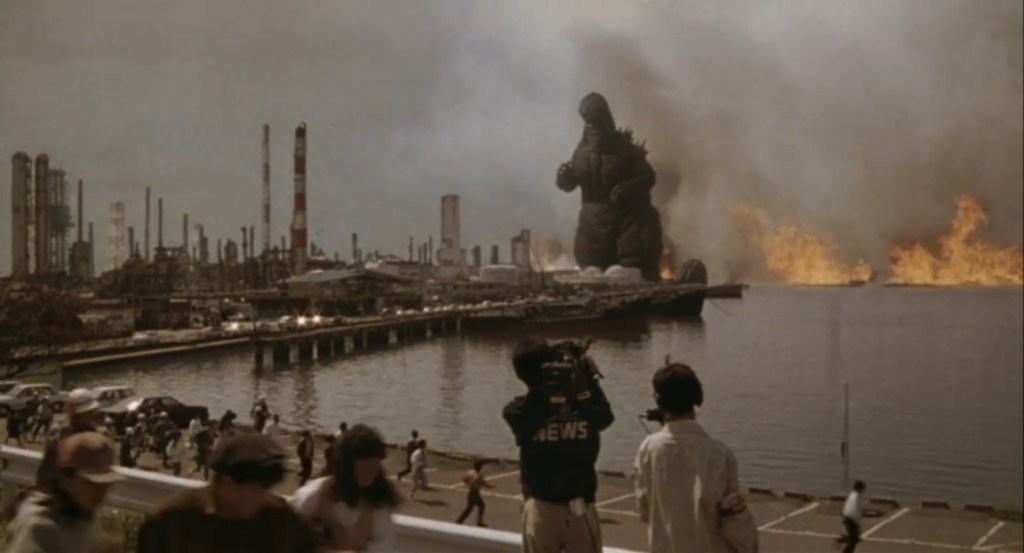
Studying Baby Godzilla reveals to the scientific community the existence of Godzilla’s second brain, which could be used as a weak point, if the head is too small of a target? We’ll call this the “G-Crusher Strategy,” and it requires Baby Godzilla to be used as bait. Miki, who’s sitting in on a military meeting for some reason, objects, because she doesn’t want the baby to be harmed. The military guy is like, “I’ll do you one better! Why don’t you ride in Mechagodzilla?!” Gulp! See, they need her to identify the second brain with her psychic powers. At the same time, Dr. Gojo pleads with a different military guy to not use the baby as bait. She says that he isn’t a military asset but a precious, living thing. So Dr. Gojo decides to accompany Baby Godzilla on the G-Crusher mission, which is a big character choice. She’s putting herself at risk to protect, or even just comfort, this creature. Unfortunately, what we have is a payoff in search of a setup. The Chinese zoo scene needed substance, like an actual arc.
That’s the story with Godzilla vs. Mechagodzilla II, and maybe Miki Saegusa is a serviceable mascot for the Heisei era. I want to like her, but what is she beyond “pretty chill” and, you know, pretty? In each of these movies, she finds herself in a different role at a different organization, like an anti-Godzilla free agent (who secretly loves Godzilla). It makes her a passive character, and at that point, we could be nearing something thematic – what if she’s a weapon? But that’s not really been the case so far. And then, Aoki steps on his own characterization by hijacking the Garuda after he convinces an American scientist (with the aid of a Star Fox 64 tech demo) that his old bird could be used to attack the second brain. To recap, his record so far is leaving his post during a Godzilla attack, kidnapping an American scientist, and stealing proprietary tech. Nobody seems to mind. Except me! How did our lovable doofus turn into such a wild child?

In the end, we learn our lesson and say goodbye. Sure, Godzilla was attacking Japan, but nobody ever asks why. Maybe he has a good reason. This time, he’s just trying to collect his son and return to the ocean. “Life against artificial life,” concludes the captain and one of many blonde female soldiers. Our technological terrors don’t have souls, though that’ll change someday.
Speaking of which, the more accurate title for this movie is Son of Godzilla II, but perhaps with its actual title (the American one, at least), we can see how much of a prototype it is for 2002’s Godzilla Against Mechagodzilla, also written by Wataru Mimura. In that one, the characters are compressed into a single heroine, and there’s a better design for Mecha-G. But that’s also the one with the little kid carrying around a potted plant meant to represent her dead mother. And really, part of the disappointment with the Millennium movies, and certainly its starkest point of contrast here, is that it didn’t fulfill the promise suggested by the Heisei era. With Godzilla vs. Mechagodzilla II, there’s almost a sense of continuity, almost an anti-Godzilla bureaucracy that develops over time. Almost a protagonist. Turns out, “almost” looks good on paper, but it’s never enough in practice.
For More on the Heisei Era:
The Return of Godzilla
Godzilla vs. Biollante
Godzilla vs. King Ghidorah
Godzilla and Mothra: The Battle for Earth
Godzilla vs. Mechagodzilla II
Godzilla vs. SpaceGodzilla
Godzilla vs. Destoroyah
 With Eyes East