

Directed by Kensho Yamashita
Starring Megumi Odaka, Jun Hashizume, Akira Emoto
“We can only speculate that it’s some sort of huge monster.”
The previous installment, Godzilla vs. Mechagodzilla II, was one movie too many. I’d actually forgotten it existed before embarking on this review journey more than a year ago. After watching Godzilla and Mothra, I was dreading it, while conversely looking forward to SpaceGodzilla, and so the two came to represent a binary in my mind. On one hand, you have a competent but generic Heisei Godzilla movie, one which introduces absolutely nothing new, and on the other hand, you have the movie where the tip of Godzilla’s tail is coming off. What better visual metaphor for a series that’s run its course? Godzilla vs. SpaceGodzilla is exactly what I want from a long-running film franchise: “We’ve run out of ideas, so let’s make crap up.” It wouldn’t be competent but unhinged, and it wouldn’t be generic but, indeed, unhinged.

To my surprise, Godzilla vs. SpaceGodzilla turns out to be the first essential episode in this cycle since Biollante, being a direct sequel. Depending on how Destoroyah turns out, we could have a mostly coherent trilogy nestled inside this mess, starting with Return of Godzilla. Where that film created a world that Biollante played in, SpaceGodzilla continues a thematic bridge. There’s no talk of international conflict over Godzilla cells (hereafter referred to as “G-cells”), and the monster threats and guardian spirits have become normal. The fundamental strangeness of Heisei’s human characters – the apathy, the lack of awareness – finally feels right, and as a result, this movie is settled into itself. The government is still hard at work trying to kill that pesky Godzilla, but there’s no rush. It’s pretty weird!
Perhaps the most profound advantage to SpaceGodzilla is that Miki Saegusa is actually the protagonist this time (with caveats). At the film’s opening, we visit her academy for gifted youngsters, where she’s approached by two government scientists, Dr. Susumu Okubo and Professor Chinatsu Gondo. Alongside the ongoing Project M, involving a drill-faced robot called Mogera meant to combat Godzilla, these two propose Project T, which stands for “telepathy.” They want to shoot Godzilla with a telepathy receiver so that Miki can control him, and presumably tell him to chill out. Miki doesn’t want to do this, because she knows what we know: human intervention is always the problem in kaiju affairs. In a shocking move, they insist that Project T will go ahead, with her involvement or one of her trainees’. There’s a great shot of Miki’s reflection as she begins to parse something novel: a conflict.

This is more character development than we’ve seen in all the previous movies combined, and it does the extra work of creating a subtle atmosphere. Sure, the world has relaxed since the advent of Godzilla, but maybe the government is taking a firmer hand with the monster, and by extension, with the old heroes who never quite got the job done. We’re resigned to this fate, so you, Miki, will be, too. We’ll also find that the institutional anti-Godzilla effort is just as splintered as suggested by two competing Projects, which climaxes in an unusual but welcome sequence on – you guessed it – a tropical island.
I could hardly believe mine eyes when we cut from the telepathy institute to a boat heading toward an island. It’s G-Force, this time represented by Lieutenants Koji Shinjo and Kiyoshi Sato – already I’m worried about cast creep – here to execute Project T. They’re introduced in a very brief scene where one of them is dancing to a boombox, and the other remarks that he’s awfully happy. That’s all we need to know about these two and all we’ll ever learn. On the island, they encounter a seeming wild man, Yuki, who’s got a bandana and rescues them from a deadly tarantula with his knife. I’ll assume that was a real tarantula the filmmakers killed, and then posthumously defamed by calling it poisonous. Anyway, Yuki is here to kill Godzilla by shooting him in the armpit. But mostly, he’s been hanging out with the totally kawaii Little Godzilla, who’s put on a few pounds since last we saw him. So, Yuki is hard-edged and the two G-Force guys are goofy, and frankly, this is enough. If we’re not gonna have depth in these characters, at least create contrast in the dynamic between them.

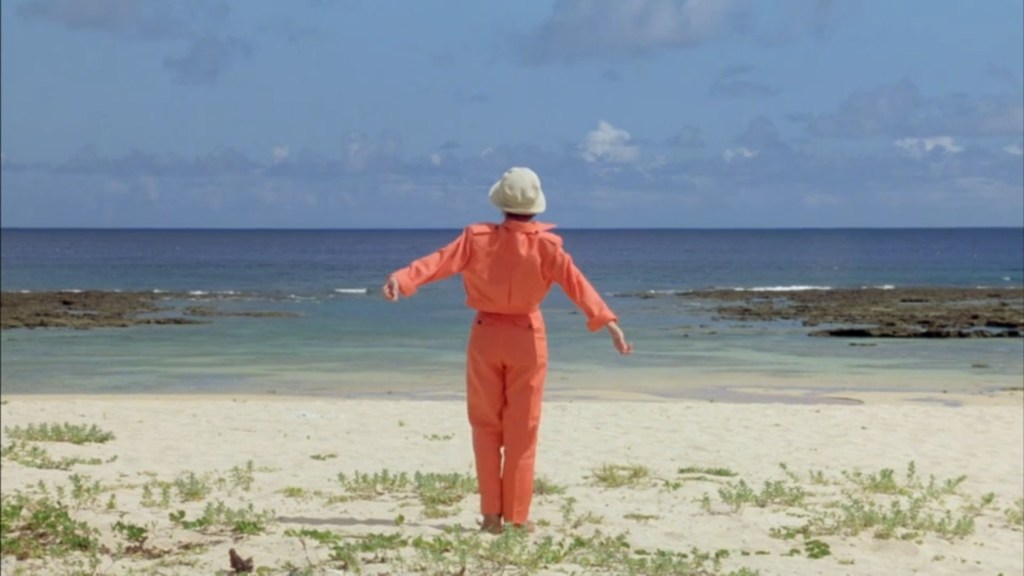
After Miki finishes parsing her conflict, which looks a lot like sitting on a bench for a few minutes, she’s greeted by the Shobijin, who tell her about a space monster hurtling toward the Earth. By this point, we know who these twin fairies are – and who they represent – and Miki knows, too. No explanation needed; the minor pleasures of a sequel. This, for some reason, is enough for her to agree to Project T. Along with Okubo and Gondo, Miki arrives on the island, wearing a bright-orange outfit that looks like a prison jumpsuit, and we’re still not quite at the actual Godzilla action yet. The film begins to show its character here with jarring edits and oddly truncated scenes.
Miki says hi to Little Godzilla, who knocks over a rock that tumbles down the hill nearby. She smiles. Then we cut to her walking toward the water and stretching against the breeze. Then we cut to some clouds. The soaring music groups these scenes together but what’s being communicated? Nothing narratively, and in fact, it’s anti-narrative, but we might feel what Miki is feeling. There’s a focus on the texture of the world, and on, I dare say, its beauty. There’s also weird stuff that happens with Yuki and the G-Force guys, like how they build a fire or when Yuki is showering and the guys are watching him. These moments have no context. It’s a laid-back vibe, because instances like these usually communicate the passage of time. But shouldn’t this be more urgent? What are we waiting for?

Godzilla, I guess, but I’d reckon the timing of his appearance is entirely up to the filmmakers. His eventual arrival isn’t greeted by a military counterattack, meaning we’re far enough into a single Godzilla continuity that we’re doing something different. Instead, Project T and Yuki’s assassination attempt execute simultaneously, and despite that, in practice, it’s a lot of guys running around the beach to get better aiming angles, it’s a different kind of energy. Not apocalyptic, but with the tension of a heist, like “We gotta make this work!” And most appreciated is how they let this sequence breathe. We’re not cutting in between every beat to check out what’s going on in space. Where, by the way, SpaceGodzilla sends Mogera packing. Why not send a drone first, guys? Don’t tell me you don’t have the technology, because you’re out here trying to mind-control Godzilla.
SpaceGodzilla, with his little T. rex arms (that go up and down like a corgi being lowered into a pool), makes landfall on the island with a tremendous explosion and attacks Little Godzilla. How does he even know Little Godzilla? To defend him, Godzilla bypasses the combined efforts of the humans, one of which literally short-circuits. Miki almost gets fried like Ghost in the Shell, but she isn’t too upset about it. In a far cry from the abusive parenting seen in Son of Godzilla, Godzilla uses his body to shield Little Godzilla from SpaceGodzilla’s winding laser beams. What a terrible family reunion. This has to be Godzilla at his most anthropomorphic in the Heisei series. I mean, he’s a dad.

I think it’s more to do with how we, and the human characters, view Godzilla. He’s taking the antihero role here, especially after Little Godzilla is buried under crystals and SpaceGodzilla hovers away to continue his rampage elsewhere. The humans may want to kill Godzilla, but Miki identifies that approach as a fallacy – one phallic in nature. There’s a scene where she’s relaxing on the beach at magic hour, and Shinjo asks if she ever thinks about anything other than Godzilla. She and I both answer “No,” but then she adds that men never think about anything but fighting. As the Shobijin had just advised her, there has to be another way. Here, the Earth guardians are working through a human conduit, and it all just makes sense. Mothra ought to be here, but in lieu of Mothra, let’s see humanity pull together and figure it out. Thus, we lay the groundwork for what’s shaping up to be an actually great entry in the Godzilla series?
The team teleports back to Tokyo via helicopter, because suddenly Professor Gondo is in a conference room advising military men on what she’s dubbed “SpaceGodzilla” (great reaction from the room). Yuki, now in uniform, is encouraged to be the new Mogera pilot. Not ordered, really, just told. Miki is actually kidnapped by Dr. Okubo, prompting a rescue mission by Shinjo, Sato, and Yuki. Refreshingly, this human versus human sequence doesn’t feel wholly cleaved from the Godzilla part, because we’ve just learned that Miki holds the key to stopping SpaceGodzilla, and therefore shouldn’t be caught up in some useless anti-Godzilla effort nor the resulting interagency squabbles. And then we head off for the final battle! This is a movie that utterly lacks a second act, but that’s never been a Godzilla movie’s strong suit anyway.

SpaceGodzilla attacks Nakano Island, which is a cool, coastal setting for people to run around in. Godzilla chooses to attack Kagoshima. Sucks to be an island nation. Invading monsters have endless points of entry. Regardless, I don’t know why these places aren’t evacuated long before the monster is within compositing distance. Yuki returns from the rescue mission and gets in the robot, but not before half-heartedly asking Shinjo and Sato if they want to join. Sure! Do they have piloting experience? Who knows! Why is everyone in the military so chill? Crucially, Shinjo and Sato make their big character decision after they’ve risked their lives to save Miki. The same setup/payoff chronology is reversed for Gondo, who we discover is indeed related to that Gondo from Biollante, who happened to be best friends with Yuki. Knowing that info earlier would’ve benefited the island scenes, but Gondo and Yuki share a nice moment before he boards Mogera.
I’m touched that there’s actual character work here, and the filmmakers are using what’s already established instead of starting over. Connecting these characters to ones seen in a previous movie doesn’t just humanize them, it asserts that such relationships even matter in what has been a very robotic series – where the best characters actually are robots. I mean, even here, after Okubo is blown up, nobody expresses surprise or betrayal. It’s like he never existed. And despite being “the key,” as I identified her, Miki is sidelined for the final battle between Godzilla and SpaceGodzilla. This is all the more surprising because there’s an obvious role she could play. The three Mogera pilots figure out that they have to blow up SpaceGodzilla’s crystal spikes – the exact kind of exposition that Miki should’ve been handling!

The battle itself is lasers and big explosions and multiple perspectives. The toyetic Mogera can split into two pieces, one that flies and one that rolls along the ground like a tank. There’s a cool shot from Mogera’s perspective as it’s being pushed backward by SpaceGodzilla, with lasers going everywhere. To avenge the late Gondo, Yuki actually goes rogue and tries to kill Godzilla instead of SpaceGodzilla, forcing Shinjo to knock him out and take command. When Yuki wakes up, he’s also not too upset, and they all work together to aid Godzilla. Yuki ends up going down with the ship, but Shinjo treks across the post-apocalyptic battlefield to rescue him. Miki uses her telekinesis to save Yuki, though it’s not like he was trapped under rubble – his leg was caught in a door. In this episode of Godzilla, more important than what she does is that she does it, because it’s one step forward for the weird psychic subplot running through this era. But it isn’t really an episode on, like, a TV scale, because when we cut back to Godzilla using his new red atomic breath, it’s spectacular.
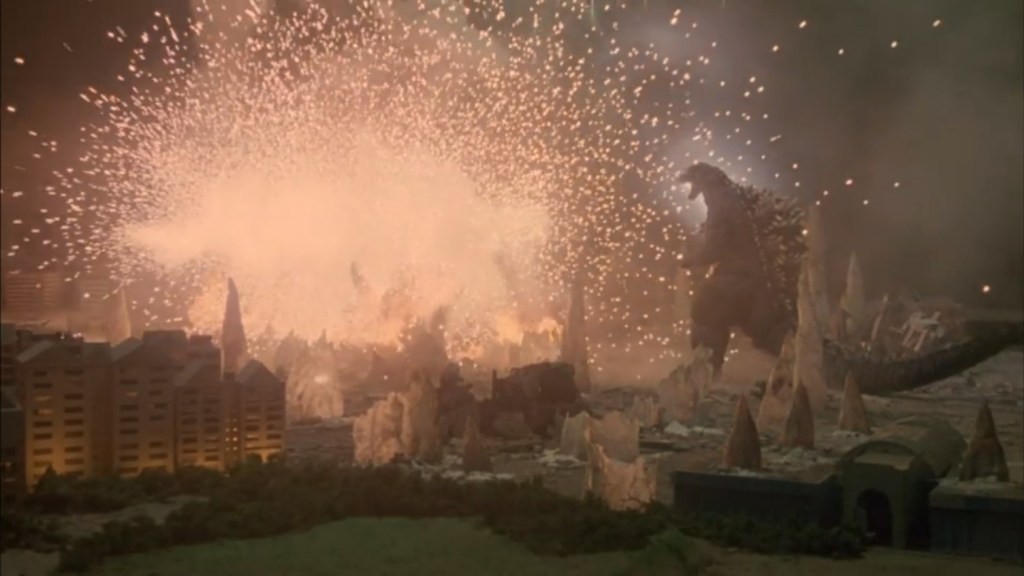
I’m left to assume that part of this film’s reputation has to do with plot holes, that it made itself vulnerable to pattern recognition. Call that Brechtian distance. Surely, why would G-Force want a Godzilla-hating guy to pilot the Mogera to not kill Godzilla, and why would that self-same pilot want to bring on two other guys if he was planning on going rogue? If stuff like that is on one end of the balance beam, I think atmosphere is on the other. Everything just feels right.
The script definitely could’ve used another pass, but the revisions wouldn’t have been as dramatic as for previous installments. Like, push on the character dynamics a little more. We might like Professor Gondo more (and therefore add weight to her relationship with Yuki) if we knew up-front about Okubo being corrupt. Let’s have them clash over ethics so that she can say things we agree with. As is, people say a lot less than they should, but that’s still preferable to saying more than they should, leaving room for… subtext?

It’s with SpaceGodzilla that I begin to understand what they’re going for with the psychic stuff, which I’d otherwise consider a product of the times, like the 1990s’ obsession with cloning. Given that psychic abilities put Miki in tight with the Mothra crew, I think it’s a sci-fi expression of what we have to become to defeat the threat of Godzilla, that we have to become something at all; posthumanism as metaphor. Here, we say that Godzilla himself is not a threat, but human nature makes him a threat, by producing monsters like him. “It was a warning to mankind,” Gondo says, and by now, this feels like an affectation, very 1950s. The movie has actually been telling us all along, and in a largely coherent way. Note that Miki is also a perpetual do-gooder, so it isn’t entirely the metaphor, but rather her choice to reject default human nature, to imagine more than weapons and killing.
If anything, Godzilla vs. SpaceGodzilla is the filmmakers on the backfoot and forced to play to their strengths: special effects and production design, and they back up on character and theme just enough to not make it convoluted. What we’re left with is a course correction to where the Heisei series began, with world-building and brand-new monsters. It’s also purely Godzilla, without the appeals to other cinematic fare (Back to the Future, Indiana Jones) that the director would prefer to be making. No, it’s all about the monsters, who bring their own otherworldly aesthetic to bear. It may not be an all-time classic like Godzilla vs. King Ghidorah, which made the most of the formula, but SpaceGodzilla is the formula perfected.
For More on the Heisei Era:
The Return of Godzilla
Godzilla vs. Biollante
Godzilla vs. King Ghidorah
Godzilla and Mothra: The Battle for Earth
Godzilla vs. Mechagodzilla II
Godzilla vs. SpaceGodzilla
Godzilla vs. Destoroyah
 With Eyes East