

Directed by Takao Okawara
Starring Takuro Tatsumi, Yasufumi Hayashi, Megumi Odaka
“The Japanese like to congregate and discuss. It’s a bad habit.”
After a surprising bump in quality with Godzilla vs. SpaceGodzilla, we’re back in business to close out the Heisei era with this, one of several series finales – like Futurama. The Showa era ended with Terror of Mechagodzilla, a return to the darker tone of the original movie, and the disjointed Millennium era had the explosive Final Wars, a special project for the 50th anniversary. Well, is Godzilla vs. Destoroyah, too, a special project? Did the filmmakers take a step back from what they’d been doing and say, “Let’s go out with a bang”? The film’s title might help us out here, bearing the typical “vs.” instead of something like The Final Chapter or maybe The End of Godzilla. No, it’s just another day, another monster. Consequently, this is a pretty low-key send-off, though at the very least, unlike Terror and Final Wars, it is a send-off.

Godzilla vs. Destoroyah is probably remembered for certain elements, like the massive creature Destoroyah and the haunting Death of Godzilla scene. Well, this movie is nothing but elements. I’d go so far as to say it barely feels like a movie at all. It’s consistent with previous installments’ television-style production, with unmotivated camera movement and the crutch of medium shots framed for people rather than the geometry of a space. There is no “What are we supposed to be feeling with this shot?” – it’s purely functional. And where SpaceGodzilla lacked a second act, Destoroyah lacks scenes themselves. People teleport from place to place. Miki’s in a helicopter one moment, then in a situation room the next, sporting a new outfit (love that pinstripe suit). We’re sort of aware of an overall story progression, but then the details are scuttled – the monster is being created by Micro-Oxygen, but actually, it’s the Oxygen Destroyer?
All the while, there is no character whatsoever. The top-billed actor is Takuro Tatsumi, who plays Dr. Kensaku Ijuin, despite occupying the “shady scientist” role, like the bad guy responsible for the monster in a monster movie, but who comes around in the end to assist the hero (and die). I’ll note that at the time of this writing, the Wikipedia plot summary doesn’t mention Dr. Ijuin at all. His chief role in the movie is to watch things happen. But inside the film’s world, he introduces a new technology known as “Micro-Oxygen,” which sends a ripple through the Yamane family. Emiko Yamane – from the original 1954 movie, and played by Momoko Kochi – is watching her reporter niece Yukari interview Dr. Ijuin, and the discussion brings her back to Godzilla’s very first appearance and the subsequent sacrifice of Dr. Serizawa.
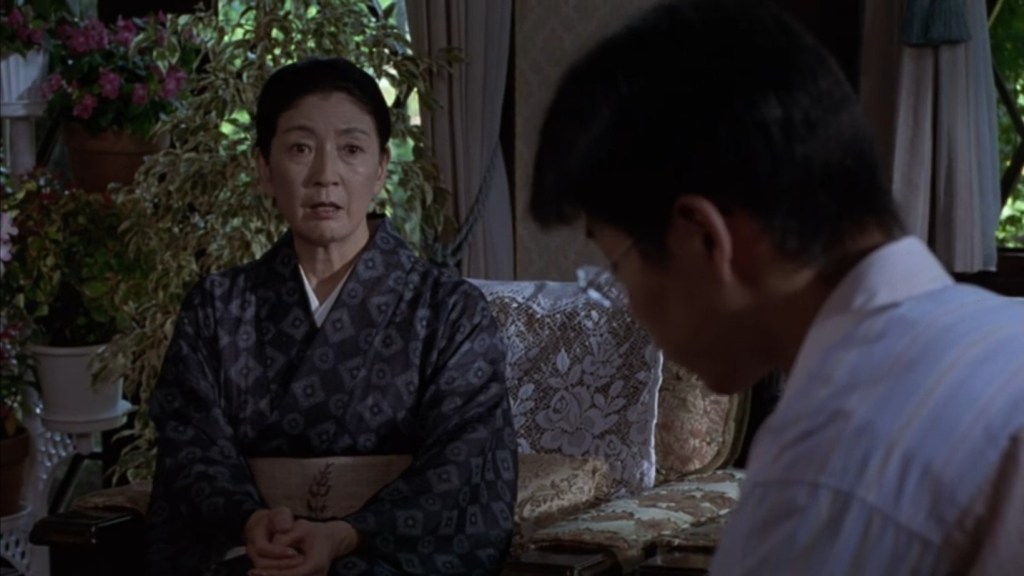
Emiko wears a kimono and her house has an old-fashioned interior design. Flashbacks to the original movie are revealed as a nightmare, so she’s very much trapped in that past. Her nephew Kenichi, however, sees Godzilla as a hobby. A college student, he wrote a thesis about how Godzilla’s heart is effectively a nuclear reactor, and his research (speculation?) found its way to G-Force, once they discover that Godzilla is literally melting down because of the destruction of Birth Island. Kenichi is hesitant to level up his hobby to a career, until he learns that Miki Saegusa also works at G-Force. A true otaku.
Miki has been flying around the Pacific trying to locate Little Godzilla using her telepathic powers, which are beginning to fade. Eventually, he emerges from the ocean as Godzilla Junior, so dubbed by a massively impressed military general guy. I love how naming monsters is such a priority. Meanwhile, another monster is taking shape, first when fish at an aquarium are skeletonized, causing a security guard to make the strangest, most primal yelping sound. Then, terrifying crab-like monsters suddenly appear, throwing a wrench into Kenichi’s plan that Micro-Oxygen can be used to stop Godzilla, like the Oxygen Destroyer before it. Stop Godzilla from exploding, specifically.

You can see from this – by the way, non-chronological – plot summary so far that there are elements both promising and head-scratching. One on hand, you have the return of Emiko, and the rather profound approach to the end of Miki’s story. On the other hand, you have Dr. Ijuin’s Micro-Oxygen, which doesn’t feel connected to anything. Characters talk about how it’s so similar to the Oxygen Destroyer, and later it just becomes the Oxygen Destroyer. That’s really confusing! And anyway, what was the motive for its creation? Why doesn’t it have anything to do with G-cells or the thematic cycle of weapons carried into this era by Return of Godzilla? It comes out of nowhere and vanishes.
More immediate than theme, however, is the filmmaking. One of the consistent quirks across all Heisei movies is that it’s rare to glimpse people entering and exiting scenes. We cut to meetings already in progress, and it can be kind of jarring. Like, has this meeting been going on the whole time? Oh, no, because Miki’s here now, when she was just in a helicopter, but these are all the same guys from before. Have they been talking for hours? We do see Dr. Ijuin drive to the aquarium, but are then treated to a puzzling sequence. He scrubs through the footage of the fish dissolving as a crowd of people watch over his shoulder. The only line of dialogue in the scene is when he says “I’d like to analyze this video.” What? Aren’t you doing that now? Then we cut to Dr. Ijuin in his lab, with a different crowd behind him, watching the video again! This time, though, he learns about the red crustaceans.

The attack of these mutant crab monsters summons a heavily militarized police force (oh, my God, we’ll come back to this), and it’s funny how they roll up with sirens blaring, but once they enter the building, they use hand symbols to communicate. Now it’s time for a tokusatsu-style Aliens, down to the motion tracker and the smart guns. Less gore and more overexaggerated stunt work. At least this is an aesthetic that fits the Godzillaverse, and I can personally attest to crossover between fans of Godzilla and Alien. The human-sized Destoroyah-crabs shoot black-hole lasers and are, well, distinctly evil. They have eyelids for the sole purpose of narrowing.
The human-sized monster in daikaiju eiga is practically a guilty pleasure of mine, because it’s more interactive. As mentioned previously, I do like the Madison Square Garden sequence in the 1998 Godzilla. To further the villainy of Destoroyah, one of the crabs goes after Yukari, who’s trapped in a car. A giant monster’s indiscriminate destruction can never be so targeted. Dr. Ijuin asks about Yukari’s whereabouts, and suddenly I realize that there are missing character dynamics here. His effort to aid Yukari would normally be a character moment, but we know nothing about these people other than their occupations. And for God’s sake, Yukari is a reporter. In movie terms, that means “exposition machine.”

New to the launch platform previously inhabited by a parade of failed giant robots is the Super X-III, which may sound like a Nintendo peripheral but is, in fact, a very bulky plane equipped with all sorts of cryo-weapons. The new pilots – a significant downgrade from the weirdos of SpaceGodzilla – freeze Godzilla and even hammer him in the mouth with a cadmium missile. That looked like it hurt. It’s just interesting to again think about how Japan has this unstoppable monster, so they invent all sorts of things to try and stop it (how this doesn’t turn into a corporate arms race is beyond this American’s reckoning). Operation Popsicle is a success when Godzilla is frozen, and they say he’ll be frozen for six hours. The film then cuts to six hours later. We don’t even get to enjoy the relative peacetime!
And that pretty much takes us into the final battle. The military wants to involve Junior in their various operations, to which Miki objects, prompting Meru, the resident non-Miki girl character, to say that this isn’t the time for sentimentality! The same old Miki song and dance. It’s an argument between two characters who have spoken before, so we had to have used their previous interaction as setup for this moment. We had to. (We didn’t). Also, I love how Godzilla Junior walks through the ocean roaring occasionally, just like his dear old dad. The life of Godzilla is just to be mad all the time.

Godzilla Junior fights Destoroyah on a massive miniature set, which is awesome, but their physical interaction is minimal. I think what happened in this era is that the monster suits were more intricate and expensive, so you couldn’t have two wrestlers throw them on and roll around together. But you can detonate, like, so many explosives. Destoroyah punctures Junior’s throat with its xenomorph tongue, which has Dr. Ijuin correctly deduce that it’s injecting Micro-Oxygen while also draining the dear boy of energy. He’s a keen observer, that Dr. Ijuin. Therefore, when he calls the military – from a goddamn news helicopter, like, how do they have a line into the base? – the general and all his men, they listen. Even when he’s advising to launch the Super X-III, an operation that probably costs millions of dollars.
What’s really astounding is how often we have extreme wide shots during the monster action, where planes taxi along the tarmac. This may be “Godzilla’s last battle,” as Miki proclaims out of nowhere, but the world doesn’t seem to care. I mean, there are a lot of these shots. If I happened to be visiting Tokyo that night, I’d at least be wowed by the amount of blood spewing from both Destoroyah and Godzilla when they finally hook up. In one moment, Godzilla tosses a crab Destoroyah off of him, and the thing flies away bleeding as if being crushed by the air itself.
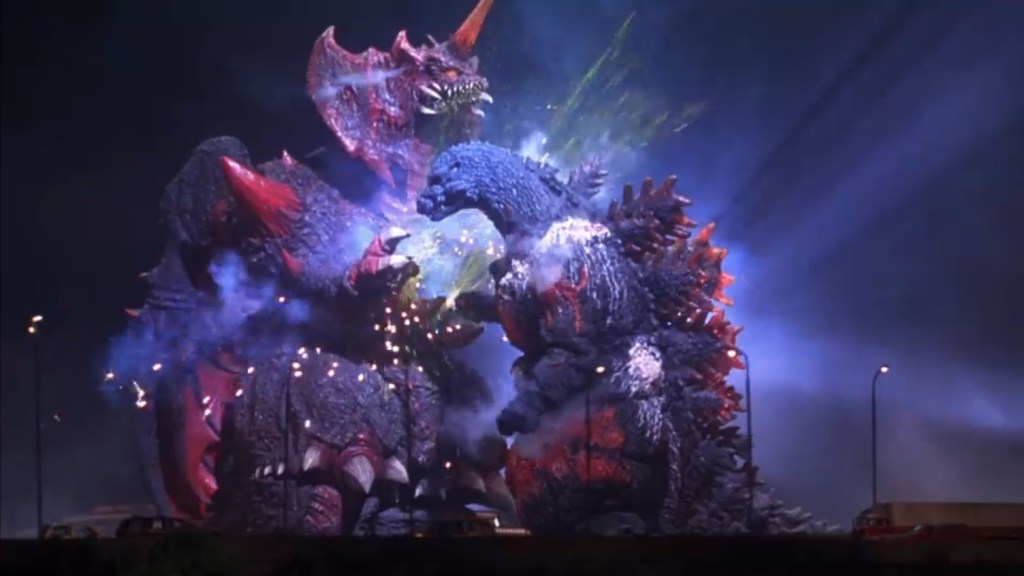
The climactic battle has an unfortunate stop-start rhythm, allowing Destoroyah to show up one last time after disappearing for a few minutes. The military blasts him dead, and then turns their attention to Godzilla. With the cryo-lasers, they cool him off as he melts away, and it’s a beautiful scene – nonetheless capped off by a prescriptive exchange of dialogue (naturally, from inside a helicopter):
IJUIN: Godzilla is gone, leaving Tokyo a ghost town.
YUKARI: Is this our atonement?
IJUIN: For what?
YUKARI: The misuse of science, nuclear energy.
Want more guesses, lady? What was this movie about? This is like an ad-lib when the actress realized the script wasn’t deep enough. More effective, I think, is Miki’s reaction, when she says, teary-eyed, “My work with Godzilla is done.”
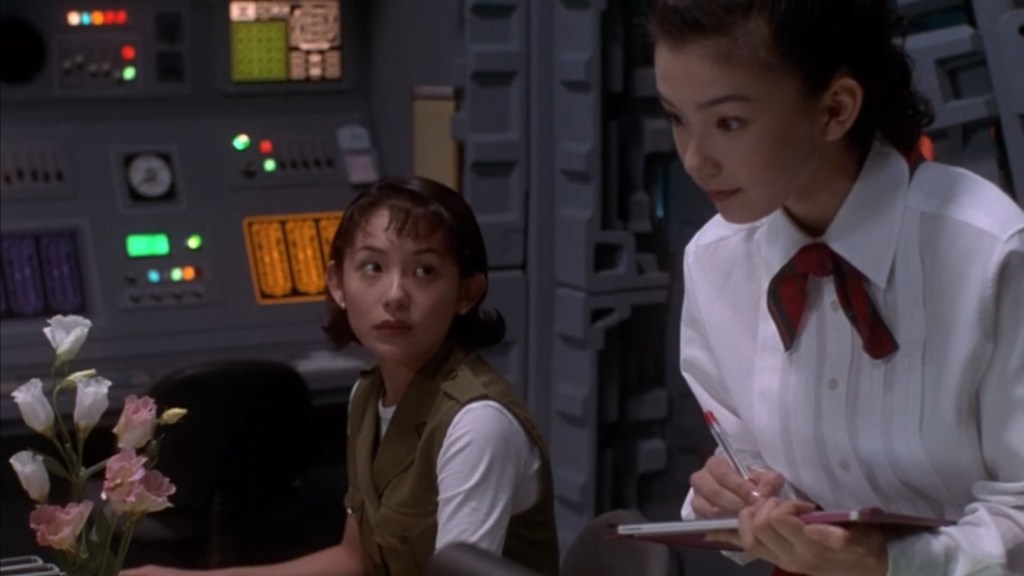
Earlier in the film, Miki and Meru had a watercooler chat about their careers as psychics, with the latter being a psychic rookie. This is where Miki says that she’s been working at G-Force for seven years, and feels her powers leaving her, which I found affecting. Meru, however, responds by saying she hopes to lose her psychic abilities and live like “a normal girl.” The scene cuts abruptly, assumedly to obscure Miki punching Meru in the gut. It’s a somber note, that this character we’ve been following for five movies now is losing her place in the world. Her powers are fading, the era of Godzilla is over. At least, for five seconds before the new Godzilla shows up.
For me, the withheld stars in these movies’ ratings have to do with missed opportunities – in most circumstances a difficult thing to measure. I pretty much like all of these Heisei movies (except for Return), so when I object to them for stupid formalistic stuff like character and theme, it’s the frustration of incompleteness, and this Miki thing is the perfect, perhaps final example.

Why not use the end of her arc as the emotional foundation for the grand finale? Maybe G-Force is being phased out by a more traditional bureaucracy because there haven’t been any sightings lately – or better yet, because a Miki-led Project T has successfully brought Godzilla under control. Meanwhile, you have all this anti-Godzilla hardware lying around, changing hands, flooding the black market, studied by industrial spies. This is how you get the police special forces and a guy deciding to invent the next Oxygen Destroyer – for the highest international bidder. Japan has become the Silicon Valley of military technology, and the laser-beam wars all over the globe are devastating the Earth, sinking Birth Island. The world is shocked out of its kaiju complacency with the arrival of a melting Godzilla, and Emiko is called out of retirement to make use of the last of her psychic powers (posing a Dead Zone-like medical threat). Unfortunately for Miki, the Godzilla meltdown poses a problem that may not have a peaceful or morally agreeable solution.
You also have Emiko, whose attitude toward Godzilla, you’d imagine, would be unambiguously negative (in the film, it’s difficult to say). So let’s contrast her with the new generation, Miki, who sees Godzilla as an Earth guardian – in a sense, literalize the fan divide over whether Godzilla should play the hero or the villain. Unfortunately, in Destoroyah, Emiko and Miki never meet, despite how easy it is for characters to suddenly appear places. There is no generational, ideological conflict. It could’ve even been one scene! Subtract one of the dozen or so where characters talk about how the Micro-Oxygen is like the Oxygen Destroyer, and is it a good thing or is it a bad thing? That didn’t come to anything anyway.

All the elements are here, but the filmmakers don’t connect them in a dope order. And sure, I can enjoy the elements alone, which is why these movies don’t usually dip below a two-star rating (with a perhaps unfair ceiling around three). But I’ll still simmer with the disappointment of “Why can’t these movies be cool Godzilla experiences and also good movies?” The practice of being good has nothing to do with broader critical acceptance or my own insecurities about watching kids’ movies, but with how character and a thematic framework can empower the monster battle scenes. The stakes aren’t required to be there when Godzilla fights a monster (see: the new Godzilla short films), but it’s really satisfying when they are. As it is, we bid Godzilla farewell with less of a mournful goodbye than a “See you later, bro.”
For More on the Heisei Era:
The Return of Godzilla – *1/2
Godzilla vs. Biollante – **1/2
Godzilla vs. King Ghidorah – ***1/2
Godzilla and Mothra: The Battle for Earth – **1/2
Godzilla vs. Mechagodzilla II – **
Godzilla vs. SpaceGodzilla – ***
Godzilla vs. Destoroyah – **
 With Eyes East