
Directed by Celine Song
Starring Greta Lee, Teo Yoo, John Magaro
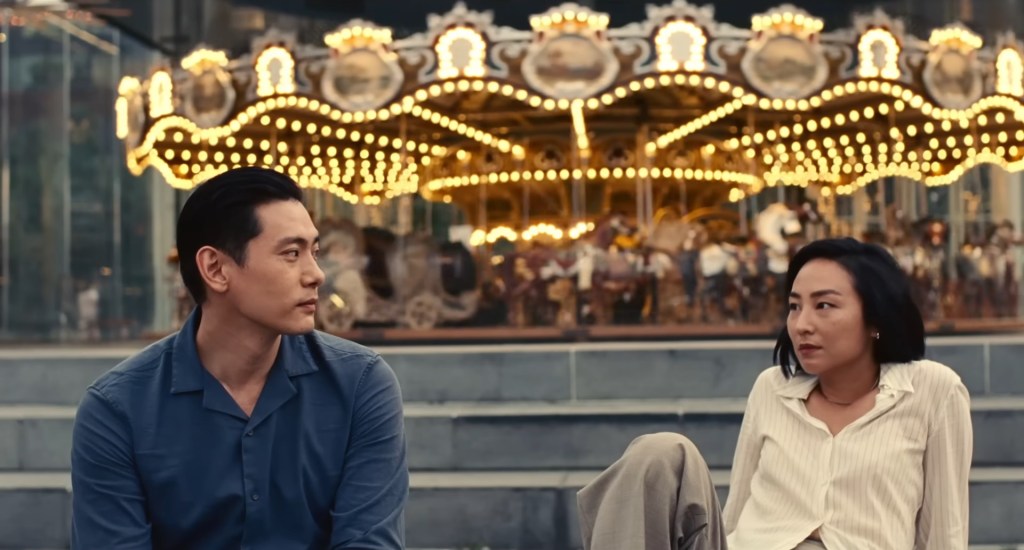
A critic shouldn’t be saying things like this, but I do want to establish or reestablish that a negative movie review isn’t necessarily me saying a movie is “bad.” Past Lives is very well acted, and it’s beautiful – notably shot on film – but my experience with it was minimal, and the subsequent evaluation remains confused. I don’t know what the writer/director was going for, though the later discovery that it’s semi-autobiographical surely explains a lot. The film opens on the climactic scene, in a New York bar at 4:00 a.m., as an Asian woman sits between an Asian guy and a white guy, with disembodied voices trying to guess at the nature of their relationship. We then rewind to 24 years earlier, when children Na-young and Hae-sung are friends in Korea, with the former moving to Toronto. Fast-forward 12 years, and they reconnect over social media but remain in different time zones.
Hae-sung had actually been searching for Na-young – who immigrated again to New York – these past 12 years, obstructed by her name change to “Nora.” While she’s been pursuing a career in literature with lofty (and alarmingly relatable) goals, the thought of her kept him going through, say, his mandatory military service. Their reconnection may spark romantic feelings, with either coming perilously close to hopping on a plane to visit the other. The hook of the movie, or the gut-punch, comes when Nora tells Hae-sung that they should stop talking for a while. When pressed for explanation, she says that she needs to commit to her life in New York, and not be looking up flights to Seoul. He then pleads, noting he spent 12 years looking for his friend. They don’t speak again for another 12 years.
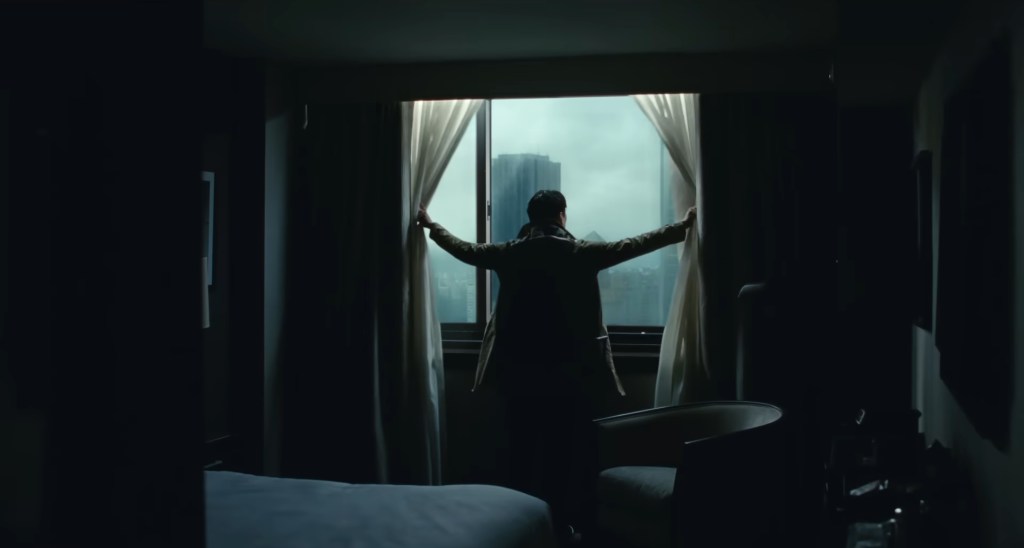
The immigrant – like the adoptee, in my case – has a what-if question built into their life. “What if I stayed? What would my life have been like?” And in the infinite capacity one has for perseverating, this leads to further, more existential questions. “What is my life supposed to be like?” When suddenly there are alternatives and versions, we might then ask, “Is this the correct version?” Past Lives puts faces to these versions, and posits that in wrestling with these questions, we have the potential to cause harm. Nora tries to reject her heritage, and in doing so, rejects Hae-sung. It’s the very idea that inspired this blog – if you can remember, through the years of writing on K-pop idols and Godzilla – that the inconvenient part of my identity as a Korean American is a real country with real people.
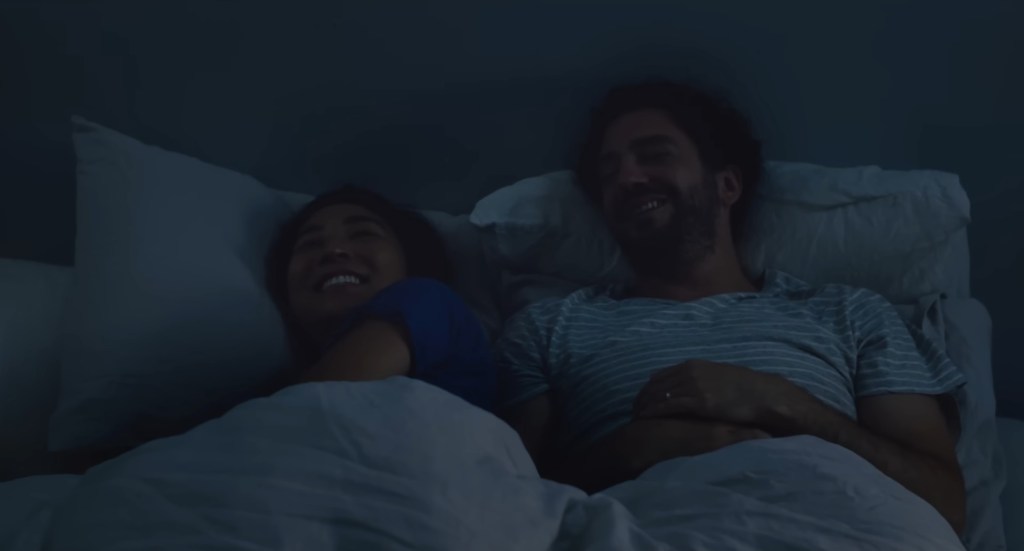
In practical terms, Nora’s disconnection from Hae-sung coincides with an artist’s retreat in Montauk – while at the same time he moves to China. Naturally, this is where Nora meets Arthur, a quiet, artier type with the sympathetic face of John Magaro. They get married, and back in the original timeline, Hae-sung finally visits New York for what will undoubtedly be a difficult, charged encounter. It seems like that’s where the story should begin, but I’ve actually recounted nearly the entire plot. Past Lives doesn’t move much beyond what’s required to understand what the movie is about, which suggests to me that it isn’t really about that.
Celine Song’s writing and direction are both very intentional; the dialogue, for example, is minimal, placing the emphasis on silences. In this way, it’s a movie about longing, but it lacks the maximal aesthetic of Wong Kar-wai. Deferring to performances, then, why is the camera so often distant from its subjects? In this way, I was reminded of the wide coverage in One Fine Spring Day. Like with that film, I found the clinical approach to romance ultimately unaffecting. Here, I don’t get the sense that adult Nora has strong feelings for Hae-sung. Possibly, this is because she has Arthur and her career. But unlike a lot of American television in the late 2010s, she doesn’t have seasons of development to arrive at the “choose yourself” ending.
Of course, what I’m trying to express here is that comparisons may not apply. Even before I learned that the story isn’t drawing on pop culture but the writer’s own life, I felt I understood that the creative execution was, in some way, a rejection of formal tradition. One of the few conversations spoken in the movie has Arthur deconstruct the romantic comedy, noting that to outsider observers, he’s the wrong man keeping two soulmates apart. He’s a character who faces this dilemma with not a little jealousy, and then tries hard to play a complicated role. It’s another interesting idea, but one that translates to screen as a few interesting moments. His first exchange with Hae-sung is the film at its most moving.

In the absence of understanding the broader intention with Past Lives, I’m still left with a movie that purposely has “less.” Beyond this great shot of where Na-young and Hae-sung’s route home splits, there isn’t a lot of imagery. There isn’t a lot of dialogue; it’s a quiet film. There’s a lot of setup, and I do read, for example, her meeting Arthur as building toward something rather than being a thing in itself. We see very little of their relationship because, as I assumed, it would find purpose in the coming conflict. And so, my experience with Past Lives was a gradual disengagement. It doesn’t commit to things, but leaves us to wonder. Unfortunately for this viewer, that’s exactly where I started.
 With Eyes East
Really appreciated this review. I cried at the ending and felt deeply touched by the unfulfilled love story, but somehow didn’t quite feel like say that it was a great movie. I thought of In the Mood for Love and felt a clear distance between these two movies, and immediately realised I’d rather rewatch Wong’s movie for the 10th time than this one for the 2nd. Mostly, and slowly, the feeling emerged of having watched something that someone made to convince themselves of something, and that some key truths were left unspoken, unaddressed. It was hard to find a non-raving review online and yours is the only one I’ve found that mentions Wong Kar Wai, so thank you for this. Sometimes after a movie one needs to connect one’s experience to others, god knows why. 🙂
LikeLike
Thank you so much! Yeah, I was struggling to say that Celine Song was possibly holding something back, because it is so close to her life. In any other movie, Greta Lee’s character would be equally divided between the two men, but how could Song write that when in real life, she’s married to one of those men?
Anyway, always a good time to revisit Wong
LikeLike