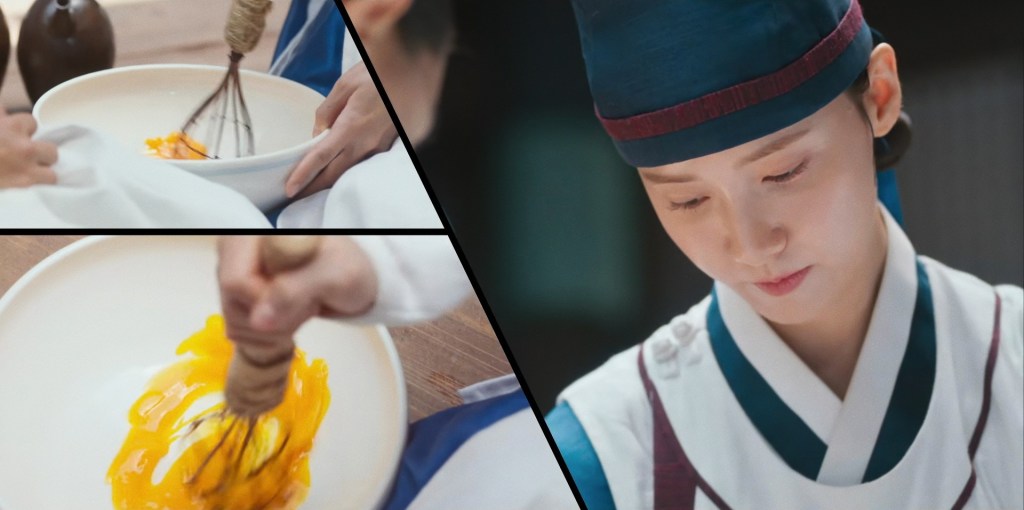
Episodes 5-9
“How can you not be romantic about [food]?”
In its second act, Bon Appétit, Your Majesty levels up from good to great to excellent at blistering speed, centered around the latest challenge for royal chef Ji-yeong: a competition against legendary Chinese cooks to decide Joseon’s fate with the Ming dynasty. At the start, I worried the show would adopt a “dish of the week” structure, with Ji-yeong making food for King Yi Heon alone until they eventually fell in love. How would they make that interesting each time? Instead, we have this latest contest which animates the entire palace, setting conspiracies into motion and raising the stakes to the level of national consequence. The Ming envoy, Director Yu Kun, walks with the authority of his emperor, turning each exchange with the Joseon king into a careful game of feints and doublespeak. The contest itself occupies two episodes – contained almost entirely to one location – with two additional episodes of build-up. It’s remarkable, and I’ll just say now that I can’t remember the last time a K-drama made me cry like Bon Appétit’s ninth episode, with the contest’s surprising climax.

It’s not really life and death for Ji-yeong anymore, with Yi Heon assuredly head over heels. He gifts her with a garden and even her precious “handybag,” which unfortunately doesn’t contain Mangunrok, the magic book, and then they take a tumble with her landing on top of him. The gifts, by the way, are apologies for that night he got drunk and kissed her. My, how things have changed. So, why bother with the contest? The increasingly likeable but still devious Song-jae tells Ji-yeong that, in time, he might be bowing his head to her and muttering “Yeh ma-ma.” Well, we see why Ji-yeong presses on with the competition in her encounter with Jang Chun-saeng, the inventor descendant of real-world inventor Jang Yeong-sil. The contest will have three rounds, and she’s determined that the third round will require a pressure cooker, technology which doesn’t exist yet. Chun-saeng, however, is a grouchy man who’s booby-trapped his home, living far from the palace after an unceremonious dismissal. He’s in no mood to help the royals, even after Ji-yeong gifts him the secret to puffed rice: sugar!
Doing her big-brain chef thing, she deduces a likely childhood meal of Chun-saeng’s, which turns out to be mouthwatering scallion pancakes – and accurate. Enticed by the scent on the breeze, he practically floats over like a cartoon cat and is, naturally, won over by the godly taste. Ji-yeong tells him that, deep down, she just really loves to cook. And with reactions like we’ve seen, wouldn’t you? With this scene, I realize how perfect this role is for Yoona, whose acting ability has been under scrutiny as part of the show’s discourse. Yes, the idol-turned-actor is a whole thing, and I’ve seen some breathtaking performances in K-dramas by the likes of Im Soo-jung, Kim Tae-ri, and Lim Ji-yeon while yet to see Yoona express the same range or power. Really, I’ve yet to see Yoona disappear into a character, Ji-yeong included. In fact, the fish-out-of-water aspect keeps Ji-yeong apart from her environment, and therefore, Yoona’s performance (a part of me wishes the character just was Yoona from Girls’ Generation).

Like Yoona herself, Ji-yeong is self-confident, professional, and a little mischievous, but mostly, the performance works because it matches its heightened environment. The show exhibits an impressive dexterity with its tone, where even earnest moments are objectively silly but played straight. If nothing else, I’d say that Yoona deserves commendation for staying nimble within that tonal flexibility, playing emotions big and broad rather than piercing necessarily – with the exception of her explanation of the wine-braised beef recalling Ji-yeong’s late mother, as Yoona’s own mother has always been a big question mark among SNSD fans. I would not assume it’s a happy story there, and I found that scene almost overwhelming. Regardless, with Chun-saeng, we see further dimensions of the connective power of food. Incidentally, I read Kitchen Confidential this year and recently started A Cook’s Tour, and this beautiful idea is a huge part of Anthony Bourdain’s legacy.
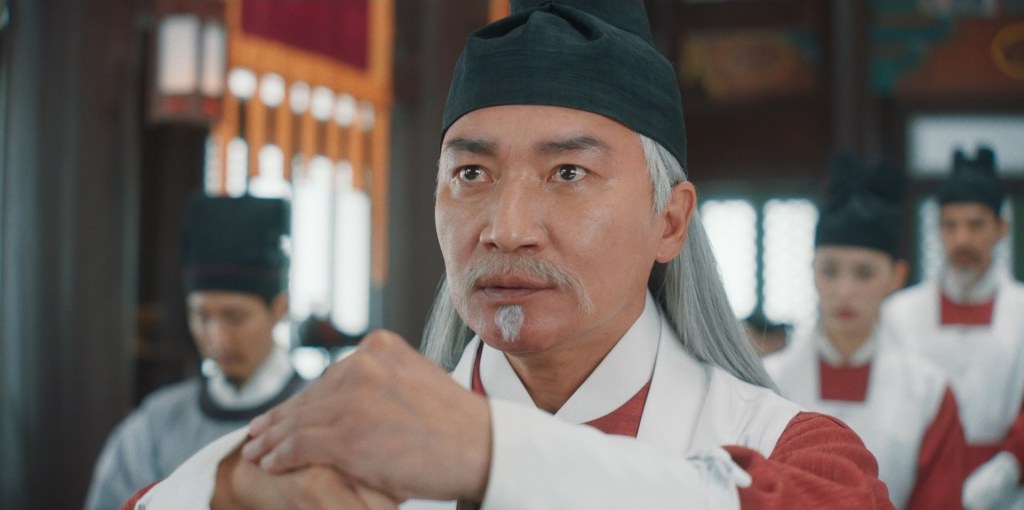
Before we get to the contest, special mention must be made of the attack on Chun-saeng’s house, with assassins specifically ordered to kill Ji-yeong. This was actually the doing of Joseon officials striking a deal with Director Yu in an effort to cancel the contest before it even begins. It is, I think, a wholly separate plot from that of resident bad guy Prince Jesan (played by a Choi Gwi-hwa bringing his frenzied villainy from Squid Game 3) and that of the ever compelling, heart-meltingly imperious Consort Mok-ju. God, I wish that woman would threaten to annihilate my entire bloodline. Jesan wants Joseon to lose the contest in order to provide pretext for an overthrow, and I think Mok-ju just wants Ji-yeong out of the picture. It’s the lead Ming cook, white-haired Tang Bailong, who overhears the first of these plots, and steals into the night with a message for Ji-yeong’s kitchen staff. As it turns out, Tang Bailong is the boss of the bosses – almost to a fault, as we’ll see. The man will not miss an opportunity to undermine the Ming’s trickery and make Joseon look awesome.
This year more than most, I’ve been thinking about action movies, and how much recent offerings have illustrated the necessity of story. Sounds obvious, but American action is currently undergoing a trend of purity, where technical details like cinematography and choreography matter more than the often maligned “plots” of old. In the worst of cases, this makes for cool action in a vacuum and pretty mediocre movies. But then there’s something like the Japanese film Baby Assassins: Nice Days, which cares deeply about its already fascinating characters, and Amazon Prime’s show Butterfly, which is an even better example. The action in Butterfly, unlike in Baby Assassins, isn’t overly impressive by itself. But its set pieces are as tense and suspenseful as intended because we’re made to care. Similarly, the swordplay in Bon Appétit, Your Majesty is functional. It is not an action show; the assassin battle was likely shot second-unit. And yet, I found it riveting.
I’m sure that episode seven of twelve is too soon for the main character to die, so I wasn’t too worried about Ji-yeong’s survival. Instead, the tension comes from the knowledge that this attack will bring disparate characters closer together. Ji-yeong’s chefs take Bailong’s message to the Chief Eunuch (who always drops by the kitchen and everyone’s like, “Oh, snap, Chief Eunuch in the house”) and Song-jae, who rides out with a contingent of soldiers. Accompanying Ji-yeong to the inventor’s house is, you guessed it, King Yi Heon, as well as his bodyguard and his secret bodyguard, the jester Gong-gil, the two of whom develop a straight-man/fall-guy routine. Seeing all of these previously antagonistic or antagonist-adjacent men align to fight for Ji-yeong’s life – including Chun-saeng – is heartwarming, and it makes their efforts that much more impactful. Again, it’s simple, but so satisfying when applied correctly.

By this point, Ji-yeong has countless reasons to want to win the competition, and unlike with the purely selfish – though not unreasonable – motivation of wanting not to be executed, the reasons align with mine. Yu Kun is so haughty (played with comical menace by Kim Hyung-mook), the sabotage plots continue to multiply, and finally, there’s the sports-movie pride in victory. This is what Ji-yeong explains to Yi Heon, who’s actually feeling regret about arranging the contest and floats the idea of calling it off. She declines! Despite the heavy political implications, she wants to win. Hopefully, Chun-saeng can deliver the pressure cooker lid on time, but I have a feeling it’s gonna be last-minute. Here we have a clever trick to help Yi Heon transform into less of a tyrannical asshole: pit him against another tyrannical asshole. He’ll sit side by side with Yu Kun during the contest as the two teams of chefs square off in three rounds in as many days.
We know Tong Bailong, but there’s also Kong Wenli, who doesn’t say much, and Ya Feixiu. I should note that these Ming chefs are also practitioners of martial arts, making Ya Feixiu a startling addition. These episodes don’t have a lot for my beloved Mok-ju to do, and seemingly in her place, this evil kung fu chef steps in to fill the treachery vacuum, even shoulder-checking Ji-yeong at one point. Ooh, she’s so bad. Anyway, Ya Feixiu makes a secret deal with Jesan and steals the chili peppers that Team Joseon had spent so much time preparing. This ultimately proves to be Team Ming’s undoing in round one, after Tong Bailong chastises Ya Feixiu, his niece, for such dishonorable behavior. We discover via melodramatic flashback that Bailong had spent some time in Joseon, and this is actually where he learned to cook. Unlike the envoy, he harbors a great respect for the people of the Hermit Kingdom.

Alas, round one ends in a tie, and so does round two. While the extensive sequences making up the contest are absolutely nail-biting, ordered and presented with astounding craft and detail, one thing seriously bothers me: the rules. The dishes will be evaluated by two judges, and for some unknown reason, those judges are King Yi Heon and Director Yu Kun. They’re going to score the other side’s dish, which is hardly how judging should work. We need to be a neutral third party, as well as a larger panel. Predictably, in round two, Yu Kun scores the Joseon dish – the wine-cooked beef – with a one out of ten, despite all the whirling and fluttering he did while eating it. After some tense negotiations, it’s decided that the chefs will score each other’s food instead. That makes even less sense!
By round three, however, the Joseon and Ming cooks have developed a mutual respect. At least, Ji-yeong and Tong Bailong have. “You always have the last word,” he observes at the end of round two, to which she playfully replies, “Because you keep talking.” They smile and part ways. It’s the moments of humanity emerging from such a brutal, often backwards world that touch me the most in this show. Throughout the contest, the royal kitchen staff has redemption arcs and Gil-guem steps up to the plate in the eleventh hour, and Ji-yeong beams with pride. She’s doing this for them, for Joseon, and for the love of the game. This, to my surprise, is where the waterworks start. When round three concludes, and Ji-yeong has presented her transcendently good ogolgye samgyetang, Yu Kun has one final trick up his sleeve: the silent Kong Wenli. The two teams are to score each other with a maximum of 30 points (across three participating chefs), so when Kong Wenli refuses to even taste the ogolgye samgyetang, that’s ten points off the board. Cue Yu Kun’s evil cackle. How I hate that man!
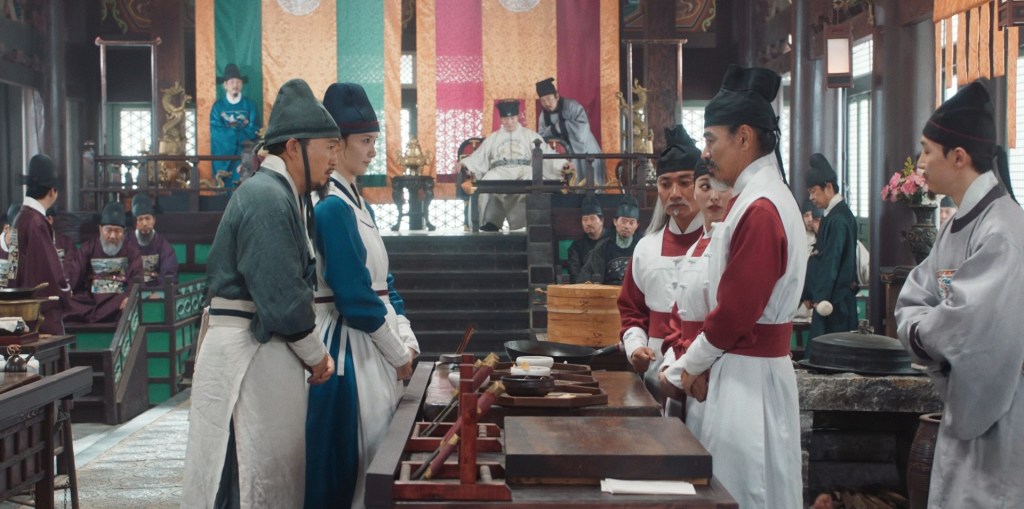
Ji-yeong theorizes that Kong Wenli may be anorexic, which I thought was a joke but actually appears to be pretty common. I mean, lots of people are chefs, lots of people have eating disorders. Ji-yeong is a lot more experienced and compassionate than I, keying into how he “looks guilty” for trying to eat, and so alters the dish’s presentation by mixing everything together. “He has to taste it to score it,” she tells her confused colleagues, but to Kong Wenli, she says, “Regardless of the result, as a cook, I present you with this food with the hope that you’ll also be happy.” That broke me. And notably, Yoona broke me. However she got there, however heightened her performance or buoyed by melodramatic music and excellent direction, her shining smile was the tip of the spear.
It’s also that we’ve spent the last four episodes fretting and puzzling over this cooking contest. Ji-yeong won over the grouchy inventor with a taste of home, survived an assassination attempt that forged unusual alliances, exposed some Ming treachery (and witnessed the origin of Kung Pao chicken), and after all that, all the team-building and risky pleas to the envoy for fairness, she’s willing to throw it all away to make a connection from chef to chef. That’s really the trick of the sports movie, isn’t it? It’s not about the victory, but what it means for the character – which is why defeat can still make for a dramatically satisfying resolution. We get another melodramatic flashback explaining that Kong Wenli’s grandmother made food by mixing all the ingredients together, and the sequence goes on for, like, five minutes, my tears running the entire time.
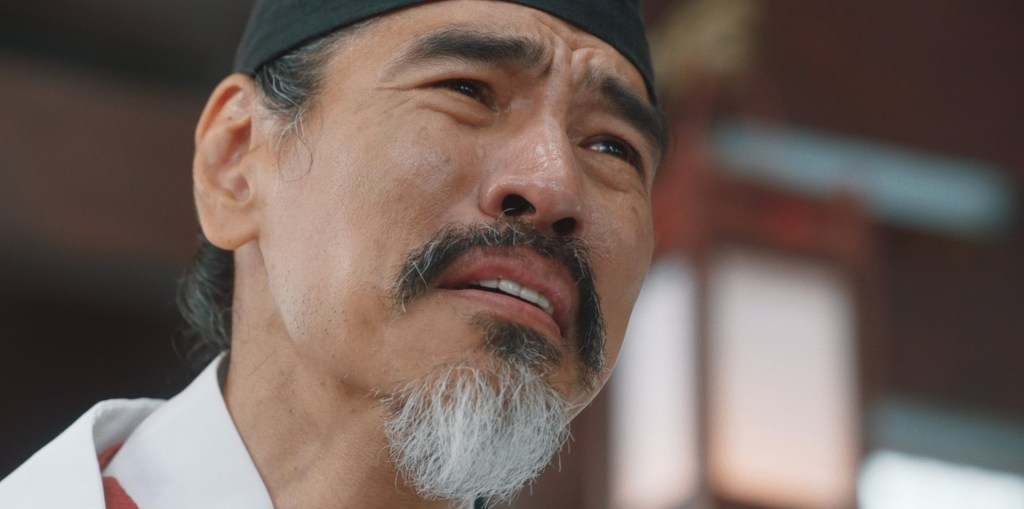
While the contest ends in a deus ex machina, with the intervention of the Queen Dowager (or one of the Queen Dowagers anyway, Yi Heon’s grandmother Inju), the Joseon and Ming cooks share a meaningful farewell, and repeat it later on. Tong Bailong hopes to compete with Ji-yeong again, properly, and I’m imagining that when Ji-yeong is back in the blessed year 2025, she’ll spot a mysterious sous-chef in her new kitchen who looks suspiciously like an old friend. Wink! And roll credits. But we’re not there yet, as episode nine closes with a cliffhanger taking us into the final arc. Ji-yeong is gifted with a sporty new outfit befitting the grandest chef in all the land, and is almost immediately stripped of it and fastened to a torture chair after her latest meal puts little Timmy in the hospital. Or should I say, the young prince who’s sort of a brother or a nephew to Yi Heon. Finally, Mok-ju and Jesan’s plots are returning to the fore, but I hadn’t missed them so much. These middle episodes were absolutely fantastic.
The final two episodes roll out this weekend and, among other things, the reputation of what’s considered to be one of the year’s best K-dramas depends on a good finale. “Other things” being a personally satisfying experience with a work of media, of course, but there are larger stakes. It won’t make or break Yoona’s career, established now a dozen times over, but it could be a turning point. I mean, how many newcomer awards has she won? Maybe she could go for a regular Best Actress this time. It’s tough, though, because if any show has a bumpy landing ahead, it’s probably the one with time travel, as well as the lingering issue of the male lead being a tyrannical murderer. Can she fix him…

…a plate?
Also, whoever decided it was okay to use AI in that 1970s “flashback,” I assure you, it was not.
 With Eyes East