Episodes 1-6 (spoilers)
Original Broadcast: 12 October – 17 November 2024
Written by Choi Hyo-bi, Directed by Jung Ji-in
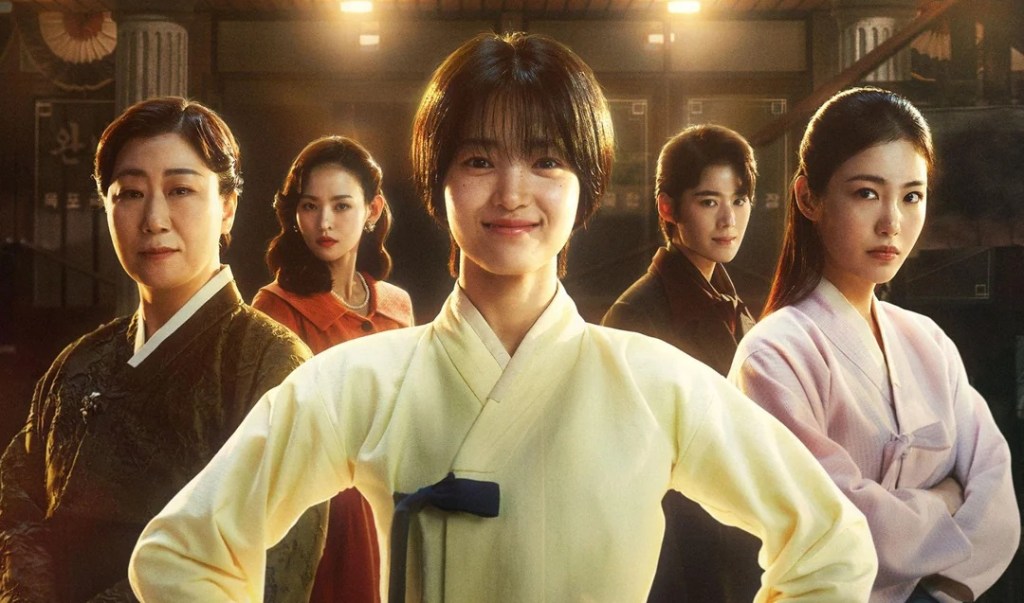
Starring Kim Tae-ri, Shin Ye-eun, Jung Eun-chae, Kim Yoon-hye, and Ra Mi-ran
“…and many girls dream of becoming princes.”
Kim Tae-ri is probably the best actor to come out of Korea since Choi Min-sik, and while such hyperbolic language may indicate a simple mind structured, Sith-like, by absolutes, I’m comfortable with the assessment because she’s so quintessentially Korean. Seamlessly toggling between physical comedy and genuine heartbreak, it’s like she was crafted by the gods to inhabit the whiplash tones and extreme scenarios of popular Korean film and television. Specifically, the way she can make me cry and laugh simultaneously is exactly how critics describe Bong Joon-ho’s The Host, and of course, her acting debut was in Park Chan-wook’s celebrated film The Handmaiden. She’d go on to win industry awards with roles in major titles like Mr. Sunshine and Twenty-Five Twenty-One, and managed to close out the first ten years of her career with another canonical entry: Jeongnyeon: The Star is Born – confound that double colon – which netted her the Grand Prize at the APAN Star Awards and Best Actress at the Baeksang Awards (her second), as well as the label “Television Actor of the Year” by Gallup Korea. Where Kim Tae-ri goes, quality is sure to follow, if her taste for sci-fi blockbusters is the only thing suspect about such a jeweled filmography. And so, taking up the titular role in Jeongnyeon, she’s flanked by a murderers row of veterans like Ra Mi-ran and Moon So-ri as well as young, fierce talent like Shin Ye-eun – and of course, the scene-stealing ladykiller, Jung Eun-chae.
With all that said, I was quite surprised by Jeongnyeon: The Star is Born. Given that our murderers row collectively have works like The Handmaiden, Pachinko, Lady Vengeance, and The Glory under their belts, I was expecting something more, I don’t know, buttoned-up? More serious? And perhaps more subtle, as we’re once again given over to the old K-drama conventions; characters speak their thoughts and motivations aloud, and the plot gears turn on coincidence and contrivance. I think the story with Jeongnyeon, then, is how much the fundamentals matter. As you might imagine from the subtitle, it follows on from countless musical fables, and the music is a kind of Korean opera, combining singing, dancing, and acting, called yeoseong gukgeuk, where women play both male and female roles. In the show, productions by the esteemed Maeran theater company attract screaming fans like modern-day K-pop acts. Jung Eun-chae plays the troupe’s top talent, Moon Ok-gyeong, who in turn usually plays the prince, winning little gay hearts the country over with her forceful stage performances and that short hairstyle. I have noticed in YouTube videos of Jung Eun-chae, promoting whichever show or movie, that enthusiasts refer to her as Moon Ok-gyeong and call her “handsome.” I’m not sure if it’s because this is Jung Eun-chae’s most recent role, or because it’s become her signature character. Being on the taller side, she’s usually playing strong or strong-willed characters, of which Ok-gyeong might be the ultimate realization.
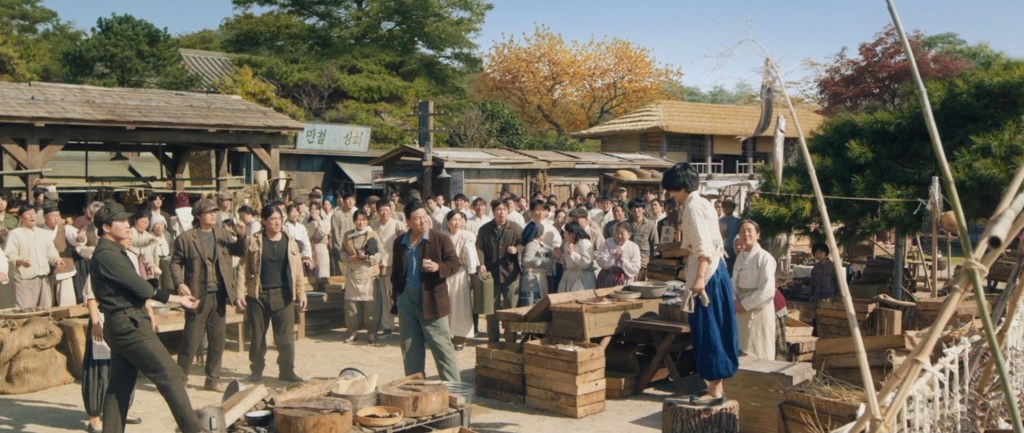
It’s Ok-gyeong who discovers Jeongnyeon, a 19-year-old girl (played by a 34-year-old Kim Tae-ri) who’s selling fish out in rinky-dink Mokpo, at a market that’s regularly threatened by racketeers. In standing up to these “kick over the goods” thugs, she shows off her pipes – despite her mother’s stern, head-scratching warning to never, ever sing. What is she, from the town that outlawed fun? That’s K-drama check box one, especially with how loud the conflict gets. While Ok-gyeong invites this unlikely talent deeper and deeper into the world of gukgeuk and pansori (the genre of music), Jeongnyeon’s mother forbids it to the point of screaming contests and even locking the poor girl in a shack and destroying her script pages. Fortunately, Jeongnyeon’s sister, Jung-ja, is a true bro, and frees Jeongnyeon in time to meet up with a departing Ok-gyeong after a tearful farewell. The sisters know that Jung-ja’s gonna catch hell back home, but this decision – communicated largely wordlessly – comes from a place of love, and it’s heartbreaking. Ok-gyeong, who’d been training Jeongnyeon, delivers her to Maeran in time for auditions, where we meet Joo-ran (Woo Da-vi), the mousy trainee with a surprising acting power and, at first, her only friend. She’ll need all the allies she can get against the fearsome Director Kang (Ra Mi-ran), a trio of bullies led by Cho-rok (a surprise turn by Oh My Girl’s Seunghee), Ok-gyeong’s scene partner and part-time femme fatale Seo Hye-rang (Kim Yoon-hye), and the icy-cold rival, Heo Yeong-seo (Shin Ye-eun). (I also managed to recognize Kang Chae-young among the trainees, glimpsed not long ago as the envious bank teller in Genie, Make a Wish).
One of the impressive things about Jeongnyeon: The Star is Born is how quickly it moves. By the end of the second episode, Jeongnyeon has successfully auditioned, learned the ropes of Maeran from Joo-ran, battled the mean girls, and auditioned for parts in two plays. By episode four, Jeongnyeon’s been kicked out of Maeran. Frankly? That was a long time coming. She’s a “brilliant jerk,” the kind of disruptive individual often romanticized by movies, but impractical (or worse) in real life. Jyeongnyeon is part of a team, and her successes and failures reflect on Maeran, as Director Kang emphasizes. And yet, she fails upward constantly, even if it’s not always her fault. Cho-rok’s clique is bent on sabotaging the “fishmonger,” and while Seunghee’s sneering performance is fun and arch, it takes on an additional layer when it really seems like she has no idea how mean she is. In a scene later on, she expresses genuine concern for Jeongnyeon not taking on a bigger role in an upcoming production, but she does so with sass. And Seunghee’s eyes go wide when her friends tell her to stop, like she doesn’t understand what she did wrong. It’s a funny detail that I doubt I would’ve picked up on if not for Seunghee playing this relatively minor character.

Part of Kim Tae-ri’s appeal here is how much her character gets riled up by the bullying and rivalries and all the expected challenges of a newbie in this sort of collegiate environment. She’s headstrong like Na Hee-do, and this is what gets her into trouble. One of Director Kang’s rules is that trainees (and established stars, I suppose) are not to perform independently of Maeran and use the name for personal gain. Unfortunately, Jeongnyeon is caught doing just this, though she had a reason. See, Joo-ran’s been working on the side waitressing at a pastry café because the trainee allowance isn’t enough to cover the medical costs of her sister with tuberculosis (cliché #1), and one day, the pastry café can’t secure its usual performers (cliché #2) and calls upon Jeongnyeon to fill in, on the very day that a music producer is in attendance (cliché #3). At some point, Yeong-seo is also in attendance, and when she and Jeongnyeon lock eyes, it’s game over. And Jeongnyeon can’t tell Director Kang the truth without getting Joo-ran into the same trouble, so she nobly falls on her sword. She ends up signing a contract with producer Park Jong-guk, one with print so fine she doesn’t even recognize some of the characters, and works with Patricia Kim, a fading star from an earlier era, played with moving gravitas by Lee Mi-do, the very definition of a character actor. I also could’ve sworn that Park Jong-guk was played by one of the earliest Korean actors I’d ever seen, Kim Tae-woo, from Joint Security Area, but it was someone else. I made the same exact mistake with The Man from Nowhere, and it turns out that the “someone else” in both cases is his brother, Kim Tae-hoon.
On her way out of Marean, Jeongnyeon had thrown herself at Director Kang’s mercy not once but twice, to where security had to come along and heave her like a barfly. The reason I might sound harsh on Jeongnyeon is because the show divides its sympathies evenly. We come to understand that her violation of this rule, for whatever the reason, puts Director Kang in a bind. If she takes her back, it would give the other trainees a free pass to pursue independent ventures. She wouldn’t want to appear to go easy on Jeongnyeon, either, just because she’s clearly a generational talent, and it’s already going around the dorms that the fishmonger is only here because of Ok-gyeong. This is a source of insecurity for Jeongnyeon, but it’s not entirely untrue. The question of privilege is compounded by Yeong-seo, who comes from a wealthy family of entertainers, which actually puts her under psychologically damaging pressure from a mother who disrespects gukgeuk and openly prefers her other daughter, a successful opera singer. This makes Yeong-seo biting and even petty, but ultimately fair, as she has the company’s best interests at heart. Her character also complicates the show’s somewhat black-and-white morality – good guys are really good and bad guys are really bad – and we see the inner conflict in Shin Ye-eun’s performance. She’s moved by Jeongnyeon’s talents, but is necessarily threatened. And man, I never thought I’d see Shin Ye-eun play another villain after a turn so convincing in The Glory that she endured hate comments and the usual netizen nonsense, but she’s just so damn good at it.
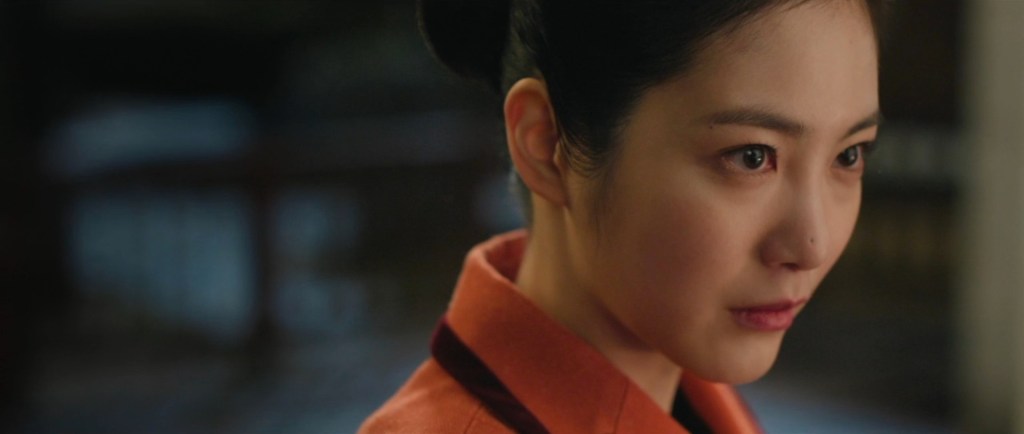
When we first see Moon Ok-gyeong, she’s brooding handsomely, and confides in roommate/girlfriend (?) Hye-rang her doubts about the future. Not only has gukgeuk become unchallenging, but a rapidly developing postwar South Korea might be moving past such a traditional artform. Park Jong-guk represents the future, with musical acts broadcast live on television, but before Jeongnyeon’s star can be born over the cathode-ray tubes, she blows up the opportunity by mixing some gukgeuk into what’s supposed to be a feminine, sensual performance. Apparently, highly commercial entertainment and gender blurring don’t mix. I am shocked. Shocked! And why does she do this? Two reasons: one, Patricia Kim told her to own the performance, no matter the circumstances, and two, Park Jong-guk’s been playing her from the very start. It wasn’t Yeong-seo who tattled and got Jeongnyeon kicked out of Maeran, but this mischievous music producer. He was truthful in promising to make Jeongnyeon a star, but part of that star-making would be revealing to the world that she’s the daughter of the legendary Chae Gong-seon, who’d vanished before she really made it – a truth that not even Jeongnyeon knows.
Well, that’s worded a bit confusingly. She knows who her mom is, but not that she was this “Chae Gong-seon” in a former life, that she’d become a pansori singer and best friends with Director Kang as young women, and for the last time, that is so cliché, but goddamn, I love it. Her real name is Seo Yong-rye, and in the present day (or, you know, period-present), goes to Maeran to take Jeongnyeon by the wrist and drag her back home. Kang arrives in time to stop her, and it’s the first time they’ve met in years. The exploration of this backstory is so perfectly melancholy, like any good anime flashback sequence – and this is, after all, a show about being the best in the obviously cutthroat world of something I’ve never heard of before. For Jeongnyeon, this revelation challenges the basis of her meteoric ascent. Is she only successful because of her mother? Another strength of Jeongnyeon: The Star is Born is how well each piece of its unfolding plot powers the characters and vice versa. Jeongnyeon is now determined to prove that she’s more than a legacy kid, and she also begins to understand Yeong-seo. Ah, the satisfying click of interlocking story elements. Closing out this arc, Director Kang truthfully denies that she knew Jeongnyeon was Chae Gong-seon’s daughter, and welcomes her back to Maeran with some words of encouragement, which feel earned after playing the indifferent authority figure for so long. Oh, how I wish I could say the same of Moon Ok-gyeong…
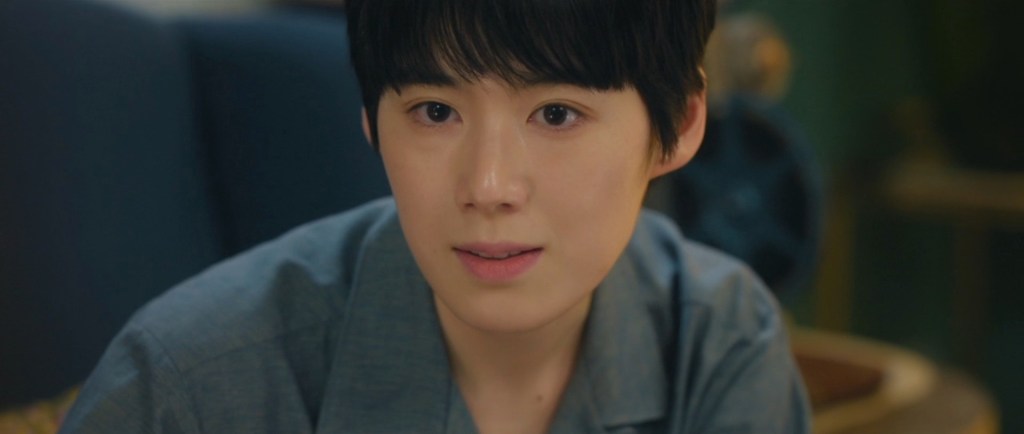
One of my big disappointments with the show is actually with how it looks. The image is overlit and therefore flat, with no permission for moody, definitional shadows when every on-screen light source has a gauzy glow. It comes off more like a mistake than a choice, in hand with how infrequently the frame feels aesthetic. There’s a scene of driving in the fourth episode with an It: Welcome to Derry caliber of green screen compositing that I instantly blurted out, “That looks terrible!” at my computer screen, which is just rude. In that case, there didn’t seem to be any foley work? Kim Tae-ri and Kim Tae-hoon’s voices were the only audible sound, when I’m fairly certain this 1950s car would be roaring and sputtering. Most acutely, the technical shortcomings I’m conjuring here come specifically with how Ok-gyeong is portrayed, when not on stage. Despite being such a legendary character, she often looks so ordinary. And it’s a simple fix: just shoot from below a little more. Tilt upward, like they did on Mad Men. And while I’ve certainly found other joys in Jeongnyeon: The Star is Born, I’d be lying if I said that Jung Eun-chae’s much-hyped, androgynous Moon Ok-gyeong wasn’t the main draw. The problem is that she’s too nice. After that introductory, brooding scene, she brightens up and becomes the kindest mentor figure in cinema history. She has an infinite patience for Jeongnyeon, whose antics should’ve, by rights, disappointed or even angered her at times. I needed some friction in this relationship, and maybe for Ok-gyeong to be a badass like the ones she plays on stage.
We reach the halfway point of the show in episode six with the preparation for and production of the new play, Jamyunggo (based on the folk tale “Prince Hodong and the Princess of Nakrang”) with a new round of auditions. To everyone’s surprise, the prodigal daughter goes for a small part – Soldier #1 – because she wants to know that her talents aren’t being buoyed by Yeong-seo, who’s secured the villain character over Baek Do-aeng, Director Kang’s own niece. She’s really that good, fellas. Like she’d done before, Jeongnyeon ventures into the world to find her character, a male role like Ok-gyeong’s. She rummages through the prop closet to find a boys’ school uniform, and begins literally acting like a man in a series of escalating gags. First, she imitates the mannerisms of a gentleman waiting for a bus, then an ajumma actually mistakes her for a boy and offers her granddaughter, and finally, she runs afoul of neighborhood toughs who chase her all the way to a small camp where volunteers are feeding soldiers. She hears from these combat veterans, both male and female, which reminds her of her own war experience, losing her father while fleeing a battlefield. At the same time, Yeong-seo and Joo-ran begin rehearsing together, as their characters play opposite, making Jeongnyeong jealous. It wasn’t so easy, however, as Yeong-seo kept spurning Joo-ran’s offer to practice together, likely because she’s unable to show imperfection – a performance in development – to anyone. Yet another strength of the show is how it’s able to introduce active, interesting conflicts that feel organic and not born of external circumstances.
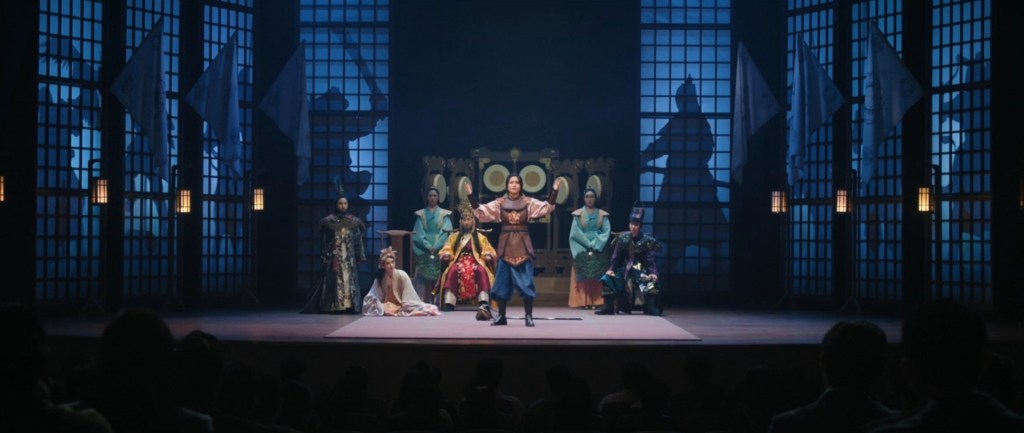
While sequences of music in film can sometimes stop the pacing dead, the performance of Jamyunggo works because it’s a payoff to what’s been building, like the final game in the sports movie or, even more aptly, the final battle in the Shaw Brothers movie. Jeongnyeon even had to train while doing chores, a la Gordon Liu. In addition, the performance draws suspense from two sources. Yeong-seo convinced her mother to attend the premiere, going so far as to promise that if she’s not impressed, she’ll never ask again. And then there’s Jeongnyeon, imbued with the power of her inspirations but taking it too far on stage. She’d been told, and then reprimanded, that her purpose as a support player is to complement the production, and certainly not draw attention away from Ok-gyeong. I don’t know if this is tapping into the primal fears at the root of stage fright and public embarrassment, but it was so cringe-inducing and nerve-racking that my body was curling up – and then she starts belting out an unscripted solo. Holy. Shit. Now, there is a justification, that she spots one of the soldiers from the camp in the audience and wants to do right by him, and is taken back to the moment of her father’s death, so the emotions are bursting out of her, but man. Man, oh, man, oh, man. If there’s any justice in this world, Ok-gyeong will punt her out of a window for this. Come on, Eun-chae, bring the hammer down!
Kim Tae-ri’s performance might best be summed up in the scene where she’s training with Patricia Kim, who asks her to rate her performance. Beaming, Jeongnyeon starts with, “Of course I’d give myself…” before slowing down and saying, “a zero.” Like Choi Min-sik, she acts with her whole body. Even small business like sitting down in a chair, she might scramble into it if the scene requires her to be flustered. It’s also well worth noting that there doesn’t appear to be any lip-syncing on this show. Those really are the voices of Kim Tae-ri and company, and apart from Seunghee, these are not former idols. On a practical level, Jeongnyeon’s floppiness allows us distance when needed, the distance to laugh and decenter and think about how her actions have consequences for everyone else. This show is a case where extremely talented actors are working with thoughtful, sensitive material which deepens as it progresses (as well as being entertaining throughout). The finer points may not be fashioned with the subtlety of non-K-dramas, but like the suspensions of disbelief made for productions like gukguek – believing, for example, that Moon Ok-gyeong is a man – I might have to look at the genre conventions like the boundaries of the stage. The creative team behind Jeongnyeon: The Star is Born, from its writer, Choi Hyo-bi, to the creators of the webtoon on which it’s based, Seo Yi-re and Na Mon, transcend those limits with big, wholesome, and powerful storytelling.
 With Eyes East