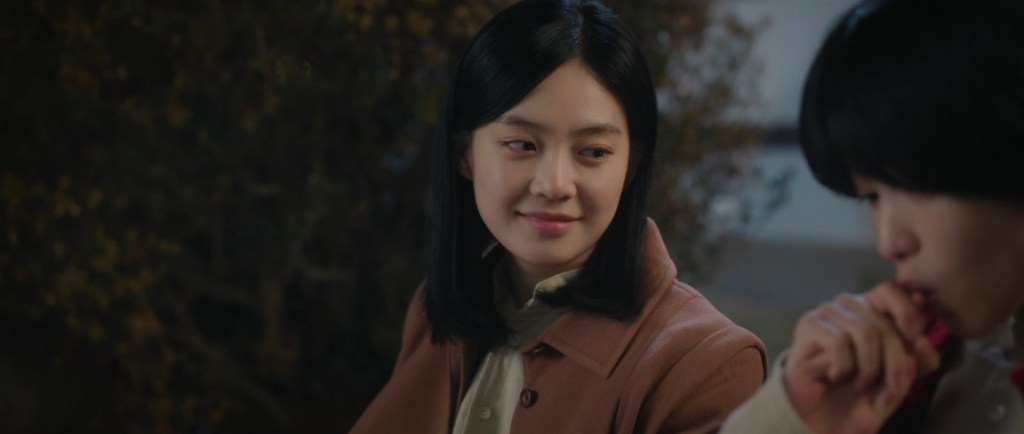
Episodes 7-8 (spoilers)
I, too, remember when these things weren’t just plot summaries
I was perfectly satisfied with the prospect of doing Jeongnyeon in two reports, so consider this an emergency situation. And I just hope to God there aren’t further incidents from here to the finale. In two episodes, Jeongnyeon: The Star is Born gave me a lot to process and absolutely no slack to do so. It’s hard to think… when you’re crying. Episode eight, specifically, is one of those “perfect episodes” I used to get so hung up on, but before we get there, I did leave myself on something of a cliffhanger. Previously, Jeongnyeon upstaged the performance of Jamyunggo, winning over the audience to the point where even the audience was like, “Wait, this isn’t how it’s supposed to go!” I was bracing myself for the scene where Ok-gyeong returns to the stage and the crowd starts chanting for Soldier #1, but thankfully, we don’t see that. And as we may find, it likely didn’t happen. Still, I assumed that Ok-gyeong’s patience with Jeongnyeon would finally run out, and there’d be hell to pay. I just want that so badly. Jung Eun-chae is so compelling as Moon Ok-gyeong as Prince Hodong, but as Moon Ok-gyeong off the stage, it’s harder for me to assess the performance because she’s so similar to Jung Eun-chae herself. In Anna, the menace of Hyun-ju reverberated through her entire body; it was a transformation. Ok-gyeong rarely even gets upset with anyone – rarely. For now, I understand that Ok-gyeong isn’t offended by Jeongnyeon’s antics because she sees her almost as an experiment. The disillusioned star is simply playing a different game than everybody else.
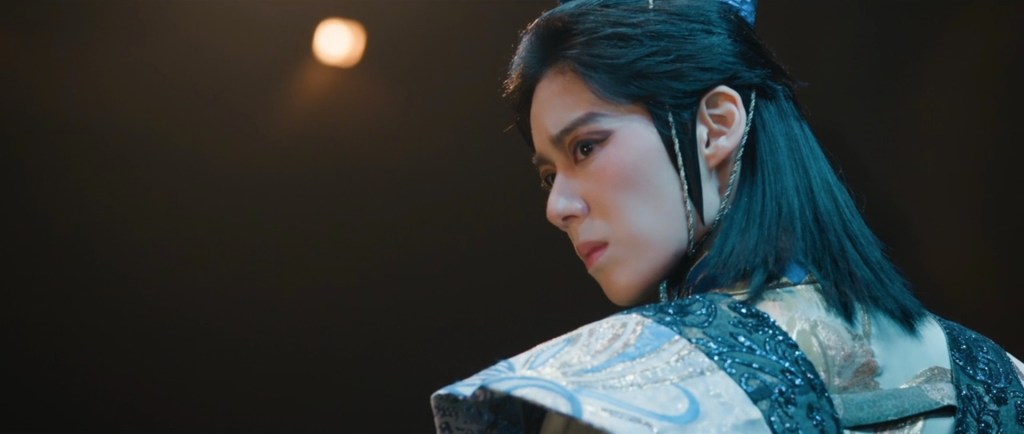
Not Director Kang, though, who removes Jeongnyeon from the roster. She’s once again in a bind, because this sort of insubordination is unsustainable, but Jeongnyeon is too big to hide under a bushel. If only an easy out could fall into her lap, or onto the stage, nearly killing Yeong-seo during a rehearsal. One character I didn’t mention in the first report was Ko, the bespectacled finance guy who’s in some sort of cahoots with Seo Hye-rang. The nature of their relationship isn’t entirely clear, and it might be a case of overlapping agendas. Ko has a gambling problem, so he’s been skimming off the top – of a theater company? – and Hye-rang wants the next generation of talent out of the picture so she and Ok-gyeong aren’t replaced. They’re both sabotaging the troupe, but for different reasons. And man, it’s gotten so bad that I get excited whenever these two are on screen, not because I particularly love them, but because I know Hye-rang is gonna do something to run afoul of Ok-gyeong. In this case, it’s Ko who messes with the lights, leading to catastrophe if not for Joo-ran tackling Yeong-seo out of the way, injuring herself in the process. Because Jeongnyeon has been dutifully studying all the characters’ lines in the script, partly out of atonement, she’s the only one who can take Joo-ran’s place – with Joo-ran’s desperate encouragement. From Kang’s perspective, she managed to take the troublesome thespian out of the play and simultaneously promote her. Good deal.
After the premiere, however sabotaged by Jeongnyeon, Yeong-seo’s mother Ki-joo actually praises her daughter’s performance, and they hug for probably the first time since Yeong-seo’s birth. It’s an emotional scene, and while I knew better than to trust Ki-joo, I wanted to believe that this could be the payoff. That would be nice, just leave it there. The next we see of Ki-joo, she’s with Yeong-seo’s sister, and I then suspected that she might start criticizing her former favorite, and Yeong-seo would come to realize how empty her mother’s love is, bringing her closer to the sister like Jeongnyeon and Jung-ja. As dramatic as that might have been, the chosen trajectory is interesting for how much it’s immediately subverted. Ki-joo had recognized Jeongnyeon’s voice as Chae Gong-seon’s, and talks about how she’s a vocal genius and some people are gifted that way, pointedly implying that others are not. At the same time, Jeongnyeon is running through all the characters’ lines with Joo-ran, and Yeong-seo happens to overhear Gomigeol, her part. This prompts Yeong-seo to shatter Jeongnyeon’s Chae Gong-seon record, and in the subsequent confrontation, Jeongnyeon’s fury is extinguished by the sight of Yeong-seo in pain. She asks Jeongnyeon to teach her how to sing like her, and Jeongnyeon says that she’s vowed to step out of her mother’s shadow, that Chae Gong-seon is Chae Gong-seon, Jeongnyeon is Jeongnyeon, and Yeong-seo should be Yeong-seo. It’s that precious moment when hero and villain meet as humans instead of rivals.
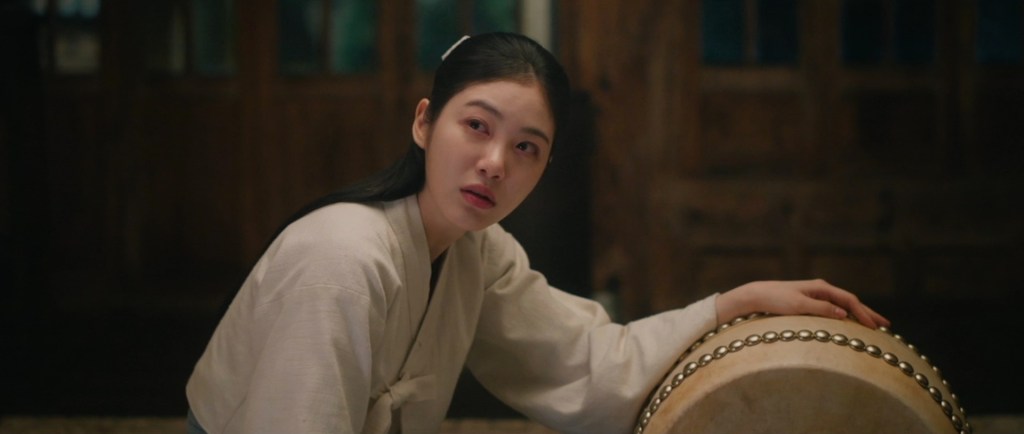
Usually, that moment signals the end of the rivalry, but the relationship between Jeongnyeon and Yeong-seo remains complex, even if its component parts keep changing. Its next form? A love triangle. Yes, the seventh episode hits the big gay button, confirming – at least, to me and my experienced caution – that Ok-gyeong and Hye-rang are indeed a couple, raising a young daughter together. As unlikely as I still think that would’ve been in 1950s Korea, progress has not been a single, global line trending gradually upward. Lots of back-and-forth, to say the least (I did not know until recently that the Weimar Republic was basically San Francisco, and that is so goddamn depressing). In addition, Joo-ran’s been awfully quiet since her rehearsal with Jeongnyeon, whose intimacy activated something deep inside. Naturally, Jeongnyeon is boyishly clueless, later taking Joo-ran’s hand in hers to warm it up. Director Kang announces that the next production will be the theater equivalent of a varsity sporting event – a collaboration with six other companies – with open auditions for the young leads, but with the catch that trainees will have to audition together. Wait a minute, that’s two parts, but we have three trainees. Oh, no… Obviously, Joo-ran will want to be with Jeongnyeon, but Yeong-seo will want to be with Joo-ran. Who Jeongnyeon picks, that’s unpredictable.
It’s widely understood, even among reporters on the theater beat, that these “young leads” are the future replacements for Moon Ok-gyeong and Seo Hye-rang. It’s the end of an era, and nobody is okay with that – except for Ok-gyeong, as we know from her very introduction. But not only are fangirls holding protests in support of their forever prince (if only they had coffee trucks back then), we know Hye-rang’s doing all sorts of shady things. Ok-gyeong, who briefly played detective with Hye-rang regarding the prop closet stunt that nearly cost Jeongnyeon the Soldier #1 audition – ironically, that would’ve saved everyone a lot of grief – has been putting things together behind the scenes. These are scenes I would’ve loved to have watched, by the way. Really, any scenes with Ok-gyeong. She’s done beating around the bush, and says that Hye-rang’s attempts to push Jeongnyeon, Yeong-seo, and Joo-ran out of the company (big ups to Joo-ran for being included) are also pushing her out. Hye-rang continues to deny everything, of course, and Ok-gyeong warns her not to test her patience. Ooh, now, there’s the Jung Eun-chae I know, from the one show of hers I’ve seen. And that’s our stage for the eighth episode, which identifies a conflict with stakes for every character, including one who isn’t even present.
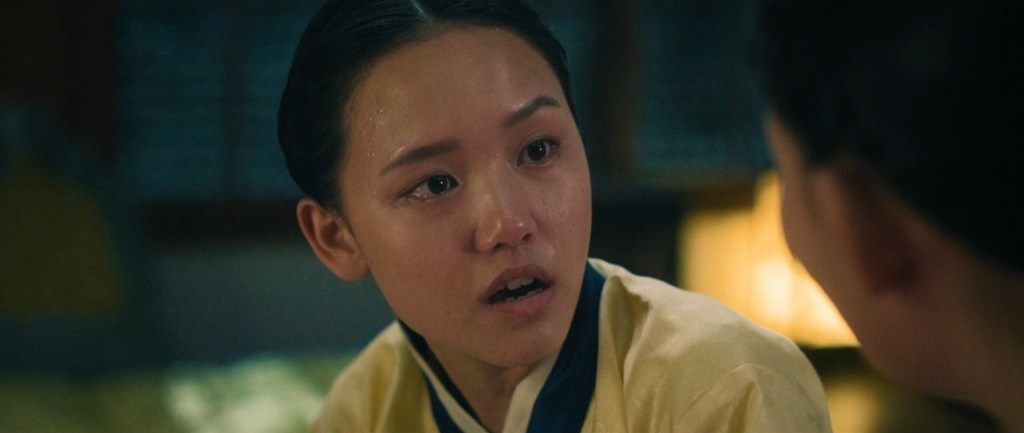
We open on an unexpected perspective, that of Park Cho-rok, whose arc I assumed was over. The bully had been vanquished, and mercifully, it wasn’t much of a vanquishing. Now she’d just be in the background, and her defanged sneering would provide a refrain of normalcy against whatever difficulties lie ahead. Instead, she almost takes center stage, pleading with Jeongnyeon to be her audition partner. Of course, Cho-rok wouldn’t be Jeongnyeon’s first or even last choice, because that’s obviously Joo-ran, right? We have a study of differences in how Jeongnyeon and Yeong-seo approach Joo-ran to be their partner. Yeong-seo is earnest and vulnerable, confessing that Joo-ran brings out the best in her. It was quite something to see. And then Jeongnyeon just asks when they’re gonna start practicing together, which is presumptuous despite being a safe bet. Still, Joo-ran chooses Yeong-seo, with one of the show’s quirks: giving multiple reasons for a choice or exhibiting multiple motivations. One can either read that as characters being less than truthful, even with themselves, or the show being so economical that it makes additional uses of each conflict. Joo-ran’s initial reasoning is that Yeong-seo is stable and she can rely on her, but “I can’t rely on you,” which hits Jeongnyeon like a freight train. All that stuff they went through together! The pinky promises! It was clear that Joo-ran was shocked by Jeongnyeon’s Soldier #1 performance, but she stayed by her side during the redemption tour. There may be more to the story.
Despite that her relationship with Joo-ran makes Yeong-seo a warmer, more open person, she turns cold on the eve of the audition. She’d overheard Joo-ran tell Jeongnyeon about “stability,” and interprets it as being chosen for ease of use. Joo-ran then gives the real, or additional, reason: she’s scared of Jeongnyeon. It was that gay panic. She’s worried that if it happens again, it’ll break her focus, and how is that something she could possibly tell Jeongnyeon? Meanwhile, Jeongnyeon is left with no choice but to team up with her archnemesis, although Cho-rok was like the baby-mode archnemesis. And yet, Chorok reminds us that she isn’t here just to play that part, but because she has dreams of her own, not to mention a killer voice. While this relationship also develops, Jeongnyeon’s mind is nevertheless elsewhere. She sees Yeong-seo and Joo-ran looking perfect together, and then Hye-rang arrives in time to twist the knife. How fun for Jeongnyeon that this one’s always skulking around the premises, but her best friend Ok-gyeong is nowhere to be found. Hye-rang says that the only way to beat Yeong-seo is to practice in that nearby cave up in the mountains, over and over until you cough up blood. Cho-rok knows this is bad advice – and it’s her audition on the line, too – but Jeongnyeon is desperate enough that she does some spelunking.
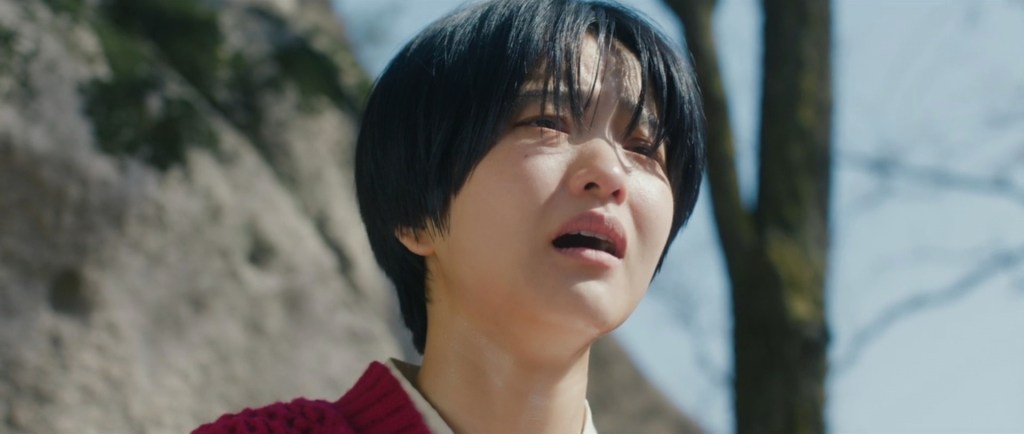
The nonstop practice attracts worried attention in two fateful encounters. First, Director Kang, who hears the wailing after hours. When Jeongnyeon screams in frustration, it triggers a flashback to when young Kang tried to stop her friend Chae Gong-seon from pushing herself too hard. Like in Whiplash, Gong-seon responds with venom, that Kang could never understand the pursuit of perfection. And now the same pressure is bearing down on her daughter, just as she’d feared. This is the kind of material that Kim Tae-ri can really sink her teeth into. The first six episodes showcased her still impressive but now familiar ability to shed decades of maturity to convincingly play a teenager, but here, she focuses all of that energy into a self-destructive mania. She shakes and shivers as she tries again and again to nail the lyrics. Kang can’t stop her, and neither can Yeong-seo, who finds her in that cave in the mountains. In yet another testament to how quickly the show moves, we’ve gone almost instantaneously from Jeongnyeon witnessing Yeong-seo’s lowest, most pitiable moment, to Yeong-seo witnessing Jeongnyeon’s. She’s barely recognizable, with wild hair in her eyes as she argues with Yeong-seo outside the cave. Of course, this is Hye-rang’s plan coming together, as she apparently hadn’t taken Ok-gyeong’s warning seriously. I don’t know how. If she looked at me like that, I would’ve reconsidered every decision I’d ever made in my life.
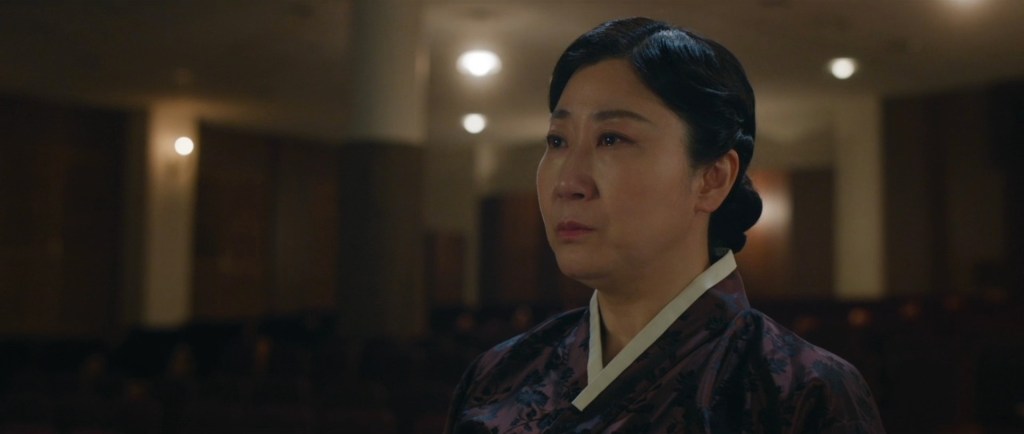
Ok-gyeong overhears from Cho-rok that Hye-rang gave Jeongnyeon this terrible cave advice, and then Jeongnyeon shows up on audition day looking like a zombie. Ok-gyeong stomps after Hye-rang and tells her that it’s over between them. As much as I might’ve wanted more from this encounter, it was still very exciting. Finally, Jeongnyeon and Cho-rok hit the stage together, where they’ll be judged by a panel including Yeong-seo’s treacherous mother. Jeongnyeon struggles with a voice now hoarse, and Director Kang, Ok-gyeong, Yeong-seo, and Joo-ran are all watching, devastated. I, too, was moved, even if we all knew this was gonna happen. It’s a testament to Kim Tae-ri’s anguished performance here that she’s not only sympathetic still but heartbreaking. Certainly, credit must be given to the actors reacting, including Seunghee, who’s seeing this unfold in front of her. When it appears that Jeongnyeon can’t go on, Ki-joo calls it a wrap on auditions, but Kang stands up and pleads with the judges to let her at least finish the song. Seeing the director shed tears is especially powerful, and Ra Mi-ran is so good at balancing the character’s stoic front with the pain she’s feeling. While it looks like Jeongnyeon might actually finish strong – “Impossible!” the anime villain Hye-rang mutters – her voice finally gives out and she spews blood all over the stage before collapsing.
My enjoyment of Jeongnyeon: The Star is Born was not a consistent, flat line in its first six episodes, but the feeling now, between episodes eight and nine, is that this is the best K-drama I’ve seen since Twenty-Five Twenty-One. The only major difference is direction, which I’ve already complained about. The former Kim Tae-ri show was so delicate and so beautiful, where Jeongnyeon is surprisingly straightforward. I have watched behind-the-scenes clips and subsequently realized that Jung Ji-in, the director, is a woman, so I do feel bad about that, given the underrepresentation of female directors in Korean television. I may not necessarily agree with all of her technical choices, but seeing her work with the actors through these performances within performances – like, “Your character’s acting here has to be good but not great” or something crazy – and the singing, it was a good reminder of the big picture. Yes, the actors are all A-list talents, but here, they’re completely in sync and part of a whole. With these write-ups, I often feel like the guy stuffing his face at the buffet and complaining about the dinner rolls, because I’m so fully transported by the show while paradoxically recognizing that the depiction of its world is what I’d describe as “not very transportive.” It’s really weird. And that’s why I want to log these thoughts, as they’re strange observations more than genuine criticism. Why does the show work so well? Hopefully I’ll have an answer the next, final time we discuss this.
Here’s a bunch of Ok-gyeong screenshots I picked up along the way. God, how I hate to criticize her character. You know, Jung Eun-chae is fluent in English, having gone to uni in the UK. There’s a 0.001% chance she ever reads this, but if she does – I’m sorry!
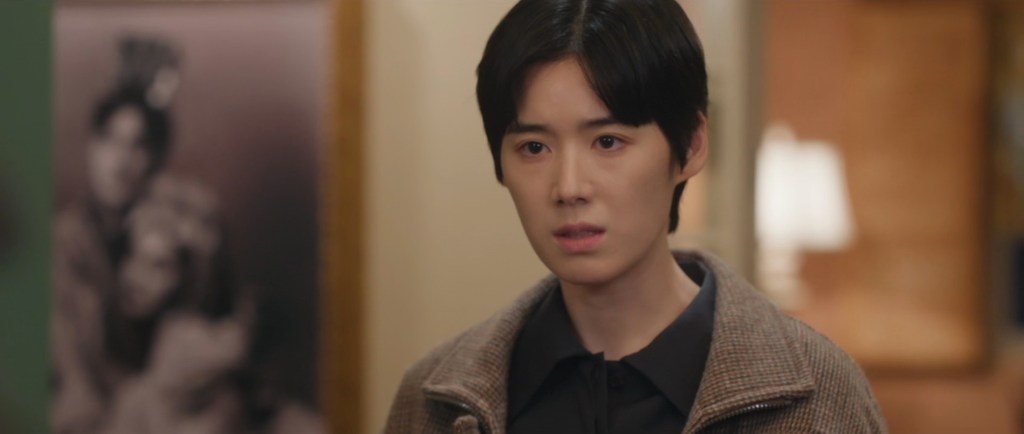
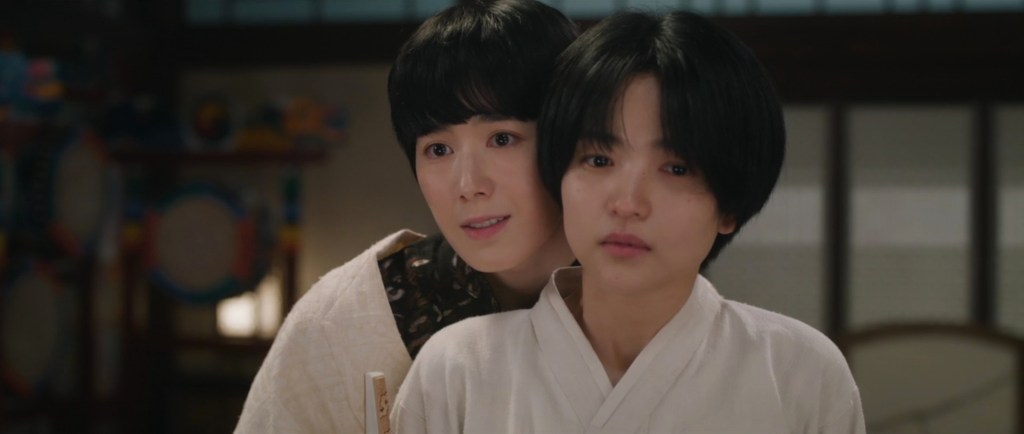
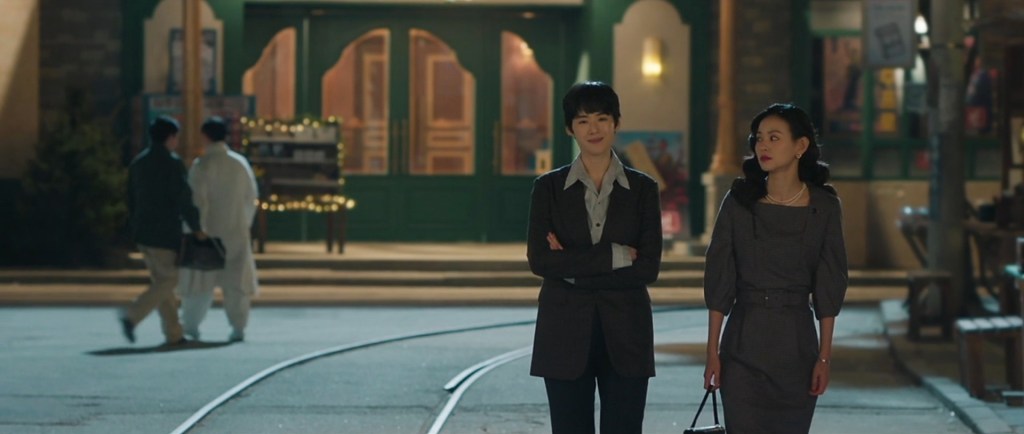
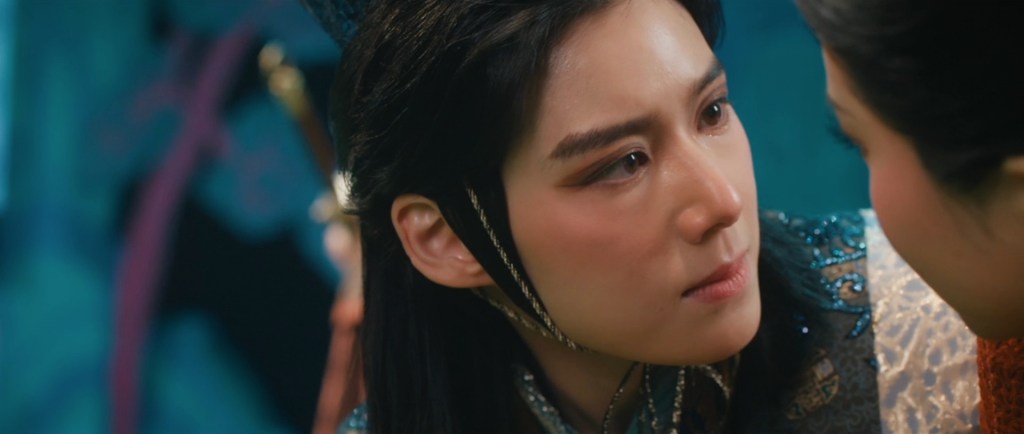
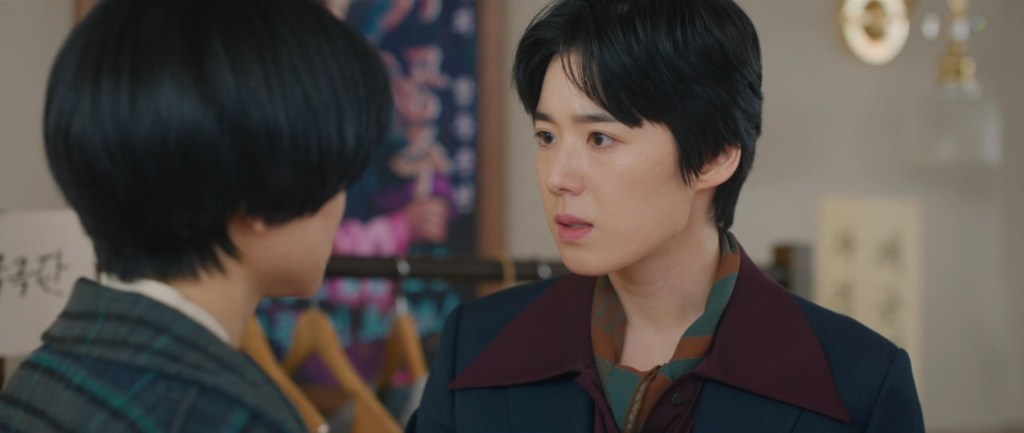

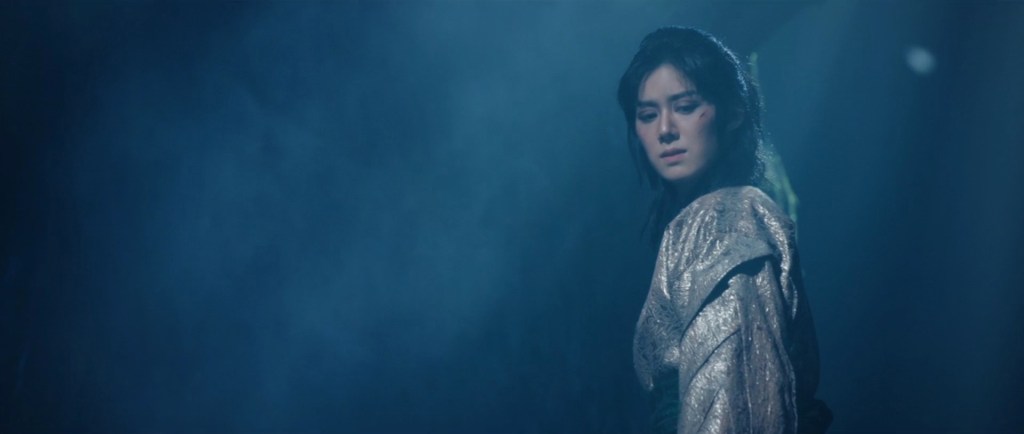
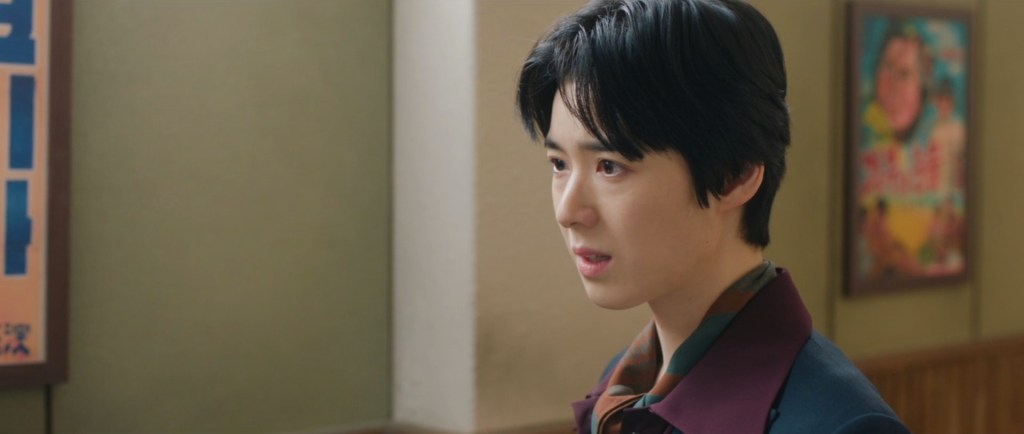
What a stud
 With Eyes East