

Directed by Hong Sang-soo
Starring Jung Eun-chae, Lee Sun-kyun
Tempted as I might be to slide into this review with no proper contextualization, no declarations, I must admit that Nobody’s Daughter Haewon is outside my wheelhouse. In fact, it’s pretty much what I imagine when I close my eyes and think “arthouse film” and then make a face. So far, my recent aspirations toward true cinephile-hood have manifested as a rejection of the biggest, crassest blockbuster movies rather than an earnest exploration of the unplumbed, leaving me hardly indistinguishable from the stereotypical Nolan-Tarantino-PTA crowd – as if the bros don’t also like Park Chan-wook. It’s just, with this movie in particular, there’s some déjà vu. Every now and again, I’d watch a movie from the back catalog of an actor or actress I liked – off the top of my head, Mary Elizabeth Winstead’s Smashed and Adam Scott’s The Vicious Kind – and come away with basically no reaction, and here I am again with Jung Eun-chae. Although she’d been working for a few years, Nobody’s Daughter Haewon was a breakout role, earning her awards and nominations at the Baeksang and Blue Dragon and so on. However, as is becoming a pattern with my Jung Eun-chae experience, she isn’t the main character of this story. That’d be the film’s director, Hong Sang-soo.
A regular at international film festivals, Hong is one of those non-European directors who absolutely kills in Europe, with a Silver Bear, a Silver Leopard, and a Golden Leopard on his shelf, like some sort of shiny animal taxidermist. Incidentally, Nobody’s Daughter Haewon was named the eighth best film of 2013 by Cahiers du Cinéma, the oldest French film magazine. He’s made movies I’d often read about in my Korean movie studies, like The Day a Pig Fell into the Well and Woman is the Future of Man, and he’s also been a surprisingly public figure. I’d recently read the fun fact that after The Handmaiden, Kim Min-hee never made a movie with a director other than Hong, to whom she’s now married. On paper, that sounds more jealous than it probably is. I mean, The Handmaiden springboarded Kim Tae-ri into well-deserved, inevitable stardom, to where she has younger actresses like Bona and Shin Ye-eun fangirling over her like she’d done with Kim Min-hee, who was never to be seen again. And, well, I don’t know how to broach this delicately, but Hong – at the time a married man of 30 years with a daughter – was rumored in 2016 to be having an affair with Kim Min-hee shortly after their first movie together. Now divorced, he’s since married Kim, who gave birth in April of last year. Some movie review this is shaping up to be.

As I suspected after watching The Assassin, I wouldn’t understand what I’d just seen without first understanding director Hou Hsiao-hsien. Certainly, part of reading a movie is pattern recognition, picking up, for example, how aspiring actress Haewon says and does the same things but with different audiences, as if she’s rehearsing a part. In her dreams, she’s complimented on her English (like Jung Eun-chae herself, Haewon had lived in the UK). Married men dating younger women is another recurring element, and three years later, it comes out that Hong Sang-soo is exactly that. So much to say, I’m getting Woody Allen vibes all over this guy, and perhaps Jung Eun-chae is like Rebecca Hall here. I wish I could say this is why I steer clear of art films, because sometimes artists forget how to be people, too, but that’s awfully convenient. Anyway, there’s an essay on MUBI by film and food critic Elissa Suh about Hong Sang-soo movies, where some of the formalistic elements and creative choices in Nobody’s Daughter Haewon are made more apparent by other movies like Right Now, Wrong Then and The Day After. Specifically, Suh points out things I felt but didn’t notice, like Hong’s “Korea purged of bystanders, a cinematic space free of distraction that allows his cast of characters to stand emphatically alone as if in a dream, or perhaps more correctly, center stage of their own reality.” At least I kind of write like that: “perhaps more correctly….” I’m making a face again.
The essay is about how the male characters intrude into women’s spaces, as the late Lee Sun-kyun’s professor character does to Haewon with his empty platitudes and sudden bursts of anger. Let’s see if this makes for an effective entrée into the world of Hong, after having spurned the more obvious options. Well, I might be willing to call this a “character study,” at least as a starting point – we can sub out the term later – and one aspect of the study is her interaction with troublesome men. What I noticed was that if Haewon has an outward flaw, it’s that she’s easily flattered, and this makes her relationships logical if not inevitable. She has the artist’s penchant for drifting through life – easy come, easy go – though she always ends up at the same places, doing the same things. It might be dream logic, but it’s certainly also the circular shape life takes in difficult times. Her mother is moving to Canada to live with her brother, leaving her unmoored, with only these complicated romances in mid-development. Her gossipy classmates have conflicting ideas about who she really is, and Haewon might break away from it all but for an utter lack of forward momentum. She’s on the verge of flunking one of her classes, and she can’t even get a breakup to stick.
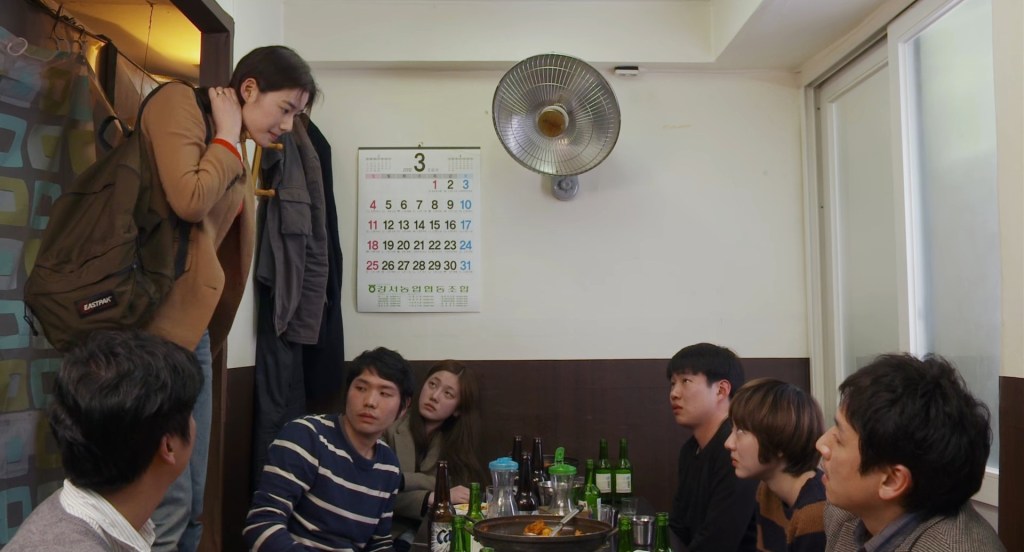
She could be Miss Korea, because she’s big but not too big
I don’t know. Does that add up to anything? Suh’s MUBI essay leads me to believe that the “experience” of a Hong movie is more ephemeral than big-picture, naturally going against how I’ve thought about movies for the last several decades. Arthouse film is such a different thing, as related to non-arthouse movies as documentaries are: similar processes behind their creation, even similar languages, but with wacky different results. To my mind, movies like Nobody’s Daughter Haewon and things like Dogma 95 are anti-cinema, whether that’s an insult or not. Why deprive yourself of the tools of the trade? You wouldn’t put on a play, usefully, in the dark. Mainstream spectacles like Once Upon a Time in the West, The Matrix, and RRR will always be more impressive to me because they make use of every tool, because these things are a means to an end. If you’re an artist, I might find your working philosophy interesting, but that can’t be the conversation we have through the medium of your creation. “Oh, you can do this, even with these limitations?” is more like sport than art. I want to know the person on the other side, and obviously, sometimes, that person sucks. But before I fully commit to this anti-arthouse platform, I’ve still got David Foster Wallace’s words rattling around in my head, where he’s talking about art that requires a bit of work to “get.” Consider this a starting point, far from the finish line.
In the meantime, I can’t say that a naked viewing of Nobody’s Daughter Haewon was especially fruitful. I was trying; I tried so hard that I fell asleep halfway through. One day I’ll tell the story of how I had to pause both Tetsuo: The Iron Man and Tetsuo II: Body Hammer to take a quick nap. I’m the only person in the world who loves Ghost in the Shell and David Cronenberg but hated those two movies. Of course, I was assessing Jung Eun-chae’s performance, hoping to see some of that snap-crackle-pop she brought to Anna. One of her comments about that character was illuminating, when the host was like, “She was evil,” and Jung Eun-chae, laughing, says, “Wasn’t she cute, though?” Haewon feels like more of a real person – and she doesn’t truthfully do a whole lot of talking – but there was something about the staging of the movie that lent its exchanges of dialogue an awkward rhythm. The scenes felt ad-libbed, and they’d often be contained within a single camera setup, so it’s as if it wasn’t 100% clear between actors who was speaking next. Jung Eun-chae and guest star Jane Birkin’s body language was halting and unnatural in that dream scene. So much to say, I imagine that acting in a Hong Sang-soo movie is a venerable challenge and a unique experience. It appears that it gave Jung Eun-chae a taste for the offbeat going forward, or maybe that was always her predilection and Hong was a natural fit along the way. I’m glad she was in this movie, and, um, I’m glad it was only 90 minutes long.
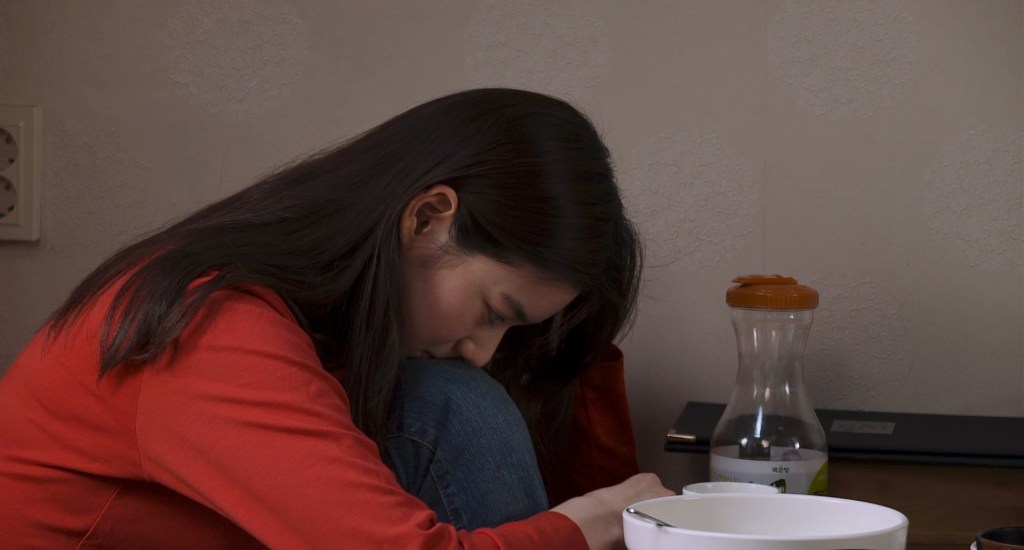
Sorry, again
 With Eyes East