Episodes 2-8
Also known as “Hello, My Twenties!”
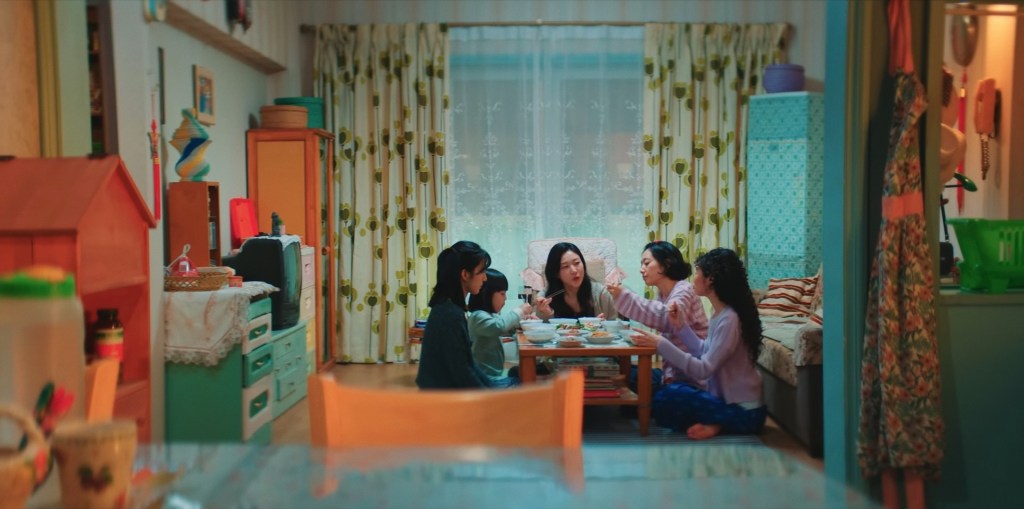
In a surprisingly literal way, Undercover Miss Hong is like candy. Its 1990s Seoul is made up of brightly-lit night exteriors and pastel office sets which look positively set-like. I mean, utterly unconvincing, as if all the harshness or potential frictions of “reality” were duly sanded away. The entire cast is gorgeous – the computer nerd Lee Yong-gi has his hair frizzed up to obscure actor Jang Do-ha’s boyish good looks (shucks, apparently, he was in The Judge from Hell, but I don’t remember) – and every expository punchline is delivered loudly, underscored by upbeat, triumphant music or upbeat, suspenseful music. This is the manner of a cartoon. Facial expressions are big and made bigger by crash zooms, body language is gesticulation and flailing. Cliffhangers are earth-shattering until their immediate, pat resolution next episode, like an old Republic serial. There’s an ease to the viewing, and most certainly a comfort. None of this description should be taken as negative criticism. It’s candy, after all. I don’t believe that the fireworks nature of the show comes at the expense of anything, like complexity, for example. The financial technobabble is persuasive, even set against the unpersuasive backdrops (which I privately enjoy because I love sets, when environments feel fully designed), and the unraveling mystery is a weave of character and plot and social commentary, with aha moments only raising the stakes.
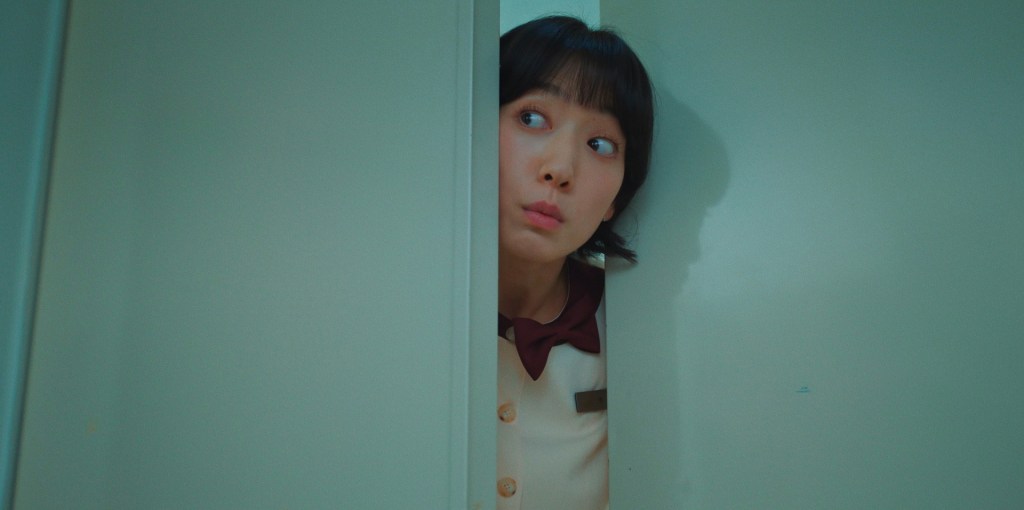
By the midpoint, Undercover Miss Hong settles into a comfortable rhythm. It’s almost a case-of-the-week, though the issue will usually span multiple episodes. All the while, Plot A shuffles forward: Hong’s investigation and others’ suspicions of her. The undercover character must be one of the juiciest roles for an actor, with the code-switching and playing under pressure; anxious one moment and determined the next. Our venerable lead Park Shin-hye imbues Hong with a wry playfulness as well, performing cuteness and weaponizing charm. The fantasy at the heart of the show is being in a workplace while not being accountable to it. Over and over, she finds clever ways to rebel against the worst agents of the system, like Cha Jung-il and all his sexist venom. She could walk out the door anytime and return to her actual place of work – with a boss who thinks she’s the greatest thing since sliced bread – but of course, the mission takes priority, and she may be finding reasons to care about Hanmin Investment & Securities after all. The oldest undercover story indeed. We’re getting a better sense of the long cast list, with representatives on every floor of the building. Some of them remain static, like the chairman and Ms. Song, firm in their one-dimensional villainy, but others reveal compelling layers, like Kim Mi-sook’s motherhood, Go Bok-hee’s criminality, President Shin’s shady agenda, and so on.
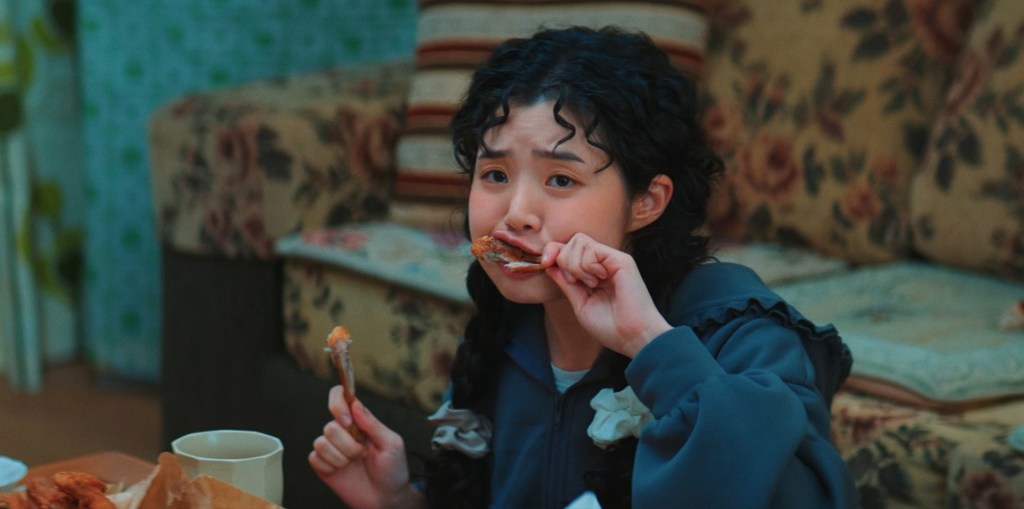
Critically, we understand these characters in relation to one another, as we see how Hanmin as a company works from the top down. The chairman introduces a new program – the New Korea Fund – and Mi-sook’s coworkers chastise her for outselling them. We’re privy to Mi-sook’s situation back at the Seoul City Dorm for Single Female Workers #301, which took in her young daughter over Hong’s objections (she can’t afford to attract attention). Mi-sook was working hard to meet the quota until the bosses moved the goalpost and upped the quota, after which she started working harder. Kang Chae-young does weary exceptionally well, which is partly why the glimpses of dorm life with Nora are such a tonic – especially when Nora’s trying to talk and eat a chicken wing at the same time. To be fair, Nora is also kind of a one-dimensional character, but she’s so funny. And while the girls and their relationships are functionally not as deep as those of Belle Epoque in Hello, My Twenties!, I’m privileged with the same pleasures of a dynamic household. They’re frosty and plotting, then allied in problem-solving. They’re all keeping secrets from one another which occasionally threaten to come out. Yes, even Nora is hiding something. Frankly, when the show introduced the idea that she and President Shin were gonna start dating, I felt anxious because she’s so sweet and oblivious that I don’t want to see her heart broken. Have some more chocolates.
Then there’s the risk management department, where Hong shares office space with the aforementioned computer nerd, Lee Yong-gi – the only actually diligent worker among them – Albert Oh, the potential heir of the entire company, and grumpy Bang Jin-mok, who spends his days reading manhwa and his nights getting blackout drunk. One by one, I came to like these three guys, which I didn’t expect (if there was a gender-bent Hello, My Twenties!, I probably wouldn’t watch it). At first blush, Albert is the typical spoiled rich kid, but I appreciated how unthreatening he was, like he didn’t understand his own position of authority or wouldn’t dare use it to abuse others. He turns out to be quite soft-hearted, embarrassed by how he’s credited for Hong’s [counterintuitive] contributions to the company and determined to make up for it. When she’s in the airport chasing a businessman implicated in an insider trading scheme, Albert shows up to deliver a telescopic baton and handcuffs, deferring the action hero role to the girl who just judo-flipped him onto the marble tile. She didn’t actually use the cuffs, though. Did you notice that? No? Oh, I didn’t, either. Of course, Albert might be falling for this secretary with the miraculous financial know-how, much like Yong-gi has, which is what initially put me off of the hacker whiz kid. Or rather, it’s what set me up to like him, because he never grew jealous of Albert nor resentful of Hong when romance was in the air. He’s remained reliably supportive of his office crush, as her number-one fan and cheerleader.
When Jin-mok goes out drinking, it’s usually with Cha Jung-il and So Gyeong-dong, who are Hong’s primary suspects for “Yehppee,” the insider working with the late president. She sure hopes it isn’t the antagonistic Jung-il, though honestly, this guy exhibits slight layers as well. Maybe it’s that he’s more entertaining than he strictly needs to be. I love that he’s desperately committed to the bit, never missing an opportunity to order Hong around or just shoot her a dirty look. It’s the little things, and that’s a microcosm of how Undercover Miss Hong is, for the most part. Big, playful, but not undisciplined. Admittedly, while the show moves, the plot does not. Uncovering Yehppee’s identity seemed to take a few beats too many. Plus, there’s lots of scenes where characters review documents they’ve already read and even marked up with red pen. The gears start to turn again by the end of episode seven, when Hong finally has her man. It wasn’t the genial Gyeong-dong nor the office jerk Jung-il, but Jin-mok, who hadn’t up to that point exhibited much character. The subsequent eighth episode is fantastic, with Hong talking in her steely prosecutor voice again, attempting to earn Jin-mok’s cooperation.
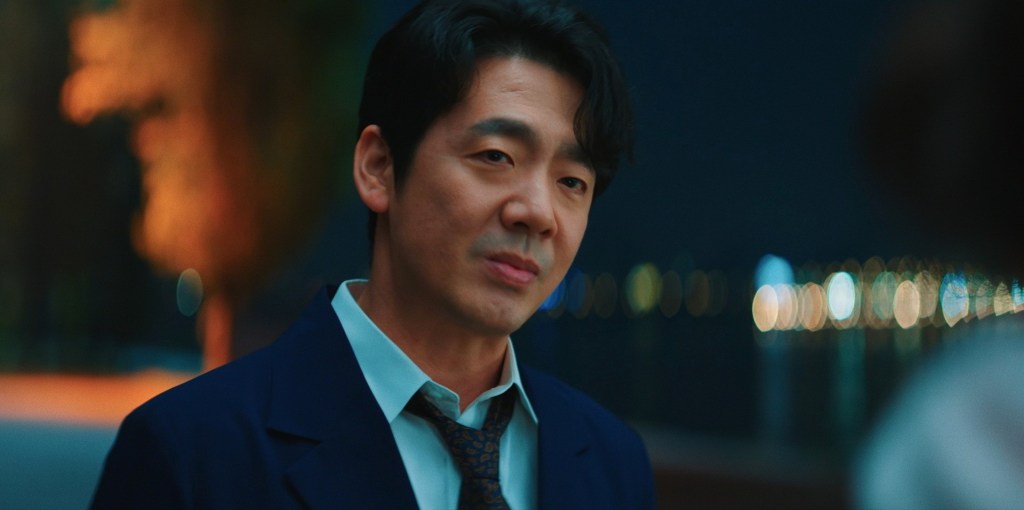
As we discover, Jin-mok was advised by the late President Myeong-hwi to burn all the evidence and go dark should their plan go to pot. After Myeong-hwi dies under suspicious circumstances, obviously Jin-mok’s life would be at risk, too. He has a family to think about, and can’t go off crusading against such cutthroat people. But Hong believes in him, and we believe in him because he’s clearly burnt out, with a face fixed in permanent resignation. He’s conflicted. However promising the partnership looks, the wedge that comes between them is none other than the IMF, the real-world economic crisis which is the reason why Undercover Miss Hong is a 1990s period piece (like my birth, it takes place at the tail end of the 20th century). I suppose social media making an undercover operation like this impossible is another reason. Hanmin scrambles to cook the books in order to get in on the international gravy train, sequestering key number crunchers to an entirely secret floor of the building, perfect for conspiracies. Hong is duty-bound to stop this from the inside, which puts her at odds with Jin-mok. His argument is that the now-thwarted bailout would’ve saved the company and all their coworkers, so Hong hits back with a long-chambered bullet: it was his work that got her fired nine years ago, and led her supervisor to suicide. Storytelling perfection (and additionally economical for teasing shades of President Shin, who’d seen the crisis coming).
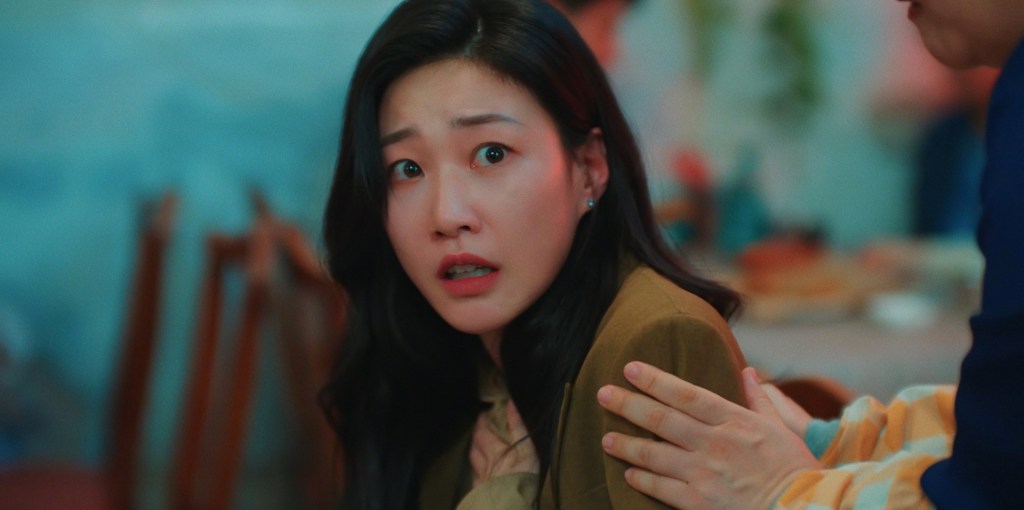
With the eighth episode, I realized how nostalgic I’d become for the pastel office and Dorm #301, with all its “celebration parties.” Not enough Nora, not enough Yong-gi. They’re the normalcy – the comfort – that now hangs in the balance. And dark forces threaten to close in, like Dal-su, the gangster henchman of Ms. Song, and Bok-cheol, Bok-hee’s violent brother, recently released from prison. For all the inherent danger, Hong’s secret identity has been slipping out, making Ma and Pa’s chicken shop an exciting venue for supporting players to be snooping around. And yet, the reveals are met with little fanfare. President Shin (Hong’s ex-boyfriend) never outright speaks it, and Albert also reaches an implicit understanding. Given that there are four episodes left, this is roughly the point where things go from “comfortable” to “uncomfortable,” so I’d better brace myself. I’m especially intrigued by Bok-hee, as her brand of antagonism reads especially Hello, My Twenties!, demarcating the dorm as adults – her and Hong – and kids – Nora and Mi-sook. The actress, Ha Yoon-kyung, is brilliant, apparently playing against type here. In keeping with the show’s general atmosphere, she’s very animated, and she probably toggles between the most extreme facial expressions of anyone in the cast. Her back-and-forth with Hong is great, and could’ve sustained an entire show by itself.
So much to say, the wait between episodes has been brutal!
For coverage of episodes #9-14, read on for the next K-Drama Report…
 With Eyes East
undercover miss hong, the best in many years, since Chaplin.
Starting with script, fabulous Park Shin-hye etc.
i’m 80 years old,born 5 days after the armistice, male, 10 years widowed, six sons, 10 grandchildren, commenting from Chile, where the world finish.
Congrat’s and thanks .
LikeLiked by 1 person