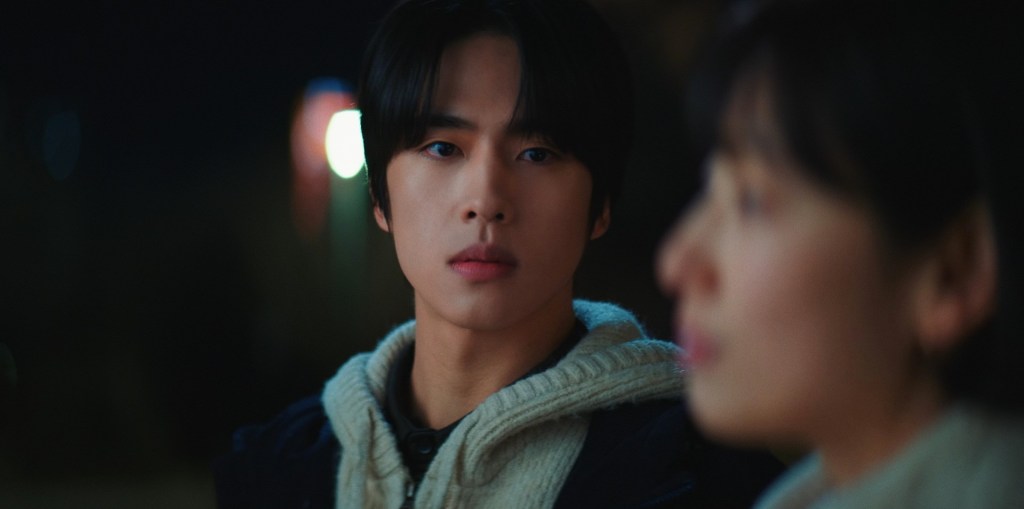
Episodes 15-16, the finale
One of the great ironies in my life is that I spend so much time on media criticism but have never successfully recommended anything to anyone. Well, there was that time a friend asked if he should take a date to either Renfield or The Super Mario Bros. Movie, and later thanked me profusely for the latter choice – myself having seen neither. I’d say I’ve also become calcified against recommendations, but there was no “become,” truthfully. For me, the science of picking a movie is so delicate and mood-based, a fast-closing window that, nine times out of ten, results in no movie being selected. How is external opinion supposed to factor into that sort of non-thinking? And so, the concept of the recommendation has retreated to an abstract use: “Would I recommend this, theoretically?” as part of the critical evaluation. It’s a question that’s surprisingly complicated with Undercover Miss Hong, being a pitch-perfect television show start to finish. I loved it, I thought about it a lot, but I struggle to identify concrete terms for the basis of a recommendation, assuming phrases like “It’s really good” don’t suffice. I asked this question last time, basically “How can perfection not be enough?” and with the show’s conclusion, I’ll try to answer. And for the record, it’s not because I feel, emotionally, that the show deserves the indignity of my criticism, but because it might be an interesting exercise. Might.
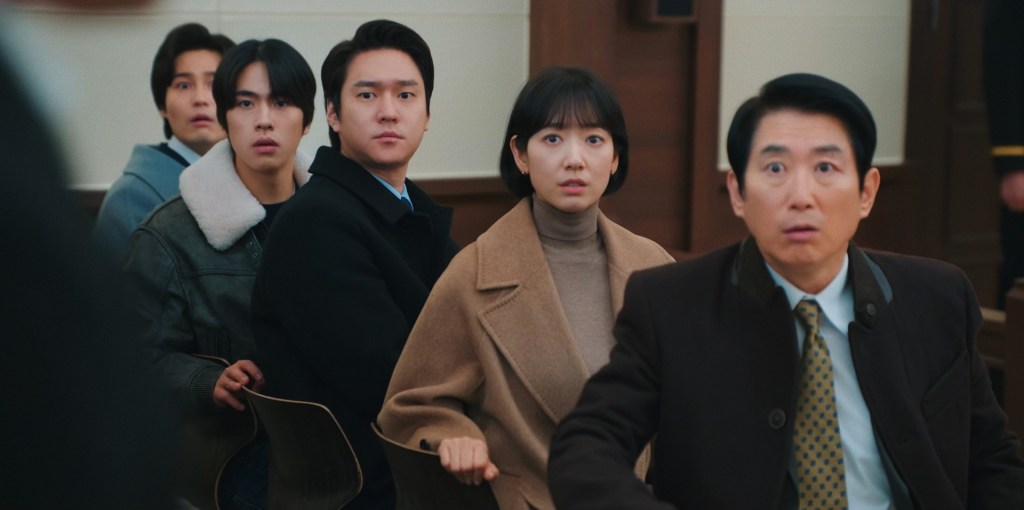
The final movement of our climactic arc hinges on Nora. We pick up the fifteenth episode with yet another abortive attempt of Bong Dal-su’s to abduct Hong – thwarted this time by the surprise martial arts of her parents – wherein Nora recognizes him as the same man who attempted to kidnap her nine years ago. This was a bit of Nora lore provided late, with the moral of the story being that her father, Chairman Kang, refused to pay the ransom. It’s not even because his wealth wasn’t liquid and would’ve been taxed or something like the Gettys, just that he already pays too much in taxes. I hear you, man. Trickle down. Plus, we wouldn’t want to put a target on Nora’s back, would we? Whatever the reasoning, Choi In-ja is desperate, as we see in the flashback where finally a character would be too young for the wig trick. The question, then, is whether or not Hong and the Pirates can persuade Nora to join the cause. She’s already disappointed them once, in Switzerland, though that was technically Shin’s fault, but her nine-percent stake in the company might prove crucial. Albert remembered that the chairman had promised her those shares if she completed her three-month probationary period, a verbal contract easily reneged during a specifically shares-related crisis, but don’t let me tell you how to run the company, Chairman.
This is where Undercover Miss Hong lures me into a trap. I was trying to figure out if Nora’s arc had thus far set up this final question of her loyalty – to either Hong and the gang or Chairman [and the] Kang – and suspected it didn’t, eyes-narrowedly with this being the character I ended up observing most. When Hong and Bok-hee start doubting Nora, it rang somewhat false, not rooted in their history. Finally, Nora gives voice to the issue, that she won’t follow Hong’s orders like everyone else. They do, admittedly, follow her around with heart eyes, but this is coming out of nowhere. Nora had too many motivations and was being pulled in too many directions. Is she upset at Hong because of her undisclosed relationship with Shin? Is this misplaced anger at being manipulated by the company? What is it that drives Nora’s decision-making? Perhaps the problem is that so much of her character arc is the achievement of decision-making.
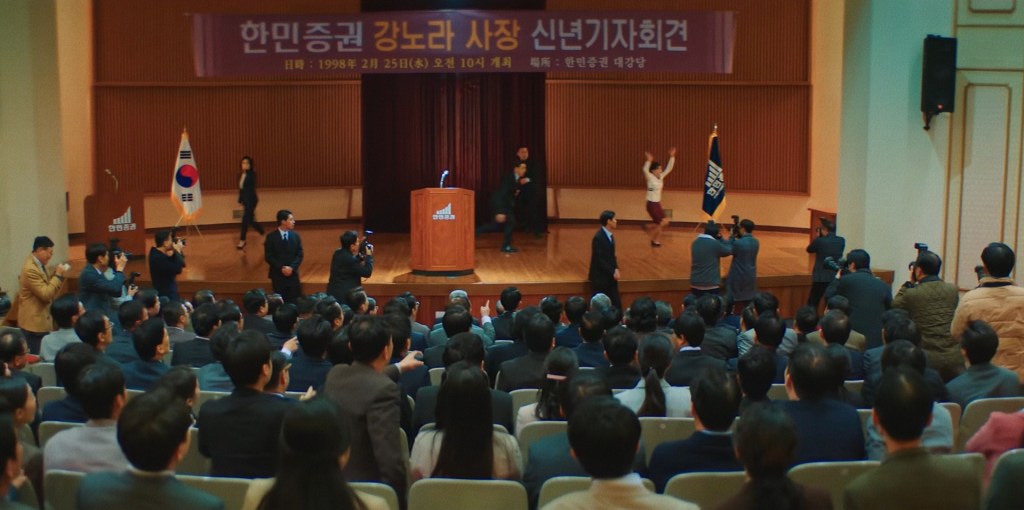
The show’s climax is composed of two major sequences across episode fifteen: the “Extraordinary Shareholders Meeting” where the Yeouido Pirates will attempt to oust Chairman Kang, and the Hanmin presser where Nora will be announced as the new president. The vote at the shareholders meeting is a great example of a K-drama making something exciting out of an unlikely subject. There’s so much on the line, with Hong’s crew taking their biggest beating after a string of uncontested wins – her family and reputation are under attack, Bok-hee is in jail – and the meeting room is a convergence of old faces (old injustices) seeking restitution. So Gyeong-dong and the other laid-off employees, their appearances arranged by Hong with the promise of reinstatement, rally against the chairman in a scene that carries the affect of a fantasy. It’s common that when management screws up, employees take the blame, but a bit rare for those employees to reach management with their unruly street complaints. Still, history will surprise you, and for my fellow Americans, other countries will, too. I mean, South Korea recently jailed a former president for abuse of authority, a laughable notion over here in the land of the free (it would be even more impressive if they hadn’t jailed, like, all of their former presidents, making this one less of a flex and more so indicative of deep-rooted institutional failure).
When the Pirates’ vote breaks in favor of the chairman, Nora’s nine percent is now a last resort. She receives a mysterious phone call, forgoes the power suit for her old secretary outfit, and takes the podium. After referencing Kang’s undercover scheme to train her up right, earning him brief plaudits from the audience, she then announces her intention to sell her share of the company to the Yeouido Pirates, sending the venue into chaos. Nora does some twirls to get away from Hanmin security, and Kang fumes. “That little brat!” Aha, so it was a ploy all along. Nora only acted conflicted in order to throw Song Ju-ran off the scent and secure her stake in the company, and there I go, tumbling into the punji pit. And that’s fun imagery, but I’d almost prefer not to be lured into traps. The character has not truly dealt with these issues, as they were not issues to begin with. And so denied, she’s also denied the opportunity to grow, or culminate. Perhaps she was on Hong’s side the entire time, and that at least means she’s on hand to offer Bok-hee the customary block of tofu upon her release from prison (jail). Hmm, time to watch Lady Vengeance again.
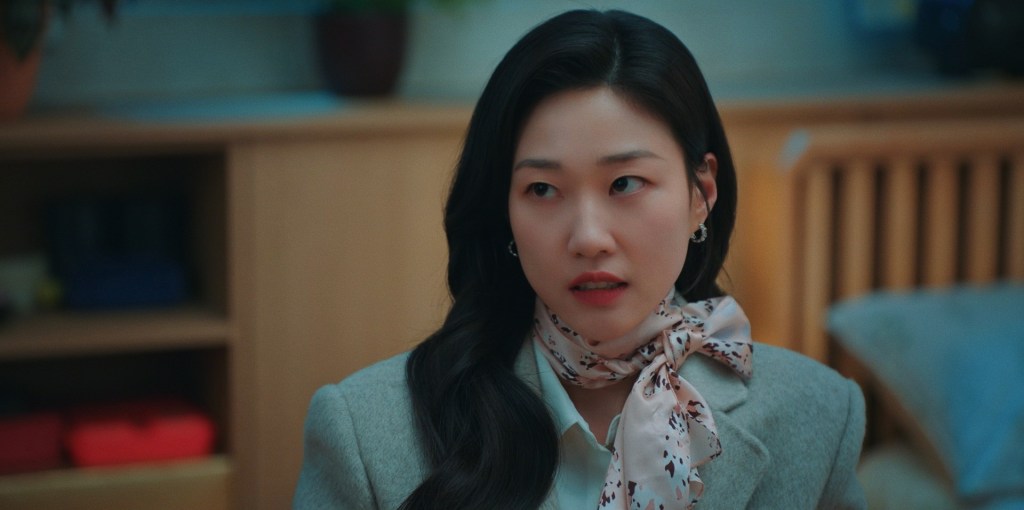
Nora’s arc here is the show’s priorities in micro. When offered three choices, a television show can choose: character over plot, plot over character, or a balance of both (with the fourth option, of course, being neither character or plot). Undercover Miss Hong is a case of plot over character, and it’s refreshing because it’s unusual. There’s a part of me that wishes the show was messier, the way that Hello, My Twenties! was messy, with an unwieldy proportion of character as well as a wide register allowing the hysterics of melodrama. I will concede that, in an alternate universe, there’s a melodramatic version of Undercover Miss Hong and I’m wondering if it could’ve been toned down. This is pretty much what I go to K-dramas for, even if I can’t admit it: come for the comfort, stay for the tragedy. Not to argue that Hong would’ve benefitted from tragedy necessarily – or more tragedy, in some cases – but it was, relatively speaking, emotionally withdrawn. I can count Park Shin-hye’s big dramatic moments on one hand, and they’re both great, but that wasn’t the show she was making. Instead, it’s a show willing to effectively sacrifice character (Nora making a hard choice) in service of suspense, a twist, and fun. As it is, fair trade.
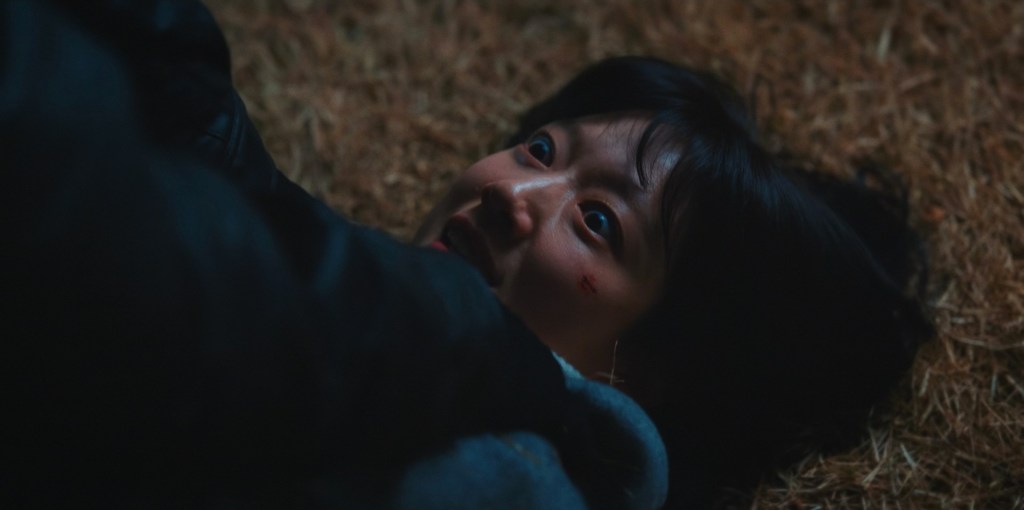
It’s also more disciplined than I’m making it out to be. Bang Jin-mok’s return to the story is a good example, where it’s triumphant and funny and even a little badass. With the threat of Kang, Song, and Dal-su – the last antagonists standing or unconverted – defused by episode’s end, the finale promised a near feature-length epilogue, and I was excited by that prospect. The world that Hong and Hong built was one I wanted to spend time in, free of any action or plot, and I was only guessing at the fates of characters like Albert, who’d seem to be a love interest, and Bok-hee, whose past had finally caught up to her. Still, there are some procedural matters left. Chairman Kang finds himself on trial, and we’re back to where we started in episode one, with Hong laying down the law. Unfortunately, the sighing chairman’s got a few tricks left, including the reveal that Dal-su was also his agent, intercepting Song before she can double-cross him. When Hong faces down with Dal-su one last time to rescue Song, it’s after she learns that he killed her old coworker thought dead by suicide (who’s also her boss Yun Jae-beom’s brother, which I hadn’t put together). Park Shin-hye has the Judge Bit-na crazy eyes when she’s secured her long overdue victory, and Hong spares Song the anonymous death she’d issued to so many Outstanding Women, instead condemning her to a life of remorse, already begun.
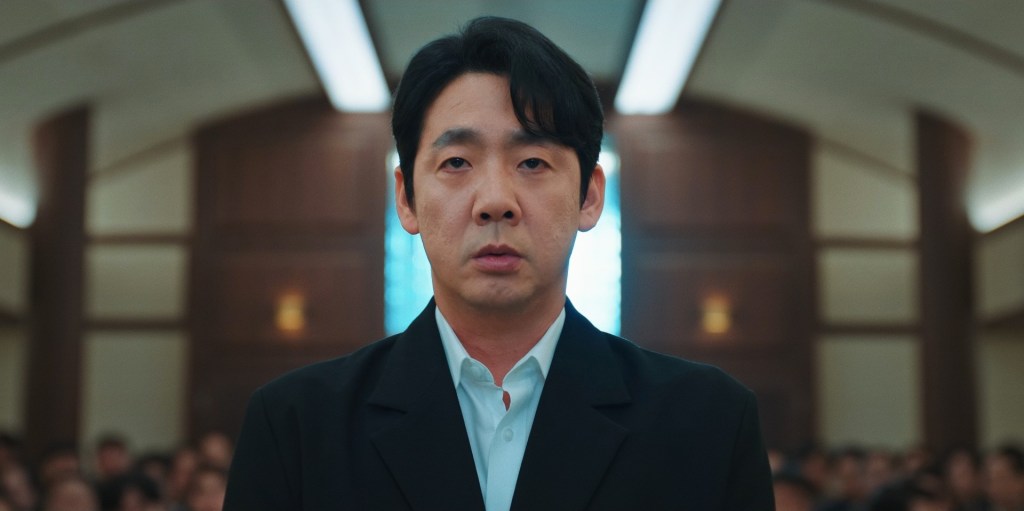
In court, Hong introduces the slush fund ledger, but she won’t divulge the identity of its creator. As she brought the boys in as moral support – Jae-beom, Shin, Albert, and Yong-gi – they all realize they never actually learned the person behind “Yehppee.” And so, the “jerkface prosecutor” calls Jin-mok to the stand, and he makes his grand entrance in slow-motion. I’m sure Hong was steaming to learn that, in fact, there were other copies of the ledger, including one stored in the ceiling of the risk management division, right above her head. They couldn’t have been produced after the Pirate takeover, as the defense charges, because he hasn’t been back in the building since the layoff. Hong notes that this is likely why he was adamant about not returning to Hanmin. The close of this character’s arc, which our protagonist only ended up affecting indirectly, was beautiful.
Infectious, too, as another key figure comes around to Hong’s side, though this was one of those slingshot maneuvers circling a planet’s gravity well: Cha Jung-il. Ahead of the shareholder meeting, he intervenes to help when all seems lost, and unfortunately, Hong is too busy to fully react. It’s with this character that the central fantasy of the show is at its most potent. Jung-il is the one who mistreated Hong-as-underling the most, so he should be trembling upon the arrival of Hong-as-not-underling, like gristle off a Thanksgiving turkey. I’d have loved for the climax of this relationship to be more interactive, given that these two have come to blows in the past. From Jung-il’s perspective, though, the unmasking of “Hong Jang-mi” was staggered and unclear in its implications. An FSS agent has no direct authority over a guy in his position, and while she eventually becomes his boss, it’s only for a moment. And of course, Hong has always been able to countermand and undermine Jung-il, so a repeat performance of his earlier ass-kicking might have seemed vindictive. Might. Now, the FSS guy who took Hong’s place in the beginning? Where was his comeuppance?!
I spoke last time about the show holding back its cards, where it concerned characters. I’m also impressed whenever a story’s follow-through feels like a premise in itself, to the point where it might appear reverse-engineered from “premise B” to “premise A.” I think first to I Am Legend, whose title derives from the scientist protagonist becoming a mythic figure, or legend, to the vampires, and that’s a premise in itself that also requires the premise of the scientist being the last man on Earth, the hook. It’s a similar situation in post-apocalyptic brethren The Last of Us, but I won’t spoil that if you happened to miss the video game, its rerelease, remake, and the TV show’s first season. In the case of Undercover Miss Hong, the idea of stealing a company’s dirty money to steal the company itself is a show on its own, but instead, it’s the verb. In this way, the show itself was in disguise, masquerading as an undercover agent story delighting in dramatic ironies but concealing the heart of a noble thief. There’s thematic consistency throughout both, as Hong is singularly motivated by justice. Initially, that justice was more abstract and vengeful, and ends up being about protecting people and preventing disasters.
Kang, Song, and Dal-su all end up behind bars (as does Bok-hee, but for far less time). This only irks for its echo of The Glory, a show I remember being mean as hell until it started softening ahead of an increasingly not-outrageous climax, wherein our rogue heroine suddenly does everything by the book. I mean, they were heavily suggesting that the cosmetic surgeon boyfriend was gonna disfigure Park Yeon-jin, which would’ve been consistent, at least (Lim Ji-yeon and Lee Do-hyun still going strong, apparently). It’s possible that Undercover Miss Hong is proposing a more radical solution to the ills of the world, that even retributive violence freezes us inside an extremely polarized cycle. But as an American millennial, having watched as the architects of the Iraq War and the 2008 financial crisis and the Jan. 6 attack on the capital went not only unpunished but rewarded, leaving us in endless repetition of those events (elsewhere in the country, the “anti-vaxx” “movement” has successfully made measles threatening again), it’s unconstructive discourse, let’s say. Satisfying in dramatic terms, for sure, but I’m left with nothing to think about in the aftermath. No open questions; I’ve even forgotten about the IMF Crisis. Everything seemed to work out!
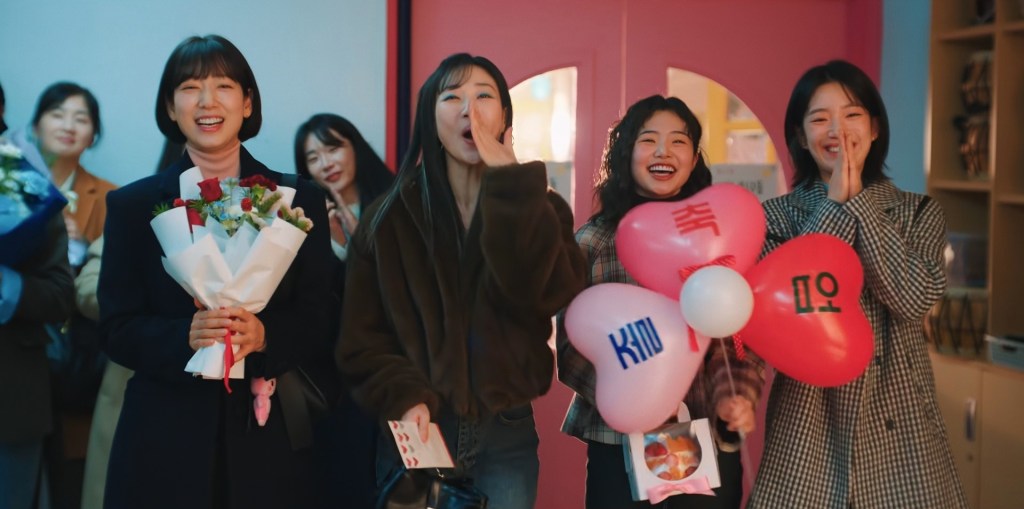
It’s tempting to complain that the good guys won and the bad guys lost, but I have to remember that it was never a straight line to such an end. Characters like Jung-il and In-ja were grey throughout, however obvious it is in retrospect they were destined for good turns. And ultimately, those cases were satisfying. Nora deserves a good mother, and though the arc was subtle, that’s what In-ja had become (or at least, an attentive one). The show’s ending is borderline pat, but I can go with “comprehensive.” Either way, it’s a luxury not typically afforded television shows. And like Jung-il, maybe I have to use my heart rather than my head. If it’s any indication of where my heart is, I’m consuming as much behind-the-scenes material as I can find. Even if Undercover Miss Hong hasn’t left me anything to chew on, it’s left me, and I am now empty, broken, a husk of my former, vibrant self.
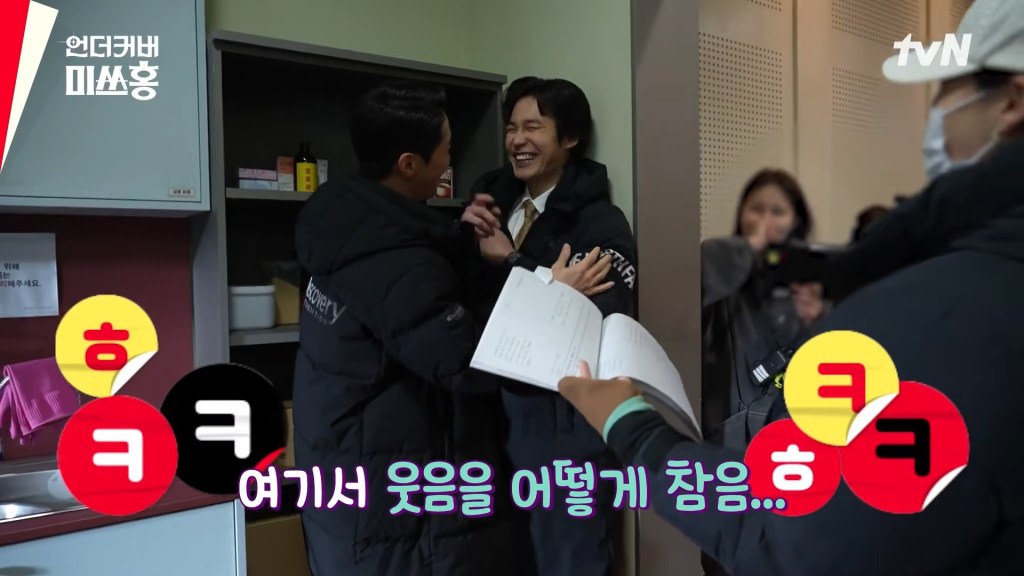
In these behind-the-scenes videos, you can see the actors wearing winter coats between takes. They might be on sets representing office interiors, but those interiors are built inside warehouses with insufficient or nonexistent heating. Boy, that takes me back to film school.
Seriously, though, I can’t believe she didn’t beat that guy up.
 With Eyes East