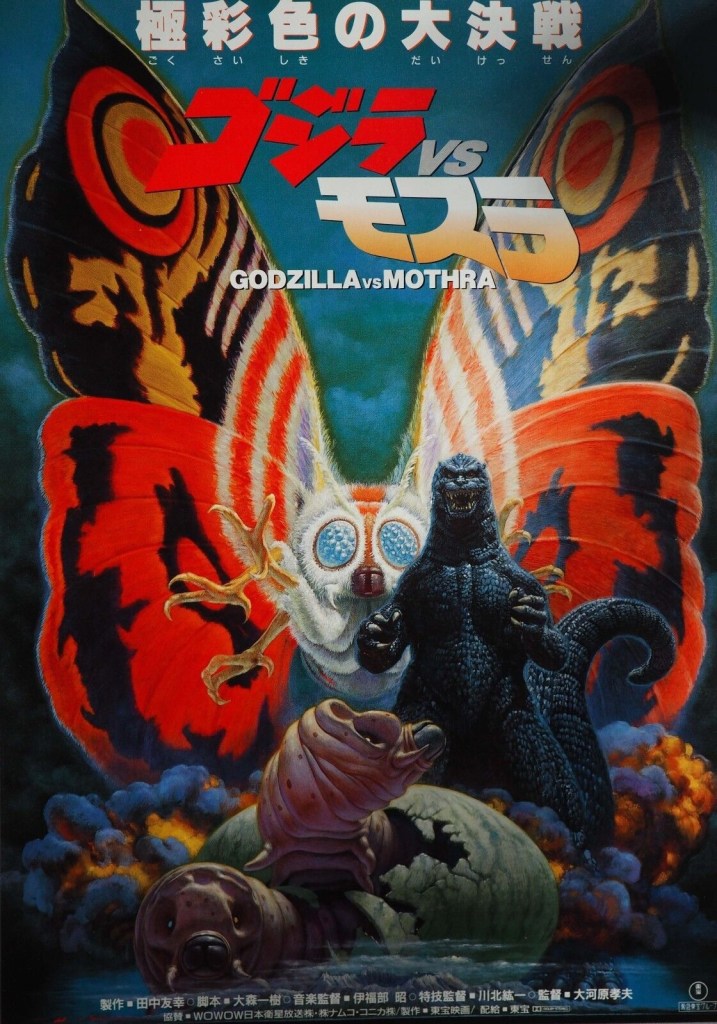

Directed by Takao Okawara
Starring Tetsuya Bessho, Satomi Kobayashi, Megumi Odaka
“The Earth is punishing us for our arrogance!”
This one is so close. It just needed a little more time in the oven. All the pieces are here, and they mostly fit together, but there’s something missing. Maybe an oomph? Maybe it’s the pieces themselves, each of them chipped in some unique way. Take the characters, for example. I know, this isn’t the place to start with Godzilla movies, but that would make Godzilla movies the sole exception. Our protagonist this time, arguably, is Takuya Fujito, an archaeology professor who steals artifacts from tombs. After he’s thrown in jail, he’s visited by government men who want him and the feisty Masako to investigate a meteor on Infant Island. Apparently, this island is in Indonesian territory, making it off-limits to Japan, like an echo of the original Godzilla’s production. Okay, so Takuya is a man of action, unlike the sci-fi writers and journalists of Heisei movies past. He has more immediate personality, but one nevertheless expressed by whining through the bars of his jail cell. Not super appealing.
He’s also, if you were wondering, Indiana Jones. He has the hat, and this movie was a few months before the Japanese release of Jurassic Park, which updated the jungle adventure from its roots in, say, King Solomon’s Mines. For now, we have golden idols and rickety bridges. And comedy? Apart from a few MPAA headaches, Indiana Jones is mostly a family-friendly ordeal, so accordingly, Godzilla and Mothra acquits itself with a couple of conspicuous jokes. After the bridge breaks and Takuya, Masako, and a company man named Ando fall into the river, Takuya realizes that it would’ve been easier to simply follow the river and obviate this dangerous route altogether. Masako and Ando pop into frame and dump water out of their shoes as the punchline. Come on, guys. And look, I realize childish humor isn’t something to criticize, doing so might suggest I jump at threats to some sort of idealized “dark” Godzilla, but in this case, I do think it comes at the cost of actual characterization.
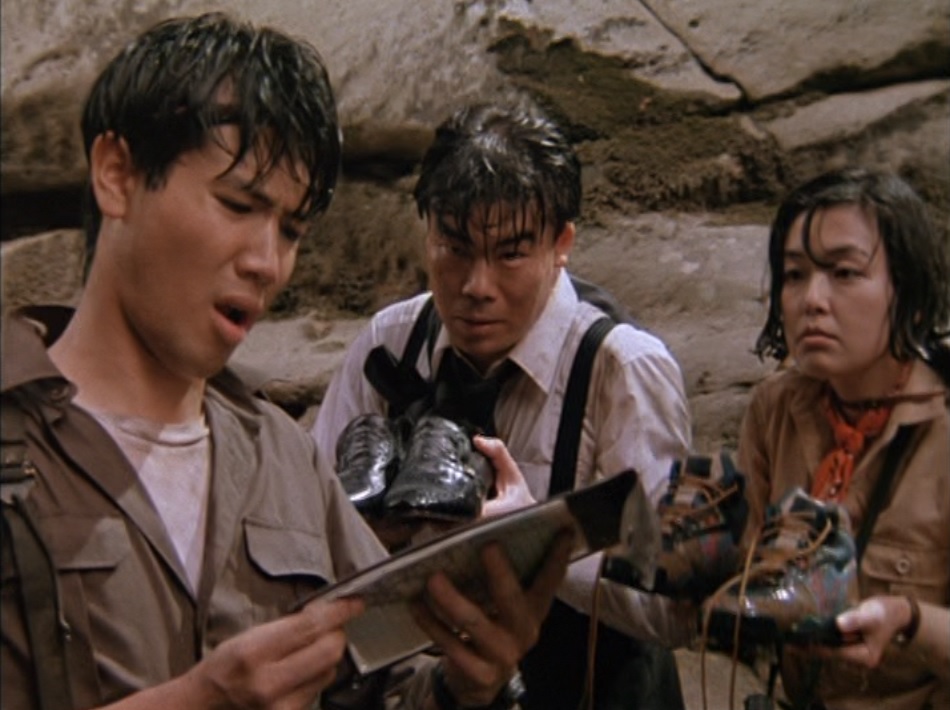
Eventually, Takuya and Masako, and this Ando guy, who has “red shirt” written all over him, discover a cavern with cave paintings of Mothra, and suddenly I remember that this is where the movie Prometheus begins. I don’t know if Godzilla and Mothra needed fewer scenes of setup or Prometheus needed more, but we still haven’t landed regardless. We should know our characters enough that this is an actual moment of discovery, that there’s some awe. But what awe-strikes these people? What do they care about? Aside from not falling in a river? The film’s character issue is also a problem of exposition, indicated early on. See, Takuya and Masako are a divorced couple, and there’s a scene where other characters discuss the complications they might face, as they definitely have lingering feelings. Why isn’t this expressed with the actual characters in question? It could be a look, or an awkward silence after some bickering. Let us figure out that the feelings linger.
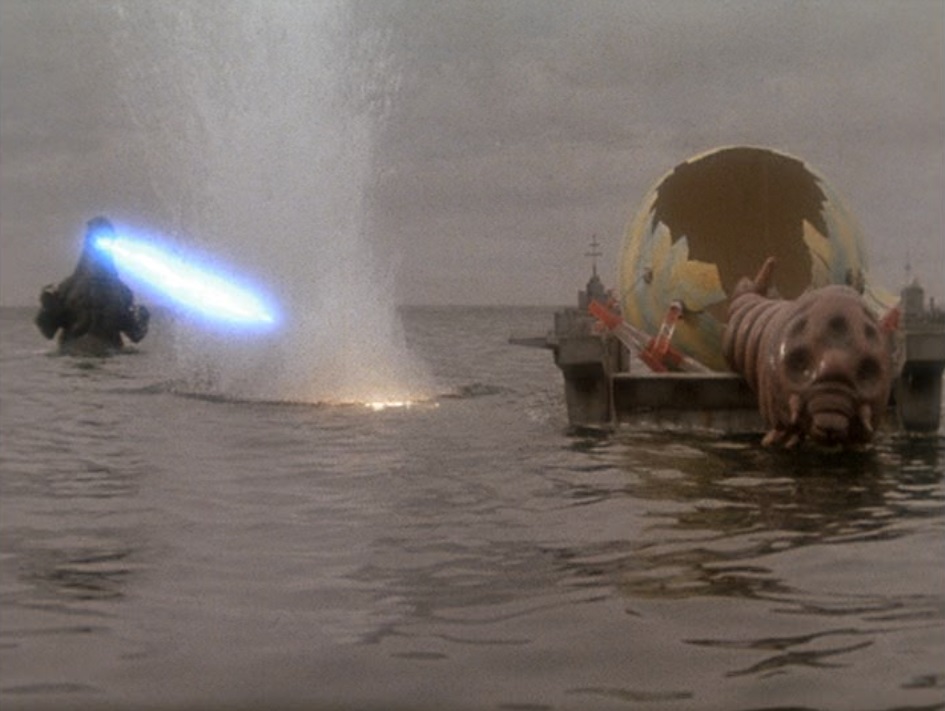
This approach becomes more of a problem when the narrative comes to a head. After discovering a massive egg on Infant Island, the kind that The Cheat comes out of, they somehow manage to put it on a military tugboat bound for Japan. Godzilla attacks, and Takuya decides to dump the egg to preserve the ship. Ando intervenes. Up until now, I kind of liked Ando. First seeing the egg, he asks if it’s a dinosaur’s, because that’s a natural question in this world, and what a world to live in. But now, I really like him, because he might just be the most complicated character in a Heisei movie yet. He belongs to the Marutomo company, and he’s tasked with bringing the egg back for, you know, publicity or something. I don’t know. I think Marutomo is a land developer, but everyone needs an egg in these trying times. As a devoted salaryman, he’s forced to stop Takuya by any means necessary, and they fight. This is another dramatic payoff lacking the proper setup. In order for me to care about this betrayal, I need to have cared about their friendship, burgeoning amidst jungle crisis, yes? (As a note, “payoff” isn’t exactly the right word, but it’s a plot beat that should elicit some emotion.)
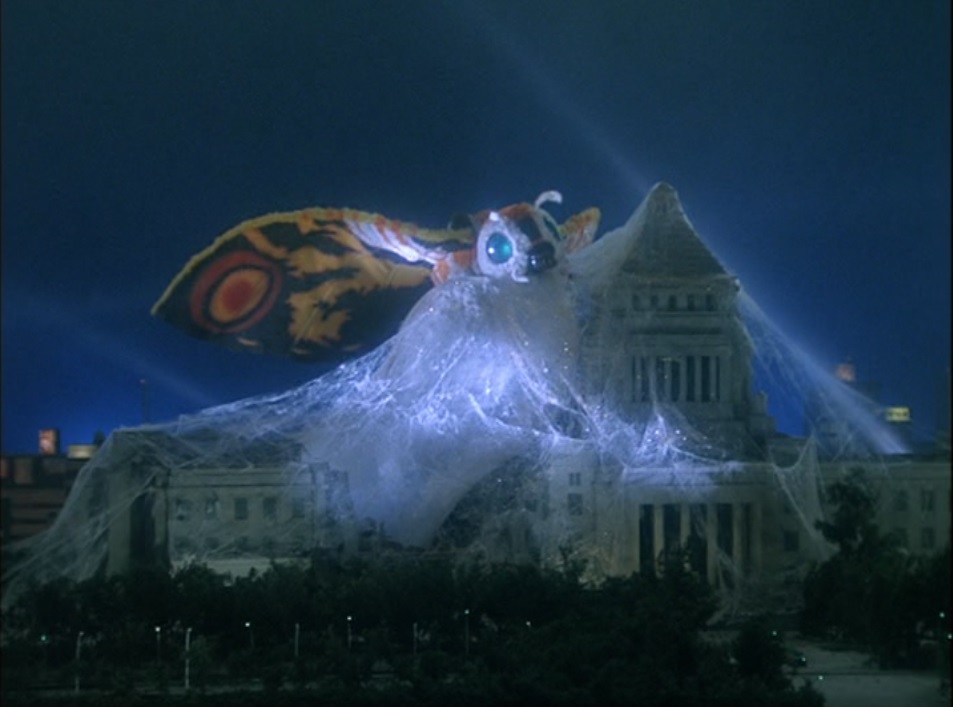
Godzilla blasts the egg, and a Mothra larva pops out. A new monster also joins the sea battle, the massive Battra larva, who’s an evil version of Mothra. According to the Cosmos – the two fairies who sang to Mothra in the 1960s – Battra was created by the Earth itself to stop an ancient civilization from altering the climate. After he got overzealous in his civilization destruction – I mean, what’s left to destroy after that? – Mothra comes in to kick his ass. Now it looks like the cycle is repeating. Instead of climate change, however, modern mankind has given birth to Godzilla, occupying a far more thematic role than in the previous film. Check! But also, climate change, and this movie lays it on pretty thick. People are constantly talking about how we’ve screwed up the atmosphere and the Earth is angry and what do we do now? It might be too much for a jaded adult living through the actual climate apocalypse this movie predicted.
And then Mothra cuts through the blockade at Tokyo Bay as the Cosmos sing to her from their erstwhile prison/handbag as Akira Ifikube’s unbelievable score plays, and I think, “Yeah, maybe we deserve it.” That’s what Mothra brings to the table: sympathy for the monster, and that requires a human foil. In this case, Masako returns home and reunites with her daughter Midori – the rare female Kenny, or Keñorita, perhaps – and Takuya sneaks out of the airport. He can’t face the child who doesn’t know he’s actually a thief. Then we cut to another one of those English-speaking scenes, where Takuya is selling the Cosmos to a shady American wearing sunglasses indoors for one million dollars. The American’s response: “Come on!” Strangely, we never saw Takuya steal the Cosmos, only that Ando had stolen and subsequently misplaced them. Why has Takuya fallen victim to the same corporate greed? This is the difference between exposition and character.
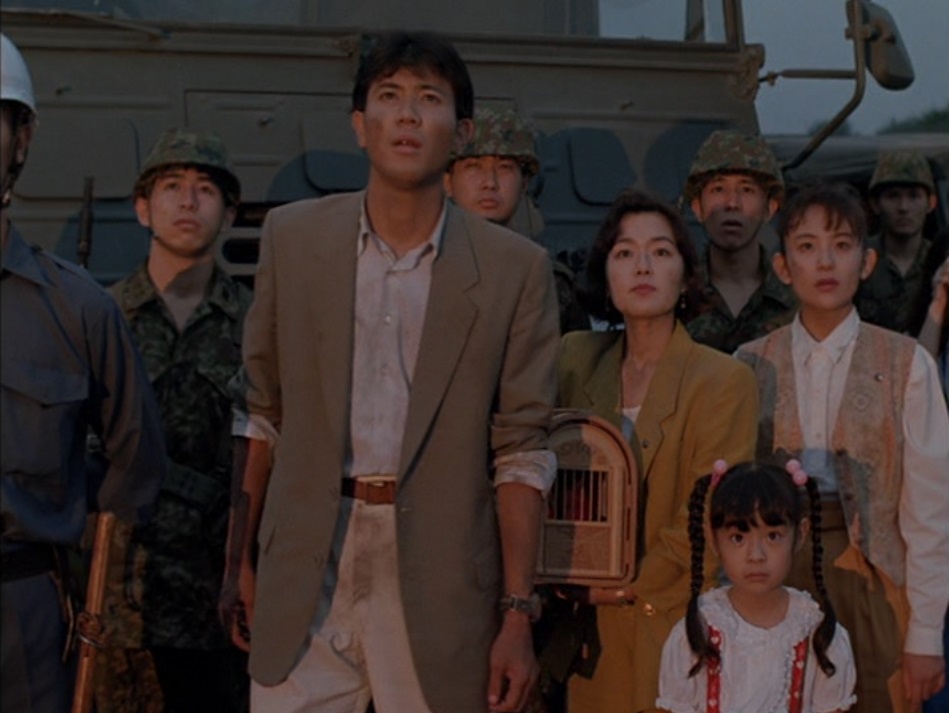
Returning favorite Miki Saegusa meets up with Masako and Midori, and together they track down Takuya. Turns out, Midori knew all along that her dad was a scumbag, but at least he can make the right decision now and return the Cosmos to Mothra. By this point, Ando has also turned around, but both arcs of redemption are more immediately motivated by the impending destruction of Japan. The flipside of this thematic framework is “Why is humanity worth saving,” right? Learning that Mount Fuji is about to erupt, members of the National Environment Planning Bureau drive out and find an unconscious woman and her daughter on the roadside, and they pick them up. This is ideal, to imbue heroism with thematic purpose. Why, then, and again, wasn’t it the actual heroes doing this? Why is it always somebody else?
When Takuya has his descent, we shift to Masako as the protagonist, and really, it should be Ando. He’s got the clearest arc, and he drives the early action. Unfortunately, by the time of the final battle, none of these characters have much to do anyway. The government in their weirdly rotate-able Situation Room is only here as the hosts of Korean reality TV, watching the program and giving color commentary. So Godzilla, Mothra, and Battra, the insect-types in their final forms, converge on a carnival (possibly sponsored by Namco), and the military sends in dual-maser planes, which sound like TIE Fighters for some reason. Also, Battra makes Rodan noises, and in one instance, Mothra sounds like Anguirus. What’s that about? It’s actually kind of important how they talk, because at one point, Mothra sits down with Battra for a chat. It’s not subtitled, like in Godzilla vs. Gigan, so it’s more like Sollozzo telling McClusky, “I’m gonna speak Italian to Mike.”

Now, the Heisei movies are pretty notorious for their monster battles, which are mostly laser beams going back and forth. With flying monsters, that’s almost a guarantee, and there’s even a monster dogfight in this one between Mothra and Battra. But after they decide to team up, Godzilla saunters over and Mothra goes straight for the headbutt. That’s awesome. Unfortunately, at the same time, being awesome feels like a bug here, no pun intended. In terms of cinematic technique, Godzilla and Mothra is plain, functional. Everything feels so matter-of-fact. When Mothra emerges out of her cocoon, she unfurls those massive wings, and it looks like, well, a Mothra puppet unfurling its wings. There’s no punch-in, no sense of weight or majesty. It’s a beautiful scene despite the presence of the kaiju, with the score doing a lot of the heavy lifting. Seriously, the score in this movie is godly. But Godzilla elements at war is pretty common. What does Indiana Jones have to do with Godzilla? Aside from doomsday weapons and the violation of ancient, sacred spaces? Hmm. I guess that’s what that puzzle piece should’ve looked like.
For More on the Heisei Era:
The Return of Godzilla
Godzilla vs. Biollante
Godzilla vs. King Ghidorah
Godzilla and Mothra: The Battle for Earth
Godzilla vs. Mechagodzilla II
Godzilla vs. SpaceGodzilla
Godzilla vs. Destoroyah
 With Eyes East