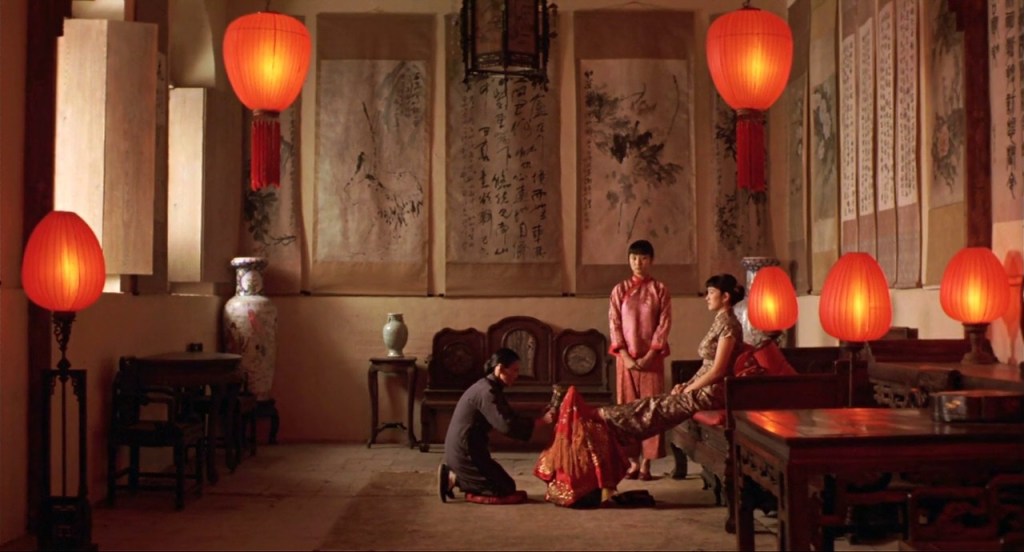

Directed by Zhang Yimou
Starring Gong Li, He Saifei, Kong Lin
All of the great films I’ve seen this year – John Wick: Chapter 4, Dragon Inn, Ran – left me thrilled or excited or breathless but intact. It’s been a long time that I’ve been this shaken by a movie. The credits rolled and the Blu-ray disc whirred inside the PS4 and I clicked around for a bit, first on the trailer by accident and then on an interview with film historian Tony Raynes. I had no idea what he was saying. I just sat there, responded to a couple of texts, and realized that as much as I’d been planning on writing a review for Raise the Red Lantern – this site would be incomplete without it! – doing so would mean lingering in that head space, and returning to that world.
We open on a kind of figurative establishing shot, one careful not to show us where we are, and that therefore has an instructional quality: we’re straight-on with our heroine Songlian, played by Gong Li in one of her defining roles. She is our world. As she speaks, surrendering to the machinations of an off-screen stepmother, tears roll down an otherwise still face. She’s being married off to a wealthy man, and is fully aware of the terrible implications. At least, she knows what will happen, but not why or how.

What follows is a portrait of what must be the last days of an ancient custom, as Songlian becomes a fourth wife – or concubine – more so marrying a family tradition than a man. In fact, the man is always kept at the edge of the frame, or in the distance. His interactions with the four wives is surprising, as he gives in to their demands and his anger doesn’t carry the threat of physical violence. When Songlian first arrives at the palace, accessed by an almost comical series of gates and alleys, of course she’s nervous and frightened, but then something strange happens. She walks over to a young maid washing clothes, Yan’er, who asks if she is indeed the fourth wife. Songlian confirms it, and after Yan’er reacts with disappointment, Songlian orders her to carry her suitcase inside. For the first time in her life, she’s found herself in a place where she has power.
Of course, it’s only the illusion of power, just as the gates and alleys and buildings create the illusion of a town. Songlian might be important in this world, but it’s a world nested within the real one. We zoom all the way in on the microscope to behold it, and that’s where we unlock the film’s hidden complexities. Songlian enters a story in the midst of unfolding, with long-simmering plots and betrayals and bad decisions nevertheless understood. Our sympathies begin to split, and then recalculate. One wife’s jealous antics are revealed as a kind of orientation program, while another’s comforting smile turns icy and cruel. As a result, Raise the Red Lantern features the most suspenseful haircut I’ve ever seen, Eastern Promises included – though technically, that was a shave.

It’s a testament to Zhang Yimou’s renowned filmmaking that he has us almost forget the big picture. Songlian’s goal isn’t to escape her new life as a sex slave, but to beat the other women at their stupid game, warring for the husband’s attention. As time goes on, the game seems less and less stupid. Another wife will do something underhanded to screw over Songlian, and suddenly we want Songlian to get the husband into bed as a riposte. It’s just a way of life, after all, and an old one. Who are we to judge? Now, this isn’t a “seduction” of the viewer, nor a contextualization project common to today’s media. I don’t know what to call it, but it’s easy to see how it works. Beat by beat, we’re drawn into this cold, quiet world, and the process is less dependent on dialogue than it is patterns and rhythm and faces. The lanterns go up, we know what that means. The lanterns come down, we know what that means – because we know what it means to the wives watching from their doors.
It’s just like how Yimou’s The Road Home is so effective at making me cry that I start tearing up even before hitting play. It’s the title – what it means and what it means to that film’s heroine. With Raise the Red Lantern, the director is using his considerable powers of persuasion to instead destroy. We close on a very simple, even predictable story resolution, but its final two notes are a breaking of the pattern, and they land with tremendous violence. It isn’t a title card dictating a basic moral lesson, it’s a hollowing out. Without showing anything graphic, the film still disturbs so profoundly because all the illusions of the architecture and the hinted-at lives are half-formed pictures for mental completion. The ideas burrow deeply and come to rest, and while it’s better to know these things, this is a great film I don’t want to remember. It’s like a nightmare.
 With Eyes East