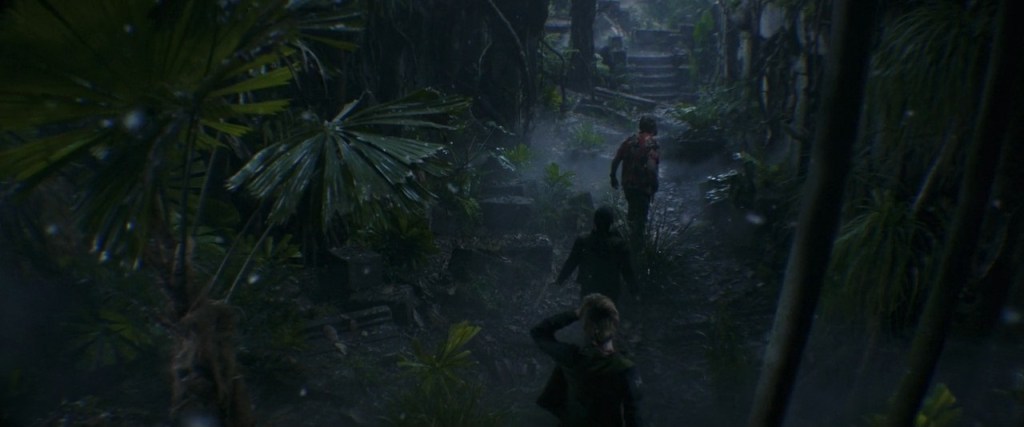
This post is technically pronounced: “Those American Godzilla Movies Marks the Spot”
It’s almost fascinating, the experience of being a fan of something but not at the moment. I don’t even know how to describe it. I’m a Godzilla fan, but his American movies have done me nothing but harm. In keeping tabs on the Japanese side, I’m inundated by news and updates about the Legendary MonsterVerse. How do I explain it to my poor mother, who asks me, “Are you gonna see that?” in response to a TV spot for Godzilla X Kong: The New Empire, and I bark, “No!” Almost fascinating, and this time, more than usual, because the marketing on-ramp for 2024’s entry coincided with the tsunami aftermath of Godzilla Minus One. The Japanese film was hailed for its sensitivity toward character, its faculty for drama, and of course, its efficient but convincing visual effects. Comparisons were drawn to the original 1954 Godzilla; it was that authentic. What, then, did that make The New Empire, whose trailer debuted two days later?
Look no further than the trailer itself, which is like a greatest hits album of, you know, a really disappointing band. King Kong – or “Kong,” excuse me – wields a Nintendo Power Glove, Brian Tyree Henry says “Is that a Mini-Kong?!” and of course, there’s the infamous shot of Godzilla running alongside Kong, which sparked a bit of soul-searching within the fanbase. “Has ‘Godzilla Minus One’ already ruined ‘Godzilla X Kong: The New Empire’?” was a real post on Reddit only anticipating future criticism as summed up by headlines like Time’s “Godzilla x Kong Shows Godzilla Is Doomed to Turn Dumb” and Variety’s “‘Godzilla x Kong’ Review: Godzilla Minus One Thing.” (A note that editors, not writers, come up with the titles). From a marketing perspective at MonsterVerse HQ, you either give up and go home or lean into it, and we know this is one series that will not quit. With Godzilla Minus One being smart and austere, this is the story of how Godzilla X Kong became “dumb and fun.” And don’t take my word for it!
Ahead of the film’s release, the IMAX YouTube channel uploaded a conversation between Godzilla Minus One director Takashi Yamazaki and Godzilla X Kong director Adam Wingard.
WINGARD: I think Godzilla’s been so popular over the years because, I mean, you can just take Godzilla Minus One and, you know, my film, Godzilla x Kong: The New Empire, and these two films couldn’t be more tonally different from each other. I think that’s what’s so cool about Godzilla is that, you know, metaphorically, tonally, he’s just very versatile in terms of, you know, what he can mean and represent in the movies.
YAMAZAKI (translated): It mirrors the social climate of the era each film was made, which I believe, um, is the biggest reason why Godzilla could maintain its popularity for such a long time. “I want to see the terrifying, strong Godzilla,” is where I started. I couldn’t help but take that direction when making it. However, the fun and psychedelic Godzilla from the Showa Era that you are saying, is also an important element of Godzilla. Because you, Adam, have inherited that side of this character, we can take the totally opposite direction, and together, we are maintaining the wide spectrum of this Godzilla IP, even now.
What really gets me is they’re not even speaking in front of a live audience. These two guys are just set up in a darkened studio, facing each other. There’s nothing natural-seeming about the origin of this line of thought – despite its eventual success. The New Empire, whose MonsterVerse was already trending in this direction regardless of Minus One, was suddenly easier to accept, for the fans and the filmmakers alike. I mean, I started to see this language echoed everywhere. On YouTube comments, on Reddit.
Well, almost everywhere.

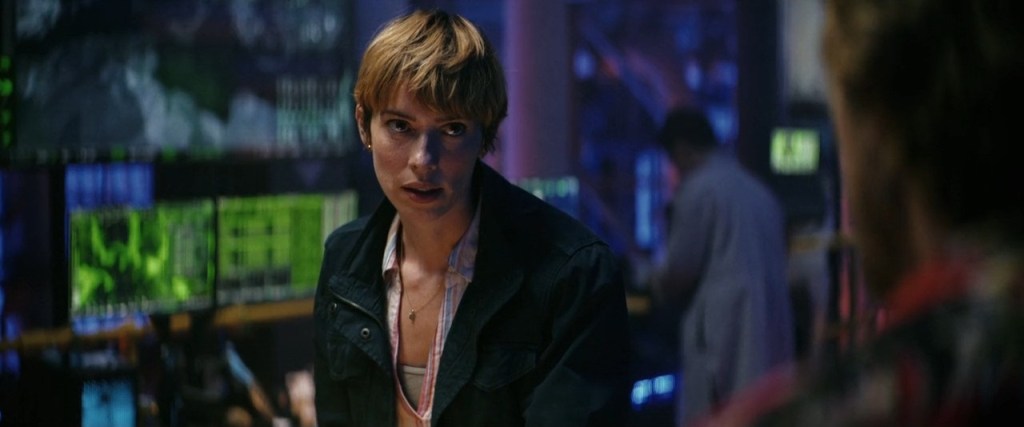
We remember from the last time we spoke about this that the actress Rebecca Hall likened her character, Ilene Andrews, to Jane Goodall, as if she were trying to elevate the material. Sigourney Weaver won an Oscar for playing Dian Fossey, after all, costarring with apes. Hall’s approach is a little bit different now:
“I mean, it’s-it’s movies, isn’t it? It’s like, it’s pure popcorn, larger-than-life delight. It’s like, it’s sort of everything that you– you know, when you dream about wanting to take part in movies as a kid, you want to be in one of these.” (ABC News)
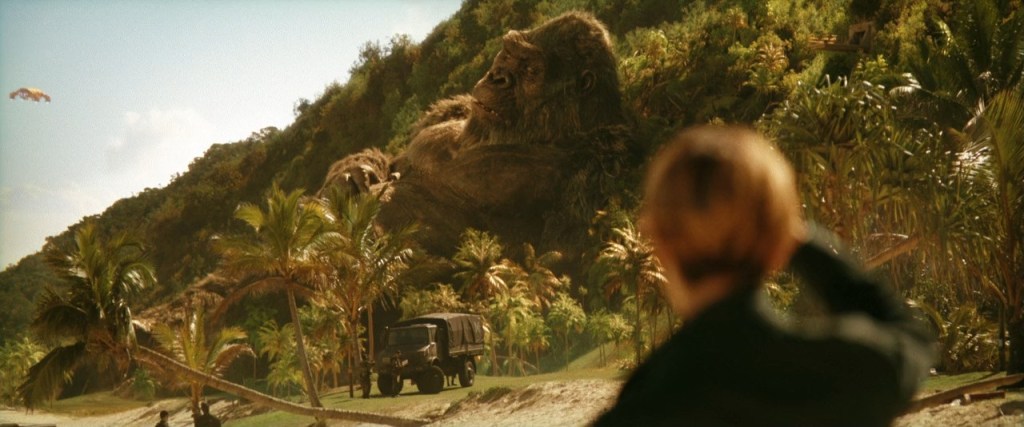
This strikes me as the more diplomatic version of the approach widely adopted by the audience, and perhaps it’s the one that an accomplished, serious actress and filmmaker like Rebecca Hall can live with, starring in a stupid movie that was retroactively made to be stupid on purpose. (At that point, it’s locked in).
At the risk of sounding like a contrarian for the sake of it – I hate these movies because they turn me into the worst version of myself – Godzilla X Kong: The New Empire is the best American Godzilla film. It’s the only one that feels both genuine and thoughtful in construction. It is, in stark contrast to its predecessors (barring Kong: Skull Island), the merciful achievement of cliché. So much of the MonsterVerse previous was pockmarked by the absence of things – character arcs, drama, theme – and so while the details of The New Empire are basic, they are undeniably complete. When Kong encounters the Mini-Kong, they start out enemies but become friends by the end. That’s a cliché, but without it, you get that trademark sort of meandering nothingness – you get Ford Brody.
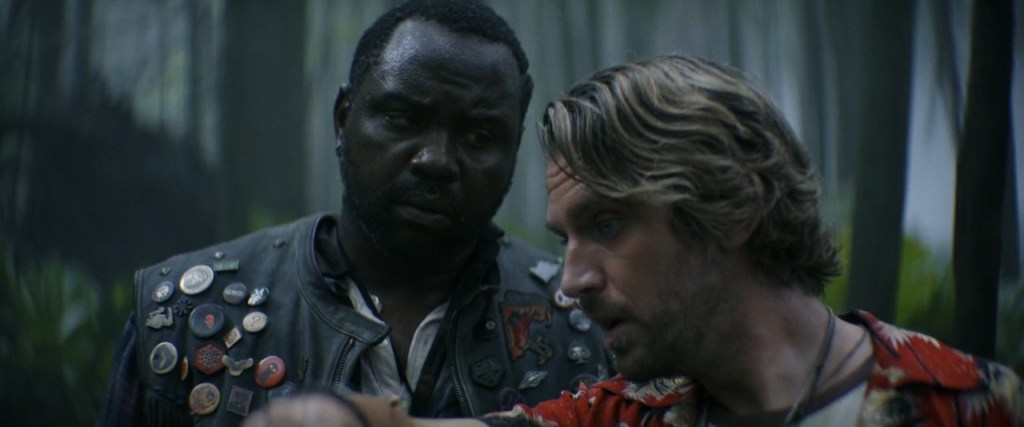
Most rewarding is the relationship between the human characters. One of the big advantages here is the focus on a small handful as opposed to the unwieldy ensembles of Godzilla: King of the Monsters and Godzilla vs. Kong. In fact, the four primaries can be further subdivided: we have the returning Bernie, who pairs well comedically with the new character simply named “Trapper,” and then there’s Dr. Andrews and her adopted daughter Jia, of the apes. Crucially, they spend a lot of time together, allowing the relationship dynamics to develop and be expressed. This discipline, I suspect, comes from a screenwriting staff change, most notably the introduction of Wingard’s creative partner Simon Barrett. If you don’t remember, he’s the one who got his face bashed in by Erin in You’re Next.
It’s also the simplicity that comes from the commitment to a single genre, in this case, the lost world adventure. Andrews and the gang explore the Hollow Earth and uncover an ancient mystery; it’s a classic, scientists in the jungle. This novelty of identity-certainty allows a measure of aesthetic coherence, reaching back to the original King Kong. At least, for the most part. And it’s “simplicity” rather than “stupidity” in part because it’s earned. This is a sequel, and there’s been enough established about Andrews and Jia, and even Bernie, that we’re skipping a lot of the exposition that weighed down the earlier movies. In essence, the MonsterVerse has now gone on long enough that it’s finally gotten to the good part. The New Empire feels like a movie. King of the Monsters and Godzilla vs. Kong are difficult to describe in genre terms, as they took such great pains to establish things like Monarch and the monster hierarchy, none of which felt especially purposeful – until now.

And so, Andrews is part of yet another nebulous organization called Monarch, and when there’s a monster-related crisis, she assembles a team to solve it. She exists in a world now building the apparatus to manage giant monsters, and – hey, stop right there, that’s it, that’s perfect. It may not seem like much, but it’s something that a similar series, say, the Heisei Godzilla movies, never managed to put together. Miki Saegusa never said, “Okay, team, let’s go to Birth Island and kick some ass!” She was always caught up in whatever plot for whichever movie, and it always required so much setup, not to mention reset. There is a Miki Saegusa character arc, but you have to squint.
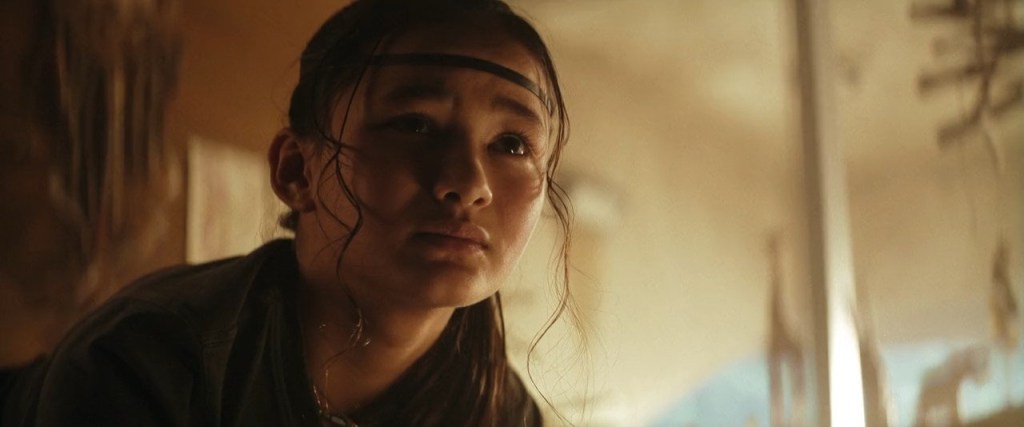
On the other hand, I may be a sucker for adoptee stories, but the scenes between Andrews and Jia are surprisingly touching. This is another major advantage of The New Empire, that Rebecca Hall is playing the lead this time, and she’s infinitely more interesting than Ford and Nathan Lind and even Tom Hiddleston’s character in Kong: Skull Island. I mean, Hiddleston was probably fine, but I don’t remember anything about him, other than he cuts a pterodactyl in half with a samurai sword. That’s why that movie is still the franchise best. Dr. Andrews wonders if Jia, who feels out of place, will ultimately return to her own people, the Iwi tribe in the Hollow Earth. Again, that’s basic and familiar, but it’s played by Hall as tenderness squeezed between harried crisis management and with kaiju-sized alienation by the young Jia actress Kaylee Hottle.
Being a proper sequel also means invention – within the parameters left intact in the absence of a reset – as opposed to coasting on the momentum of an alleged cinematic universe. In Godzilla vs. Kong, it was the fated meeting of the titular monsters and very little else, basically the same story formula as AVP: Alien vs. Predator and Batman v. Superman: Dawn of Justice. Holy crap, at least Godzilla vs. Kong didn’t have some stupid acronym or a subtitle. And because I don’t like the MonsterVerse Godzilla, or King Kong generally, their fight could’ve only worked for me with sufficient narrative build-up. In The New Empire, that’s exactly what we get. Kong encounters a threat too big to handle on his own, so he seeks out Godzilla, who’s got that hierarchy thing, making him fiercely, even comically territorial. The resulting fight scene is far more interesting than the previous few. It’s even kind of fun.
Still, I’m not super sold on MonsterVerse action. Rendered entirely with CGI, the fight scenes lack the traditional tokusatsu feel, and because it’s giant monsters, they forgo the immediacy that animation affords, as seen in the viciousness of the Jurassic World creatures. Theoretically, then, the “giant” aspect should grant us spectacle or a sense of majesty, but The New Empire eschews scale entirely in at least one instance with a literally zero-gravity fight scene taking us into the climax. The final battle moves to Rio de Janeiro, with Kong and the Skar King swinging around on buildings, their attacks intercepted by tail swipes intercut with composites of fleeing crowds. It’s dynamic, and with enough stuff in the environment that every impact registers with an exploding cityscape. I don’t know, though, I think it’s just a million little things. The creature designs, the arbitrary setting, the complexity of the choreography – with its moves-per-minute.
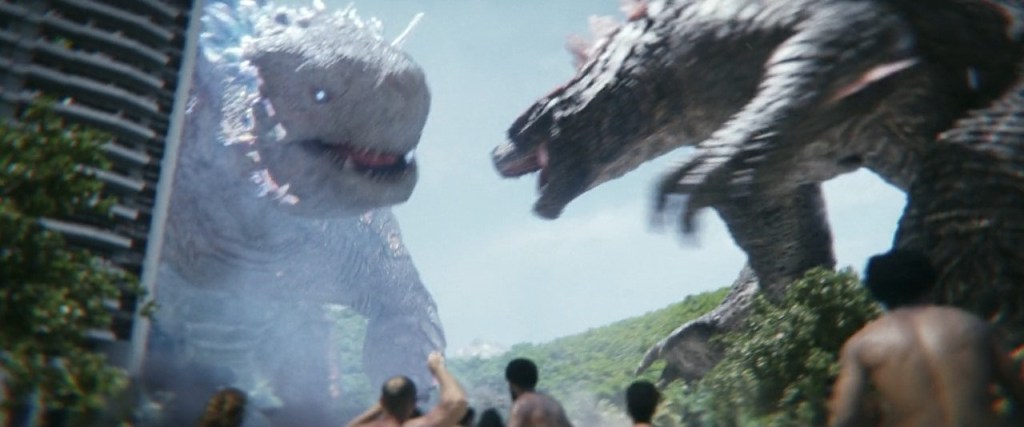
It’s my own unresolved attitude toward giant monster action as well as, perhaps, the final problem with the film. Godzilla x Kong reaches the ceiling of the Legendary MonsterVerse, and suddenly, the ceiling is visible. For all its subversion of the usual flaws, The New Empire remains an undeniable piece of the greater, profane whole; it can’t pay off what hasn’t previously been set up. For example, I think it’s smart that the story’s tone bends toward “light adventure,” following logically from the premise, but it’s then strange to see Jia in a classroom setting, where her internal conflict is expressed as a struggle with everyday mundanity. Like, these characters don’t go to school. They don’t exist in spaces we the audience are familiar with. They don’t live real lives.
And so, by the end of Godzilla x Kong: The New Empire, I’ll admit that I was pretty exhausted. There’s been enough experimentation that they’ve finally ironed out the formula, but it’s not a formula that excites me anymore, speaking to the entire genre. It’s “monsters,” and then the “human stuff” is secondary, no matter how carefully rendered. This is the real shadow of Godzilla Minus One, which handsomely argued that the monsters and the human stuff could entwine to mutual beneficence. Because, ultimately, what does Jia’s heartwarming choice to remain as Andrews’s daughter have to do with Godzilla and Kong overcoming the Skar King? They’re just two things that happen in the same movie.
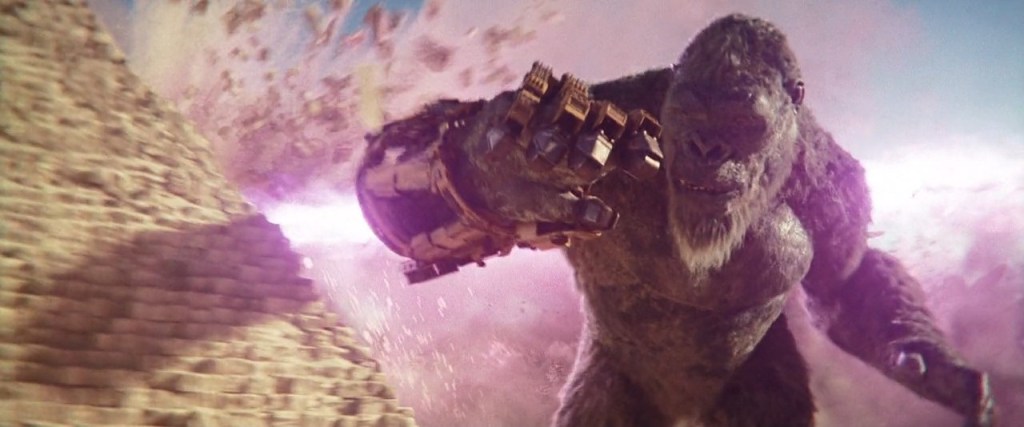
Clearly, we can see that this doctrinal approach of cleaving “monster” from “human” isn’t as inspired as the creative decisions behind Godzilla Minus One. In fact, it’s an ancient, inelegant solution to the very problem of the monster movie itself. In another cinematic universe, a heightened world like that of Godzilla and Kong’s, with heightened characters like Trapper and Bernie, could potentially elicit a response in the audience consistent with its, well, height. I may find the relationship between Andrews and Jia affecting, but it doesn’t belong. It’s the best of a bad situation, and The New Empire is, I want to emphasize, the best. To be more like Minus One, however, doesn’t mean to be dramatic or “not dumb” necessarily, but to identify and cultivate the emotions inherent to the story being told.
When Trapper is extracting Kong’s tooth, what is he feeling? It may be “dumb,” but so is a policeman keeping a public bus from dropping below 50 miles an hour or else it’ll explode. Is there tension in the tooth extraction? Why is it just something that happens and not a set piece with an obstacle and a triumph? Rebecca Hall is starring in a movie that’s supposed to be fun. Maybe if she got to do her character’s equivalent of chopping a pterodactyl in half, it wouldn’t just be “one of those” blockbusters that you got to do at least once – or in her case, twice, this time with a bad hairdo.
Sorry, Rebecca.
 With Eyes East