Written by Shin Ha-eun
Directed by Yoo Je-won
Broadcast from 17 August 2024 – 6 October 2024
Episodes 1-7
“You can never go home again,” according to so many movies and TV shows. Within its first half at least, the K-drama Love Next Door asks the other, rarer question: “But what if you could?” Our heroine is Bae Seok-ryu, a Korean who’s been living and working in the U.S. for the last ten years, homebound after leaving her big tech job and even a fiancé. Her mother Na Mi-sook has a habit of bragging to her friends about Seok-ryu’s grand successes overseas, if only to match her frenemy Seo Hye-sook’s equally aggressive bragging about her son Choi Seung-hyo, an award-winning architect and co-CEO of a new firm. This is the world waiting for our heroine when she lands in Korea, and it’s a world of hurt – literally. Finally breaking the news to her mother, Seok-ryu is beaten, though she expected nothing less.
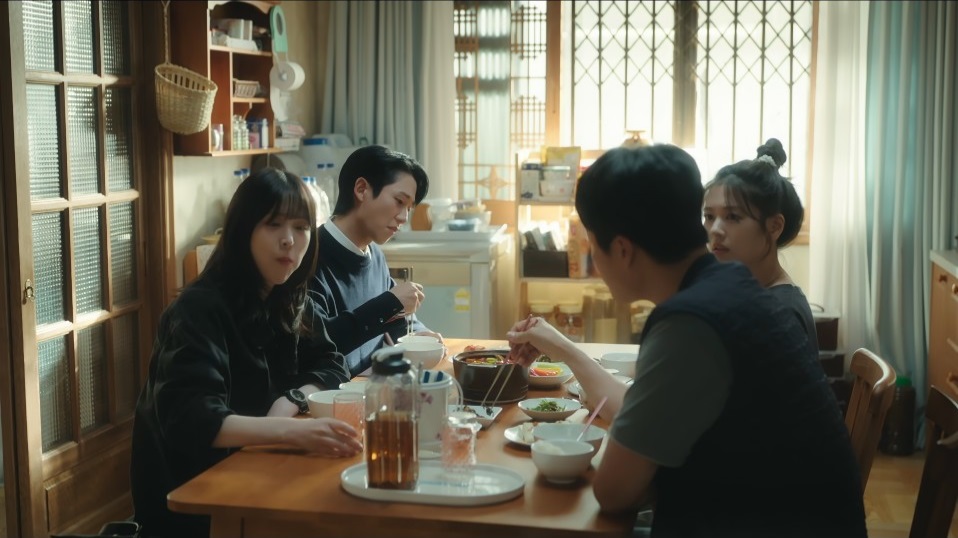
Despite the chill that sets in the air between mother and daughter, practically the entire neighborhood gathers in Mi-sook’s kitchen the next morning for breakfast, including Seung-hyo (whom she treats as a son); her actual son, the fitness-obsessed Dong-jin; and Seok-ryu’s friend Jeong Mo-eum, her first point of contact at Incheon International. As everyone is eating and talking, revealing the nature of these relationships, the seeming conflict of the show begins to shrink.
I still think of K-dramas as a specialty genre, or perhaps a “specializing” genre. Beyond the linguistic conflation of all Korean television as “K-dramas,” what I mean is that when I’m in the mood for a K-drama, I want the pure product: two people, and they kiss by episode nine. I don’t want time travel or ghosts or body-swapping – that stuff only gets in the way. Simple. See, Omar like it simple. In browsing for the next K-drama to watch, this is my mission, and it’s possible that Love Next Door accomplishes the mission too well. The mother/daughter conflict, the one wrinkle which defines the show, climaxes by the second episode and was barely enough to sustain that much. We’re then free to pursue the usual K-drama formula, the romance between our leads Seok-ryu and Seung-hyo.
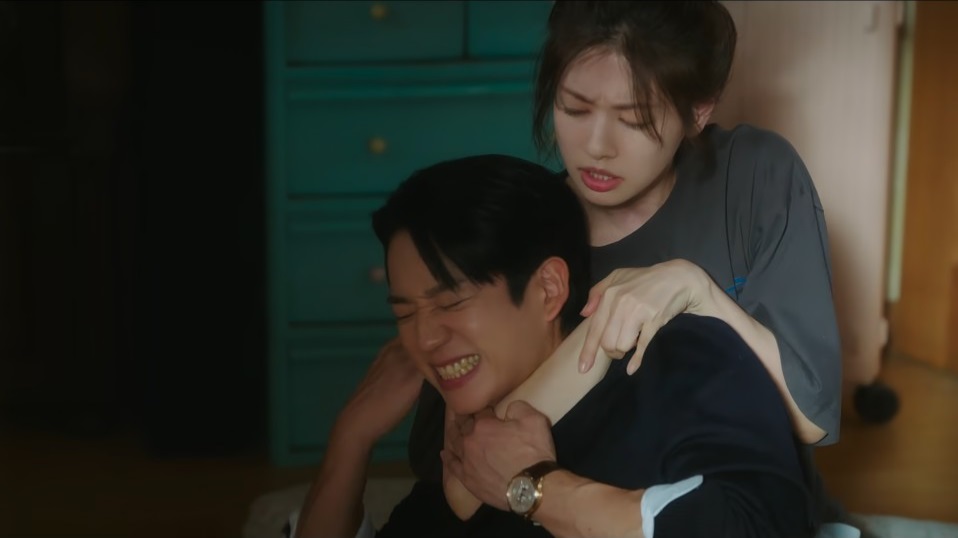
As we discover, these two have known each other for a long time, having grown up together under the same roof. Seung-hyo’s parents were never really around, with his father the surgeon and Hye-sook being a foreign diplomat. This is why Mi-sook treats Seung-hyo like a son, even favoring him over Seok-ryu in the early episodes. Despite that we’re introduced to Seung-hyo as a pretty standard K-drama male lead – played by genre stalwart Jung Hae-in, who starred opposite Son Ye-jin in Something in the Rain – a suit-wearing, award-getting young man offset by a goofier, older co-CEO, and the object of a female coworker’s lust, the reveal of his past with Seok-ryu paints a startling, less dignified picture. By the composite testimony of their shared childhood, Seung-hyo was taken under Seok-ryu’s wing, and so he found his voice but was subject to her roughhousing. In the present day, she’s always putting him in headlocks, and he can hardly defend himself despite being twice her size. Some things never change.
In K-dramas past, I’ve liked the female leads mostly by default, or I suppose I’d stop watching the show. They’re well characterized or well acted, and I want to see them succeed, like any compelling protagonist. Seok-ryu is the rare female lead who I like because I think she’s my type. Like Cha-hyeon in Search: WWW, she’s reflexively violent, but it doesn’t come from a sense of justice. In this case, it’s hereditary, but it’s also an outgrowth of her overall energy. In episode four, we find Seung-hyo out walking in the neighborhood when Seok-ryu appears, headed in the opposite direction, and she shoulder-checks him. Now, this scene was teased at the end of episode three, framed as a dramatic confrontation. Seung-hyo turns to engage and says, “Was that a hit-and-run?” to which Seok-ryu responds, “Can’t you see the sign on my face? It says, ‘Don’t mess with me.’” He responds, “No, it says, ‘My face is very puffy.’” She steps forward, “I dare you to keep going.” When he starts to walk away, she shuffles after him. Apparently, she’s going to the library and wants him to join her. “I’m going to do something amazing!” she says, with a big smile plastered on her face.
So why would she say “Don’t mess with me” if, indeed, she does want to be messed with? That’s just how she is, I guess, and I think it’s endearing that she’d put so much theatre into a minor interaction. In screenwriting-lesson terms, it’s “flavor,” that this scene doesn’t begin with “two people meeting in the street.” Of course, we may be skirting the edge of “manic pixie” here, but she’s too warmhearted, too genuine. I can’t see Ramona Flowers getting excited about helping a bunch of grandmas with earthenware. She’s just very cool, and as played by Jung So-min – another genre stalwart – she’s animated and unpredictable. You never know when she’s gonna flop around or kick your bike, but she also has a sensitive side, and when that smile droops even slightly, it’s surprisingly affecting.
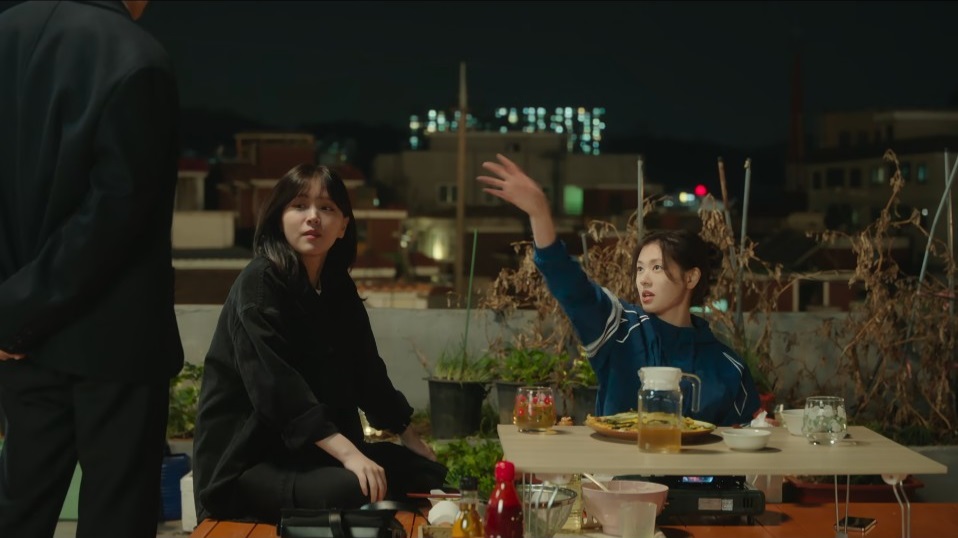
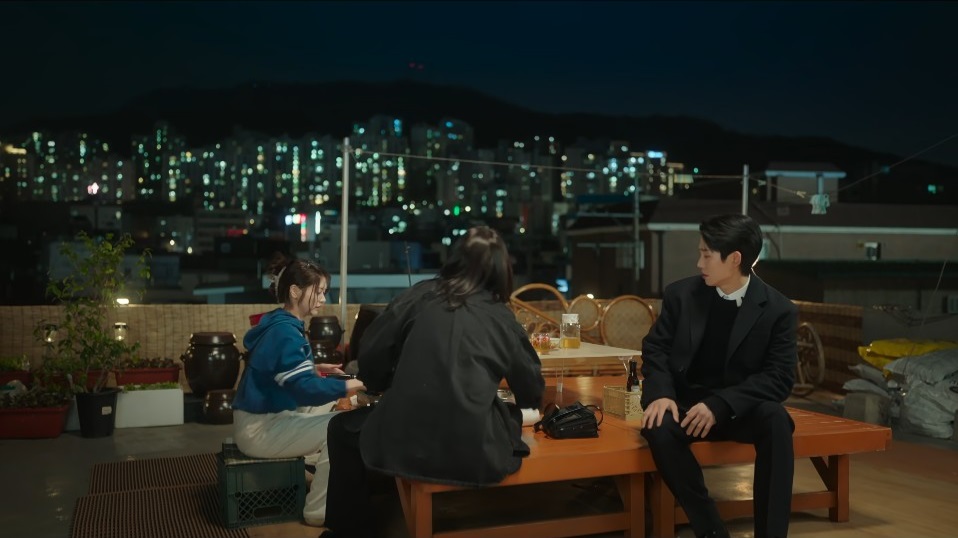
It’s a balance, as Love Next Door is billed as a comedy, and certainly, it takes place in a sitcom world. The neighborhood is an entire universe of familiar faces, so all you have to do to incite the next plot thread is go out for a walk. It benefits from the inherent coziness of, say, the American sitcom, while being free of that genre’s requirement for nonstop, typically stale joke-writing. The hook for me came in the second episode, when Seok-ryu is cooking on the roof of her family’s house and Mo-eum comes up, who then decides to invite Seung-hyo. The three of them hang out for a while, eating and drinking under the stars, from an awesome rooftop overlooking the city. Recently, I had a friend move states, and there was a chance she’d move to my state, which had me reflecting on how all my friendships these days are online. Unlike in sitcoms, I don’t get coffee with the gang every morning, and can’t go a floor up in my apartment building and knock on somebody’s door. That’s probably what I thought adult life would be like.
It wasn’t just on TV, either, because I grew up in a picture-perfect middle-class American suburb. My neighborhood was removed enough from the main road to be quiet, and it was all kids my age and their parents. These families would actually gather for July 4th parties and have backyard bonfires with the Red Sox game playing on the radio. There’s a flashback scene in Love Next Door to Seok-ryu and Seung-hyo’s graduation, and we see characters like Seung-hyo’s dad Kyung-jong, who’s a factor in the present-day timeline. That was not my experience. The cast of characters who would’ve been around for my high school graduation are long gone. In that neighborhood, people moved away, even got divorced. I know I moved away.
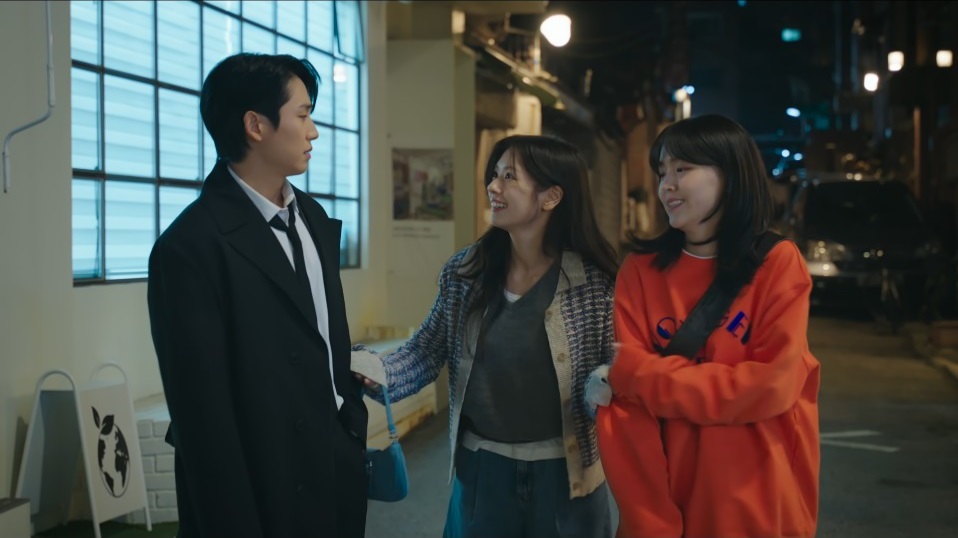
After graduating college in 2015, I moved to Los Angeles, which is apparently the only place in America where K-pop idols go. Seulgi was there recently. Anyway, I moved back home in 2021, and in that six-year interim, my parents had sold the house and moved to Cape Cod, three out of four grandparents had died, and whatever high school friendships I might’ve been able to salvage were out of the question. The plan at that time was to live with my parents for about a year – to make up for time lost to the pandemic and because my sister was getting married in autumn 2022 – and then move to South Korea. I was in the same post-grad mindset, that home was meant to be abandoned and redefined, and that maybe I didn’t even have a home anymore.
So while my homecoming was a lot more celebratory than Seok-ryu’s, I know what it’s like to have a reset, to gradually appreciate old, familiar things in a new light. It helps that the sitcom world of Love Next Door is so truly comfortable. The production may not reach the cinematic ambitions of Twenty-Five Twenty-One or Doona!, favoring medium shots and unspecific coverage, but it’s just as heightened with color and light – and sound, or lack thereof. Seriously, I don’t know what’s going on with the foley work, but you’ll have a scene in an office and only hear the characters speaking. No keyboards clicking in the background, no phones ringing. It would almost be eerie if it didn’t feel so purposely intimate.
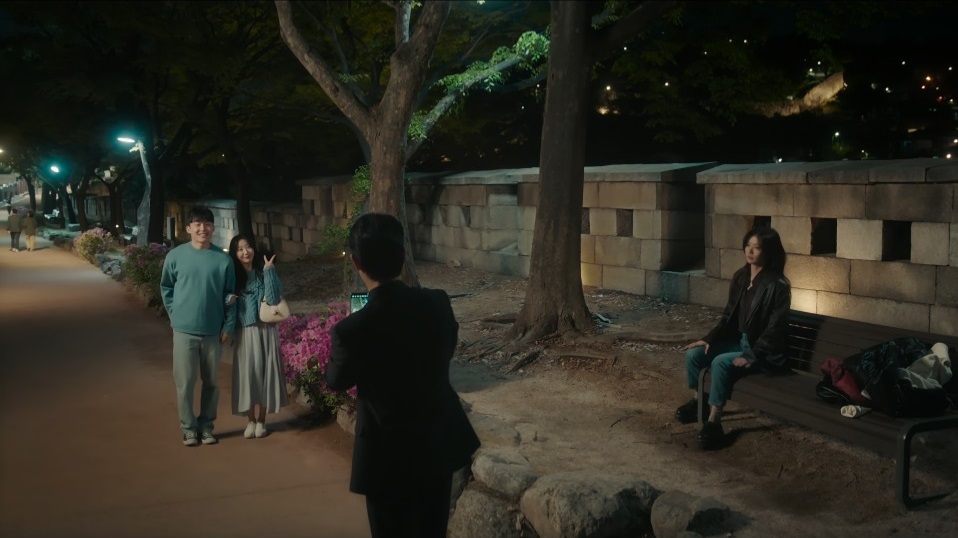
Crucially, the locations are well chosen. Of course, there’s the awesome houses in the neighborhood, a convenience store with tables and chairs on the patio, the tteokbokki stand, and at the end of the first episode, they end up at a park with yet another view overlooking the city. There, a friendly couple asks for their picture to be taken. Jesus, what a paradise. I mean, I know they’re making Korea look as good as possible for prospective tourists like me, but this is a nice change of pace from, say, Queen of Tears, with its blinding opulence. Like, I’ll never experience life inside a mansion, but a quiet park where you can see Namsan Tower on the horizon? I’m booking the ticket right now!
The key to the show’s coziness, however, is in the script, as it comes from how the characters really, really like each other. Secondary male lead Kang Dan-ho works as a reporter, and his boss is really proud of him when he gets his groove back. There’s a teacher from Seok-ryu and Seung-hyo’s past who just thinks they’re the greatest. Seung-hyo’s goofy co-CEO Yoon Myung-woo, played by Kingdom MVP Jeon Seok-ho, is Seung-hyo’s number-one fan, and cleaves to Seok-ryu immediately. Then there are all the well-worn relationships, like the two dads, the group of moms who call themselves “Suk Sisters” and then “Lavender,” and of course, the trio of Seok-ryu, Seung-hyo, and Mo-eum. Even though Seok-ryu and Seung-hyo are the destined couple, Mo-eum never feels like a hanger-on. She’s able to talk one-on-one with Seung-hyo, and she has her own life as an EMT and dreams of taking a boat to the South Pole.
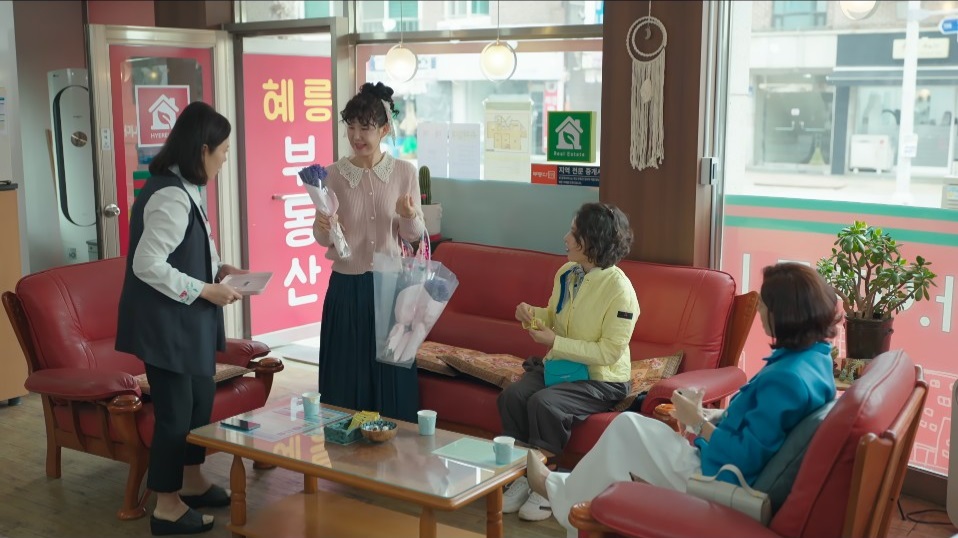
One of the hallmarks of women-written television, I’ve found, is that the dudes are awesome – in a way that, like, they just aren’t in real life. Of course, there’s a strong tradition of abusive husbands in Korean movies and TV – I tend to avoid those – but take Seok-ryu’s dad Geun-shik, for example. Played by Jo Han-chul, a highlight of the otherwise extremely bonkers Gyeongseong Creature, he can be inconsistent character-wise but is always sympathetic as a meek, somewhat downtrodden guy. And one of the hallmarks of male-written anything is that women instinctively hate each other. Love Next Door opens with a friendship – slightly contentious – between middle-aged women, and Seok-hyo and Mo-eum feel completely natural. That would be enough, but then they introduce The Other Woman, and my word.
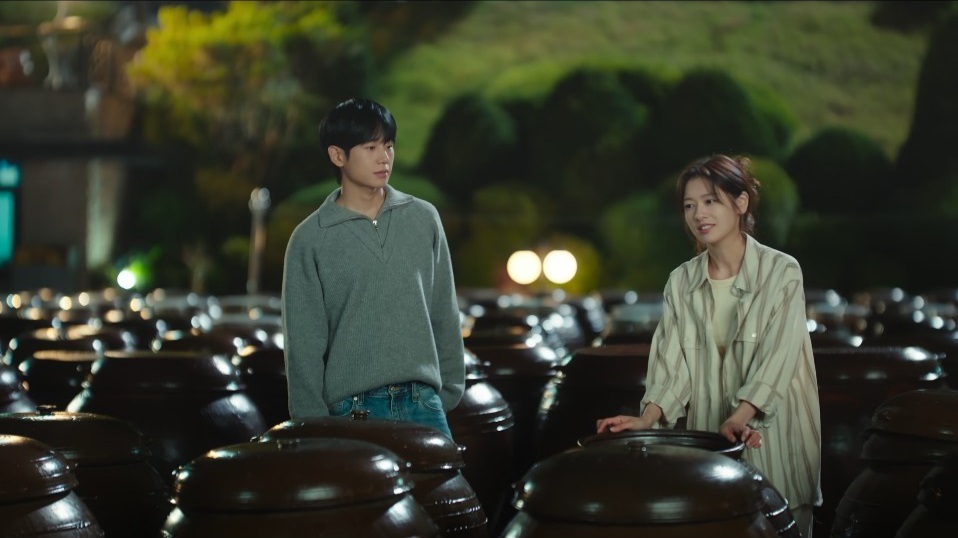
If you’ve read my coverage of other shows, you know that this is one of my favorite tropes. Really, it’s just “love triangle,” but for whatever reason, in K-dramas, the non-lead part of the triangle is always a nice, wilting girl who you just want to tell that everything’s gonna be okay. In one scene, Seok-ryu and Seung-hyo are interrupted by the arrival of Jang Tae-hui, Seung-hyo’s ex-girlfriend. Older and wiser than our leads, she has a cool job as the maker of onggi, earthenware pots, and is non-suspiciously friendly with Seok-ryu. Yes, she still harbors feelings for Seung-hyo, but also intuits his feelings for Seok-ryu. When she explains this to him, it’s with a world-weariness that makes her, like, cool, and that’s really novel. It’s hard to imagine the usual scenario, that being rejected by Seung-hyo in favor of Seok-ryu would cause her even a moment’s pause. I’m desperately hoping they don’t go in that direction.
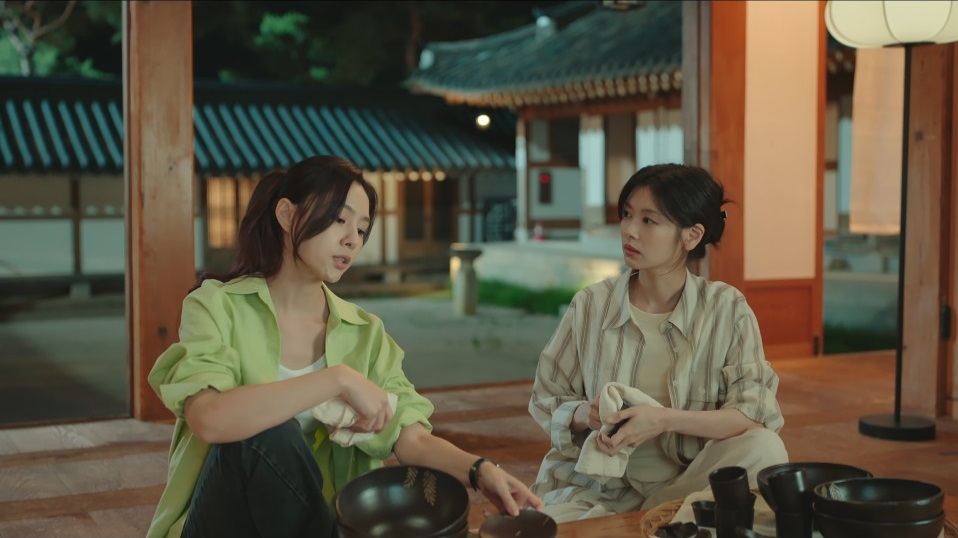
And this is a feeling characteristic of my experience with the genre. Love Next Door isn’t the first K-drama with world-building, a world I could watch indefinitely and fear that something bad may happen. It’s all the more impressive for how much is actually held back, especially about Seok-ryu. By episode seven, I’m not totally clear on why she’s returned home. But it’s not a mystery box, it’s almost like an exercise in patience. She just isn’t talking about this part of her life, and there are more important things. Searching for the 100-year-old soy sauce in one of the onggi, Seok-ryu realizes that she’s always had a passion for food and cooking. This is the answer to her long-simmering question, “What do I want to do with the rest of my life?” and Seung-hyo is there by her side at that moment.
When I started writing this post, it was after watching the first three episodes, where I even had a line about “Three episodes? Isn’t that premature?” and then explained that I wanted to establish a reaction to see how it’ll change later. But soon enough, my viewing speed outpaced the writing, and I think I needed the old K-addiction back in my media diet. There have been a lot of great American movies and TV shows this year, but nothing with the peculiar pleasures of a K-drama. Love Next Door especially hits close to home with its themes and characters, ultimately offering the acute fantasy of my own life had things shaken out differently, as I’d imagined. I’m sure I’ll go into further detail on the inevitable follow-up post, but the reflection it’s inspired has me thinking most about Korea itself, this place where I’ll always “almost be.” The finale premieres today, actually, so I can’t wait to see where Seok-ryu’s homecoming takes her.
 With Eyes East