
Episodes 11-16
Here at the end of Love Next Door, I’m revisiting a question from early on. These Reports frequently reference back to the small clutch of K-dramas I’ve seen, and a few get more attention than others: Twenty-Five Twenty-One, of course, while I almost never mention Madam Antoine, despite really liking it. Both Doona! and Love is for Suckers come up because they had obvious or interesting flaws to measure against. Now I’m wondering how often I’ll cite Love Next Door in the future, because it bears almost no distinguishing hallmarks. I think it’s a great show, ultimately, but it’s the K-drama you’d get from the K-drama wishing well. Appealing leads? Check. Beautiful setting? Check. Cozy atmosphere? Romance? Happy ending? Check, check, check. Then you’re standing there, looking at your cup of vanilla ice cream, full of grave self-doubt.

If you remember, this is exactly what I wanted. Not only from the beginning, when I was browsing for a show with a focus on romance uninterrupted by genre largess, but especially into the dog days peaking with episode ten. That’s when we discover that Bae Seok-ryu has stomach cancer, and it was the subsequent depression that killed her engagement in the U.S., and then it looks like Seung-hyo’s parents are getting divorced, and his mother Seo Hye-sook has Alzheimer’s – “Please! Stop!” I screamed, and then the show did. It wasn’t Alzheimer’s, it was just stress. And they’re not getting a divorce. With the sundrenched bliss of the final episode, you might just forget these characters ever had problems.
Let’s take Choi Kyung-jong as an example, Seung-hyo’s father. After he reconciles with Hye-sook, we see another side of him. As it turns out, he’s a very emotional man, the kind who breaks down in the hallway of a hospital after his wife gets the all-clear. And I mean, like, sitting on the floor and crying. To indulge in modern parlance, he’s a total wife guy. They take a trip with Seok-ryu’s parents Na Mi-sook and Bae Geun-shik, and he goes all-out with the photos, assembling an actual camera and striking poses of his own. The problem here is that it doesn’t feel like a flawed character who’s made a change in his life but rather a flawed character now substituted for a different one. Contrast this with Dong-jin; when his boss gives him a symbol of acceptance, he still finds something to complain about.
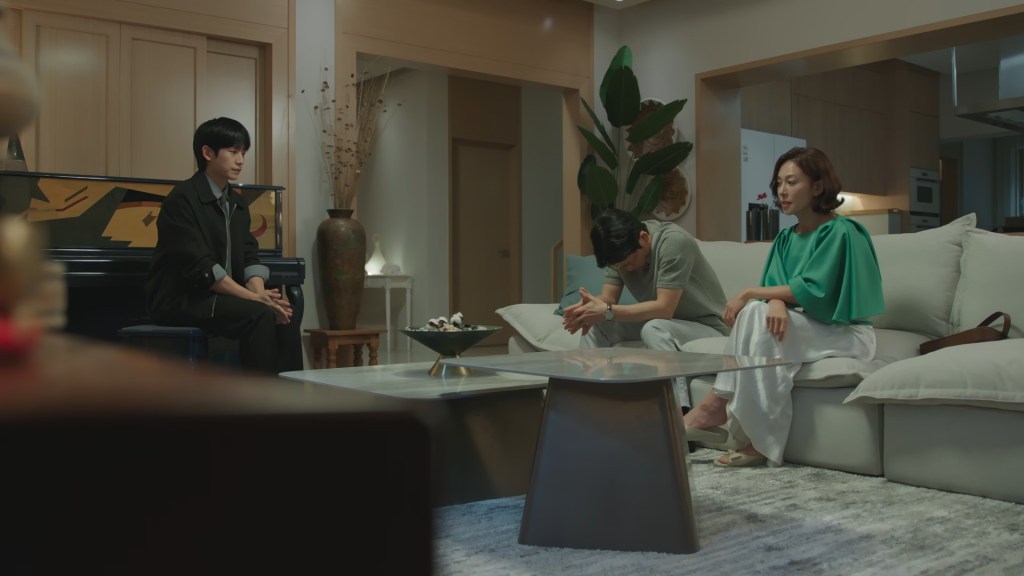
Even Seung-hyo becomes almost unrecognizable, in his devotion to Seok-ryu and in trying to deal with both sets of parents in the show’s final conflict. This is where writer Shin Ha-eun’s most egregious habit comes in, which is introducing an unexplained impasse and then having a character – usually Mi-sook – later explain via info-dump. Her resistance to Seok-ryu and Seung-hyo dating is convoluted, something to do with her illness being a potential vulnerability in a relationship, when I would’ve easily accepted “she’s mad at Hye-sook right now.” It’s doubly odd because she has any number of reasons to dislike the idea, chiefly that these two are both her children. This was part of the conflict in Jung Hae-in’s romance with Son Ye-jin in Something in the Rain.
It’s interesting how Love Next Door will glide perilously close to difficult subject matter like this and then bank left into the sunset. To everyone’s surprise, Mo-eum’s mother Do Jae-sook opposes her dating Dan-ho. Later, she explains that because Mo-eum has a big heart, she might be attracted to Dan-ho only because he’s a wounded puppy. I mean, Jesus, let’s see. We learn that Yeon-do isn’t his actual daughter but rather his niece, and that the car accident killed his brother, his brother’s wife (Yeon-do’s mother) and his parents. That’s a little too much for me to make fun of this time. So, he decided to raise Yeon-do on his own, and that’s like catnip for superhero-obsessed Mo-eum. It’s an intriguing idea, one that potentially reframes their entire arc.

Like any K-drama viewer, I’m a big “secondary romance” fan. I liked this one, but I’m plainly aware that it’s almost entirely artifice. When Mo-eum begins to fall for Dan-ho, she’s all “It can’t be! It can’t be!” but why? In the beginning, they do this thing where they’re playfully combative with each other, especially at the convenience store, but that’s not enough to make her grit her teeth over the possibility of feelings. It’s just another example of conflict for no reason, or a delayed reason, like when she finally tells Dan-ho she likes him and he goes cold. With Jae-sook’s concern, we could argue that Mo-eum’s initial reluctance came from a place of self-awareness, that she liked the idea of the man, or even the idea of rescuing the man, more so than the man himself. But all along, we’ve been watching Dan-ho be a stand-up guy, so it’s not like the man and the idea are so distant.
For Seok-ryu and Seung-hyo (who she adorably calls Choisseung!), we have the Westermarck effect, which Wikipedia helpfully sums up as “a psychological hypothesis that states that people tend not to be attracted to peers with whom they lived like siblings before the age of six.” This doesn’t really come up in the show, and I think it’s because this is a “soulmate” pairing. There’s something almost eternal about them, like in the movie Past Lives, so of course they’d be in love as children, too. They didn’t see each other as siblings then (boy, let’s not take these last few sentences out of context). The real solution to all of these problems is more ephemeral, more emotional, that when these characters come together, I don’t care that there was something off at some point.

While the final movements of the show are breezy and light, they’re no less gratifying for it. Mi-sook and Hye-sook accept each other as in-laws, Dong-jin earns his parents’ respect, Mo-eum goes to the South Pole without blowing up her new relationships, and Seung-hyo helps Seok-ryu continue her father’s legacy by opening a new restaurant in the place of the old tteokbokki stand. We find that Love Next Door is as much about the creation of couples as it is the creation of families. This is made thematic by the end, but it’s been there throughout.
One of my favorite quirks of the show is how scenes linger for a beat, long enough for one last, sometimes off-screen line. The morning after Seok-ryu and Seung-hyo sleep together, Mi-sook and Geun-shik return home sooner than expected from that trip with the photos. When the bickering duo enters the house, they find the two kids calmly reading manhwa in the living room, and we have this repeated gag of exaggerated tension – very funny stuff. In one such instance, Geun-shik asks why Seung-hyo is reading a girls’ comic, Princess, something he’d grabbed to stage this non-suspicious tableau. Then he laughs and says he didn’t know Seung-hyo was such a romantic! The button on the scene, if you can even call it that, is when Seung-hyo leaves and Geun-shik picks up a comic and excitedly says, “Princess volume 20 is out!” Things like that help situate us in a world that doesn’t turn off when we leave for another scene.

This is the character of the show as well as its heart, and that’s not as easy to condense into a sound bite as other, flashier K-dramas. So I could spend all day telling you what the show doesn’t have that others do. There’s no Lee Da-hee beating people up or a sad idol or a grand, twisted psychology experiment (there you go, Madame Antoine), but what is here is done well. After Seok-ryu turns down Seung-hyo’s invitation to join him on a business trip, she tries to occupy herself without him to no avail. She then makes the trip herself, and finds him in a field of sunflowers made golden by the setting sun – or just, the sun in the sky, but it’s all pretty much signposting: this is it, kids. Buckle up. I’m usually surprised by the first kiss, but not this time. It was perfect.
However, I want to mention Seok-ryu’s pre-kiss speech, where she describes how life is boring without him. Reading comics isn’t fun, food doesn’t taste right. It might be a slight exaggeration, because without Seung-hyo, she still has Mo-eum, and her family. She also gets to wake up every morning and think, “Hmm, what am I gonna do today? I have cooking class from noon to 1:00, and it’s 11:30 now…” which has to be nice. Despite my sob story in the first Report, I also know what it’s like to be unemployed without it being a scary thing. But then Seok-ryu and Seung-hyo kiss, and she’s simply adding him to her already amazing life. Love Next Door is a fantasy where everything good is made better. It’s the reason I worry that it won’t prove memorable in time, because the emotions and thoughts it stirred in me were profound.
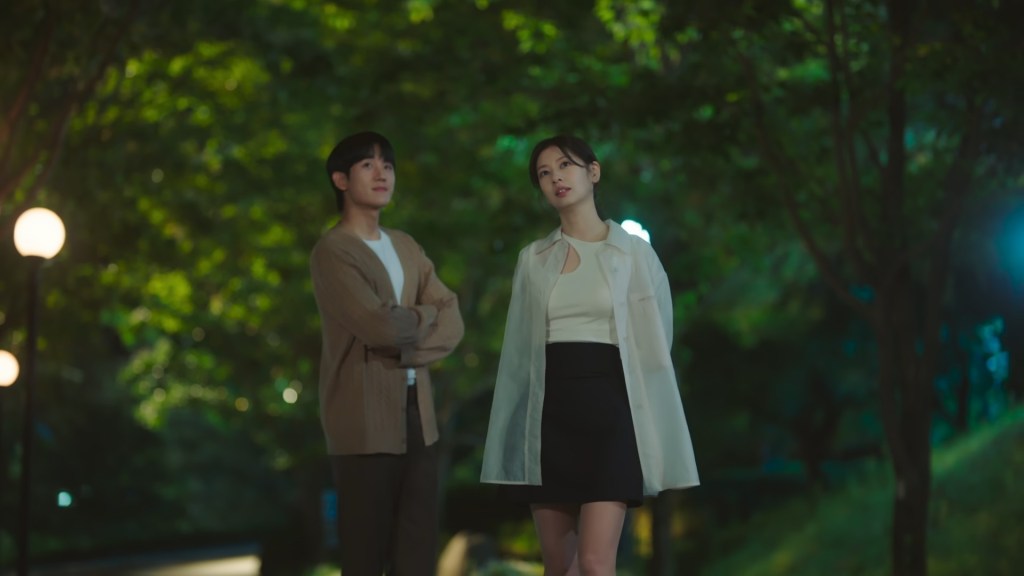
I was happily unemployed for several months in 2022 because, as outlined previously, I was planning on moving to Korea at the end of that year. While that didn’t end up happening for reasons difficult to discuss, I was relatively clear-eyed about how challenging it would’ve been. It had become a personal slogan that I’d be just as much a minority over there as I am here in America, and that was the problem: I’d been living with this reality for so long that it became abstract. It was actually watching Love Next Door that helped me see the specificity of Korean culture. I guess it was this portrait of a small community, a neighborhood so similar to mine, wherein the differences began to pop. There’s a cadence to the dialogue, a ceremony to every interaction, a level of politeness too foreign to my American short fuse. There are countless reasons why I can’t really live in Korea, and this is only the most immediate.
My misapprehension is that you can create your home, and it’s probably small wonder why an adoptee might think that. And so, Bae Seok-ryu’s homecoming resonated with me, even as her story began to diverge from mine. It makes me think that Shin Ha-eun has the essential quality of any good writer – empathy – that she can reflect someone’s experiences on screen with such verisimilitude, despite the heightened K-drama world. Unfortunate, then, that I’ve only ever name-checked her alongside criticism, so I’ll at least balance it out with a positive observation: pacing. She manages to allot a fair amount of time to each character in the large cast, to where each feels significant, and none are boring. It’s with that sort of screenwriting discipline that she’s crafted, honestly, a near-perfect K-drama. It may not be the most unique or special, but it’s special to me.
 With Eyes East