Episodes 2-4
Okay, maybe not everyone, but I’m still satisfied. Previously on the K-Drama Report, I complained that for a show featuring Park Shin-hye as we’ve never seen her, empowered with the infinite power of hell, her character was woefully underwhelming. Add in unpleasant scenes of domestic violence, and I was ready to call it quits. I’ve been had before, and maybe in my old age, I’m too frustrated by failure. Well, it turns out, there’s a reason why the first episode doesn’t end with the cathartic release of Shin-hye’s character Kang Bit-na (or Justitia the demon) beating up the abuser guy for a couple of minutes. No, no, The Judge from Hell had something much greater in mind: twenty minutes. Yes, friend, you read that right. A sustained sequence where she’s just blowing this guy up.
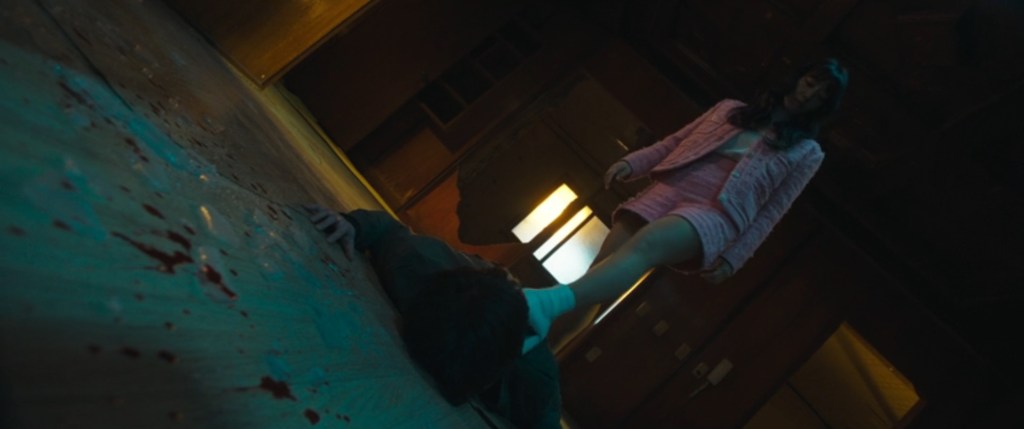
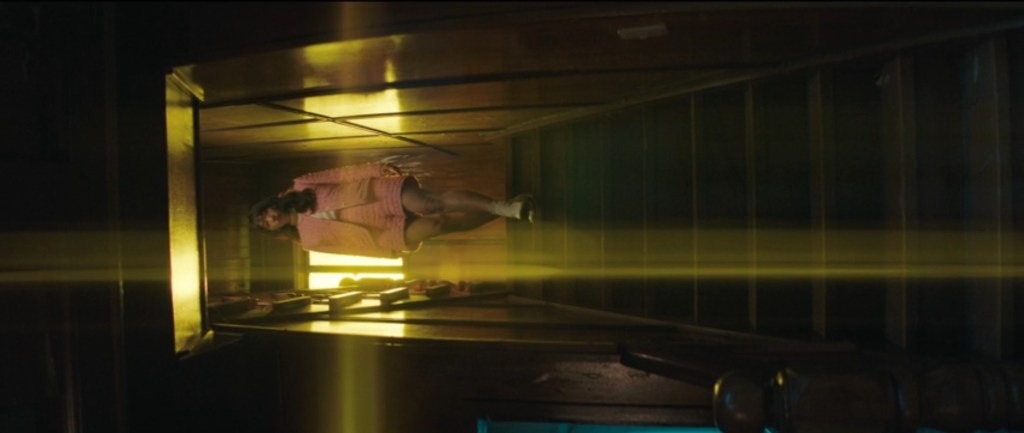
Specifically, what she’s doing is putting him “on trial,” where the rules are a little unclear, but that hardly matters. She lures Moon Jeong-jun away from Cha Min-jeong’s apartment, where he was a doorbell away from murdering her parents, summoning him to an abandoned house in a dark neighborhood tagged for redevelopment. It turns out that Bit-na’s hapless assistant Gu Man-do (or Valak the hapless demon) was speaking in Min-jeong’s voice over the phone, in the gotcha segment of this To Catch a Predator. Bit-na descends the stairs – in one of the show’s less-than-successful stylistic flourishes, the image tilted 90 degrees – and says, “I’m here to kill you.”
What the hell is this trying to do?
To start, she asks if he indeed killed Cha Min-jeong and is unrepentant and unforgiven. Lots of holes already. For one thing, he didn’t legally murder Min-jeong, and “unrepentant” and “unforgiven” would be coming from two different sources. Again, it doesn’t matter, because it’s a rhetorical question, as she’s about to render a judgment on all three counts. She summons the demon knife, and there’s lots of good scared acting from Shin-hye’s scene partner Jang Do-ha. Jeong-jun flees, and stumbles into a different location altogether, a new scenario wherein Bit-na is his girlfriend. They’re eating dinner at a restaurant and she reacts poorly to his claim of being full. She starts jamming salad into his mouth, and then slaps him – whoa! He tries to leave, and she gets on her knees and apologizes, then threatens to kill herself. “I can’t live without you!”
Next, a very funny cut, when they’re in Min-jeong’s apartment and he’s saying “Let’s break up,” and we see she’s holding a birthday cake. More slaps, and then the first beating, which quickly escalates from punches and kicks to a metal baseball bat. In the next scene, she’s using that bat to break into the apartment. She’s taken away by police, but when Jeong-jun enters his new apartment, she’s already inside cooking. She punches him in the nose for calling the police, and when he begs to break up, here comes the next beating. She does all this in an apron with flowers, including breaking his leg with a hammer, for which she frantically apologizes.
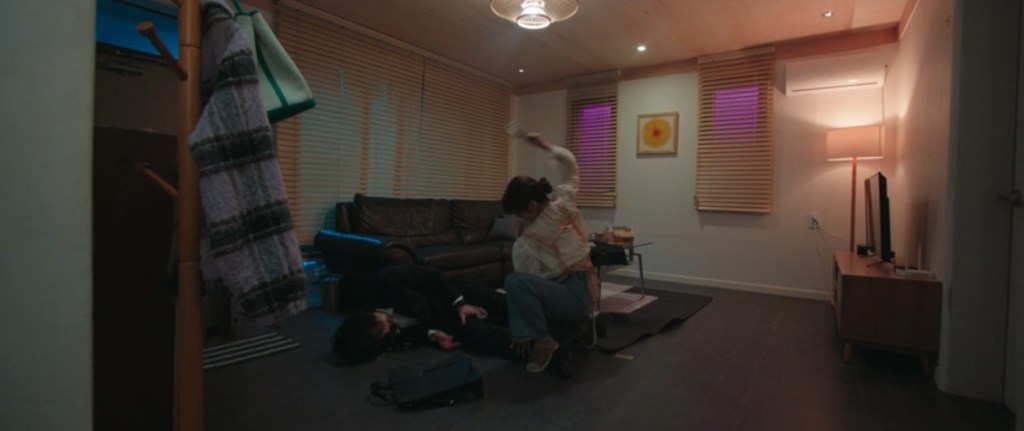
We’re still not done. Jeong-jun is back in Min-jeong’s apartment, and Bit-na’s trying to get in. Like Min-jeong, he hangs himself, which pulls him back to reality in the abandoned house. Bit-na tells him, “Those who do not admit their crimes shall feel the same pain experienced by the victim.” She also clarifies that she isn’t doing this for Min-jeong, because she doesn’t care about humans. I think we can safely mark that as Point A on the character development chart. Then she slaps him through a glass window. He feigns “repentance” and attacks when her back is turned. She plays along with the choking, until the chokes turn to laughs. “Having fun?” she says, and grabs him by the throat and lifts him into the air. I guess this is the third beating.
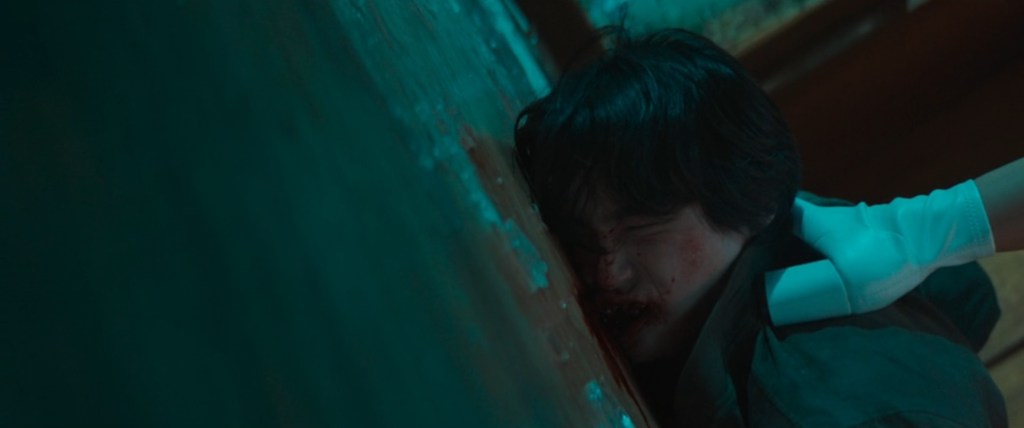
She breaks his fingers, punches him, kicks him, stomps on his neck, stomps on his fingers (driving them into glass shards). He still tries to fight back, and it goes badly for him – this is a remarkably long sequence. An arm break, an ankle break, perforation by glass. Lots of blood and screaming. Finally, she gets him to admit that Min-jeong is dead because of him, that he hasn’t been forgiven, and he’s remorseful. Also, that he deserves to die, which would seem to be the right answer, but then she says, “Then die,” and stabs him with the demon knife. “Go to Hell,” she says in Italian. Here’s a dumb question: is it Italian because of Dante’s Inferno? Like, why not Latin? “Court is adjourned,” she says with a big smile.
It should have been me, not him!
A question remains: could this trial sequence nevertheless have fit into the end of episode one? What’s the point of even having episodes if the story’s gonna be broken up so arbitrarily? And I can rephrase that: it would seem that the episodic format of television is, for this production, a hindrance, or a creative challenge not met with grace. In an earlier K-Drama Report, I mentioned watching The Shield, and one of the striking things about that show is how every episode ends with something crazy happening. It’s got kind of a reputation for doing crazy things, especially for the time, but that reputation is more like a guarantee. And each episode builds up to that crazy thing – crucially, in an entertaining way. It isn’t like most, especially streaming television, where there are scenes of characters literally waiting around for the plot to happen. I hate that!
Following this sequence, my suspicion was that The Judge from Hell would be a mostly dull show with spikes of excitement, but then it accelerates the romance plot in a surprising way. Bit-na decides to get closer to Detective Han Da-on to ascertain the names of some killers, and he provides his own. With drunken melancholy, he claims that when he was a child, he killed three people, including a family member. Perfect amount of detail withheld for later. I assumed Bit-na was gonna somehow milk this revelation, or at least take time to realize that “Oh, I might be able to kill this guy,” and then she stabs him to death!
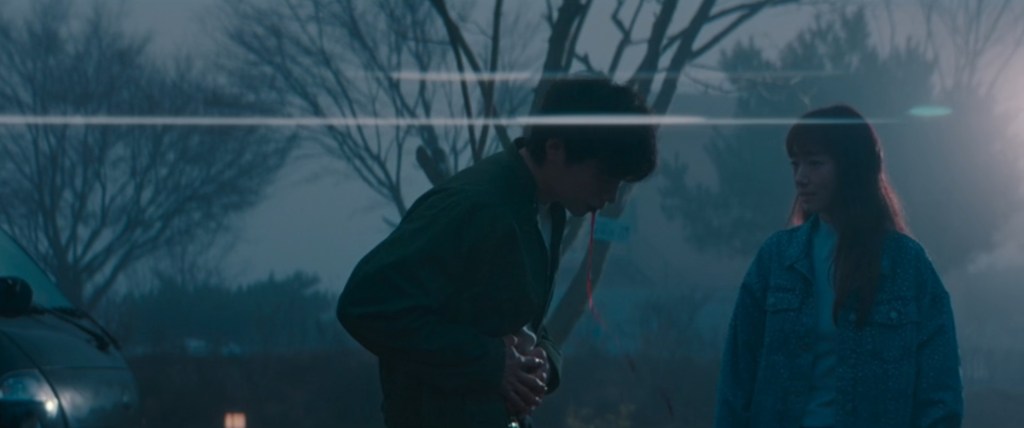
In the next episode, Bael returns to tell her she wasn’t supposed to do that, and revives Da-on (and gives her ten more souls to reap as penalty). Now, Da-on knows that Bit-na stabbed him, he died, and came back to life. All that demon talk, and her preternatural strength during an early encounter, it’s suddenly adding up. Later, Bit-na confirms this rather than dragging it out, initiating a sort of cat-and-mouse game. They’re both intrigued by each other but don’t want to show it, being opposed in so many ways – professionally, morally, spiritually. They take turns trying to abandon the other or fabricate their next encounter. That’s not bad. There’s constant invention, and the dynamic keeps shifting while staying fun.
Han Da-on is gradually being revealed as my favorite kind of guy character: the sad boy. For reference, my favorite ML (“male lead”) in a K-drama so far is Choi Si-won’s Park Jae-hoon in Love is for Suckers. Now there was a quiet, sad dude, and I either relate to that or find it attractive – not sure. To that, it helps that Da-on’s actor, Kim Jae-young, is very pretty. I’d argue he’s rivaling Kim Soo-hyun in Queen of Tears (who, with Kim Ji-won, made a blindingly hot couple, my God).

Anyway, the real test comes with the third and fourth episodes, as Bit-na’s next victim is a woman – the kind what I prefer to be practicing the violence, not having the violence be practiced upon. Is she really gonna go as hard? Spoiler alert: yes. And I’m not sure if it was the fact of gender or the show’s intensity or that I was enjoying it so much, but I had this pang – when wild-eyed Bit-na is straddling the woman and suffocating her with a pillow – that “This is a lot.”
You know, I talk a big game about violent women, but maybe I wasn’t prepared to see exactly what I’ve always wanted. The mirror darkly. “This is what I like? This is who I am?” Specifically, I think it’s a problem of the vanishing moral center. We like when Jason Vorhees chops a teenager in half because it’s like a perverse thrill – we identify with the teenager – giving rise to academic theory about a streak of moral conservatism through ‘80s horror. True enough, there’s a line. What if that teenager was despicable, and we were rooting for Jason and the chop not out of a sense of fun but because we really want to see someone die? Wouldn’t that be pang-worthy?

There’s a reason why Batman is a hero, the Punisher is an antihero, and Rorschach is a character study. The conceit of The Judge from Hell is that Bit-na tortures and kills people deemed worthy of such treatment, and it’s like, to what end? Not only are there questions about the moral polarity of God and Satan (if they both dislike sinners, why aren’t they buds?), it also, apparently, gives rise to a philosophical quandary: at what point is a masochist so excited by sadism that he, too, becomes a sadist?
Help me.

We’re going on 2025 now, and I still have this habit of viewing things through the lens of “Is this problematic?” Whether or not this show is, we can have that debate with actual material in hand, rather than the abstract boogeyman of what could be. In this case, and in the case of the movie Civil War, for example, sometimes it’s just about seeing it. “What if violent criminals were punished with their exact violence?” is a pretty basic hypothetical. The job of The Judge from Hell is to contextualize that with sufficient narrative to, at the very least, not feel like a snuff film. I think it does this job. We then watch Bit-na smother a woman with a pillow, forcing her to say “It’s fun,” and at worst, it’s vicarious revenge for people whose moral values roughly align with the carceral state. At least on the eve of episode five, I think at best, it’s weird entertainment.
The Judge from Hell is a production of Studio S, consistent with shows like Business Proposal, Good Partner, The Penthouse: War in Life – though, admittedly, there are darker shows in that library, like Phantom, Revenant, The Killing Vote – and it was broadcast on SBS TV. In other words, it’s a “K-drama” like Crash Landing on You, not a “Korean television show” like Squid Game. Scientists are still working out the finer points of the distinction, but I imagine that, on paper, The Judge from Hell began with the spine of a romance story, and was dressed up with all this fantasy-horror stuff. For all its blood and gore and the eye-popping ferocity of Shin-hye’s performance, it still feels like a visitor to the genre, rather than something that sprang from the mind of, say, Clive Barker. Compare the depictions of hell, between this one’s music video aesthetics and the spooky geometry of Hellraiser II. God, the demon knife is just so bad.

At this juncture, the show lives in that balance between weird and disarming. Because it’s a K-drama, it’s got jokes. I especially like that Bit-na, as part of her demon persona, is just kind of an asshole. She’s a mean boss, she’s vain, she doesn’t observe traditional Korean manners. Doesn’t respect her elders, but of course, she’s like 500 years old; that old chestnut. And while this genre-busting is generally what I avoid, in seeking out “pure” K-dramas like Love Next Door, there’s an agreeable balance of the elements, and the tone. No whiplash like I had with Strong Girl Bong-soon and its weird Criminal Minds interludes. I’m still sitting here shaking, trying to make sense of what I’ve seen, but goddamn it if I’m not starting episode five as soon as this is posted.
 With Eyes East