
Episodes 5-14, the finale
In the first Report, I said – and I quote – “Shin-hye should be god mode in Grand Theft Auto,” in expressing frustration over her character’s limitations. In the second Report, my wish came true, and I was excited and terrified. Now, in our final Report on The Judge from Hell, I think it’s time to deconstruct this term, “god mode.” While I watched the first five episodes in a matter of days, the next nine took me practically the rest of the month. The first lull came with episode six, right before Kang Bit-na was about to lay her righteous beating on a condemned soul. This actually turned out to be “the elevator scene” I was crowing about. Of course I wanted to see more of Park Shin-hye beating people up; that’s the most amazing thing I can think of. So why couldn’t I hit play (or rather, open Disney+ and hope it didn’t crash or ask me to sign in)? It broke my heart to realize, but I had to admit: I was bored.
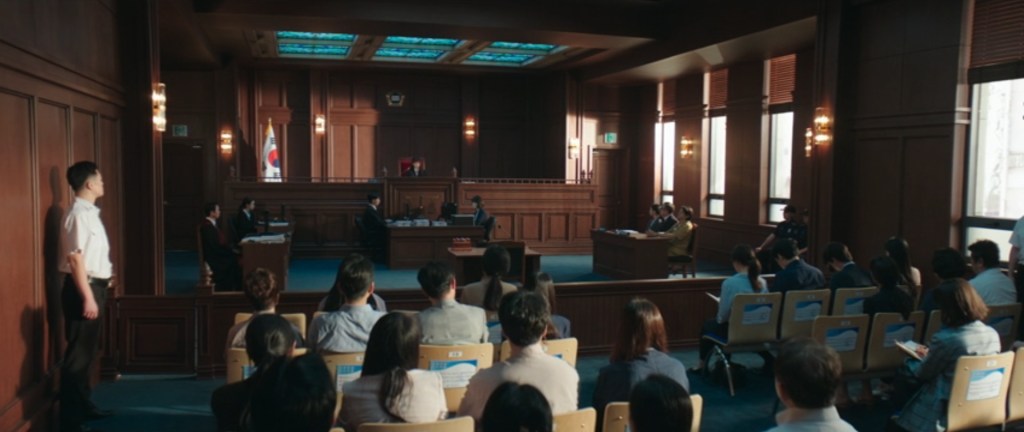
After careful consideration, I’ve decided it’s two things. In case Electronic Arts decided that this Part III is a good place for you to start, here’s the formula for The Judge from Hell: a new criminal appears, the criminal goes on trial, Bit-na convicts the criminal but hands down a light sentence – to the shock and anger of everyone – and Bit-na tortures and murders the criminal elsewhere. Immediately, you can see how this repeated structure might impact the “criminal goes on trial” part. Unlike in most courtroom dramas, there’s no suspense because the outcome is predetermined. And while there’s a depiction of corruption behind the scenes, there’s very little engagement with it (the corrupt judge ends the show having started a successful YouTube channel).
It should have been me, not him!
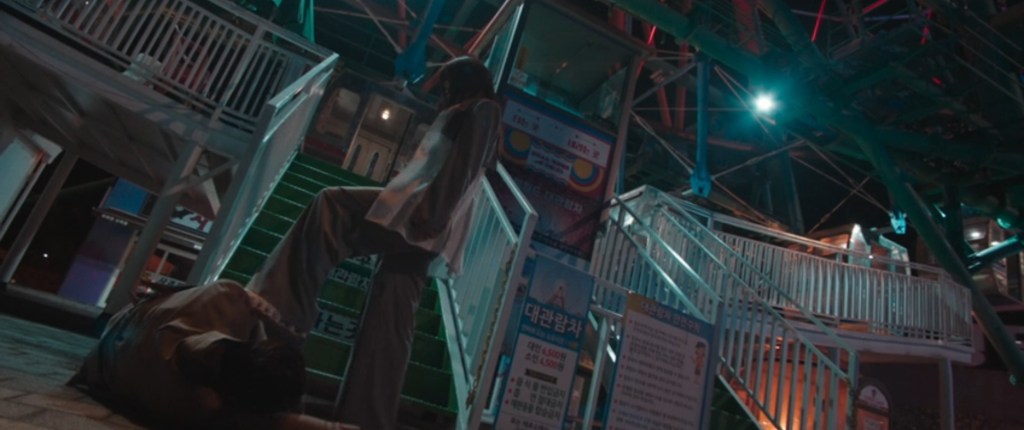
This is only a microcosm, because the impact also spreads to the important bit, the “Bit-na tortures and murders the criminal elsewhere.” Once she has the victim in hand, it’s really as simple as that description, no matter how elaborate the torture. She’s never racing against the clock or solving a problem. There’s no narrative to these sequences, making it violence in a vacuum. That’s fine, but it’s not storytelling. It’s not providing the hard-won pleasures of a story, whether broadening my appreciation for the character or moving me emotionally. It’s just light and color, though arranged in the still pearlescent imagery of Park Shin-hye beating a guy to a bloody pulp. I like exactly that much, but nothing else, and there’s a lot else.
The Judge from Hell does something pernicious, which is to present worst-case crime scenarios in isolation. If you’re only seeing – or can only see – a raving bastard who’s just murdered his family, you’d think, “Yeah, law and order. Bring the hammer down on that guy.” The problem, for liberal types, is that the hammer is not so precise. This bastard never actually exists in isolation. Since 1992, the Innocence Project has freed 250 innocent people from prison. Calling on the hammer is the creation of a system vulnerable to abuse, which is why 58% of those 250 are Black, reflecting the racially disproportionate impact of wrongful convictions (and the carceral state as a whole). And the Innocence Project is only one example of several wrongful conviction organizations.
The tricky part is that some people truly can only see the bastard, like the families of the victim. They want the criminal to suffer and likely don’t care if it’s the state’s doing or a shank or an act of God, and I’m in no position to say that isn’t okay. Vengeance is an entirely natural response, so it transcends morality by simply being inevitable. One of the great lessons of The Wire, borne out in real-world examples like the war on drugs and the war on terror, is that the American desire for instant gratification (“drugs on the table,” drone strikes) tends to divert time and resources from actual preventative work too complicated to relay to constituents. So much to say, the aggregate of American television is a full-court press to convince you that the function of justice is to punish crime, not eliminate it. And because I’ve watched a lot of American television in my long, pitiful life, I’m allergic to the fabrication of criminals in entertainment, ever suspicious of even accidental propagandistic conspiracy. Also, I’m not used to the declaration of a death sentence being met with sports-movie cheering. Seriously, Bit-na hands down one popular sentence and the protestors scatter?
To return to our story formula, really the problem is the “new criminal appears” part, because there just isn’t enough time or storytelling economy to make me sufficiently (and correctly) hate the criminal. I hated the multiple-personality guy, but only because his scenes dragged, not because he was a murderer. This is the sociopathic-sounding part of media analysis, which is that, mathematically, he had to have killed someone I cared about. Failing that, the torture sequences feel weirdly vindictive, in addition to anything else. Like, enjoyable, but also weird, and I would’ve preferred just one. If it must be both, lean into it. Make me feel like a voyeur and throw it back in my face. She’s a demon! In the text of this show, demons are bad! (They can, however, become human-like).

This would be my core revision: an ideological clash between mortal and demon justice. Right from the beginning, I don’t know why the series writer Jo Yi-soo nor the character Bael decided that Bit-na had to also be a judge in the human world. In Bael’s case, it feels so arbitrary. Like, maybe that’s part of the punishment, because it does end up complicating the mission later on, but if the mission is truly important, why complicate it? It’s hanging me up because the only crime in the entire world of The Judge from Hell is murder, and this is the only sin that Justitia punishes. Why not, instead, have her punish sins according to the holy book? I don’t mean feed the gluttony guy until his stomach ruptures, but going after people for being envious? Slothful? Then the violence would actually be scary.
It doesn’t make sense for me to root for the violence of the infernal trial and also witness Bit-na’s character arc as becoming less like a demon and more like a human, and also have the final conflict be about choosing between legitimate judgment and the murder of sinners. Like, what do you want me to like, The Judge from Hell? Well, because I was generally discouraged by the meat of the show, my affection began to drift to other, surprising places. I did enjoy the interplay between Bit-na and Da-on at their most adversarial. I didn’t quite understand why she was so offended that he suspected her for murders she committed; I mean, she knows he remembers she stabbed him to death, right? But then there’s that moment when they run into each other outside the apartment, and even though Da-on is upset with her, she still gets this expectant look on her face. As much as she plays it off and pretends to be annoyed by him, she craves his attention.

Mostly, I’m won over by the secondary characters, and let’s say that The Judge from Hell has three character tiers. In the first, you have Bit-na and Da-on. In the second, it’s Mando, Arong, Jang Myeong-suk, Detective Kim, and maybe Bael. In the third tier, it’s everybody else, so defined because despite their high levels of incidence, they serve zero function in the story. It could be Bit-na’s boss Na Young-jin, Bit-na’s curt assistant Choi Won-kyung, even Da-on’s father, who comes into the show very late. By the way, I don’t know who or what wrote the character descriptions on the Wikipedia page, but as of this post, here’s a sampler:
- He is like an unbridled calf with an inferiority complex towards his socially prestigious father’s sore finger.
- A demon named Seire and entered a body soldier who was killed in a rollover of a military transport vehicle 10 years ago, and after being discharged from the military.
- Unlike his blunt wife, he is infinitely affectionate and friend-like to his children, revealing his ‘child-fool’ side and warming them up.
- She is a fairy who leaves work on time who disappears at 6 p.m. and lives without much interest in others.
- A young demon who is human despite being a devil due to the unclear distinction between good and evil since he was born not long ago.
- She is full of privilege and a sense of entitlement, and feels inferior to Bit-na, who is always ahead of her.
That last one is my favorite, describing Lee Mi-do’s character Seo Hwa-seon, and I suppose you do have to make things up in the absence of extant character. Like, what is the purpose of Lee Mi-do’s character, truly? It’s just that, at some point, Bit-na will inhabit a space, like the courthouse, and that space should contain people. My God, do we have to formulate character arcs for each of these people? Do they even have to interact with literally any of the other cast? The truth is, she and her male counterpart are part of a running gag where the courthouse’s cafeteria gets better and better food. That’s it. At one point, they’re chowing down on, like, Ren fair mutton. Then they get lobster. I don’t know, is it the corruption thing? Are these meals part of the kickbacks from the assembly? That would be a strange way to depict that, so let’s just say “no.”

To get back into second tier, I appreciate that the most religious character, Myeong-suk, isn’t the butt of the joke. It really seemed like she was gonna be, as not only a proselytizing Bible thumper but a landlord – two people constantly in other people’s business (on TV; I’ve actually never had a landlord problem personally). There’s no cloud of violence hanging over Myeong-suk because she’s a nag, and I find her interactions with Mando to be heartwarming. After Arong forces a fellow demon to return to hell, which looks like suicide in the mortal world, Myeong-suk finds Mando out sulking. He tells her that he’s sad because a friend passed away, and she encourages prayer to ensure he enters heaven. Of course, Mando knows the guy isn’t going to heaven, so she assures him that the prayer is just as much for him.
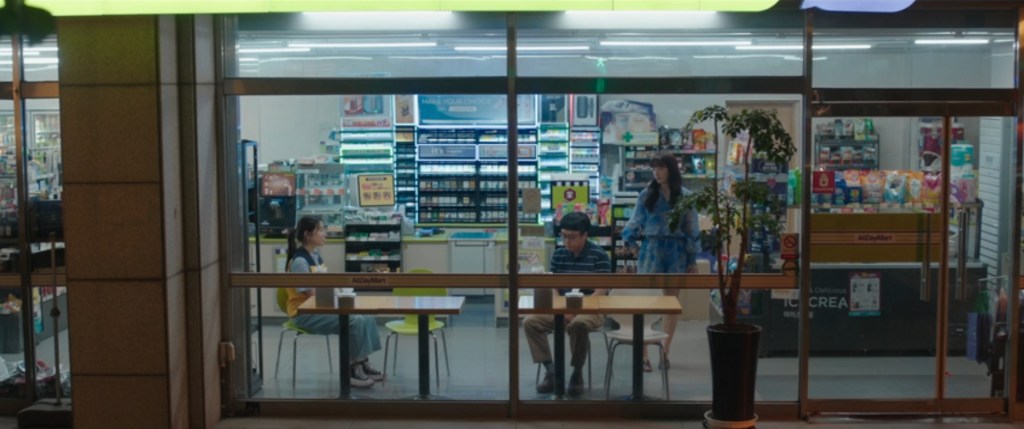
If the main character of The Judge from Hell wasn’t Kang Bit-na, Mando would be my favorite. He’s not even the guy I’d be in this scenario – prostrate before violent women – he’s the guy I want to be. He’s also the most lovable character, as a mild-mannered demon naturally drawn to the side of heaven. It was weird to see his “origin story,” where his demon form is a younger, more conventionally handsome man who scoffs at the appearance of, well, actor Kim In-kwon. So, at one point, he was clumsy and cloying while also being handsome? As it is, he bumbles around, living in constant fear of Bit-na and then of Arong, who was a brilliant addition. Their extremely toxic found family became the highlight of the show for me – the K-drama comfort zone. Whether it’s Bae Ta-mi and Scarlett working at Barro or the girls messing with each other at Belle Epoque, at some point, the K-drama will establish its status quo, and for The Judge from Hell, it’s when Bit-na and Arong are plotting in the convenience store, and the latter occasionally raises a hand to a cowering Mando. In modern parlance, I’d say that actress Kim Ah-young is giving “Evil IU” in these scenes.

The reveal that Arong was not actually the demon Gremory but rather Venato – a reveal exclusively for the sake of Mando and Bit-na, because it’s no skin off my back? – threatens our found family because Venato is something like demon internal affairs (shall we say infernal affairs?). She’s already busted Mando’s friend for having a human wife, and begins asking questions about Bit-na’s curious relationship with Da-on. Is she crying at Detective Kim’s funeral?
Just as Bit-na is blissfully unaware of her subordinate’s screamingly obvious treachery, I also found Arong’s exact agenda to be unclear. We know that she’s Justitia’s number-one fan, and I kind of interpreted her venom toward Mando as professional jealousy, pitifully misplaced, but then her scheming would seem to contradict that. Is she disappointed by her idol and therefore vengeful? Only at the eleventh hour do we learn that her plan isn’t to directly confront Bit-na like with the previous demon, but rather to summon Bael to kill Da-on. Now, come on, sister. Bael’s not gonna do your dirty work. After he appears and says, “A lowly demon like you summoning me?” making me wonder why it’s that easy in the first place, he turns the job over to Paimon.

The next lull came with Detective Kim’s death. Even after having finished the show, I’m still not sure it was the best call. Felt a little bit too mean? But it isn’t long before things culminate, around episode ten. By the time we’re introduced to Paimon, we’ve already met his human face, as he’s inhabiting the body of a detective assigned to Kim’s open spot in the police squad. For a while, he occupied a sort of mysterious Bob Benson role (with a similarly minimal reveal), getting close to Da-on to make the case against Bit-na the murderous judge.
Arong has been using Mando in this plot, threatening to tell Bit-na about his churchgoing. After he uses his Terminator phone trick to lure Da-on to Paimon, he’s had enough, and throws some magic dust in Arong’s face. This is the dust that depowers demons, which Da-on had used on Bit-na earlier. I’m surprised, by the way, that Bit-na didn’t roast Mando’s ass for letting Da-on in on that little secret, but it’s only because, you know, Detective Kim died and actual drama disrupted the pleasures of my K-drama. Mando scampers off, and with the angel Gabriel’s help, he reaches Bit-na in time with… a change of clothes. I’m not sure why that was necessary, but the all-black with the ponytail and combat boots? It’s a good look.

It’s interesting, because in practice, we see instantly that Paimon is no match for Bit-na. But I was worried, because Bit-na’s had setbacks before, and this is an actual threat from the demon world. The violence of this sequence, while not as pornographic as earlier instances, has real narrative weight – not to overstate it; action plots don’t need to be especially complex to be effective. But I want to see Bit-na defeat Paimon more than I’d wanted to see her punish any of the sinners because of Paimon’s actual antagonism. There’s something genuinely hackle-raising about his taunting Da-on; he’s not only threatening Bit-na, he’s raising a frustratingly good point about Da-on’s turn toward the dark side. Our conflicted detective’s fist-tightening in response is a good screenwriting trick, deferred tension finally released when Bit-na shows up and punts Paimon through several concrete walls.
On a dramatic note, this culmination around episode ten also deepens Myeong-suk’s character. All we know about her is that she’s very religious, she refuses to sell her property for redevelopment, and she’s hiding a secret in a locked room. For a moment, I worried that secret was dark and she’d turn out to be a killer, in this world where, at any moment, anyone can turn out to be a killer, or a demon. But it’s the bedroom of her son, another victim of Serial Killer J. I found it pretty moving when she entered that room for the first time in what seemed to be decades (open a window, quickly), and I think it’s because the build-up was subtle. Yes, we’re quickly treated to the melodramatic hysterics consistent with the genre – in the funeral flashback, she’s thrashing around on the floor – but for a moment, this character who we’ve only known as a humanized stereotype, awkwardly compassionate and a nosy chatterbox, is suddenly silent and extremely vulnerable.

We also do a lot of mental calculation, filling in the gaps between Myeong-suk as we’ve seen her and the one in flashbacks, who’s rejected her faith and begun to alienate her surviving daughter. It actually recontextualizes the earlier instances of the character, imbuing her with a worldliness atypical of the archetypal devout (turned inward and upward rather than outward). I also want to note for the record that I wrote a screenplay long ago about a mother whose vengeance, inside the context of a revenge thriller, strains her relationship with her surviving daughter. I was excited to see something similar here, because there’s a lot of dramatic potential to mine (I wasn’t able to).
After a solid run of episodes, we come to the final act, which begins by pivoting around the most unexpected depiction of Satan I’ve ever seen. In this one, he’s a rogue demon wanted by hell, like, he’s just another guy. We discover that he’s taken the body of Jung Jae-geol, Bit-na’s former father-in-law (to be) and resident chaebol. You knew he was gonna turn out to be evil, but for the entire show, he’s nothing but nice to Bit-na. He loves her. So, in the past, Jae-geol’s eldest son Tae-gyu murdered him, Satan occupied the body and then commanded Tae-gyu to collect body parts, as part of an immortality ritual. This is how Tae-gyu, Bit-na’s former fiancé, became Serial Killer J, murderer of Da-on’s family and Detective Kim, among others. Bit-na ropes the youngest son, the troubled Seon-ho, into a scheme to catch Satan and fulfill her earthly mission, and punish Serial Killer J.
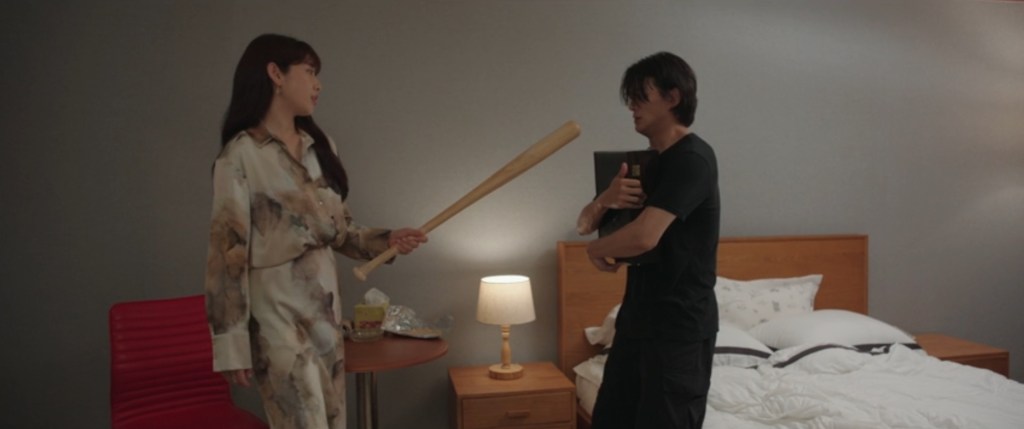
There’s a lot of back and forth, but it’s impressive how writer Jo Yi-soo keeps everything balanced. Throughout this climactic sequence, there’s a question of Bit-na and Da-on, and whether he’ll commit a sin to exact vengeance or make an arrest. Some of that balance is achieved by literal deus ex machina, in the form of Gabriel, who’s always introduced by a musical flourish akin to It’s a Wonderful Life, a movie which premiered almost 100 years of film language ago. It’s fine; generally speaking, I wasn’t a huge fan of the music in this show, though I’ll probably have “Gehenna” stuck in my head for a while, unfortunately.
Most of the penultimate episode is the mortal trial of Tae-gyu, and it’s pretty much like all the other trials. This is a criminal so brilliant he kept recordings of his murder victims, which turns out to be the smoking gun! Sort of. Bael had appeared to Bit-na on the eve of this trial, telling her that the return of Satan to hell has fulfilled her duty, but there’s one last thing: let Tae-gyu off and send him to hell. First of all, why is the defendant’s ex-fiancée presiding over his murder trial? Some of my questions about the show’s jurisprudence could be answered by an even cursory understanding of Korean law, surely. But second, Bit-na’s unpopular rulings are agonizing. Thankfully, she gives Tae-gyu the death sentence (audience cheers), despite that it means Bael – or a Grim Reaper guy – will kill her. Spoiler alert: she’s saved by Gabriel.
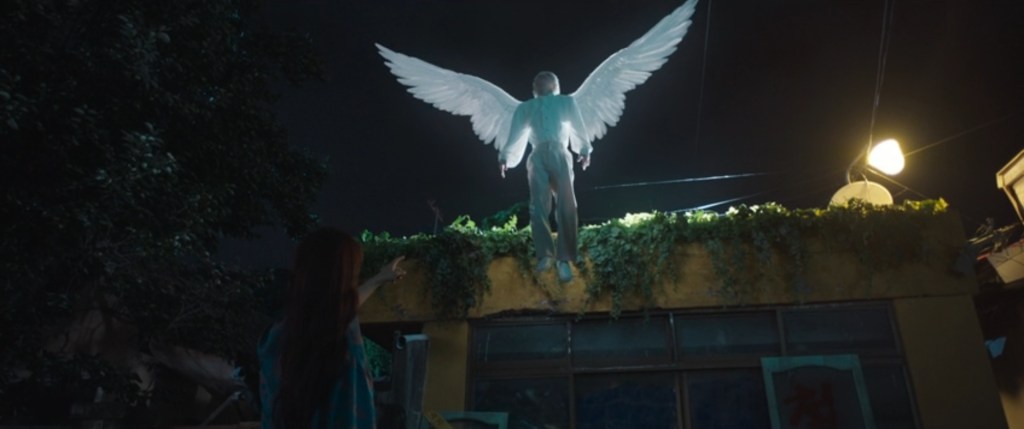
I kind of thought she’d defeat Bael and take his place, which might sound lame, but it’s got to be better than the actual resolution. Anyway, Tae-gyu escapes, allowing Bit-na one final infernal trial to kick off the final episode. At one point, she stomps his head through a little IKEA side table. That pretty much frees up the rest of the show to be an extended denouement, and it’s got that meandering quality like the end of The Last of Us Part II where you think, “They’re trying to find the profound thing and it’s proving elusive.” The Judge from Hell has far fewer thematic concerns, using this luxurious space to take a goodbye tour. Bit-na has been transferred to another courthouse, another city, and she makes a deal with Bael to live for three more years as a human in order to be with Da-on – again, sort of.
She says goodbye to all her coworkers, all the people at Hwangcheon Villa. And then after two years, she’s transferred back, and catches up with everybody – and more. We learn that the victims of the punished sinners are thriving or learning to survive, that Mando’s a Buddhist, that Lee Mi-do and the guy are engaged. It’s an indulgent ending, and I probably wouldn’t mind, but it made me reflect on the terror of TV endings in general. In most forms of storytelling, the ending is a crucial component. In the original The Last of Us, for example, there is no story without the ending. It would just be zombies. The ending is the aha moment, or the moral resolution, or catharsis, and only on television can it be like it is in The Judge from Hell. It goes on for so long and then has the audacity, the temerity, to be inconclusive. We don’t know if Bit-na – after yet another deal from Bael, by way of Lucifer – will decide to return to hell in a year or kill ten more sinners to be with Da-on forever. What the crap?!
In the final math, I enjoyed my time with The Judge from Hell, but only after I realized it wasn’t going to be “good” in the traditional sense. It was confused and weirdly aggressive and kind of an eyesore. I imagine it would be like attending a really loud punk-rock concert in middle age. You’d walk out, head throbbing, being like, “Okay, but why, though?” An imperfect stage for the perfect, novel concept of “Park Shin-hye beats everybody up.” Next time, let’s not overcomplicate it, and – if there’s a God in heaven – let there be a next time.



 With Eyes East