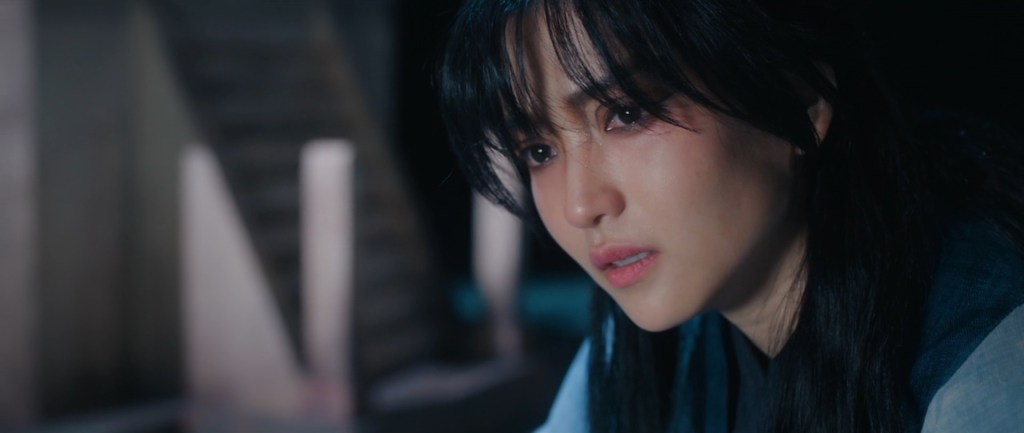
Episodes 9-12, the finale (spoilers)
I guess I’ve been on autopilot for the past few days. I’ve had time off because of the holidays, and there’s a family matter to attend to next week, so I haven’t been in a regular state of mind. I’d decided to dedicate this sort of limbo space to watching and writing about Jeongnyeon: The Star is Born, which might’ve felt indulgent but not wildly divergent from other experiences with K-dramas here. I basically binge-watched both Anna and Genie, Make a Wish, though not in such a concentrated period of time. To clarify, I generally don’t watch TV shows like that; I don’t even watch movies in one sitting. And although it didn’t match my exact expectations, Jeongnyeon turned out to be great in a more traditional way, as covered in the first report, before darkening, as noted in the second. Still, even at that point, I imagined I’d watch the rest of the show and type up this very blog post, easy peasy like always. Sitting here in the immediate aftermath of the finale, I can tell you that I don’t want to write this prophesied third report. I feel really, really weird. Bad, I suppose, but in an unfamiliar way. It might seem silly to be so affected by a work of entertainment, and I can’t address that without an entirely separate conversation about the social utility of art and what have you, so in the meantime, you’ll just have to excuse me. I think Jeongnyeon: The Star is Born is a really great K-drama. Easily one of the best I’ve seen. I also – at least at this moment – don’t believe I’ve been more harmed by a TV show. I’ve been disturbed, harrowed, and moved countless times, but this is different.
There’s an element of expectations once again, some of which were nurtured by the show’s early movements. To start, the original title of Jeongnyeon: The Star is Born is Jeongnyeoni, as it nearly is with the source material, Jeong Nyeon. I don’t know where the subtitle “The Star is Born” comes from, which suggests something not exactly expressed by the show. If Moon Ok-gyeong is to be believed, Jeongnyeon will one day take her place as the star of Maeran, and thus, a star will be born. As it turns out, very little of what Ok-gyeong says is meant to be believed. The final four episodes take on a downright apocalyptic pall, centering on two consecutive crises: Jeongnyeon losing her voice and going home, and Ok-gyeong abruptly leaving the company altogether, leaving Maeran to a slow death. In retrospect, it should’ve been obvious where the show was headed, given that I’d never heard of yeoseong gukgeuk before, and that it was, in all likelihood, a dead art form. Or at least, one that doesn’t have the same cultural primacy it once enjoyed. In the finale, male reporters are desperate to get inside the audition room to cover the showdown between Jeongnyeon and Yeong-seo, and that seems so fantastical. As is made bitingly clear with Joo-ran’s farewell, the show’s depiction of gukgeuk’s waning days is an elegy for a time when women ruled the world. The substance of that depiction is inherently deconstructive, filled with self-doubt and a cold awakening to the reality that everything once held dear might be impractical, useless, and better abandoned.
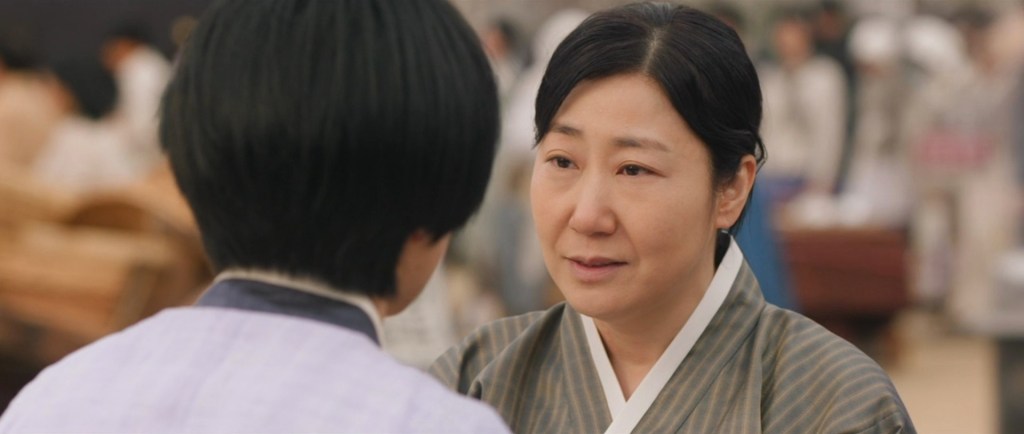
It’s almost obscene how sad the show becomes in its final episodes. Jeongnyeon returns to Maeran too late, Joo-ran can’t even face her because she’s being married off, Director Kang suffers a breakdown, and of course, the one character we all thought was so cool and generous turned out to be a flake. It’s like the show saying, “Everything you valued is now bad and broken, and nothing will ever be the same.” It’s sadistic. But it’s not sudden. All of these disasters have been building gradually, and everyone was too distracted to notice. It’s true that Director Kang should’ve been more prepared for Ok-gyeong’s well-telegraphed departure, even if it came sooner than expected. And Ok-gyeong never lied. She was looking for a replacement, and when that replacement permanently damaged her vocal cords, the game was over. In the end, Ok-gyeong truly didn’t see Jeongnyeon as a friend, and while she never indicated otherwise, her “artistic temperament” remains undeniably cruel – to herself, even, with the reveal of her suicidal tendencies. It did shade the character, which is what I wanted from the start, but this has really taken the wind out of me. Also, this is the second Jung Eun-chae show in a row where she’s not even in all the episodes. Again and again, it seemed like Ok-gyeong might come back, that she’d help fund the final production or at least show up to the premiere – even outside, when the fireworks go off – but no. She’s gone.
In those dog days, I’d become nostalgic for the relative frivolities of the first half of the show, when things were dramatic but safely contained within durable, storied walls. Joo-ran’s sister is sick with tuberculosis, so Jeongnyeon covers the waitressing gig, setting off a chain reaction covered previously. That’s fine. However, this aspect of Joo-ran’s life comes up again when her mother arrives with an offer for her to marry a wealthy man who’ll pay for all the sister’s medical expenses. “How long are you gonna keep playing make-believe with that theater troupe?” is effectively the question, and Joo-ran doesn’t even have to think about it. She keeps it a secret from Jeongnyeon, but announces her exit ahead of the auditions, where she was all but guaranteed to play the female lead. It’s impressive how broadly and how deeply this goes, how much dramatic potential is wrung out, to where Joo-ran’s actress, Woo Da-vi, has tears on her face scene after scene after scene. Her keeping the secret strains her friendship with the recently returned Jeongnyeon, she’s become friends and creative partners with Yeong-seo, and of course, her gay awakening is being snuffed out by marriage to a man, one she’s never even met and whose family disapproves of gukguek. One night, she asks to practice a single scene with Jeongnyeon, and when she gets emotional, covers by saying she’s getting too into character, but it’s because she knows it’s the last moment she’ll have with her true love.
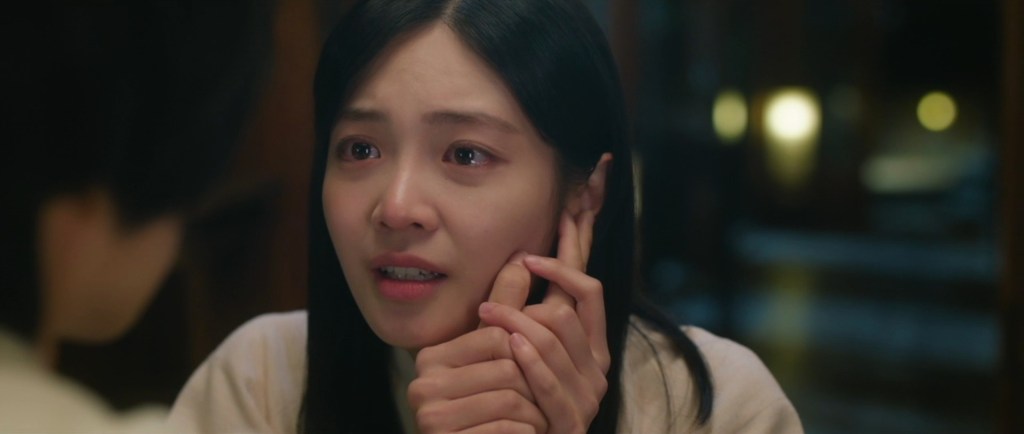
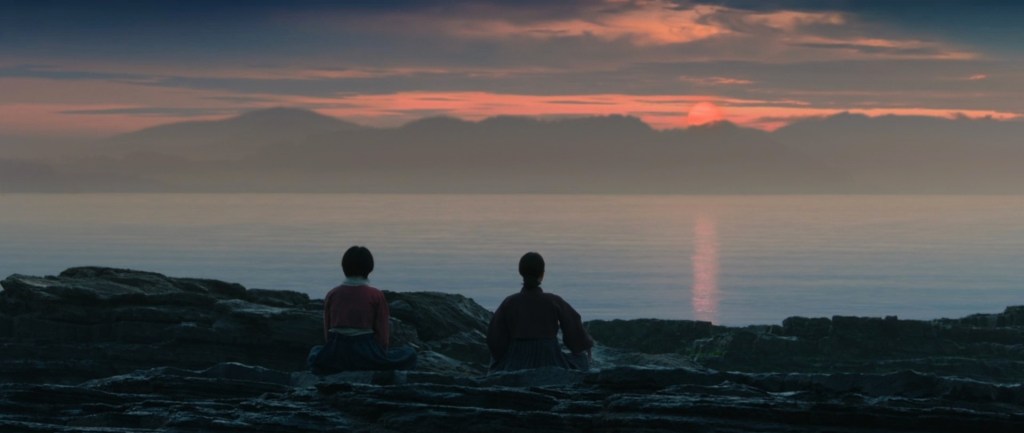
With Ok-gyeong gone, Director Kang back from the hospital, multiple troupe members having quit, and hoarse Jeongnyeon demoting herself to trainee status, the hierarchies in Maeran have broken down. The young actors like Cho-rok and Bok-sil speak out of turn at the morning meeting and the director listens to them. Yeong-seo expresses gratitude to Joo-ran before she leaves, this girl who meant nothing to her at first. Things continue to complicate, however, with a trio of redemption arcs. First, it’s Jeongnyeon’s mother, Yong-rye, who was the legendary Chae Gong-seon in a former life. Kang and Yeong-seo take the long drive to Mokpo to get Jeongnyeon back, but Yong-rye discourages them, going so far as to splash Kang with a bucket of water and ordering Jung-ja to “Get the salt!” And so, in marked contrast to the romantic “put this town in my rearview” exit of the first episode, Jeongnyeon resolves to return to Maeran only with her mother’s permission. It’s the greatest sign of maturity for a Jeongnyeon who has, naturally, slowed down a bit. It also becomes a subversion of the fantasy of a young starlet making it and rescuing their family from “the life before.” Kang asks Yong-rye to teach Jeongnyeon how to sing with a broken voice, and while the fallen star remains stubborn, she eventually gives her daughter a singing lesson at sunrise. Indeed, Jeongnyeon finds she needed to be rescued by her family.
Then there’s Yeong-seo’s mother, Ki-joo, though this one is a bit less clear. In order to pay Maeran’s debts left over from the aborted production of The Princess and the Fool and fund the Hail Mary production of The Legend of the Two Pagodas, Yeong-seo seeks out the inheritance promised by her grandfather. Unfortunately, she finds Ki-joo devastated by the loss of her other daughter to marriage, which will end the opera singer’s career. Ki-joo takes this as a personal failing, and we see her at a low moment. What I don’t get is how that anguish translates to antagonism toward Yeong-seo here, but the point of the scene is for Yeong-seo to declare that she’ll give up gukguek if she can fund Maeran. It’s a big development, one consistent with her character, but not consistent with the scene. Wouldn’t Ki-joo be happy to keep Yeong-seo in the performing arts? Finally, we have the biggest surprise, when Director Kang visits Ok-gyeong’s house and finds the little girl – Hye-rang’s daughter – outside playing alone. Inside, Hye-rang is drinking herself to death. Apparently, Jeongnyeon’s earlier words burrowed deep, when she went looking for Ok-gyeong and found a spiteful Hye-rang instead, who told her that Ok-gyeong doesn’t care about her former apprentice anymore. Jeongnyeon’s response is that Hye-rang should let go of someone like that, as she intends to, while determined to remember Ok-gyeong fondly. Of course, what really got to Hye-rang was being called an “empty shell” somewhere in this exchange. Kang advises her to get cleaned up for the sake of her daughter.
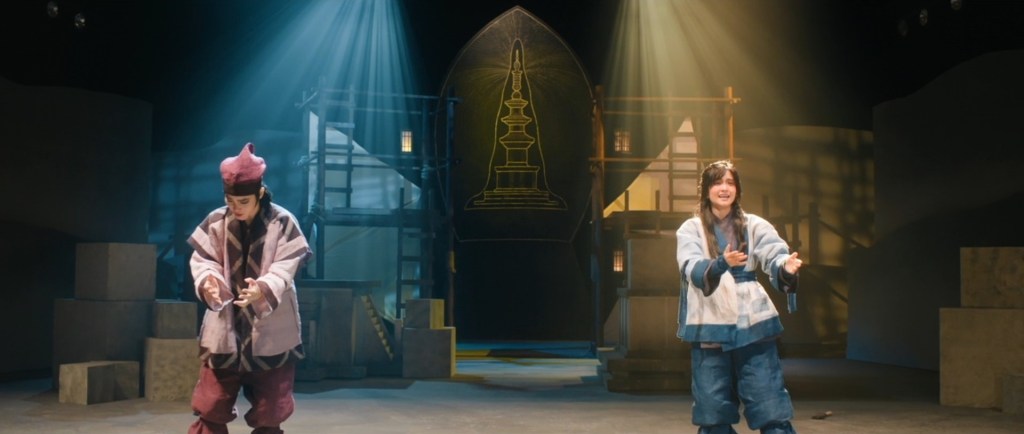
And so, Hye-rang shows up to the production of The Legend of the Two Pagodas, as well as Ki-joo, and Patricia Kim, and even Yong-rye and Jung-ja. The fangirls attend, too, eventually reasoning that while their hearts remain with Ok-gyeong, there’s space for Jeongnyeon and Yeong-seo as well. Everyone’s here for different reasons, but when the lights dim, the only thing that matters in the world is this final performance, which is also true for Jeongnyeon and the troupe. Maeran had held auditions for the male and female leads with the last of its dignity, with Cho-rok automatically winning the princess character following Joo-ran’s departure. That leaves Jeongnyeon and Yeong-seo and the male role between them. The relationship climaxes moments before the audition, when the two young women exchange knowing looks that speak volumes of their shared history: they’re not rivals anymore. And although Yeong-seo gives a stirring performance, she’s the first to call it for Jeongnyeon. She’d spoken with Director Kang earlier, who could relate to always being in second place, as she had been with Chae Gong-seon. And so, Yeong-seo will play the villain, who turns out to be more of an ally in the end. This will mean that her dialogue will reflect her actual experiences, just like the death scene in The Princess and the Fool had for Ok-gyeong and Hye-rang.
For being so mercilessly tragic, Jeongnyeon: The Star is Born is not about grief, but its characters are nevertheless forced to accept impossibly difficult realities. Jeongnyeon has to accept that she’ll never be whole again, Yeong-seo has to accept that she’ll never be the best, Director Kang has to accept the end of Maeran as she knows it, and the Maeran troupe will put on their last performance by having the time of their lives. The world changes, and people leave – with a trail of destruction in their wake or by choices not their own – and all we can do is remember the good. It’s a simple moral lesson, one spotted on YouTube comments the Internet over (usually about how video games aren’t the same anymore), but as I discovered with the first K-drama report now six years ago, the function of story is to reformulate or recontextualize that lesson, to speak to the heart instead of the head. And that’s actually what kind of messed me up after finishing the show. I was in utter shock over Moon Ok-gyeong’s final moments, and overall, I’ve been in this nonstop state of tears or near tears for the past few days – which I honestly don’t think is healthy – but the show’s parting words actually worked as a healing tonic. Remember the good, move on. I didn’t want to go back through the show and revisit all the sadness in order to write about it.
If I could go back in time, I would advise myself not to binge-watch this show. Recovery time is necessary, although I could hardly sleep last night, with about 20 minutes to go on the penultimate episode. Naturally, I was thinking about Ok-gyeong. She had to come back, right? And I was genuinely unsettled by Jeongnyeon losing her voice. Both developments, I think, were almost too dark for the tone the show had exhibited. But at least I see why Jung Eun-chae took on this role (one apparently vacated by Kim Hieora), because a “nice lady” felt like a waste of her talents, no matter how cool she looked.
And where do I go from here? I have just enough time to squeeze in another K-drama before Park Shin-hye’s new show, and it should be a Bae Suzy if I’m alternating – Start-Up, probably, which I’d eyed after Twenty-Five Twenty-One, and plus, it’s got Kang Han-na – but I now have a Jung Eun-chae-shaped hole in my heart, so I’ll probably at least watch one of her movies. However, like the really impactful shows, Jeongnyeon might have broken my K-drama fever anyway. I was on a good tear, but maybe it’s time for a break. This one was really, really rough.
 With Eyes East
Heh – it’s good to see how much you enjoyed Jeongnyeon. I liked it a lot as well, though I do not think it effected me as hard – I just thought Kim Tae Ri was great and deserving of all the accolades.
The series did have me searching to learn more about gukgeuk and pansori, and of course I started with the English Wikipedia where I learned the following about pansori: “If Pansori comes from a shaman’s husband, a clown, the musical wish should be saved in their connection.” and I’m sure all of us fans of the series can agree with that. (The page is obviously a very poor machine translation of the Korean page, and to this day no one has attempted to fix it.)
Gukgeuk started a few decades after a similar form of theater arose in Japan which started with the Takarazuka Revue. I do not know if there was a direct connection because of intervening occupation of Korea by Japan, but it had a very similar history of explosive popularity and the rising of rival troupes and dealing with issues around gender roles in these two very conservative cultures. As I understand it, the Takarazuka Revue remains relatively popular to this day though its last rival troupe died in the 90s.
Pansori is a form of folk singing, and there is a current singer, Song Sohee, who came to prominence at age 8 for singing the local folk tradition of Seoul, Gyeonggi minyo. You’ll find the style of with its vocal flips and control of vibrato very similar to the pansori in the series. I bring her up because now in her 20s she has taken some very interesting steps towards integrating that traditional form of singing with, of all things, New Age music like Enya and, more particularly, Loreena McKinnet. I recommend checking out any versions of her song “Not A Dream” on YouTube or the streaming service of your choice.
LikeLiked by 1 person
Fascinating history. I wonder if they get into the Japanese origins in the webtoon; I kept expecting something along that line, as they were sure to note that some of the language in the show was Japanese. But I was surprised by how little the show felt like it was even set in a time and place, because it was such an isolated pocket of society, and maybe that makes sense. But that’s great about Song Sohee (“Traditional Music Girl”), that pansori lives on even today.
LikeLike