
Directed by Takashi Yamazaki
Starring Ryunosuke Kamiki, Minami Hamabe, Kuranosuke Sasaki
The question isn’t about potentially overstating Godzilla Minus One with hyperbole, but rather which hyperbole to choose from? So far, I have “In terms of improving upon source material, Godzilla Minus One may be the greatest remake of all time,” and “I didn’t expect a Godzilla movie to make me cry, but here we are.” In terms of the first, I’d had the sense that I wanted to go into this one knowing as little as possible. I wasn’t as fixated on the advent of a new Godzilla movie as I had been for, say, a new Predator, because we were just recently gifted with a great installment. So, going in, I knew that Minus One took place directly after World War II – and that was pretty much it! Would this be a remake of the original, down to Serizawa and the Oxygen Destroyer? And most importantly, what would the titular monster mean this time?
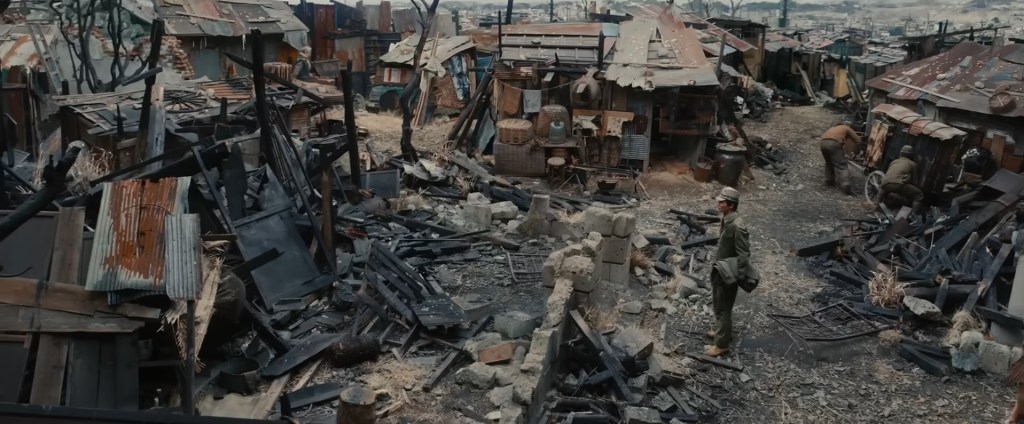
Godzilla Minus One begins in the final days of World War II and takes place over the next few years. Japan is in ruins, and the film identifies a microcosm for postwar recovery in kamikaze pilot Koichi Shikishima. Upon his return home, he’s scorned for what’s considered to be the kind of cowardice that lost the war. And yet, his castigating neighbor doesn’t know how right she is – after landing his explosive plane on Odo Island for unneeded repairs, the garrison is attacked by the native Godzilla, leaving Shikishima and the lead mechanic Tachibana the sole survivors. He just couldn’t pull the trigger when he had the chance. Now Godzilla’s making his way toward Tokyo, having grown massive thanks to, well, you know.
This year, a single volume collecting the novelizations of the original Godzilla and its first sequel Godzilla Raids Again was released for the first time in English. It was an occasion for me to revisit the awkward approach of the original movie in telling this story, being a docudrama in the first half and an almost-love triangle in the second. Despite the film’s reputation, its story beats don’t feel definitive like in, say, King Kong. You know, you got the island. Dinosaur fight. Bring him back. Empire State Building. ‘Twas beauty. In each Godzilla reboot and each American remake, the story is overhauled for something similar but different. In Godzilla Minus One, we have a story arc that develops over the course of the entire runtime, and the problem of “how do we put this human character in the Godzilla set pieces” is solved elegantly.
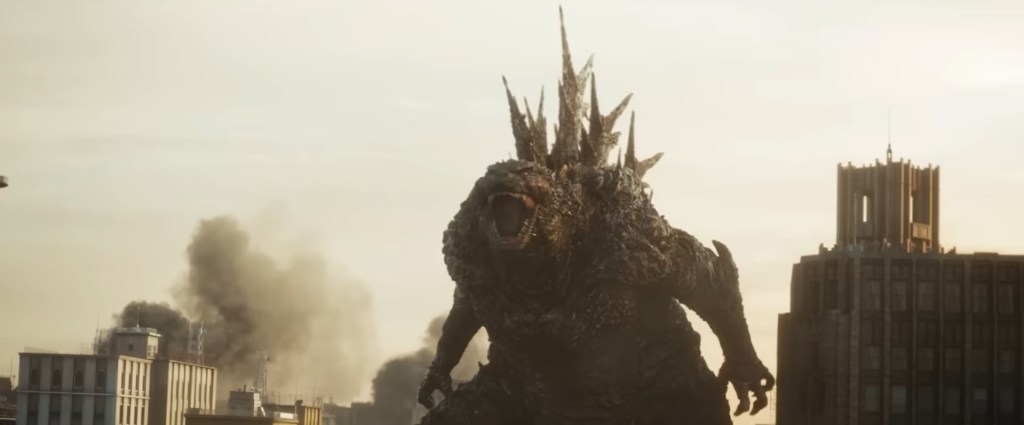
There are four Godzilla set pieces, and they’re all unique but follow logically from the insistence in Shin Godzilla that Godzilla is enough. We don’t necessarily need a second monster or an alien invasion or even – and we’ll get there – social commentary. In Shin Godzilla, the atomic ray is an entire set piece, not just something that happens, and it’s breathtaking. Here, the atomic ray is a mini-nuke, and I swear to God, the theater I was in had the volume cranked too loud. I felt it. There’s the initial attack with a miniature (or perhaps normal-sized) Godzilla, a battle at sea, the centerpiece attack on Ginza, and the final operation. Shikishima is involved in each one, and while on paper that seems coincidental, in practice, it’s more like he’s being haunted by the monster.
Shikishima has nightmares from his time on Odo Island, and his survivor’s guilt is so severe that he sometimes wonders if he’s only experiencing the dreams of an actually dead person. The very title “Minus One” refers to the destruction of Japan after being at “zero” following World War II. My limited expectations did allow the concern that this movie would be depressing (and then, nationalistic). With a deft hand, however, we keep things light. Shikishima joins a minesweeper boat, and when the captain, Yoji, hears about Godzilla, he rallies the crew in the ganbare spirit. “Godzilla’s headed toward Japan. We’ll stop him.” Then he sees Godzilla eat another boat and says, “Never mind. We’re leaving.”
It isn’t the same kind of comedy as Shin Godzilla, which made the first generation of bureaucrats look like fools. Godzilla Minus One isn’t a criticism of anything, even though its characters criticize the Japanese government for being ineffectual and secretive. Its concerns are less sociological and more psychological, individuating a collectivist society to explore themes with little precedent in Godzilla-land, like duty, manhood, and ultimately, the will to live. The result is a truly heart-wrenching horror drama, a top-down reboot every bit as successful as Prey, and – saving the best hyperbole for last? – it’s the best film of the year.
Spoilers!
But is it better than Shin Godzilla? There isn’t an even remotely appropriate opportunity I’ll let pass without lavishing the 2016 film with praise. It’s the kind of Godzilla movie I’d want to make, where Minus One is far more classical (actually, I’d want to do one with practical effects). The depths of my Shinsanity are such that I almost didn’t want Minus One to be better, because that would shatter how I’ve come to define myself. And, deus ex machina, they’re difficult to compare. As Minus One is “classical,” it increasingly puts Shin Godzilla in a different context – not the First Great Godzilla Movie, but a radical reinterpretation that’s nonetheless a masterpiece.
In the details, unfortunately, the comparison isn’t always flattering for Minus One. Where Shin captures a very specific, vibrant aesthetic in modern-day Japan, Godzilla Minus One has a somewhat plain visual appearance despite the period setting. It doesn’t have the earlier film’s mad, meticulous compositions, nor the grey grandeur of the 2014 Godzilla. It isn’t so awed by spectacle, though this is on purpose. Godzilla himself isn’t as convincing as earlier CG models, with stiff and then too-fast movements to give his powers an anime snap. Of course, I’m perfectly fine with CG Godzilla going forward, as the rubber suit legacy lives on in toku projects like Ultraman Blazar, with its own tonal self-confidence. And finally, the acting can be spotty, in the absence of a singular, focused tone. The characters speak to each other in shouts, and the at-times repetitive dialogue gives the performances a vintage, 1950s feel. Again, though, maybe this is purposeful.

Whatever my misgivings, Koichi Shikishima remains a compelling character. Unlike the blank badassery of the 2014 hero, this military man is vulnerable. The actor Ryunosuke Kamiki (a box office superstar in his home country) is given wide latitude, including a pained, primal scream into the air after the Ginza attack, and the final note of relief that has him breaking down in tears. I appreciate that he’s kind of edgy, too, kind of sketchy, distancing us for the final act; we’re left to wonder if he’s planning on fulfilling his kamikaze duty. On one hand, he has that survivor’s guilt, but on the other, he has a daughter back home. And then, on the other hand again, he’s claimed that Akiko isn’t really his daughter, and so on.
It’s just so remarkable, because even the best Godzilla movies are thematically bereft, being throttled by the central metaphor. We understand that Godzilla was originally a symbol for the atomic bomb, and when he becomes defender of Earth in sequels into the ‘60s, we find him malleable. But within that malleability, he always has to be something. A hero, a god, a destroyer, an animal. Writer/director Takashi Yamazaki deemphasizes that aspect, because while his Godzilla is a “destroyer” if anything, it’s only so that he destroys. Redoing the famous train bit? Put someone in the train who we care about. Less a metaphor this time around, he’s simply a very large adversary.
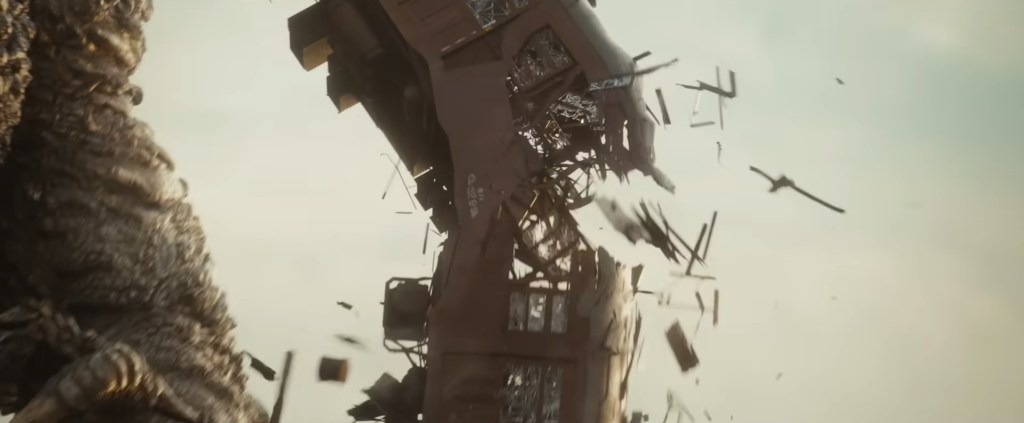
Which may be semantic, but once Godzilla is entered into the thematic fabric of a story as a metaphor, he requires thematic resolution. The original film is about breaking the cycle suggested by the atomic bomb. Defeating the “adversary” in Godzilla Minus One exists on a dramatic level, because what’s important isn’t the terrible consequence of The Weapon, but the human decision-making in the moment. There is no Oxygen Destroyer, though they had me for a second with that tank of water. Instead, the plan is to sink Godzilla with freon gas, using the ocean’s pressure to crush him. The operation requires Shikishima to lure Godzilla with a fighter plane, though he secretly plans to kamikaze the monster. That’s what Godzilla “means.” He’s here to facilitate this choice for the character, and the decision that he ultimately makes – is to live.
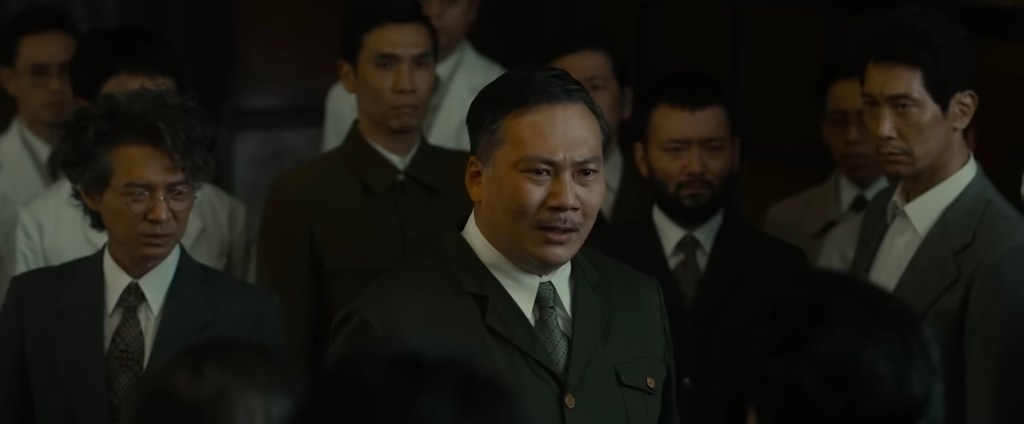
Despite being a long movie, I did feel the absence of one sequence, and it’s one regarding Tachibana. He’s the one who tells Shikishima to live, and while that makes sense because they both survived Odo Island, I want to know how Tachibana came to that conclusion himself. In general, the character work was strong enough that I kind of put the pieces together in my head, that all these veterans are realizing how ruinous their war truly was. Shiro, the minesweeper rookie character, says he can’t wait to finally see action in the Godzilla operation, having not served in the war. Captain Yoji tells him he isn’t going, on account of a broken arm. Shiro’s frustration finally boils over. “It’s because I’m not a veteran, right?” Yoji stops and says, “Not having served in war… is something to be proud of.” That broke me. I had tears actually rolling down my face in the theater.
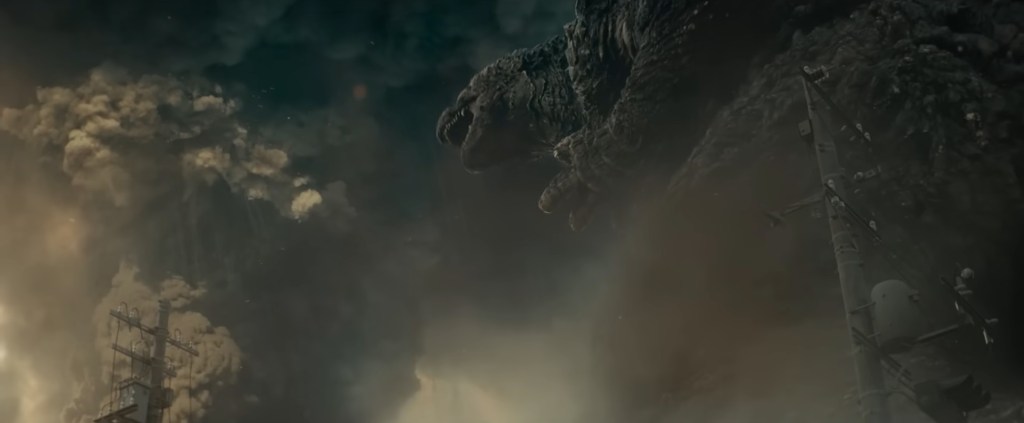
While the minor technical faults should probably take off half a star – properly subordinating Minus One to my beloved Shin Godzilla – a film this moving is worth the highest recommendation. While not explicitly commenting on recent events, it is a timely reminder of the hard line between civilian and soldier within individuals caught up in wartime. For belligerent nations like Imperial Japan, there has to be an alternative to bombs and battleships, if only because there’s so much in the world to live for. Godzilla Minus One is a big, beautiful film, matching the impact of its higher-budgeted brethren not with spectacle but with the scope of the human heart.


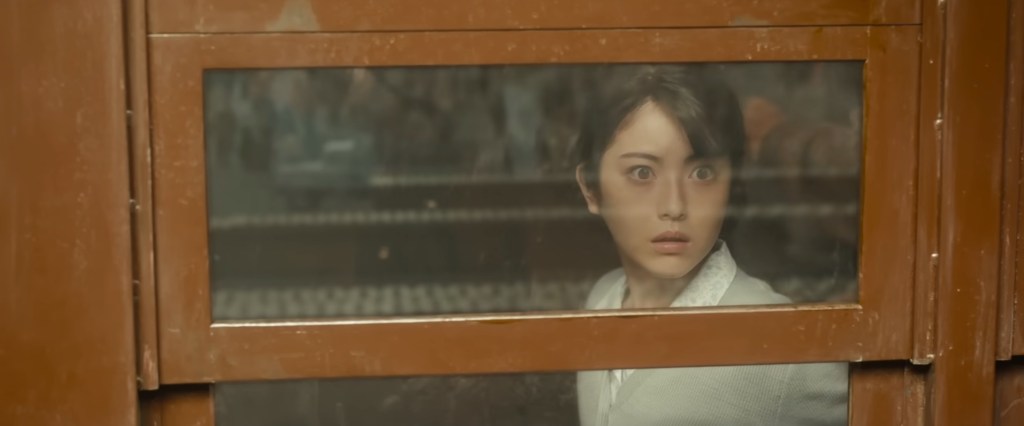
I’m surprised you didn’t mention the female lead, though you have 1.5 images of her (she’s on that train that Godzilla is holding). Where does she fit within your analysis? Was there a similar character in the original? Would the male lead be as sympathetic without her?
LikeLike
Very interesting review. To me, the standout feature of Minus One is that there are so many non-Godzilla fan reviewers stating that it is the best film of the year. I find the dismissive tone of many others towards this film (none of whom have seen it) to be humorous when the highest lauded film for most of them is based on a plastic doll. While Minus One might (but probably won’t) win a “special effects” Oscar, the truth is that this film should be contesting for Best Film – or at worst, Best Foreign Film.
LikeLike
Thanks, Norman! Yeah, I was so excited by the critical response in America that I ended up reading/watching maybe too many reviews (with too many plot summaries). Everyone’s been so blown away — myself included. I’m definitely gonna see the black-and-white rerelease later this month.
Japan submitted Wim Wenders’s Perfect Days for Best International Feature, which makes sense given their Oscar success with Drive My Car (and not Shin Godzilla). I’d put my money on Anatomy of a Fall, which is a pretty good movie (great performances), but I know which 2023 release will stick with me.
LikeLike
Exactly my point: if people could get over their pre-judged ideas about “a Godzilla movie” and actually see this film, I still think it would have a Best Picture nomination, much less Best Foreign Film. I mean, we are not many years away from a “controversy” surrounding the possibility of nominating a Marvel film for Best Picture, correct?
LikeLiked by 1 person