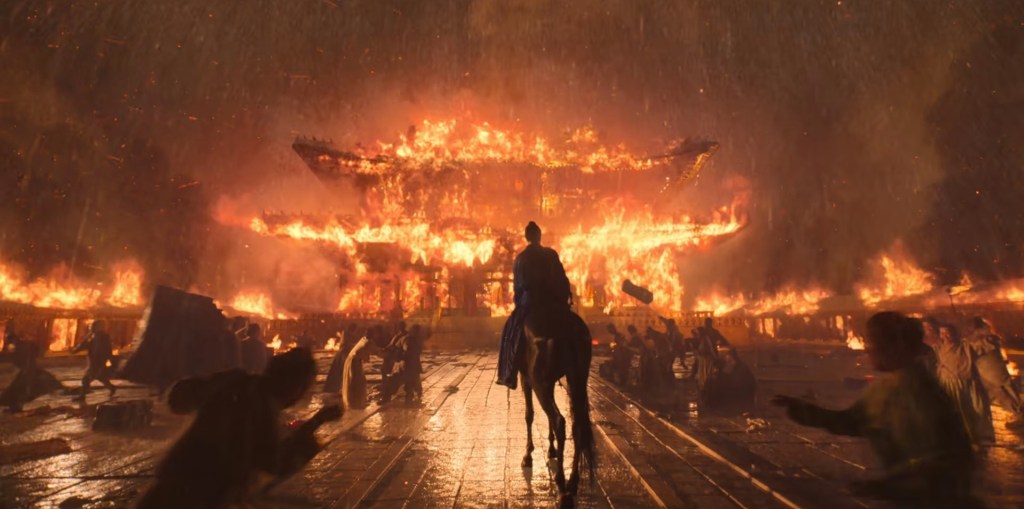

Directed by Kim Sang-man
Starring Gang Dong-won, Park Jeong-min, Jung Sung-il
The 2024 historical epic Uprising is about two things: the Japanese killing Koreans, and Koreans killing Koreans. This is literally the experience in an early sequence of two cross-cut battles, when Toyotomi Hideyoshi’s samurai advance beyond the Han River in the first invasion of the Imjin War, and the hungry Joseon masses turn on the fleeing King Seonjo (who Wikipedia notes shouldn’t be confused with Sejong the Great). Fans of the recent Shogun will remember Hideyoshi as the taiko whose death incites the feudal struggle for power, briefly embodied as “Nakamura Hidetoshi” by my man Yukijirô Hotaru, of Zeiram (and not actually featured in Uprising). Apparently, this guy was trying to take Korea all the way till his consequential death in 1598. And fans of Netflix’s Kingdom will remember the Imjin War, the historical backdrop to that tragically short-lived zombie masterpiece. Well, rejoice for now, as Uprising shares the same brutal world of beheadings, cannibals, and funny hats – stopping short at zombies, of course, but not before outrageous political corruption. It’s a timely tale of ancient revolution against a cruel aristocracy.

Uprising is also a lost Park Chan-wook film. The famed director of Oldboy cowrote the script with the intention of directing, but chose to do HBO’s The Sympathizer instead, retaining a producer credit. I was surprised. He’d never played in this genre before, the historical epic, with its decorum and aspirations of accuracy, prohibiting a subjective camera and darker-than-night black comedy. And yet, Uprising bears plenty of Park hallmarks, beginning with its nonlinear structure, moving back and forth in time like a half-remembered account gradually taking shape. Less generously, my thought was, “This story is being told by an asshole.” Despite one absolutely necessary chyron, of “seven years later,” a lot of the movie slips and slides like Lady Vengeance, though not nearly as confusingly. Maybe more arbitrarily? It’s mostly in the introduction of our hero Cheon Yeong, who we meet as an adult, then a child, then an adult, and so on. A nefarious legal loophole dictates that his commoner status be downgraded to slave – as a young boy – and he serves as whipping boy for Lee Jong-ryeo, the son of a Joseon official.
Jong-ryeo is training to be a soldier, but he’s not a great student, and whenever he messes up, the whipping boy is struck. See, Jong-ryeo will be a general someday, so he can’t have scars on the backs of his legs. Cheon Yeong, after countless lashes watching Jong-ryeo falter in training, decides to learn the sword and teach the damn kid himself. Already a gifted fighter, this puts him side-to-side with Jong-ryeo, and the two develop a brotherly bond. Which isn’t clear right away, especially as we first see an adult Cheon Yeong, captured by slave hunters, threaten to kill Jong-ryeo’s entire family. In a way, it’s the puzzle-box reveal of a relationship like in The Handmaiden, though the homoeroticism is muted here. Park’s direction is also lamented in glimpses, like when young Cheon Yeong and Jong-ryeo’s father exchange a surprised glance after Jong-ryeo has a sparring breakthrough. Slave and master, having a moment! That sort of comedy inside an extremely non-comedic context requires a deft touch.

The Japanese invasion throws the master’s house into chaos, giving the many, many slaves a window to revolt. It’s bloody and chaotic, with those hardwired with slaveowning supremacy still not quite getting it. Jong-ryeo is off escorting King Seonjo to safety, and Cheon Yeong only emerges from “the hole,” basically, when it’s all over and everyone’s dead or about to self-immolate. He decides to join the fight against the invaders and hopefully reunite with his old pal. The battle scenes that follow, including those described at the top of this review, are strangely out of step with, at least, my expectations for the genre. Compare and contrast to the battles in Hwang Dong-hyuk’s 2017 film The Fortress, which takes place about 50 years later, when the Chinese invaded Korea (one of the worst geographic locations in history). I love how Hwang lenses fight scenes, especially the hand-to-hand combat in Squid Game, and the set pieces in The Fortress are similarly gritty and grounded. There’s a “comic book” quality to the same scenes in Uprising, with Cheon Yeong at one point jumping from a tall height to flank the enemy, which is more “action movie” than “war movie.”
Add in some rockin’ guitar to the score, and I was flashing back to the Cinemax show Warrior, whose pulp sensibilities paired strangely (but not ineffectively) with its story of violent racism in 1800s Chinatown. I kind of read Uprising‘s high-flying style as a reasonable interpretation of a Park script, which likely doesn’t hew so rigidly to reality. Something similar happened with the American remake of Oldboy, down to Pom Klementieff’s sexy assassin. Or it could’ve been the intention regardless, as there’s an undeniable capery undercurrent with Cheon Yeong’s eventual team including such archetypes as “the kid,” “the rogue,” and even a token woman, who’s rad. Very emotional, but super rough-and-tumble. She believes firmly that the government will always screw you over, a position not totally shared by ex-slave Cheon Yeong. Guy takes some convincing along the way, as he tangles with the samurai left over from the invasion, now roving guerrillas in enemy territory.

Really, there’s a lot going on here. Uprising is only two hours long, but it feels bigger, if not longer. Moving at a steady pace, it is so dense with battles and betrayals and backstory; it’s a proper night at the movies, on Netflix. Cheon Yeong’s journey is not a straight path, any more than its telling, but it does build to the reunion with Jong-ryeo, now at the mad king’s side and convinced that his former friend/slave made good on his murderous promise. In between, we’re witness to a breathtaking uprising during the Japanese invasion, as Joseon is consumed from within by proletariat anger.
As far as recent events go, it’s imagery that anticipated the chaos in Nepal, and the ever-present threat of civil war in my own hometown. We’re not quite at “eating dead bodies,” but throwing rocks at the king? Make it a sandwich and you’re in America, buddy. As with The Handmaiden, though, all that historical violence is in the background, with Uprising also more concerned with the individual, the human psychology under colonialism and social bondage. See how slaves become generals, invaders become secret police, and rebels become opportunists. The resolution is less cathartic than in the 2016 romance film, less sweeping, and more classically Park-cynical. People die horrible deaths, but not before being total bastards.
 With Eyes East