Does anybody know what a ninja is?!
So, I got into anime relatively late in life, and it was a lateral move, from an existing interest in science fiction movies. As a big fan of The Matrix, of course my first anime was Ghost in the Shell. And I liked Trinity, but wow, the Major? Now, there was a helicopter-wrangling, tank-wrassling straight shooter – and unlike what I was used to, she wasn’t alone. There’s her cousin Deunan Knute in Appleseed, Priss and the Knight Sabers in Bubblegum Crisis, Nausicaa, Battle Angel Alita, Armitage III, the Dirty Pair, Gall Force, Iria: Zeiram the Animation. It’s an embarrassment of riches. An embarrassment.
The creator of the Major is a mangaka called Masamune Shirow, who’s perhaps as known for Ghost in the Shell as he is for pretty out-there pornographic art. The cynical read into the prevalence of action heroines in anime is not the unreasonable one, that as Peggy Olsen says, “Sex sells,” especially to the perceived demographic at the time. Maybe the most famous of these such characters is Rei from Neon Genesis Evangelion, which is where the sexual component becomes more taboo and yet more widespread. You’ll find her on the cover of an academic text entitled Beautiful Fighting Girl by Tamaki Saito, which is more about otaku psychology, but it’s amazing that there can be so many of these “fighting girls” that one can approach it like an epidemic. One that’s spread to Japanese video games, Japanese… movies?
Well, okay, there’s Lady Snowblood and Sister Street Fighter. Stuff like that. Great stuff – Meiko Kaji, Etsuko Shihomi, amazing – but if we’re talking about quantity, they’re outliers compared to their animated counterparts, and to the amount of star power in, say, contemporary Hong Kong action cinema. Now, I realize Hong Kong and China have martial arts traditions, but Japan does, too. It’s possible to make movies about karate. Either way, there’s a gap here. What’s going on? What happened to the live-action Japanese fighting girl? How could something with such an obvious appeal, to otakus and action fans– whoever– be so rare?
Rina Takeda

This is Rina Takeda, a black belt in karate here making her cinematic debut in 2009’s High Kick Girl!, directed by Fuyuhiko Nishi. Despite the exclamation-pointed title, High Kick Girl is stoic, with a relaxed camera like the respectful spectator at a live martial arts demonstration. Not a lot of music, not a lot of dialogue. One of the first things you’ll notice is the slow-motion replay, like a sports broadcast, which is impressive without CG enhancement or quick cuts. Like, these hits have to land. Strangely, though, these replays are not cut seamlessly into the sequence, but instead call attention to themselves. This has to be on purpose, like cleared of certain formalistic elements, this is not a movie, it’s a demo reel. Our story begins here because High Kick Girl would seem to be a conscious effort to launch the career of an actual, factual Japanese fighting girl.
It’s a rare kind of movie, but not unprecedented. If you remember, Steven Seagal’s first movie opens with autobiographical information about his being an actual aikido instructor based in Japan – I mean, a secret CIA special agent. Right off the bat, Rina Takeda is a commanding presence on screen; all the more so that she was 17 at the time! I like that she’s an asshole. She knows she’s good at this, and she’s gonna let everyone else know. But listen, kiddo, that’s not how karate works. Like an old-school kung fu movie, High Kick Girl espouses a martial philosophy, in this case that karate is not meant for fighting but self-defense. So says her karate master, played by real-life karate master Tatsuya Naka, who apparently won the kumite in 1992. I guess this is why there aren’t a lot of karate movies. I mean, if the project of High Kick Girl is to promote Rina Takeda as an action star, it’s kind of an odd note. I’d say it becomes downright frustrating when, as part of her learning this martial philosophy, she’s sidelined in the second half of her own movie, in favor of Tatsuya Naka. I mean, he’s cool and all, but far less unique as a high kick man.
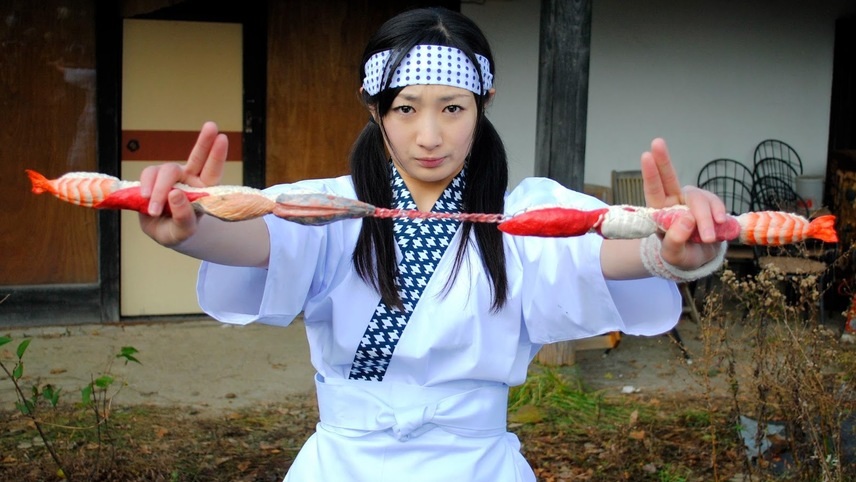
Following her debut, and like with Steven Seagal’s early career, Takeda enjoyed a run of similar-sounding movies, such as 2011’s Karate Girl and 2011’s The Kunoichi: Ninja Girl. So, a successful launch in one regard, but maybe she’s being typecast. She’s an action guy, but is this all she wants to do? In interviews, she expresses her enthusiasm for Jackie Chan and says she’d love to work with him someday. Director Noboru Iguchi gave her the next best thing: the lead role in a zany horror movie with Chan-style comedy. The result is 2012’s Dead Sushi, a deliberately silly movie made in the waning days of the splatterpunk era. By this point, we’d already had Ichi the Killer, Tokyo Gore Police, and Iguchi’s own Machine Girl, so the prospect of killer sushi almost seems quaint. It’s like she just missed the boat for the craziest stuff, but she’s great in a comedic role. And of course, slapstick can be pretty brutal. After she beats up her first opponent, she just starts stomping his face for a little bit. Takeda makes the most of this opportunity, but it’s still a movie about killer sushi, and even if you can physically fight sushi, it’s probably not gonna look super cool.
Danger Dolls is more like it. Straight to the point, no bullshit. This is a 2014 Takeda movie where, after the Cold War, American President Ronald Reagan outlawed guns, and we cut to present day Japan where cops are chasing a criminal, and everybody’s wielding swords. Our heroes are four young women who protect the world from supernatural bad guys they refer to as “filthy invaders,” and for their next mission, they have to go undercover as pop idols so as not to arouse suspicion. I may have spoken too soon. It turns out that these invaders are not monsters but rather people who have crossed over from a parallel dimension, in which their parallel selves are already idols. That doesn’t make sense. And I don’t mean the “parallel dimension” part because that’s the buy-in – after, you know, alternate history and supernatural bad guys – but sci-fi has rules. There’s a way of doing things.
Clearly, this is understood, because in typical fashion, the Danger Dolls answer to an adult male handler, who’s introduced by admonishing them for doing their jobs – that is so tired, dude – and then tells them to go undercover as idols. So it’s a pretty big coincidence that their parallel selves are idols, too. And then it doesn’t even matter that they’re idols because they get found out immediately. The fact that they’ve been murdering these parallel people the whole time is the kind of twist on the formula that I could see in one of those “toku after dark” shows, so that’s kind of cool, but… I mean, look at this movie. It’s directed by Shusuke Kaneko, who’s better known for the ‘90s Gamera movies, which didn’t have the biggest budgets in the world, but looked good.

Danger Dolls has the ultimate hallmark of a low-budget movie: they filmed it in the woods. With a handheld camera, long takes without any close-ups, feature-lite costumes, overall it’s got that “edited on a MacBook” sort of feel. And look at this: this is like the worst death I’ve ever seen. She clearly puts the sword behind his head, and then he turns – showing there’s no wound – and there’s no blood on the sword. In fact, there’s no blood in this entire movie! Why are we pulling punches? For Rina Takeda’s part, indeed, this is a step backwards. As her character Ray, she’s on an even footing with her opponents, meaning there are fewer opportunities for being an asshole. If anything, she’s… timid! This is what happens when a regular guy introduces himself as a reporter and steps forward. She steps back! She doesn’t just say “I live to see you eat that contract! But I hope you leave enough room for my fist, because I’m going to ram it into your stomach and break your goddamn spine!”
This movie didn’t cause me outright harm, but it did not induce a serious viewing. There were some eyerolls and guffaws, when I consider myself to be a polite patron of the pop arts. At the baseline, the characters are thin, which is unfortunate, because it’s about a unit of people, so you’d think that would mean relationships and interpersonal conflict. Well, this unit mostly just shouts in motivational-poster phrases. And then there’s the action, in which you’re gonna see a lot of cool moves – I can’t dispute that – but these moves exist in isolation. Who are these people they’re fighting? There’s no friction, there’s no narrative to the action. Because this environment is an open expanse, there are no props, there’s no sense of direction. I might as well be watching a marathon of Instagram skits by Jiang the taekwondo master. I’m still gonna be awestruck, but I’m not gonna mistake this for a movie.
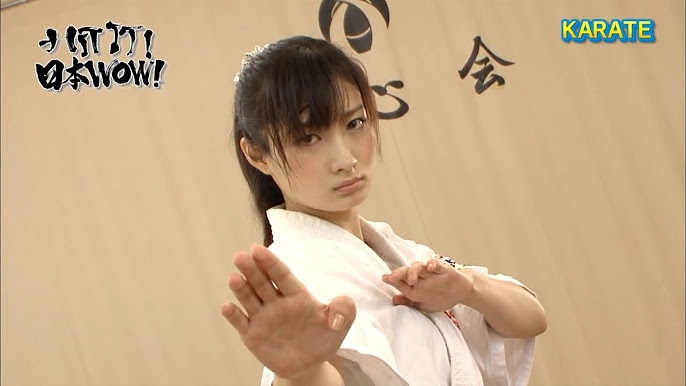
And that leads us to the question beyond the simple mechanics whose dereliction altogether produces a “bad movie”: what is the point of this? I know I’m watching Danger Dolls because I’m trying to get a sense for Rina Takeda as an action star, but what about the filmmakers? What are they trying to do here? There are shades of franchise potential, but everybody dies at the end. And even though they sort of pass the baton to their parallel dimension counterparts, the thematic endgame is a renunciation of violence. Karate master strikes again. But even this is impacted, because part of Ray’s arc is to proclaim that, unlike her enemies, she has free will and fights because she chooses to. But what she chooses to fight for is to be able to stop fighting. Wow, these Danger Dolls are so cool how they kick ass, but they disagree. That just makes me speechless.
After this point, Takeda’s filmography becomes a little less hyperlinky, but some of these are not action parts. To scratch that itch, she’d have to go abroad and take part in Hong Kong projects, which does put her closer to Jackie Chan. She’s going where the action is. Despite the initial push, these movies just weren’t enough to establish a lasting market at home for Takeda to thrive. This is like a talent drain on a micro-scale. Can we do better next time?
Kaede Aono and Miyahara Kanon

This is Kaede Aono, a black belt in karate here making her cinematic debut in 2014’s High Kick Angels, written by Fuyuhiko Nishi. It’s an action comedy about students whose film project is interrupted when bad guys invade their school. Call me a sucker, but productions within productions never fail to make me laugh. It’s an easy in for star Miyahara Kanon, though as we’ll find, she doesn’t need any help. Her character Sakura is a martial arts otaku, who also likes Jackie Chan, and as with all otaku, she’s consumed by her obsessions. She’s begun to think of herself as her fictional character, and when the bad guys come in, her friends all assume she’s gonna do something stupid. The bad guys, by the way, led by Dragon Mom from Super Inframan. This was idol, actress and one-time Samus Aran Chisato Morishita’s last role before she retired and went into politics. Last October, she was part of a record-breaking influx of women into the Lower House. I don’t know where I was going with this. She keeps her henchman schoolgirl on a collar that constrains her power.
Apart from the fetishistic appeal embedded in the premise, with high kicks equating to panty flashes, this movie is actually pretty down-to-business rather than fully exploitative. The characters are broadly defined but nevertheless extant. In the beginning, they talk about this cool girl named Maki, and when we finally see her, she gets a cool introduction. We see her the way the other girls see her, and Sakura in particular is a big fan. Both Kanon and Aono are great, but I also have to highlight Mayu Kawamoto, who appears to have retired from acting. Her character’s style is actually the most practical of the three, if Maki’s high kicks are incredible but risky, and Sakura’s brawling reflects her headstrong character. The school actually makes for a great setting, with plenty of sliding over tables and props, of course – most of them silly.

For these girls especially, making their debuts in a feature film, High Kick Angels is a labor of love. You don’t perform this well in an action movie if you don’t believe in it. This is where success stories are born, with a group of passionate people coming together and making things like Ong-Bak, The Raid, and Japan’s own Versus. Star-making indies. High Kick Angels was successful enough to reach me, but why isn’t it on that same level? Why didn’t Miyahara Kanon and Kaede Aono become the face of Japanese action like Tak Sakaguchi? I mean, this is round two for Fuyuhiko Nishi. My guess, while High Kick Angels is fun and functional, it doesn’t specialize.
The Protector has that famous oner. The Raid is super violent. In one scene, Ip Man gave birth to a four-film series with spin-offs. We’re still thinking about that scene almost 20 years later, and it’s at least three things: the technical excellence, which was also the case for the earlier fight with Riki-Oh, but it’s also character. This is the first time we see Ip Man lose his cool. And third, the sheer volume of “Oh, shit” moments. By contrast, High Kick Angels is an action comedy – the bane of anybody who appreciates action heroines – and so while the girls do awesome things, the movie is mostly a trifle. The character work comes from when they stop believing in themselves and they have to learn to believe in themselves. That’s not gonna be enough to put weight behind the high kicks. I do like that Maki’s plan to inspire everyone is to just beat up Sakura. It’s crazy, too, because look at how many stunt people there are in these scenes. The talent is obviously here and willing.

While not a major crossover success, High Kick Angels became sort of a summer camp, as Kanon and Aono have remained friends ever since. Dude, I love that. I think they, like, opened a gym together? I don’t know if it’s still around, but that’s so cool. As actors, they reunited in 2017 for a curious movie entitled Asura Girl: A Blood-C Tale. Oh, man, I wish I could tell you this was my first run-in with the Bloodiverse. As the story goes, the president of Production IG – the animation studio behind Ghost in the Shell and Psycho-Pass – asked Mamoru Oshii to come up with a new IP. He delegated this task to two of his understudies, Junichi Fujisaku and Kenji Kamiyama, the latter of which directed the recent Lord of the Rings anime and one of the greatest TV shows of all time, Moribito: Guardian of the Spirit. Together, these two guys came up with something astounding. Brace yourself: “girl in a sailor suit” and “samurai sword,” which is pretty much Blood in a nutshell, beginning life as a theatrical short film in the year 2000 before branching out into manga, TV shows, and live-action films.
Asura Girl is the second of such films, following 2009’s Blood: The Last Vampire, with Jun Ji-hyun as half-vampire vampire hunter Saya. That movie was difficult to distinguish from other anime adaptations of the era. This movie is a different breed. Right away, you can tell, it’s got something stuck somewhere. In most movies, functional cinematography is determined by the relationship between the subject and its surroundings. We can see people here, but we don’t really know where they are. And the camera’s always sitting at this weird profile angle, like a sitcom.

Miyahara Kanon takes up the Saya role, here dressed in a sailor suit I have to imagine is anachronistic to 1937. Not sailor suits themselves, but one that looks like Senketsu. So, in this remote village, there have been disappearances which the locals believe to be a curse, but a contingent of Imperial Japanese agents disagrees and generally causes a nuisance. You know what, this setup kind of reminds me of Michael Mann’s The Keep. There’s a movie that watching this movie has robbed me of rewatching. Only Saya knows that it’s a vampire, and the vampire is none other than Ran, played by Kaede Aono. See, that’s fun! Oh, my God, there’s a rape scene. What the fuck? For a movie that’s, like, not-at-all R-rated, it’s a little aggressive.
Which is ironic, because Blood-C has a reputation for being extremely R-rated, but in Saya’s first fight scene, she just beats everybody up. You have a sword! I guess you don’t want to destroy the costumes or narrow down the cast or reset all the practical blood effects. You could always go CG. It worked out so well last time! If this movie could’ve at least given Kanon a super bloody sword vs. vampires scene, I don’t know that this video would need to exist. As it is, we’ll have to assess the material she’s given, and well, that’s gonna be difficult. Because of the cinematography and blocking, we don’t see a lot of her performance. And most of her dialogue is just repeating her basic character motivation anyway, but she does come on strong with the spare instances of comedy, which shouldn’t be unexpected at this point.

This is also some reunion, by the way, as Kanon and Aono barely have any scenes together. I like the idea of a vampire hunter encountering a vampire under unusual circumstances, like, maybe they become friends first – that would be cool – but this movie prefers to focus on the relationship between the vampire hunter and the vampire’s brother. Not much of a relationship, either, they just tend to occupy the same static frames at the same time. In the end, the climactic battle is just a bunch of sword swipes, barely captured by the camera, scored with terrible music and interrupted constantly by bullshit. I know these two are better than this, I just saw. Okay, now, this is the worst death I have ever seen. And once again, he turns around to show you there’s no wound. What did I do to deserve this?
Well, Asura Girl: A Blood-C Tale seems to be the outgrowth of a stage production, in which Kanon and Aono play the same roles. So, in truth, I don’t know if this is a low-budget horror movie or a high-budget taping, except that the actual taping looks way better than this movie. Kanon would go on to do two sequels, and Aono would return to the stage as the Major in a theatrical adaptation of Ghost in the Shell: Arise. But this is when Kanon’s career especially starts to get eclectic. The year following Asura Girl, she appeared as a contestant on Sasuke, the all-female spin-off of Ninja Warrior. She managed to clear her first stage, but ran out of time on the second. Dude, that’s so crazy. That would be like seeing some CBS sitcom guy show up on Survivor. That’s why we have celebrity versions. If anything, it’s supposed to be the other way around, like Jamie Chung and The Miz, or the guy who makes The White Lotus.
Here’s where it gets even crazier. At least as far back as 2022, Kanon’s been working regularly as a ring girl for professional kickboxing events. I can’t even come up with an analogy for that one. And then, in 2023, she decides to get in the ring for an actual bout. Now, I understand that she’s been doing karate since she was a kid, but come on. She’s an actress – she got a knockout in 39 seconds.

In the interim, Kanon has also found success on the small screen with tokusatsu shows like Kamen Rider Amazons and Kamen Rider Gotchard, where she’s a bad guy. She’s also a bad guy in 2019’s Blackfox: Age of the Ninja, the live-action prequel to an anime movie called Blackfox. With that sort of introduction, surely we can expect another low-budget bruiser. This one even does what High Kick Angels so assiduously avoided, which is that terrible color correction endemic to Japanese genre films. To be honest, though, this movie’s okay. It benefits from following a very simple story with movements understood by the screenwriter at an almost instinctual level. But forest for the trees, man, it’s also a ninja movie without any ninja. When one clan decides to attack another, this is what it looks like. I know what it’s supposed to look like. One of the best depictions of ninja I’ve ever seen comes from a Chinese movie, Curse of the Golden Flower. Now that’s ninja.
Our main character is Rikka, and she’s a ninja whose whole thing is she doesn’t want to kill anybody, which again, would seem to run counter to prevailing ninja wisdom. Kanon plays one of the evil henchmen, and while her performance is just as untuned as everyone else’s, the villainy influences her fighting style in a way that shows development from High Kick Angels. She’s faster and she hits harder, and most importantly, she does cool things. See, now we’re verging on Ip Man territory. But we’re still at the border, because she’s trapped in this anti-ninja ninja thing, and is that something people are really gonna get excited about? Like, it’s a fine, inoffensive movie, but when I think about a crossover success for a Japanese movie of this vintage, I think of 13 Assassins, which was extremely violent. Now, as Peggy Olsen knows, violence is not the only thing that sells, but it’s eye-catching, and it’s concrete. How do you pitch a movie like Blackfox: Age of the Ninja to someone who has the option of watching anything else, including 13 Assassins and that scene in Curse of the Golden Flower? Shadow also had some good ninjas – that movie is nutso.
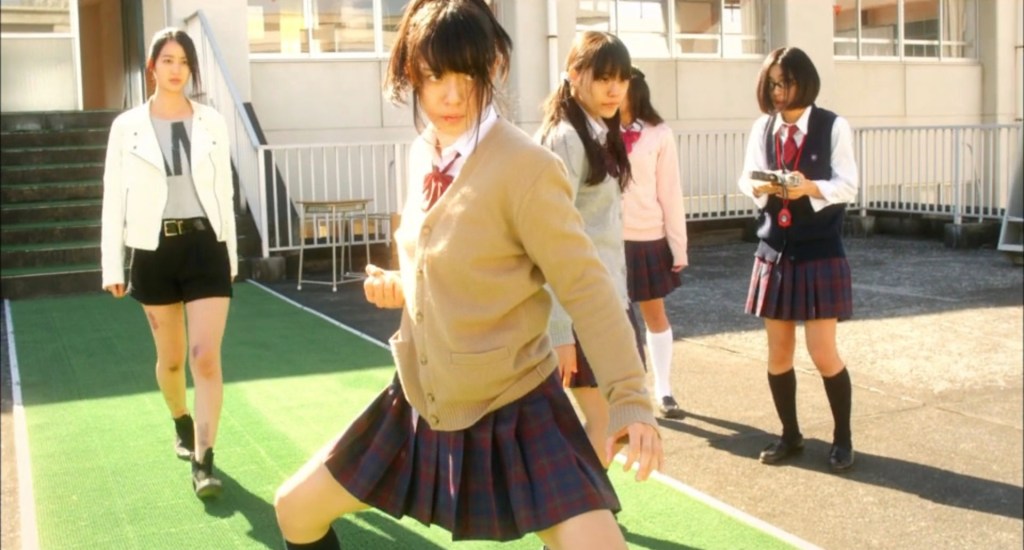
Something that strikes me about a lot of the movies we’ve discussed so far is the incidence of the word “girl” or something similar in the English titles. Rina Takeda was the High Kick Girl from the producer of Shaolin Girl, and would go on to be Karate Girl, Ninja Girl, and one of the Danger Dolls; Aono and Kanon were High Kick Angels, those Asura Girl sequels were called Blood Club Dolls. It’s no surprise that a lot of these actresses got their start playing high school girls – sometimes as high school girls – because there’s a market for that; it’s what nerds like Kenji Kamiyama think is cool. But once these actresses, you know, graduate high school, what’s left for them? Stage plays, Sasuke, kickboxing, baseball, Hong Kong, opening a gym?
When I think about why an actor hasn’t broken out yet in a way I believe they ought to, the easiest answer is that they simply don’t come to mind. If you were writing an action movie about a detective trapped in a skyscraper with a bunch of bad guys, and I said, “Oh, I’ve got the perfect lead” and showed you a random Japanese actress, you’d look at me like I was an asshole, and the detective would probably end up being a guy. But there are Japanese actresses who want to do this – some who want to just do everything, it seems – and we’re failing them. If they want to do action, they have to seek out these tiny, niche projects that aren’t gonna scrape together even a moderate budget. And then if that movie blows, it’s like, “Oh, great, that was our one chance.” But every now and again, I suppose, you get lucky.
Saori Izawa and Akari Takaishi

Moving fully into the 2020s now, I’d like to tell you about Baby Assassins. And when I say “I’d like to,” it’s literally all I can think about any of the time. But wait a minute, wasn’t I just crying about titles like this? In fact, the original title is “Baby Valkyries,” which is also gendered, but less ironic. With “Baby Assassins,” it sounds like there’s gonna be some sort of contradiction between these young women and their chosen profession. Well, that might require a plot and character, and that’s not what we’re going for here. But let’s back it up a second.
Saori Izawa is a martial artist and stunt performer with a resume long and impressive enough to eventually double on one of the biggest action movies in the world, John Wick: Chapter 4. In 2021, she got her breakout role when director Yugo Sakamoto teamed up with action legend Kensuke Sonomura. Now, Sakamoto proved his bona fides earlier that year with the excitingly titled A Janitor, but the addition of Sonomura lends Baby Assassins that frenetic fight choreography which you might’ve seen in the wild because it’s just so crazy. Sonomura and Izawa are a match made in action heaven. She’s so good, and finally, with this, it’s Ip Man giving that Japanese guy the hundred hands. I can sell this.

Even if it’s another silly movie about some girls, it doesn’t have to be so prescriptive. These are not good guys, or even badasses with hearts of gold – they’re straight-up sociopaths. So while Rina Takeda is always learning the lesson that violence is not the answer, and Miyahara Kanon never packs as much of a punch in her movies as she does in real life, the Baby Assassins are extremely violent and very casual about it. That’s different, that’s noticeable, and partly thanks to the unique fighting style – like pencak silat in The Raid, or gun fu in John Wick – these movies really caught on. It helps, of course, that they’re also really good. But I don’t know if I’d call them really good action movies.
What I’ve come to really value is the downtime between the action, because of the interplay between the two characters: Izawa’s Mahiro and Chisato, played by Akari Takaishi. In her J-drama Falling Student and Irresponsible Teacher, which is a romance between a high school student and – well, we don’t have to get into it – Takaishi proved that she could play a shy, troubled girl with pathos and deadpan humor, but if that’s all you’d seen of her, I don’t think she’d be on the shortlist for the next big action movie. It’s in Baby Assassins that she really gets to run wild. Chisato is the more upbeat and energetic of the two, possibly making her sociopathy more shocking.

It is such a compelling, unpredictable performance. It seems like she’s making countless micro-decisions about her posture, about where to look, about how much to be twitching. I love the face she’s making when she’s so happy about cake. And that freakout in the second movie after losing a game of shogi. But what’s really stuck with me is a smaller moment in the first movie, in the maid cafe. So, the story is: these assassins have to get part-time jobs for some unknown reason. Although the socially awkward Mahiro struggles with the audition for the maid cafe, Chisato finds that she’s a good fit. It actually seems like she may have found her people, and it’s surprisingly sweet. But then these yakuza guys got to come in, including one played by Yasukaze Motomiya, who you might recognize from The Man Who Erased His Name.
This scene is such an exercise in action filmmaking: the hidden badass, you know, when the guy you thought was an accountant or a beekeeper is like, “I’m not an accountant or a beekeeper!” Or a maid, in this case. Now, in a more conventional movie, there would’ve been some sort of rivalry or politics in the maid cafe, like in the strip club in Anora, which would make Chisato’s reveal more impactful for everyone else, and that is missing. I kind of get this feeling that Yugo Sakamoto is a director who’s, like, never seen a movie. But when she tells everybody to leave, there’s some actual pain in her voice. She really liked this job and maybe even these people, and now it’s over. And of course, Takaishi is also a natural with the action, which is amazing, because there’s nothing natural about it.
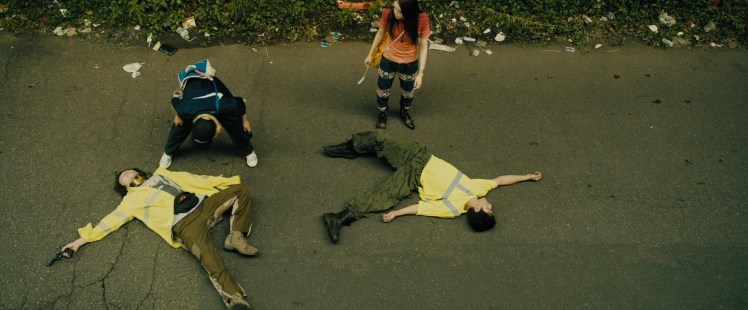
Even as Takaishi broadens her filmography, she hasn’t abandoned the genre, having done so many Baby Assassins projects over the past few years as well as Kensuke Sonomura’s third directorial feature, Ghost Killer. Izawa, of course, is more of the action insider, but keeps popping up in unexpected places. Not so surprisingly, she features in a Sakamoto short film, 2022’s “Heaven’s Rush,” but she’s also a go-to for music videos, some of which don’t feature martial arts at all. Here she is on stage with a band called Wasureranneyo. I’d be curious to know why she’s so popular in the Japanese music scene, other than who else could you possibly find who’d be cooler? She’s also been involved in the marketing for the video game Assassin’s Creed Shadows and the manga series Sakamoto Days, with an ad that has Mahiro’s laidback vibe.
It’s the sort of work that’s consistent with her action reels which predate Baby Assassins, so I hope she’s doing these things for fun and not because they already made three Baby Assassins movies, and what, are they gonna make four? God, I hope so. There’s also a TV show. Obviously, Chad Stahelski already knows she can do John Wick-style action, and while her performance as Mahiro is more reserved than Takaishi’s, I think she more than holds her own. In movies with such unorthodox storytelling, her quiet, subtle expressions do a lot of heavy lifting. She’s ready to go. Whatever it is. Sky’s the limit.
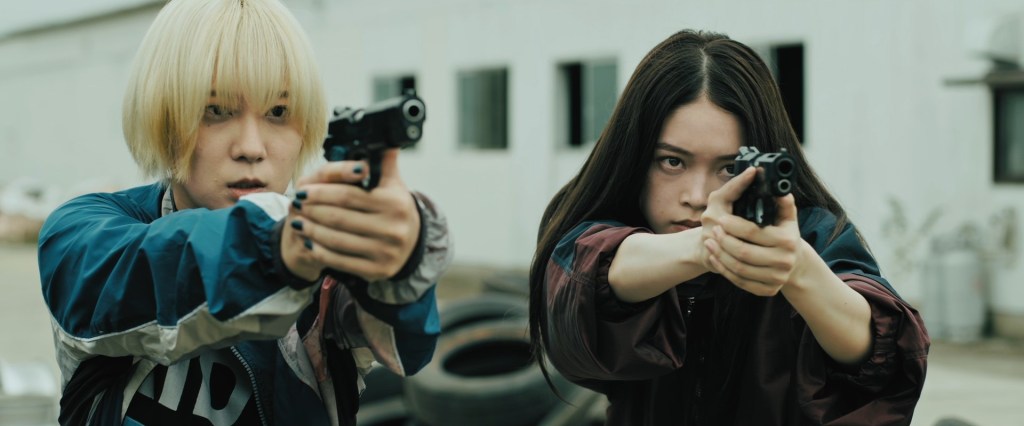
I couldn’t ask for a better showcase of two talented actresses. This is the new standard. Or the first standard. Surely, it’s gonna be smooth sailing from here on out because the Japanese film industry saw this and said, “Hey, let’s just do that now,” but they were smart about it, they were smart about it. Unlike in Hollywood where they looked at the success of John Wick and tried to shoehorn gun fu into everything, they had a nuanced response and put real money and talent like Sakamoto behind these actresses. Talent that knows how to appeal to an international audience without making compromises, without selling out and playing on Western stereotypes about crazy Japan. Fuck that. I mean, look, man, you do what you want to do, and I think you’re pretty genuine about it, but don’t feel like it’s a fucking obligation. Surely – surely nothing bad is about to happen.
Konomi Naito and Himena Tsukimiya
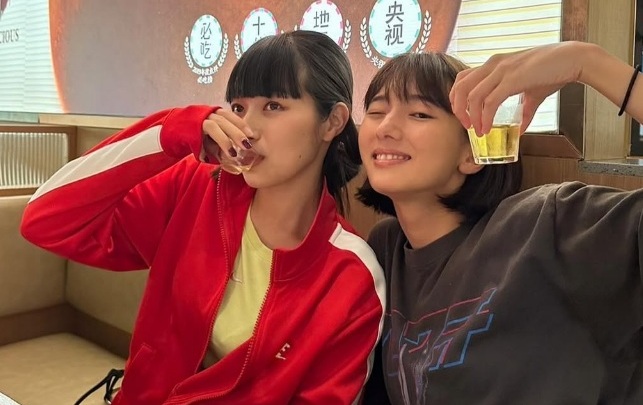
I’m a huge fan of Ultraman. Love Ultraman. But you know, in theory, because I’ve only seen a handful of episodes from the original show. In fact, I’d never watched an entire show until 2023, with Ultraman Blazar, which happened to feature on YouTube. That was quite the coup, and I really appreciated that as Godzilla is getting more CGI, Tsuburaya Productions is holding the torch for rubber suits. These monsters look fantastic. But I’d be lying if I said they were the reason I was watching. I don’t remember now, but I have to imagine I just stumbled onto Konomi Naito thanks to the Instagram algorithm. You know, I may be terrified of new technology, but the algorithm is how I found out about my beloved Julie Estelle and The Night Comes for Us. Maybe it wasn’t such a bad thing, especially in light of later developments like NFTs and AI! No, it’s very bad, too.
So, Konomi Naito is an actress who also appears to be a black belt in karate. She teaches self-defense classes and choreographs action scenes where she beats up all her students. And she seems cool? See, I’m actually just guessing about all of this because I don’t know anything about her. You know, I’ve never gotten to hear and understand anything Miyahara Kanon has ever said that wasn’t scripted because these guys aren’t like K-pop idols. They’re on all these international platforms, but there’s no expectation of an international audience, and that breaks my heart. Also breaking my heart, Naito had precious few opportunities to lay the karate on people in Blazar – or aliens, as the case may be. Ugh, dude. We used to build shit in this country. We used to make movies like Zeiram.
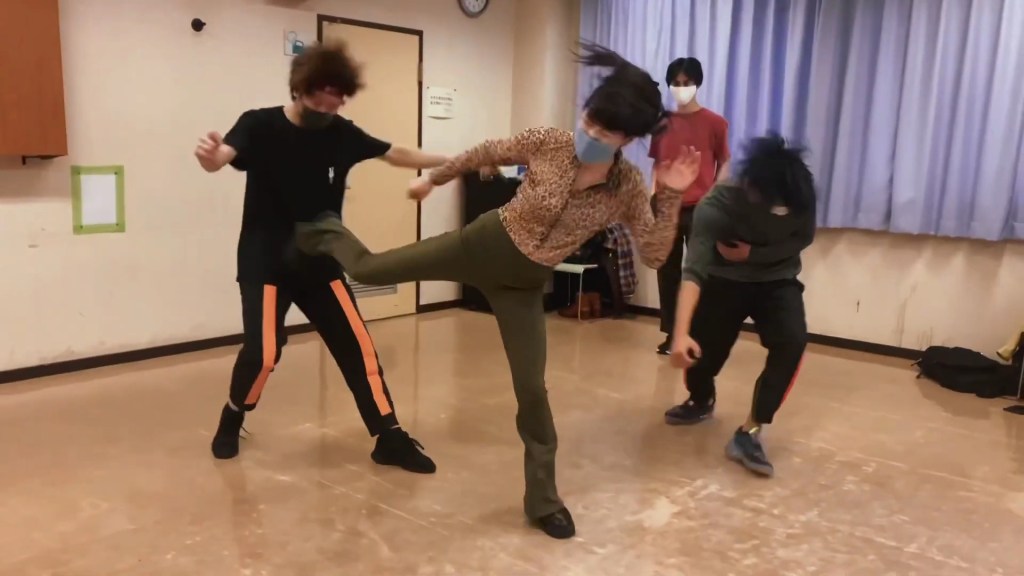
But like Kanon, Naito is another one who stays busy. If you do follow her on Instagram, you’ll see horseback riding, traditional Japanese stuff, Korean language lessons, and horrifying acupuncture. Man, where does she find the time for all this stuff? Oh, right, by not being in action movies! Okay, look, I might be stretching this premise. I’m not saying hobbies are bad, or certainly that these women should only be doing things that I’m interested in, but this is an incomplete math equation. She does karate so well that she’s teaching it to other people. She’s an actress who’s appeared on television. She does not do karate on television. How the fuck does that make sense?
Ultraman Blazar also stars Himena Tsukimiya, who now goes by her actual name Himena Yamada, and I wouldn’t have even thought to mention her, until I found out that she was gonna star in a movie called Shogun’s Ninja this year. I mean, she didn’t do a lot of action on the show, so I never considered her for the next big action movie. Hmm. I might’ve even passed over Yamada regardless to spare myself the embarrassment of this hypocrisy, but for the fact that in Shogun’s Ninja, she stars opposite none other than Miyahara Kanon. Nice! But let’s back it up again, because as it turns out, Yamada is just as much of an action stalwart. In the 2018 movie Red Blade, she’s one part of a kunoichi sister duo who trains our lead character in the ruthless ways of the ninja. That sounds okay, right? That sounds like a reasonable story.

Okay, this movie opens with ten minutes of Tak Sakaguchi fighting ninja in the forest. Ten minutes! After that fucking ordeal, we find ourselves in present-day Japan where a sad-sack high school girl finds a magic book that transports her into some sort of semi-mythical ninja dimension where she wants to learn how to be a ninja so she can get revenge on the fact that her father was made to be a scapegoat for his company. I-I don’t even know where to begin with that. What the fuck did I even just say? So it’s like Godzilla’s Revenge crossed with those videos you watch in middle school where a student goes back in time and meets historical figures. This one’s trying to be more of a drama, which is a change of pace, but it’s just unpleasant. Before we know who any of these people are, they’re yelling and screaming at each other. It’s the appearance of a dramatic story but with none of the substance.
Some of the ninja action is surprisingly ninja, with weapons and stealth and teamwork, which is criminally underused. Yamada performs admirably. She’s clearly got the physical stamina, as we can see in some of these long takes. Conversely, her character is totally weak. I mean, the movie simply does not believe in its action heroines. They play second fiddle to Sakaguchi, and the ratio of them beating up the bad guys to getting beaten up by the bad guys, you know, the numbers just aren’t crunching. If anything, this movie is on the other end of the exploitation spectrum, too. Lots of voyeuristic photography, and that’s a counterproductive design philosophy, if you want to call it that. For however much the filmmakers wanted to make a movie about cool ladies doing cool things, they also want to ogle these ladies. So it’s no fucking surprise that they have basically no character. The light of Ip Man is fading as we fall further down the abyss hole.

Yamada’s character actually dies partway through, which meant I had to watch the rest of this movie for no reason. Afterwards, the girls are crying like “Why don’t you care that she died?” and Tak Sakaguchi is like, “That is the way of the ninja.” Shouldn’t they already know that? How are they even ninja? Like, ninja training is just fucking around in the woods for a little bit. It’s a fucking laugh. If it’s not a comedy, why doesn’t this movie take itself seriously?
So, Shogun’s Ninja is directed by a fella named Koichi Sakamoto – no relation to Yugo, I assume – and I trust him to take care of Tsukimiya more than the crew behind Red Blade. For one thing, he directed Blackfox: Age of the Ninja. He actually works with Kanon a lot, having directed episodes of Kamen Rider Gotchard. In 2023, they reunited for a movie called Ninja vs. Shark.

Goddamn it.
Look, if you’re the kind of person who sees a title like Ninja vs. Shark and says, “That sounds awesome!” that’s okay. Maybe you rent this with your buddies and get a pizza and get high – that’s a legitimate moviegoing experience. Maybe not the most attentive, and from the perspective of the filmmaker, it’s a positively masochistic exercise. It’s this whole SyFy Channel Original Pictures “bad on purpose” racket meant to invite scorn. “Oh, my God, it’s so dumb. Who would make a movie so dumb?!” Despite the surface-level similarities to something like Sharknado, Ninja vs. Shark also isn’t a comedy. Actually, it’s more like a SciFi Channel Original Picture, if you know what I mean. It’s silly but not cynical, and I appreciate that Sakamoto sees enough range in Kanon to cast her in villainous roles. In this one, she’s an evil ninja who wants to fuck and kill the main character guy, and she is going really hard. Dude, your eyes are gonna pop out of your sockets. But that’s the movie she’s in. If she were to rein it in even a little, she’d be out of place, because this movie also has to contain a shark-fighting ninja.
A title like Shogun’s Ninja suggests something more straightforward. We’ve run the gamut, between no-bullshit movies High Kick Girl to movies full of bullshit like Red Blade. For our purposes here, I think the former is the most helpful, though it does run the risk of being dry. Shogun’s Ninja is about two somewhat unrelated things happening simultaneously. Our heroines are Kagaribi and Okyo, played by Tsukimiya and Kanon respectively, the last members of a disgraced clan who as children watched their leader cut down before them and swore vengeance against the Yagyu. Over at the lord’s castle, it seems that the shogun’s proclivities for men are threatening the Tokugawa bloodline, prompting extreme members of his circle to abduct concubines to bear a son. One of those prospective concubines is Oran, an acquaintance of Kagaribi and Okyo’s, whose subsequent attempts at rescue reveal that the Yagyu clan has embedded itself in the shogunate. So, while these two threads do come together, I say they’re somewhat unrelated for thematic reasons. We have two separate arcs. The two heroines have to learn to get along, and Oran helps the shogun follow his heart.
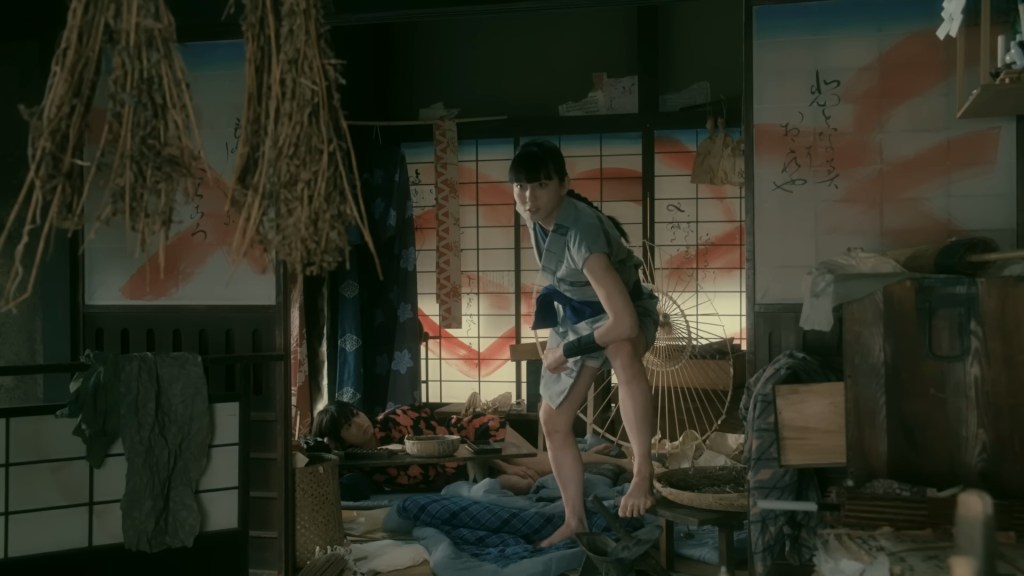
In a literal sense, these two arcs dovetail when, in one scene, Kagaribi and Okyo settle their differences in order to aid the shogun. But let’s take a closer look. Why do they have to settle their differences in the first place? Well, after losing Oran, they argue and then come to blows. Kagaribi doesn’t like that Okyo is so headstrong while Okyo doesn’t like that Kagaribi is so passive. But this is all happening really quickly, with a lot of telling and not showing. For a brief counter-example, you notice that whenever Walt and Jesse fight on Breaking Bad, they don’t have to say what it is they don’t like about each other. Well-understood tensions have been simmering and now they’re boiling over. And when these two walk out on each other, they’re not abandoning a super compelling relationship. In their natural state, they mostly just bicker. What do we lose when we lose this friendship?
We should be losing the meat and potatoes, the double dragon action. We should understand and maybe even fear that neither is as strong as they are together. We’d need to see that first, but in the opening, they fight pretty separately. Compare this scene to one later on where they beat up this pickpocket guy. This is easily my favorite fight scene in the movie, if you can even call it a fight scene, because it’s consistent with the lighthearted tone and demonstrates an unspoken bond. Like, come on, guys, ninja is so much more than just the outfits, with the zigzagging and you don’t know what’s going on and then you get stabbed. You even talk about it, but I want to see it. I just want something more tactical, more thoughtful. The climactic fight is a pretty good example. Of this, anyway, because when Kagaribi meets the final boss, she’s like “Oh, it’s you, you’re the object of my lifelong revenge.” It’s all just happening by accident.

Realizing that this guy has an unbeatable sword technique, the two ninja decide to neutralize the sword. Not overly complex, but fight choreography can sometimes seem arbitrary, so having a discrete goal beyond “harm” lends purpose and readability to each move. We know what’s happening and why. And they’re working as a team. Unfortunately, to reach this point, they kind of just had to air their grievances – change nothing about themselves in response – and decide that they were ready for the big fight. Like, Okyo loses two fights to this character Akane, and for their final match, literally nothing has changed. There was no training montage, no revelation, no technique newly unlocked. Like, yeah, we’re hitting all the major beats, they’re all in order, but there’s nothing in between. Who is Akane to Okyo other than an especially tough opponent? What did she take from her? What does she represent?
I’m in an awkward position because it’s in my muscle memory to criticize every female-led action movie that isn’t Julie Estelle putting a blade through Hannah al-Rashid’s throat – and that’s not even a female-led action movie – but I genuinely appreciate that Koichi Sakamoto has built this stable home for a lot of these Japanese action stars. In addition to casting Kanon multiple times, he’s also brought in Fumi Taniguchi from Kamen Rider Gotchard. And then there’s Akane’s actress, Julia (or Juria) Nagano, who’s another one of these guys. Okay, let’s see, she’s a karate black belt – that’s like the minimum at this point – but she’s also a nurse, and a professional wrestler? And a YouTuber. Here she is hanging out with kickboxing sensation Panchan Rina. Here she is hanging out with Kaede Aono. Maybe Koichi Sakamoto doesn’t make movies for me, but he makes movies for them, and if everyone’s happy with that arrangement, I can be, too.
In Conclusion

One thing, though. No blood again. I’m no expert, but I hear that swords are cutting weapons. When you get hit by a sword, you don’t just fall over. That, to me, is the great mystery in all of this. I get that I might be asking for an excessive, say, Indonesian level of gore, but why in so many of these movies is there no blood at all? Well, another recurring theme is cute outfits. Sailor suits, boob windows, ninja gear like Dead or Alive. I think the Japanese fighting girl as she currently exists is meant to be looked at as much as anything else. They’re cute or they’re sexy, and that’s why people make these movies and that’s why people watch these movies. That’s why they’re never too serious and never too bloody, unless that’s the gag. And maybe these guys like being cute and sexy, that’s fine, but they should also be able to do literally anything else, short of being in Baby Assassins 4.
Maybe the mistake I’m making is in assuming that the market for these movies has aspirations beyond its built-in audience. I do think High Kick Girl and Angels were meant to launch the careers of their respective stars, and they succeeded, just not at the one in a million levels of The Raid guys, who showed up in Star Wars not long after. It doesn’t always have to end in Hollywood. I mean, they were only in Star Wars for, like, a second. My dream is that any one of the actresses I’ve talked about here, or all of them, can star in a big-budget Japanese action movie with zero content restrictions or restrictions of any kind like The Night Comes for Us or Twilight of the Warriors. Now, in the latter case, the studio logos ran for, like, a minute and a half, so you know those producers went hat in hand to every dentist in Hong Kong. And The Night Comes for Us is a Netflix movie.

Over the past couple of years, with success stories like Drive My Car, Godzilla Minus One, FX’s Shogun, and Shohei Ohtani, there’s been this narrative of a comeback for Japanese pop culture, and you can’t have a comeback without a going-away. In movies specifically, a perceived decline in quality can be seen in flashpoints from 2004’s live-action Devilman, which Beat Takeshi called “one of the four most stupid movies ever made,” and 2022’s What to Do with the Dead Kaiju?, basically thought of as the next Devilman. I’ve seen opposing viewpoints online. I mean, the 2000s in America were a disaster, but we only talk about There Will Be Blood and No Country for Old Men. Not to mention, when the Japanese economy collapsed in the early ‘90s, the anime boom was already underway, and the burgeoning home video market allowed the independent scene to flourish. So there’s no direct correlation between the cheap genre movies we see today and there simply not being a lot of money in the Japanese film industry.
One thing is without dispute: there’s not a lot of money in these movies. The Koichi Sakamoto ninja stuff especially seemed to recycle costumes and even shoot at the same locations, with that one thoroughfare looking like the open-air museums you see on YouTube. Maybe that’s why they never, like, break stuff? I don’t know what kind of strings come along with foreign investment, but the billions of dollars flowing into Korean productions for Netflix has paid out dividends – at least in terms of what I’m talking about here. We don’t really have Korean action stars, other than Don Lee, but we do have stars in a more profound way than ever before. I mean, look at Lee Byung-hun, who’s far better known as the Front Man than as Storm Shadow. And sometimes, every once in a while, a Park Shin-hye or a Han So-hee will do action, and it looks so fucking good. Ugh, my kingdom for – well, for Kingdom season three with Jun Ji-hyun – but if Konomi Naito or Kaede Aono could look like this?

So, that’s where we are. The disappearance of the Japanese fighting girl in live-action film is a combination of several factors – money, mission, the fact that all these filmmakers are dudes – but I want to stress that the talent is there. It’s so obvious to me, even if the movies themselves often struggle to articulate that.
 With Eyes East