

Directed by Kazuo “Gaira” Komizu
Starring Cutie Suzuki, Megumi Sakita, Kera
Where’d that rocket launcher come from?!
It’s true that the movie fully entitled Battle Girl: The Living Dead in Tokyo Bay has a very low budget. As much as I’d prefer to be an enlightened critic who doesn’t discriminate on such bases, in this case I’m interested in how the miniscule production influences the viewing experience. For reference, we can plot this one somewhere between, say, Nemesis and Screamers? The former is so raggedy that it’s sometimes incoherent, not only in the big picture but in the micro, where the camera and editing have to be so judicious, so careful not to show the edges of the set, so to speak. Battle Girl has a little bit of that, though its setting – the zombie post-apocalypse – is easier to render than other sci-fi worlds, where “scatter some trash in the corner” is actually workable.
Still, the opening minutes might fool you, and I was mentally hovering over the stop button while watching a girl sitting in some of that trash and receiving orders, wondering, “Is that the Battle Girl?” You’d think something like that would be immediately evident. Even when she’s shooting zombies with a revolver, I wasn’t sure. That is a girl doing battle, but she’s just standing there. It doesn’t help that gore is one of those things we’re cutting around because it’s expensive. If the movie’s gonna be named after her, shouldn’t she be special in some way? Then a bus of post-apocalyptic miscreants rolls up – including a girl with an urchin of green hair – and finishes off the zombies. Then they take Battle Girl’s gun and drive away. Then Battle Girl (or Keiko, I should say) is seen outside the moving bus’s window. “Shake her off!” They shake her off. What is all this?
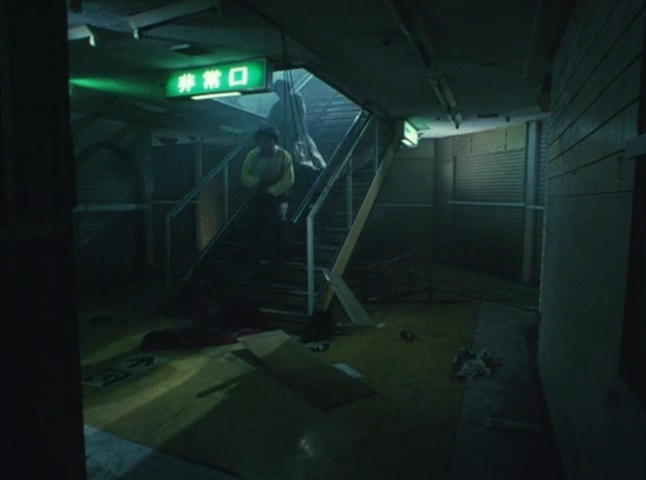
It’s strange, because there’s nothing original about a zombie movie, so you’d assume that the script would be straightforward enough to avoid these sorts of head-scratchers. Earlier, a gang of ruffians attacks an innocent couple, beating up the guy and dragging off the woman. Surely, this is when Keiko comes in to save the day. No, actually, as this sequence is meant to introduce the zombie concept, that – might you not know – the dead woman will come back to life and bite the neck of the husband cradling her, all while Keiko watches. This is when the bus shows up. Shortly thereafter, Keiko arrives in a nondescript room off a nondescript hallway (was she headed there all along?) and is introduced to something called the “Battle Suit” by her father via video recording. A great sigh of relief. Cue a fairly poor suit-up sequence where she’s already suited up and just presses on her arms and legs as if fitting things into place. It’s no John Matrix.
A good Battle Suit, though, looking like a very, very slimmed down version of the Kerberos Protect Gear, swapping the iconic mask for the Major’s forehead rectangle thing. It’s so cyberpunk that the rectangle has a retractable pair of sunglasses for the purpose of scanning. I’m not sure if Keiko herself is superpowered, but the suit does have hidden weapons including a knife boot and a gun boot. How do you have both?! Surprisingly, as it goes on, Battle Girl becomes more coherent and even interesting. Throughout, there’s a bunch of murky scenes with the evil military guy, and you kind of understand that he’s doing evil experiments on the zombies, but you don’t expect him to give a detailed, even reasonable explanation in the end. He also suffers one of the funniest villain deaths I’ve ever seen. I was giggling for, like, a minute.*

If you don’t have the biggest budget in the world, at the very least you need character. Battle Girl is full of odd things. People seem to conjure guns out of nowhere, including a compound bow and even a rocket launcher. In her struggle with the villain, the green-haired girl loses her green wig. Keiko’s entire motivation is that she’s a daddy’s girl. A guy throws his life away for basically no reason, remarking passively that one of the mutant super soldiers tore off his arm. This is substantively different from the scene where a soldier shoots himself in the mouth because all this zombie carnage is simply too much. We’ve never even seen this guy before. But it was in Day of the Dead, so it’s got to be here, too. If anything, Battle Girl strikes the right balance between the structural utility of genre cliché and the kind of wackiness that comes from a production environment with not a lot of oversight.
We’re not talking about an all-timer scene like zombie vs. shark in Zombie, which sounds ridiculous but is actually jaw-dropping on-screen, but there’s enough here to justify the runtime (a little over an hour). Keiko is alright. She’s pretty indomitable and never suffers the usual indignities of an action/horror heroine, but she could definitely be more hardcore and the action itself is slow and silly. I mean, you’re not watching a movie like this for “convincing” anything, but there is a certain oomph missing when there’s not enough money to stage effective choreography. Not a lot of gore, Keiko’s facial expression never changes to evince struggle or anger or energy. We see the pulled punches and the careful pro wrestling moves. And that’s okay. Battle Girl very nearly has the feel of a live-action video game commercial or that Appleseed video – things you watch and say, “I’d love to see more of that.”
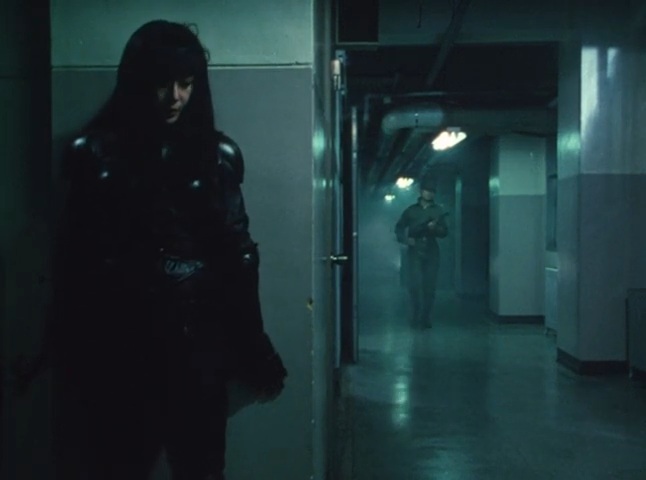
*Spoiler alert: Keiko breaks his arms and puts a grenade in his mouth, so as she and the girl walk away, he’s just waddling around with his arms dangling at his sides, unable to reach the grenade.
 With Eyes East