
Directed by King Hu
Starring Li Li-Hua, Roy Chiao, Hsu Feng, Tien Feng, Angela Mao
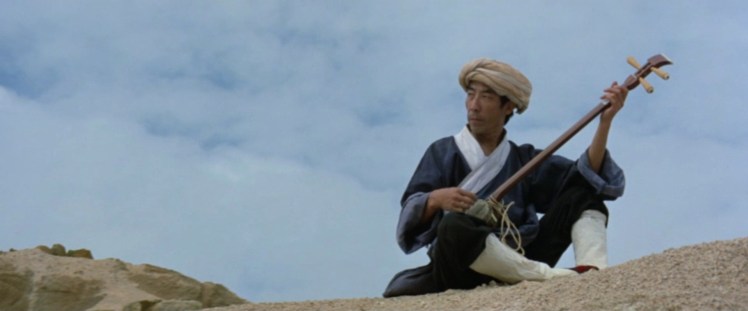
A King Hu wuxia film is a precious thing, there being so few. I’d taken a circular route from the canonical works at the start of his career – Come Drink with Me, Dragon Inn, A Touch of Zen – straight to the Mountain duology of 1979, skipping over The Fate of Lee Khan and The Valiant Ones. Either way, I’m running out, though I was mightily defeated by Legend of the Mountain and left it unfinished. And so, there was something bittersweet about finally sitting down and watching The Fate of Lee Khan, or “The Turbulence at Yingchun Pavilion,” here at the beginning of the year, when the kung fu mood usually strikes. And ironically or not, the film is a pastiche, taking little bits from across the catalogue. It’s the tavern setting of Dragon Inn, the caper premise of Raining in the Mountain, and the cast of A Touch of Zen. Here, Hsu Feng plays a villainous Mongolian princess, sister to the titular antagonist, while the villain of A Touch of Zen, Han Ying-chieh, is a resistance member disguised as a drunk, and Roy Chiao, the Buddhist monk, is undercover as the henchman at Lee Khan’s right hand. By the way, is it technically yellowface for these Chinese actors to play Mongolians? You’re not fooling me, man, no matter how much additional facial hair.
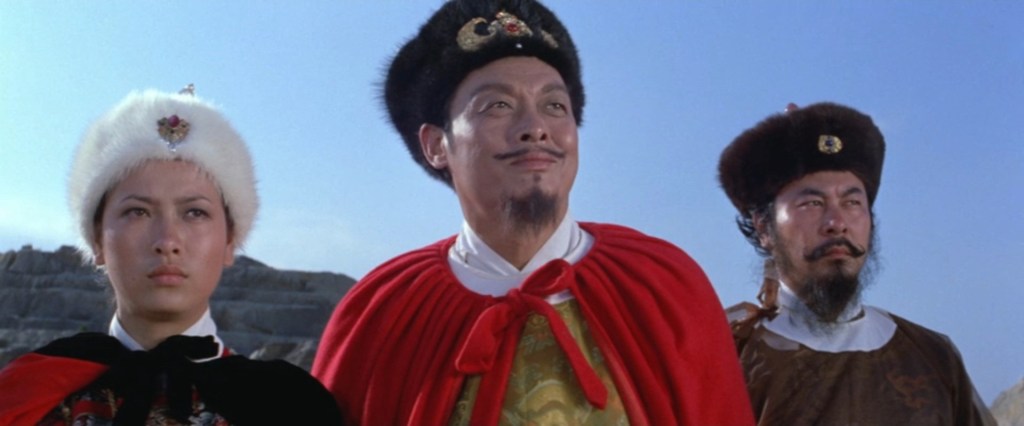
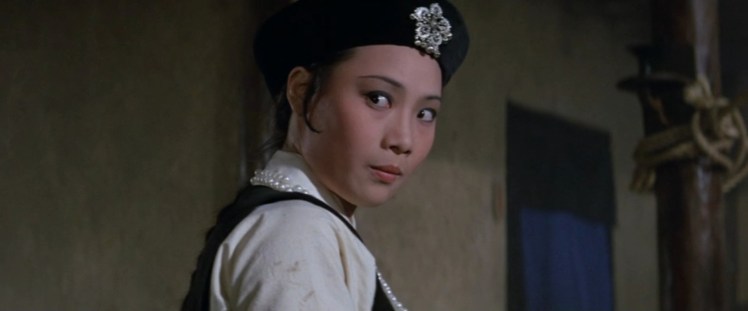
The plot is relatively simple, as introduced by the opening narration in which there appear to be two narrators? A map of rebel war plans has fallen into the wrong hands, and General Lee Khan and his sister go to retrieve it, which means staying over at the Spring Inn, run by resistance sympathizer Wan Jen-mi. She’s conspiring with other rebels to recapture the plans – and the traitor handing them over – and consequently, to determine Lee Khan’s fate. Along with rebels posing as staff, including the apparent drunkard Sha Yuan Shan, Wan Jen-mi has brought in a quartet of female badasses to pose as barmaids. This group of ne’er-do-wells – bandits and pickpockets – includes Hai Mu-tan, codename: Peony, played by Angela Mao. As it had been a while since I’d seen Mao in anything, I was trying to pick her out of the crowd until she turned around with that unmistakable hard stare. Truly, nobody has a meaner mug. Well, other than Hsu Feng, of course. But the reason it wasn’t immediately clear is because The Fate of Lee Khan unspools like all King Hu movies, and seemingly all vintage kung fu. It’s something I felt more strongly with Lau Kar-leung, that I wouldn’t even know what the story was until the end credits, by which time everything somehow made sense.
For how embarrassing it is, I’ve spoken before about my difficulties following kung fu plots. I’m beginning to understand the phenomenon. The Fate of Lee Khan is from 1973, which for reference is exactly between the two Godfather movies. In America, the ‘70s was a time of radical transformation, ushering in what we consider to be modern cinema, but that doesn’t mean the rest of the world followed in lockstep. Raining in the Mountain was the same year as Alien, and it was made with the same techniques as all of King Hu’s earlier wuxia films. Natural lighting, trampolines instead of wires, and more to the point, a stagey, heightened storytelling that’s obscure but not subtle. Characters might speak their feelings aloud if not for the covert operation at hand. They feel like characters in a story, not characters made to effect the illusion of verisimilitude. I don’t know how to explain it exactly, other than to wildly gesticulate at the half-remembered trivia about martial arts movies coming from an opera tradition? 1973 was also when these movies were transitioning from big-name directors like King Hu and Chang Cheh to big-name stars like Bruce Lee. Sammo Hung actually choreographed the action in The Fate of Lee Khan, which again, looks so much more swashbucklery than later examples – his own work, especially.
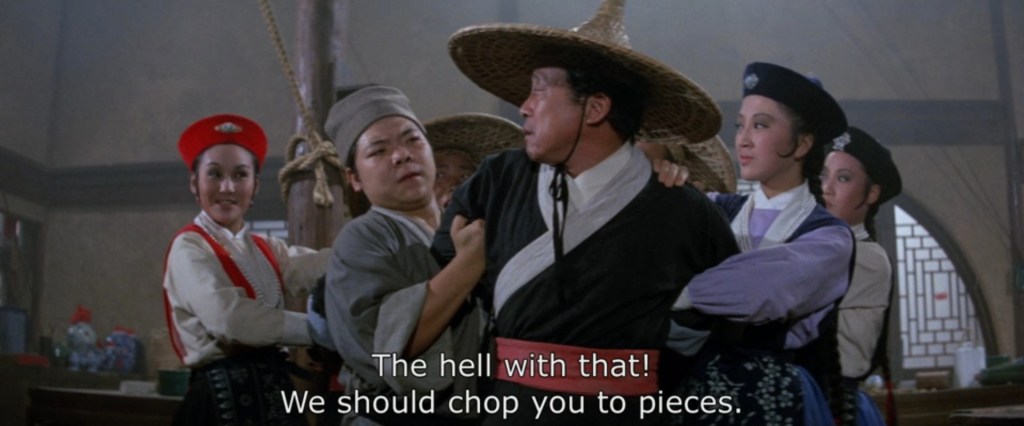
And so, the experience of watching The Fate of Lee Khan was about being in the present. I can’t really tell who the main character is, but I’m vaguely aware of the pieces on the board. From there, the story moves in micro sequences inside its tavern location. We establish the female badasses within the frame of Wan Jen-mi’s observation, promising a rebel they won’t give in to past vices and make a scene, and then we examine incoming patrons one by one. Everyone’s suspicious, and they might turn out to be enemy spies, rebels, or pursuing their own agendas. Buddy, this is the last place you want to be running a low-level hustle, unless you like getting beaten up by kung fu girls. Perish the thought. Later on, the consequences for transgressions escalate to off-screen beheadings, once more reinforcing the film’s theatrical quality or perhaps its constricted budget. The spectacle is admittedly lesser here, aside from the fundamentals of King Hu’s ever satisfying camera movements. He sweeps along the tavern’s length, tracking with the high-flying action whenever the tension boils over. On the other hand, he’s also given us one of the most beautiful films ever made in A Touch of Zen, and the contrast is notable.
Again, that’s only because I’m nearing the end of the King Hu wuxia oeuvre. The Fate of Lee Khan is maybe a solid entry point for the director, being like a greatest hits and relatively easy to follow, but I wonder if something was exchanged for the accessibility. Less grand and opulent than his other movies, I could almost accept that it’s more of a straight-ahead action thriller if not for the dearth of action until the climactic three or four-way brawl. It’s unfortunate, because there’s such a desperation in the fights, with the established stakes and the actors’ physical performances. Death comes quickly, with little warning before or fanfare after. And with such a large cast, nobody is safe. No, even that one you’re thinking of; believe me, I was shocked. Alas, The Fate of Lee Khan is fun and tense, like the best contained thrillers where everyone in the room is hiding something, and it feels classical, but with a legendary filmmaker like this, there’s a difference between feeling and being.
 With Eyes East