

Directed by Huang Feng
Starring Angela Mao, Chang Yu, Oh Kyung-Ah
Since we’re all in the “video game adaptation” mood lately, I might suggest a challenge: a faithful film version of an RPG, say, The Elder Scrolls V: Skyrim. The hero has a task, and then they spend the entire movie on side quests. This was my thinking during Lady Whirlwind, one of the early star vehicles for Angela Mao. Having costarred with him in Enter the Dragon, she’s sometimes considered “the female Bruce Lee,” but I was skeptical, even watching her early scenes here. The character she’s playing is cool and confident, but her facial expressions tell a different story in the midst of fighting. Does “female Bruce Lee” simply mean “female martial arts star”? And does a woman score the title just by being good, suggesting that we don’t expect greatness? It takes me a moment to realize that she’s taking on a dozen guys at a time, and most critically, that like a lot of Bruce Lee characters, she’s kind of a dick. She is certainly not the hero, and in fact, wants the hero dead. Thank God she spends the entire movie on side quests.
Mao plays Tien Li-Chun, who rolls into town and starts winning every round of a dice game at the casino. The dealer and the other men at the table grow increasingly concerned, and even try to pull one over on her when she isn’t looking. Somehow, she wins again, and then Sammo Hung – the proprietor of the establishment – comes in and challenges her to a fight. That’s fine, but actually, I did want to know how she kept winning. What follows is the first of several protracted martial arts scenes, with a whirling, flowing style and impossible physics – and most curious, durability. Maybe Mao’s signature move, at least in this film, is the front kick to the face, which sometimes just stands a guy up. Combatants will turn into blood fountains before going down, and to finish off Sammo, she has to step on his chest and whip him with a sack of coins, back and forth, back and forth across the face. Goddamn. He isn’t dead, though.

On a mission of revenge, Tien was asking around the casino for a Ling Shi-hua. Apparently, when this guy broke up with her sister, the sister died by suicide. Too bad for Tien, though, as Ling is also dead – or playing dead, anyway, having run afoul of the Japanese gangsters who run our casino town. He’s now hiding out with a woman named Hsuang Hsuang, and they’ve fallen in love. And while this is beginning to sound like a crowded first act, that’s really all there is to the story. I love a good Shaw Brothers kung fu movie, but I am frequently lost by all the table-setting (which is like saying I’m frequently lost during Showa Godzilla movies – also true). I don’t know which side are the Manchus, or who’s in the royal court, or where the eunuchs are coming from. Then there’s the Shaolin Temple, and the various schools which form their own political factions. I appreciate the relative simplicity of Lady Whirlwind as a respite. It’s timeless, and people have grudges with each other, not organizations or abstractions.
Which isn’t to say that there’s not enough going on, though the premise was plenty, and captured my heart immediately. Ling is on a righteous crusade to eliminate the Japanese gangsters, and he and Hsuang Hsuang have to beg the vengeful Tien for a little more time. “You can kill me later!” This is the kind of story I wish I’d thought of, with characters being in thrall to the badass kung fu lady. There’s a bit of push and pull with that; initially Sammo’s insistence on fighting Tien appears to be sheer disbelief. Later, however, as one example of the film’s dimensionality, they share a second, unusual encounter. He doesn’t want to fight her, but this time because he knows she’ll kill him. As a disgraced member of the gang – he lost his casino after the embarrassing loss – he has no choice. So they fight, and she kills him. I mean, he was in the way, and she’s got a single waypoint on her map. It’s just that her mission, often restated (with an often restated conflict: “You can kill me later!”) is interrupted by chores. As Ling is involved with the gangsters, she has to make sure he doesn’t die by another hand. And then there’s Hsuang Hsuang to take care of, and so on.

Pushed on a little more, this could’ve been a straight-up comedy, but I’m glad it wasn’t. Lady Whirlwind takes its female characters seriously, giving us at least three, each occupying a position of authority. There’s Tien, the freight train, Hsuang Hsuang, to whom Ling owes a great debt, and Tiao Ta Niang, possible leader of the dastardly Japanese. It was difficult for me to tell; the longer the movie went on, it seemed like maybe she was second-in-command to this guy Tung Ku? At the very least, she had hiring/firing power (she fired Sammo, who was also her little brother! He can’t catch a break in this movie). Unlike so many female-led kung fu movies, or action movies generally, the women here aren’t undercut by pratfalls or punchlines – or are themselves the punchline by being skilled. But, you know, there are other ways to do it.
Lady Whirlwind is a study in film language, as the rhythm of its editing, for example, can be comedic when the script isn’t trying to be. Tien demands to know when Ling will finally confront Tung Ku, to which Ling dramatically replies, “Tomorrow.” Smash cut to tomorrow, when Tien and Ling are in Tung Ku’s courtyard, facing him down. No entrance, no establishing shot, just bam. Tung Ku then decides that their final battle deserves a better location – smash cut to a riverbank! And they’re already fighting! It was so funny, I didn’t immediately register the beauty of the location. Unfortunately, not as interactive as the great set pieces of the genre; they might as well be fighting against a green screen. That would’ve helped when Tung Ku goes flipping through the air with such a goofy shout it sounds like a bad dub. I mean, technically, it is ADR, but theoretically from the original actor.

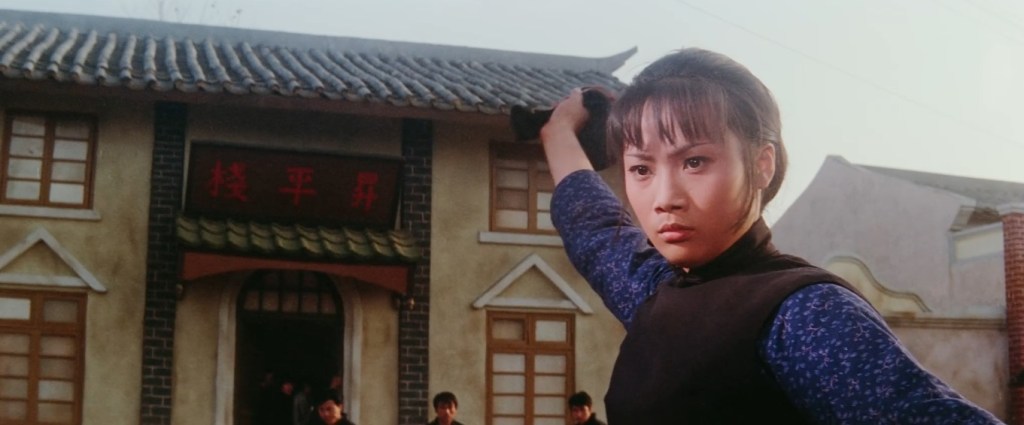
It’s hastily shot, with some angles that look bent, the circular lens warping the very architecture at the edges of the frame. Ling’s actor Chang Yu plays well here, with an expressive face that sells his inexperience with fighting. And then there’s Mao, whose very first close-up is out of focus, and for whatever reason, she always appears small on-screen. This is another contrast to Bruce Lee’s presence. Tiao Ta Niang is shot from low angles, but that’s specific to the scene where Sammo begs for mercy (poor guy). It’s strange, because the camera should be imbuing Mao with that kind of gravitas throughout. Despite my early misgivings, she isn’t the kind of character who has to earn respect by kicking people repeatedly in the face – she just does so anyway. In another comedic instance, she rises into frame too quickly with a very serious face, but with that same sincerity she says hard stuff like, “Come on, then. This is where you’ll be buried.”


 With Eyes East