

Directed by Timo Tjahjanto
Starring Aurora Ribero, Hana Malasan, Kristo Immanuel
“But to have it happen to my own neck is… ridiculous.”
Timo Tjahjanto is a filmmaker with the intuitive understanding that, in human nature, we’re at our angriest when we’ve taken a blade to the shoulder in a fight to the death. I don’t know how he knows this, but it does make sense, and in his latest film, it comes up a lot. For reference, The Shadow Strays could be described as a sequel to 2018’s The Night Comes for Us, though in spirit, it’s more like a prequel to that film’s own – tragically unmade – sequel, Night of the Operator, which would’ve spun off Julie Estelle’s assassin character. I was so stricken dumb by the “bones tearing through flesh” style of The Night Comes for Us that I didn’t realize how much I loved it until subsequent, wide-eyed viewings. I’ve watched Julie Estelle’s big fight scene so many times that I know every beat by heart. And so, the experience of The Shadow Strays is relatively unique for this movie-goer. Tjahjanto said, “Want more?” and I said, “I-I didn’t even know that was an option.”
One of the traps I could fall into with this review is referencing back too much to The Night Comes for Us, and the other is pretending like I’m some kind of Tjahjanto expert. He’s mostly a horror director, and I confess I haven’t seen, for example, May the Devil Take You or his contributions to the V/H/S series. But it’s enough to know that he dabbles in both genres – and even in slapstick, with 2022’s The Big 4 – because it gives his action an edge, literally, that you don’t see elsewhere. So, let me get the Night Comes for Us comparisons out of the way up-front by saying that I think he’s upped the gore factor on this one. I think. By now, I’ve seen Julie Estelle tear her finger off so many times that I don’t gag like I did originally, but I’m still willing to place this bet. A low-stakes bet either way, because it just means that both movies are completely out of pocket.
We open on an action movie staple: one of those wooden Japanese houses with the sliding paper doors, its yard dotted by obvious henchmen. We follow through with some action movie dialogue about deals and betrayals, have the obligatory “bad guy’s about to rape the girl” moment, and then the good guy comes out and puts a stop to that. Typical stuff, verging on cliche, just like how the bad guy’s head is verging on his upper back. The ninja puts a new spin on decapitation by doing it not all the way, so the head flaps back and the body stumbles around momentarily, looking like a body horror creature. And this is only the first part of a three-part sequence that serves as the 20-minute prologue to an action film clocking in at two hours and 20 minutes. The ninja then has to fight the henchmen, and then another ninja comes in and fights the henchmen. It’s a bloodbath!
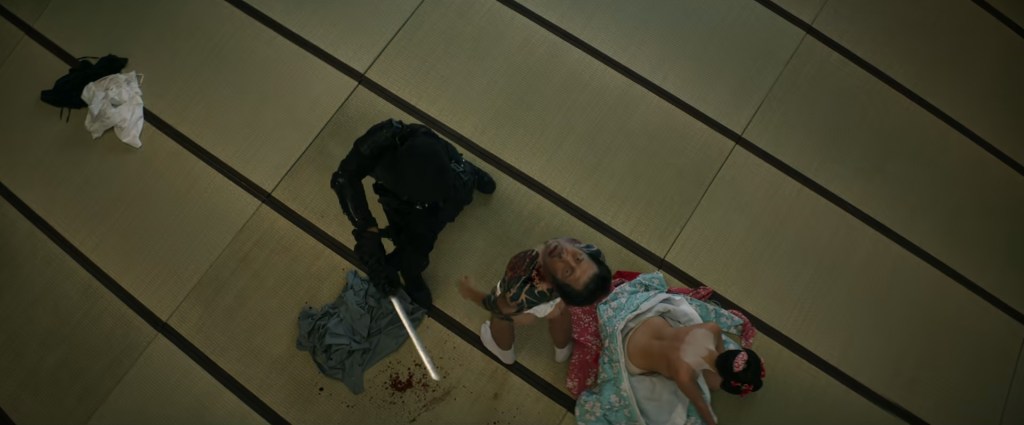
And it’s a promise, one that the movie is sure to fulfill. I seem to have this problem with Korean action, where the opening scene is great and then they don’t know how to have a second act – The Villainess, My Name, Ballerina. Oh, and this is a good time to mention that when the ninja unmask themselves, it’s women who have been decapitating almost all the way! Fear not; there are full decapitations later on. One of the reasons The Night Comes for Us (that’s a demerit) appealed to me so much is that it’s fronted by Joe Taslim, who’s a ten out of ten on the badass meter in that film, but when it’s Julie’s turn, there was no turning the dial down to “girl mode.” Her character, the Operator, is just as violent, and even more skilled, where so many other action movies see their female characters as, like, screenwriting obstacles.
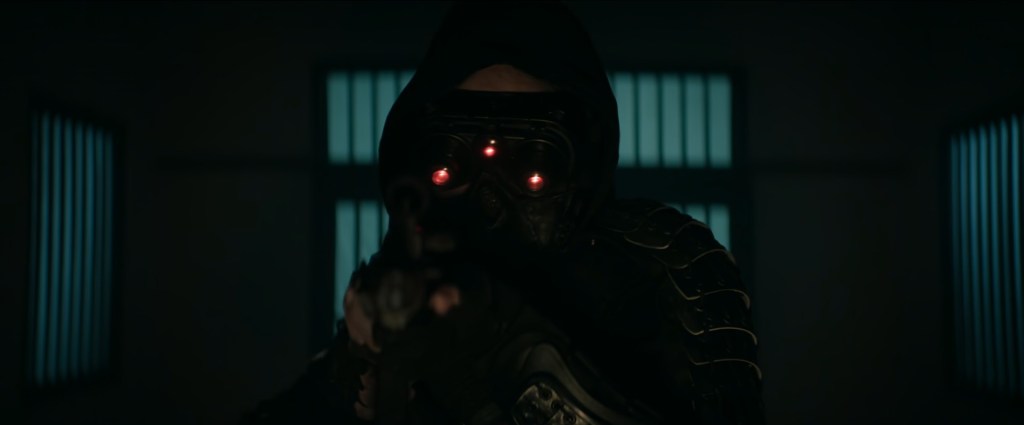
Other action movies would also situate the prologue of The Shadow Strays at the end, and we’d close on a voice-over about how “This is only the beginning.” Well, then, why the fuck isn’t it?! Our heroine is named “13,” and she’s a rookie in an organization of international assassins so powerful that yakuza whisper about them like urban legends. They also wear cool armor, with samurai plating and gas masks. But right there, I was flashing back to La Femme Nikita and all its exhausting derivatives. For once, it seems, a woman-fronted action movie isn’t an origin story. There’s no training montage to be found; 13’s done with all that shit and she hits the ground running. The young actress Aurora Ribero imbues her with something else exceedingly rare among her genre sisters: rage. She’s clearly capable of being an efficient, clean assassin like Léon or John Wick, but she chooses not to. Why stab a guy once when you can do it a dozen times, screaming a blood-flecked, Guts-style war cry as you go?
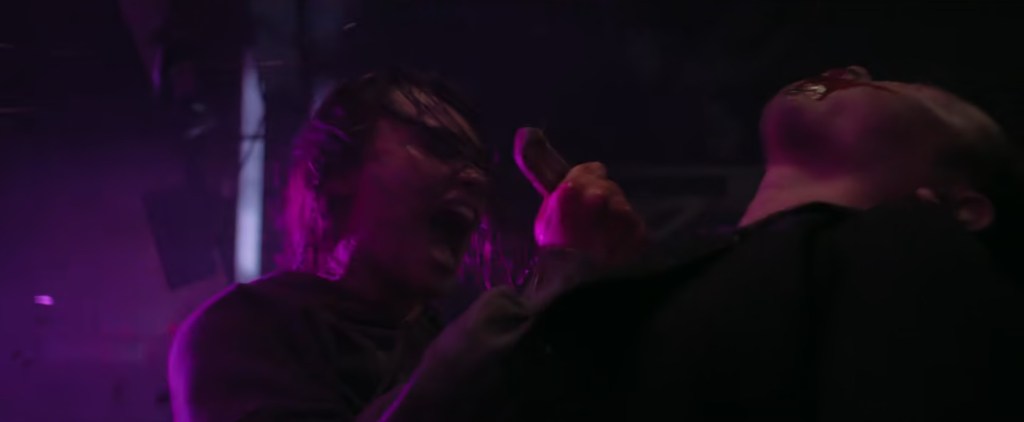
13 is sent home to Jakarta, where she’s slamming pills and trying, halfheartedly, to stay out of trouble. Her neighbor Monji and his mom are attacked by the local gang, which unravels as an escalating series of high-stakes villains. First it’s the corrupt detective, then it’s the guy running for governor. The Shadow Strays builds a comic-book world (that’s another demerit) where the bad guys are extremely bad, and the good guys are, well, also bad, and they’ll have to be. That said, our resident gangsters and dirty cops are clear-headed enough in the moment to lend the brutal film moments of levity, especially Andri Mashadi’s Ariel. After 13 has just murdered someone in a way so horrifying I dare not repeat it, the gangster persona completely drops and Ariel rushes back to his friend’s body, shocked and scared. This is a movie where the villain calls the hero a “psychopath.”
One of the things that I’ve had trouble with as a lifelong movie critic, coming of age and leaving certain things behind, is trying to pare down and define exactly what it is I even like. The fear, of course, was, “What if I don’t find that thing?” The childhood blend of Terminator, Godzilla, RoboCop, Jurassic Park, with all they have and don’t have, set me up to identify it in Zeiram, of all things: “woman versus monster.” I love Zeiram and 2022’s Prey, but then, in my wildest imaginings, I think, “What if the woman was the monster?” and that’s something that no action movie had ever given me, until the Operator pushed a blade through an assassin’s throat like one might kill a zombie. The Shadow Strays may not be Night of the Operator, but it is that moment on repeat.

And therefore, the film is so special to me and so unique that whatever I can identify as “flaws” is a mostly academic exercise. Let’s see, I mean, there’s the plotty part of the plot, the broad strokes, which is that 13 is going off to rescue Monji, and that’s built on the least interesting of her three relationships. Otherwise, it’s mentor/mentee with Umbra, played by the equally impressive Hana Malasan, and the friendship she stumbles into with a low-level criminal named Jeki, played with comedy and surprising melancholy by Kristo Immanuel. Both of those are more active and unpredictable dynamics, but I suppose I do like that her devotion to Monji kind of comes out of nowhere and bewilders everyone. I’m stopping myself before I say something stupid like “I don’t even need plot!” because that’s a fallacy I find disrespectful to the genre.
It’s one thing to see a fight scene divorced of its context, and you think, “Ooh, that’s cool,” and another to see it in context, where you either care about what’s going on or you don’t and it just becomes noise. Some of our most treasured action scenes in movies like Raiders of the Lost Ark or Die Hard aren’t gonna match the choreographical complexity of the average Yuen Woo-ping movie, but not every Yuen Woo-ping movie is Iron Monkey. These scenes reach us because of the characters and their dilemmas. The final showdown in The Shadow Strays is disrupted slightly by motives obfuscated by internal conflict – the ultimate villain doesn’t commit fully to villainy – leaving us halfway between a tragic ending and a cathartic one. But goddamn, is it bloody. For all the warehouse shootouts and motorcycles crashing into houses, Tjahjanto saves the biggest spectacle for the one-on-one fight, with as much carnage as the set pieces with far higher body counts. When that bomb loaded with nails goes off, it’s not gonna be pretty.

Crucially, we know these things ahead of time. Our attention will be brought to a prop in a scene, like a receipt spike on a bar, and we just fucking know. It’s an action movie where the environments are well-worn, even torn apart in some cases. There’s narrative in these scenes, and rhythm, and they punctuate on heads shredding under point-blank automatic fire and a particularly gnarly burn gag as pictured above which – spoilers – doesn’t turn out to be lethal. And, man, that’s the other thing.
The afore-described “comic-book world” of The Shadow Strays doesn’t make a lot of sense, which might call into question the need for world-building in the first place, but it does set the tone, and that’s what helps a movie with such ultraviolence feel palatable. For example, you got to have that one character who just refuses to die, and she’s also fantastic. This is really the final ingredient to a great woman-led action movie – women, plural, in all sorts of roles, like crazy-eyed, shotgun lady who gets hit by cars. An important niche in any film. It’s character, in the sense of, like, personality. We have visual iconography here, and production design – and I’m sure the Jakarta tourism board just loves Timo Tjahjanto – and a sense that there’s more going on. The post-credits stinger (post one credit, anyway) sets us up for further adventures with no less than two opportunities for a Julie Estelle cameo – you’ll be just as happy with who shows up instead – but with the director heading stateside, who knows?

Precedent hasn’t shown that Asian filmmakers are able to retain their essence under the Hollywood system, from the infamous John Woo detour through Ryuhei Kitamura’s many fumbles and even the one-hit wonders of the artier crowd like Wong Kar-wai and Zhang Yimou. But one of the radical changes in the mediascape, ushered in by streaming, is the relaxation of ratings systems, and American audiences have always been A-OK with violence. Here’s hoping Bob Odenkirk in Nobody 2 hits as hard as Aurora Ribero does here. She’s pulling off the bloody kills – absolutely cringe-inducing stuff – and also the crazy choreography generally, staying mobile and rolling to cover and, my word, making great use of meat shields. So many dead bodies get blown up by friendly fire, just so many. That’s the essence of this very particular filmmaker, and I’m cautiously optimistic about its future. Regardless, we have The Shadow Strays today, which means twice as many gory scenes I can endlessly rewatch.
 With Eyes East