

Directed by Yugo Sakamoto
Starring Akari Takaishi, Saori Izawa, Mone Akitani
“Where did your idea of ‘female-centric business thing’ go?”
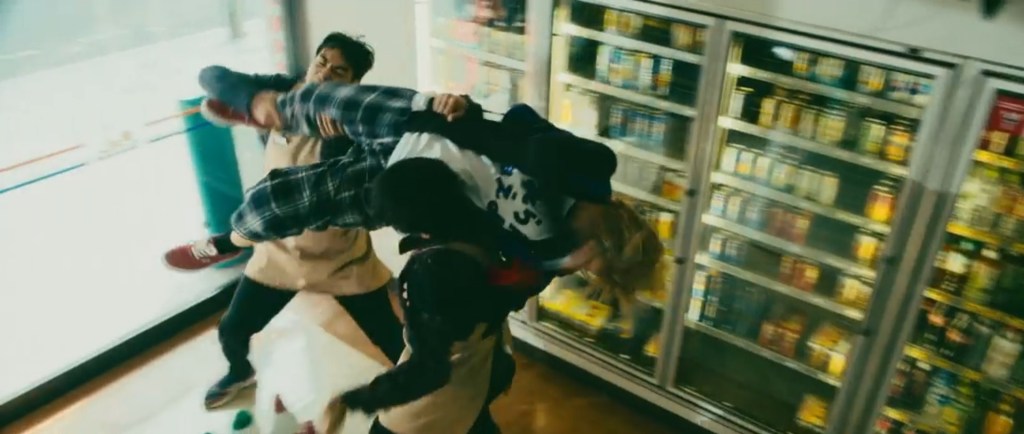
In action movies, there’s always that moment in the final battle when the bloody-faced hero looks up at their opponent, and the line is something like, “I’m not giving up” or “Is that all you got?” In Baby Assassins, it’s more like, “She didn’t tell me about this strong guy.” That’s it. Just another snippet of an internal monologue that’s sometimes spoken aloud. At the start of the movie, this character Mahiro is introduced as a socially awkward teen doing something painfully relatable: bombing a job interview. Only, she cuts it short by shooting the hiring manager in the head (ideally, that’s less relatable). What follows is a frenetic fight scene choreographed by the modern master Kensuke Sonomura, where assailants lifting Mahiro into the air doesn’t stop her from repeatedly stabbing their shoulders and arms. Spoiler alert: this is most of the movie’s action until the final battle.
For the most part, Baby Assassins is a stoner comedy from the 1990s, cut from the American indie cloth of Linklater, Tarantino, and even Kevin Smith, rather than the expected Rodriguez. There’s no tension or suspense, no escalation or anything typical of the action genre. No real plot, either, no character arcs. The original invention of Quentin Tarantino’s was the extraction of the Mexican stand-off, toward heightened, dark comedy. Take the scene in Once Upon a Time in the West where Cheyenne and Harmonica meet, with its tension and wry humor, and expand it to a feature and you’ve got Reservoir Dogs and, I assume, The Hateful Eight. Turns out, when somebody has you at gunpoint, they’re able to talk a whole lot. And if the manner of their talking is in any way inappropriate given the life-or-death stakes of the situation, it’s a compelling juxtaposition.
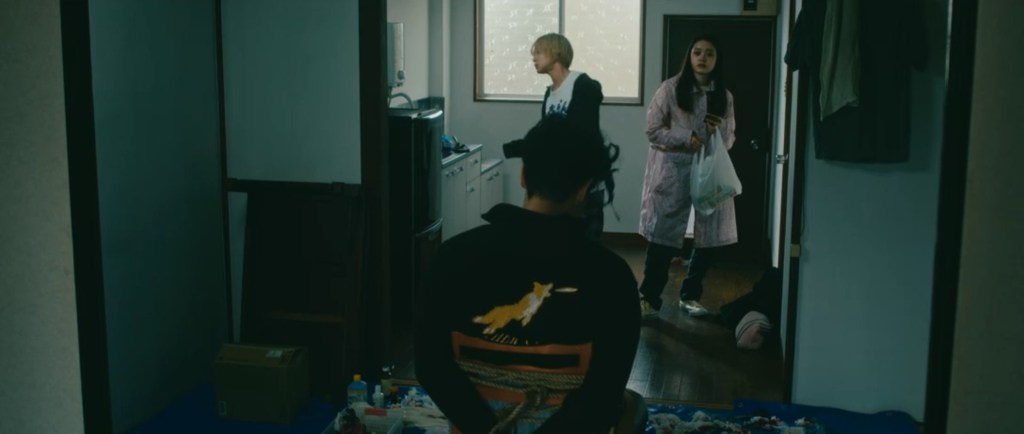
This, certainly, was the lifeblood of Tarantino’s many imitators through the turn of the century. In an early scene in Baby Assassins, Mahiro bickers with her partner Chisato in an extended, static shot, wherein their bloody prisoner sits in the foreground, tied to a chair. I don’t know, it was almost like coming home – to film school, more than ten years ago now. To that simpler, ancient time, this is a modern action movie devoid of world-building. There are hints, with the crime scene cleaner and a website for the assassin organization, but these go mostly unseen. There’s also the organization itself and its rules, similar to the recent Mr. and Mrs. Smith, which provides largely unnecessary narrative pretext.
The Kevin Smith part is the central conceit, maybe the “joke” of the movie, that these two assassins have just graduated high school and are required to get part-time jobs. First of all, the joke is also, “They’re assassins, but they’re teenage girls!” and “They’re assassins, but they’re roommates!” Second, why? To maintain cover? Supplement income? It’s an arbitrary requirement, something better patched up by an establishing scene where they run out of money. Why do these two antisocial, anarchic individuals need to answer to a superior? Perhaps the sequels will clue me in. For now, they go out for odd jobs in convenience stores and restaurants with little success, and then come home and deal with tiny domestic issues like a broken washing machine (broken because someone left a magazine with bullets inside).
It’s so indie it feels borderline film-school, with jokes that aren’t really jokes. Like, Chisato loves her machine-gun, and that’s played for laughs but, like, what’s funny? And why am I laughing? I’m tempted to say “Baby Assassins is at its weakest when it tries for actual plot and story,” but it’s more like the addition of traditional story elements to an untraditional structure makes me rethink the untraditional structure’s conscious design. The closest thing to character work here is when Mahiro feels abandoned by Chisato, who eventually lands a gig at the maid café (a scene I found genuinely funny), and they get grouchy at each other later. In the end, Mahiro apologizes to Chisato while affirming that while she may be a sociopath, it’s all good. I mean, that’s not substantive enough to work on its own, and the movie has anyway formalistically refused substance altogether. The point is, an act-two “dark night of the soul” precludes yet more of Chisato and Mahiro being weird and violent. Priorities, people.
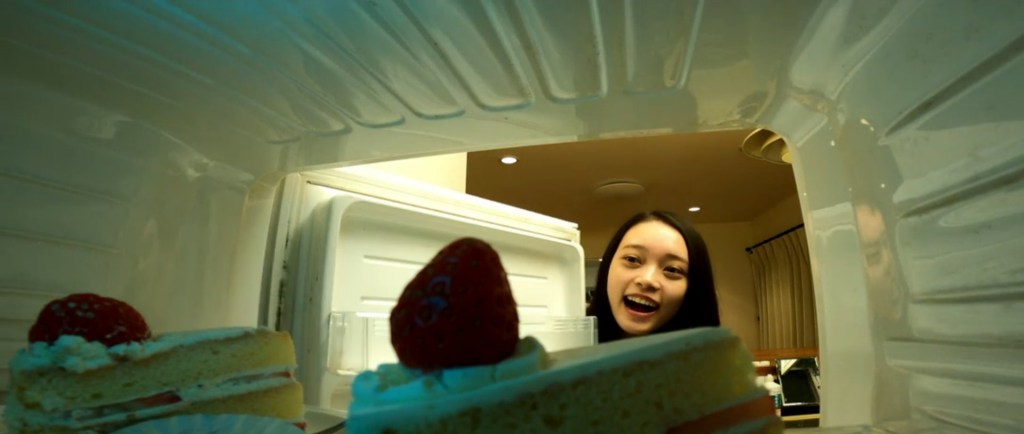
Despite the titular assassins’ impressive, ooh-getting fight choreography, their general bizarreness is the true star of the show. Part of their charm is their unpredictability, that after behaving so oddly in the most mundane situations, suddenly every situation has the potential for more oddness. I especially like the scenes (and montages) where they’re lounging on the couch in their apartment, sometimes wired into devices that go flying when one of them abruptly leaves. Then there’s the one where Chisato keeps slurping her ramen too intensely, and gets a smack on the head.
They both share a weary, sort of exhausted attitude toward the world around them, which serves as good setup for moments of actual engagement. Mahiro watches cat videos in her downtime (“I love cats”), and Chisato, after having perfected the whipped-cream topping on a waffle, only for the customer to scoop it off, kills the customer and her manager in a frenzy. Whether or not this moment was “real” is debatable after the curious reset on the opening action scene, but it was shocking, especially the ease with which Chisato snaps the manager’s neck, who moments before flashed a warm, proud smile at her successful employee.

It’s difficult to tell if the stylistic flourishes, which contribute little to a movie so uninterested in being a movie, are always purposeful. The villains are extremely unthreatening, with the primary antagonist’s eventual anger toward our leads being arguably insincere. Earlier, she wanted to be Chisato’s friend, and I’m not sure how true that was. It’s just not the kind of movie for questions like that. You got to roll with the punches (and stabs). And so, while the movie feels “messy,” as more of an attempt at an outdated, pioneering style of film than a trailblazer itself, there’s enough of an attitude, and enough strengths in the right places that Baby Assassins is an unforgettable good time.
 With Eyes East