

Directed by Yugo Sakamoto
Starring Akari Takaishi, Saori Izawa, Sôsuke Ikematsu
“The name is Riku Nanase. I’m the guy who’s gonna kick your ass.”
For two movies, Baby Assassins has been a source of unusual joys. They’re charming even in their deficiencies, with scenes lingering on nothingness for so long that it becomes funny and the lack of plot making for unpredictable sketch comedy. With this third outing, the winning non-formula is finally given structure, which might sound unduly disciplinarian for our anarchic duo, but this was the only ingredient missing. I think that sometimes, filmmakers, film critics, and film students can romanticize the subversion of convention, when so much of the artistry and effect of movies is in the exercise of character arcs and stories which resonate with subtextual meaning. And yet, even with a Baby Assassins set to provide usual joys instead, I couldn’t have anticipated such virtual perfection as Nice Days. I was already a fan, guys. You didn’t have to do all this! A proper coming of age, it’s an optimization of every formerly experimental element; a bloodsoaked spectacle with a cathartic, heartfelt finish.

We’re reintroduced to our leads, Chisato and Mahiro, whirling and twirling on a beach in Miyazaki, Japan, enjoying their time together despite being on the clock. For a few beats, we hang in this vacation headspace, which may or may not feel earned after constant failures at part-time jobs. These two are just so fun to watch, even if, historically, it has felt like observation. Without forfeiting their inherent strangeness, Nice Days makes its heroines more readable, even granting access to their thoughts. Chisato is alerted via push notification that it’s Mahiro’s birthday, something she completely forgot. Voice-over indicates that Mahiro had gone all out for Chisato’s birthday, and this is the essential stuff of friendships, isn’t it?
Before Chisato can figure out her gift, they’re pulled into the next job, only to encounter a fellow assassin already mid-hit. Our brooding villain is Kaede Fuyumura, played by Sôsuke Ikematsu, who impressed as Takeshi Hongo in Hideaki Anno’s Shin Kamen Rider. He turns in another intense performance here as a true-blue psychopath who’s actually dangerous, especially after beating the undefeated Mahiro in a one-on-one fight. See, she tries her signature headbutt move and totally whiffs – realizing in glorious slow-motion – only to be headbutted upon in return.

Subordinating the class commentary of its predecessor Baby Assassins: 2 Babies to the textural makeup of the world – so full of societal rejects – Nice Days instead foregrounds a thematic concern, one linked to the very premise of the series. Mahiro begins to spiral, reflecting not only on her worth as an assassin, but on her own mortality. And significantly, we get the sense that she believes the tragedy of her death would be that she can’t hang out with Chisato anymore. In this episode of Baby Assassins, the two are never separated by a petty spat. While their goofiness remains a compelling series trademark, we reveal contours which don’t complicate but rather deepen the dynamic. These are two people who have a hard time expressing themselves, even to each other sometimes, but their bond is never in doubt, both in and out of combat. Another key upgrade, as previously, Baby Assassins could get away with muting the characters for the action scenes because the action scenes were cool, but this time, Chisato and Mahiro are just as expressive in a firefight as they would be on the couch.
Fuyumura is also afforded more interiority than the average Baby Assassins villain, with an origin story relayed via clever film language. Initially so relatably awkward – unable to raise his voice enough to ask a food stand for chopsticks – he’s contracted to kill 150 people connected to the online cancellation of an influencer (which makes no sense at all) and takes to it with the artistic acumen of a Hollywood movie serial killer. Despite never having fired a gun, by his 150th kill, he’s evaluating each corpse for style and satisfaction, transformed fully into a machine. His only contact is a conniving handler who notably gives up Fuyumura under Chisato’s gleeful threat of “Torture time!” without any actual torture; the quiet assassin has only known loneliness. His longest ongoing conversation is with himself, in a diary. Throughout, the contrast is made between a lone wolf and a team, which doubles with the addition of Miyazaki-based assassins. This is a movie about teamwork! And you know what that makes work…
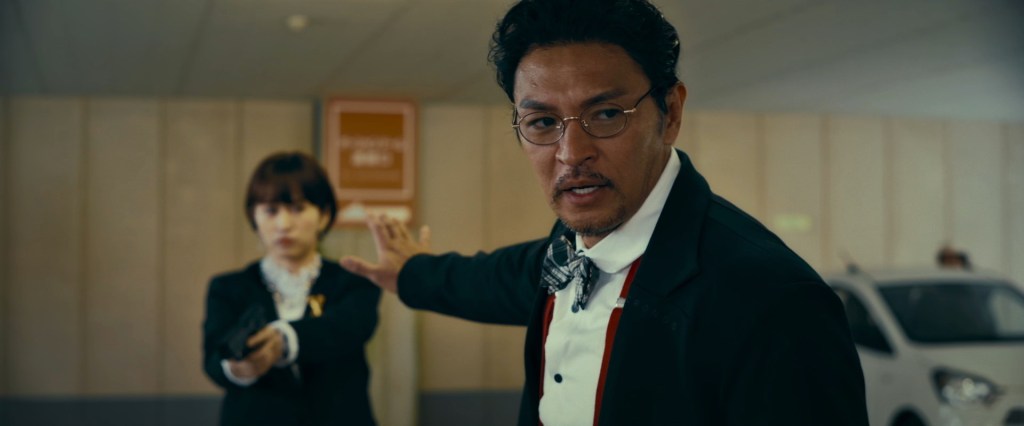
Until the second act, it seems that the series has been loosened of dead weight, specifically handler Susano and cleaner Tasaka, though the latter does make an appearance alongside the more welcome Miyauchi. In theory, I liked the idea of the found family beginning to form at the end of the previous film, but Susano has always been atonal. Nice Days really drives home that these are movies about weirdos, and Susano is at best a straight man to Chisato and Mahiro’s fall guy. Tasaka is better defined, but his nervous, muttering energy didn’t serve much purpose beyond his introductory scene, annoying Chisato outside the maid café. Miyauchi, on the other hand, is more engaging – and useful, with her machine pistol. She handles it so well, there isn’t even any kickback. Crucially, the new additions are big personalities. The professional Iruka Minami effectively replaces Susano as the resident authority figure, and her partner Riku Nanase is a body-builder whose instinct when tensions run high is to suggest everyone do squats.
In a lot of ways, the Baby Assassins series has felt like a budget John Wick, with the same aspirations toward world-building but no means to fully realize them. In trying and failing, it actually ends up squeezing just enough flavor out of that lemon. A proper spritz of exposition lets us know that Fuyumura is part of an “agricultural” assassin conclave, which means that they work on a farm – referred to as “The Farm” – and they pack crates with handguns topped by concealing bell peppers. And that’s pretty much it. The farm theme never becomes a thing, beyond a supply for cannon fodder. At the same time, writer/director Yugo Sakamoto is thoughtful enough that the cannon fodder indeed comes from somewhere. In this case, it’s a scene where a blood-splattered Fuyumura rallies his troops with a sort of “might makes right” speech that could only come from a skinner-box upbringing. Elsewhere, our four heroes regroup at a safe house in the jungle which looks like a half-finished playground, or an obstacle course. If it sounds like the movie is headed for its final stretch, it is, but we’re somehow only halfway through a two-hour runtime. What follows is a protracted climactic sequence made up of absolutely jaw-dropping action set pieces.
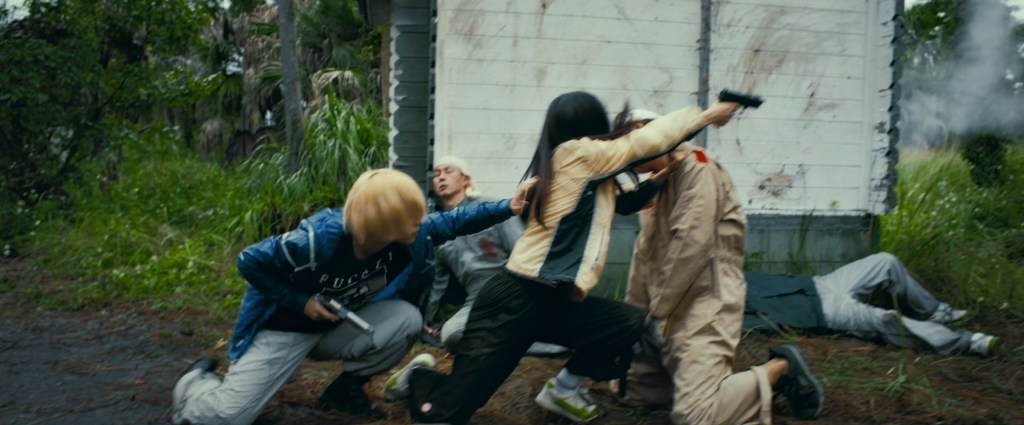
In the past, I’ve complained – or at least been snarky – about the one climax that Sakamoto and his creative partner, action choreographer Kensuke Sonomura, cook up every time. Across every film they’ve made apart or jointly, whether Hydra, A Janitor, Bad City, or Ghost Killer, the two final combatants will square off in a nondescript environment with zero props. Nobody’s thrown into breakaway furniture or over the railing to another floor. That’s still the case here, but Sonomura is at his best with the Baby Assassins movies, as Chisato and Mahiro tend to be physically smaller than their opponents, making for tricky and strategic choreography. They’ll slide between legs and whirl around to get a better angle. They kick off our climactic sequence with fire and movement using human shields acquired via close combat, all set against a lush jungle backdrop. It’s so breezy and witty and cool – an encapsulation of the series itself.
The girls then work some of the farmers’ implements into the fighting, namely little sickles for spinning and slashing – melee weapons to justify the series’ often impractical gun fu. Every scene in the final sequence, and nearly every beat in each scene, is constructed around a gag, and executed with such intricate, inventive stunt work and, truly, masterful direction. The action stays mobile and legible in the open daylight, with plenty of perfect compositions framing poses and back-to-backs – not to mention character moments, too. It’s a tour de force approaching the dizzying climaxes of Hard Boiled and The Matrix, weaving in the series’ core strengths now augmented by a story suddenly concerned with things like melancholy more than non-sequitor humor. Of course, leads Akari Takaishi and Saori Izawa can be trusted to preserve the series’ comedy even as we explore more dramatic territory.

After an incredible turn in this year’s Ghost Killer, playing two very different people simultaneously, Takaishi does outstanding work in Nice Days, reining in a bit of the mania from 2 Babies and compensating with episodes of actual sincerity. Her final moments with Fuyumara are gonna be burned into my brain, at once heart-rending and cringe-inducingly bloody, culminating in a big, triumphant laugh. And God, does she get angry – with actual weight this time. We’ve come a long way from the first film’s climactic showdown with people she barely knows, or even her barking at the bank teller in 2 Babies, which I loved so much. Damn it, she’s hilarious. In this one, she shouts, “I think I got it!” over gunfire in response to Iruka’s shot-calling. Classic Baby Assassins.
It’s funny, nothing about the premise of this series – however appealing – nor its first two installments – however good – suggested that somewhere waiting therein was a masterpiece. And yet, Baby Assassins: Nice Days is phenomenal. An absolute joy from start to finish, capped by a resolution of remarkable contradictions: I’m laughing and crying, and most surprisingly, I’m left completely satisfied. Of course I’d love to see more Chisato and Mahiro in the future, but if not, Nice Days strikes a perfect final note.

PS. I was super torn over whether to give three-and-a-half or four stars, and I know, it doesn’t actually matter, but if the difference of any two ratings did, it’s this one. To me, a perfect score is like “Drop everything and watch this right now,” and obviously, you can’t do that with a sequel. You might be able to enjoy Nice Days without having seen the first two, but why rob yourself of that fun? More pressingly, it’s entirely possible that Baby Assassins 4 – as yet unannounced – will turn out even better, and then what do I do? Five stars out of four? In truth, Nice Days isn’t a perfect movie. It even does something I criticized Shogun’s Ninja for, with its rematch between hero and villain coming after zero change in the hero’s abilities or mental state. A more traditional film would’ve used Fuyumara’s defeat of Mahiro to identify a weakness in our heroine, which she then resolves ahead of round two (and three). Of course, that’s not exactly what happens in ol’ Baby Assassins land.
The reason, then, for the perfect score is twofold: a half-star bump over the previous two movies’ three-star scores wouldn’t properly communicate the upgrade, and more importantly, in an age of extreme anxiety, Nice Days was transportive. However fleeting, it made me genuinely happy. I am so glad this movie exists.

 With Eyes East
One thought on “The Dream | Baby Assassins: Nice Days (2024) Review”