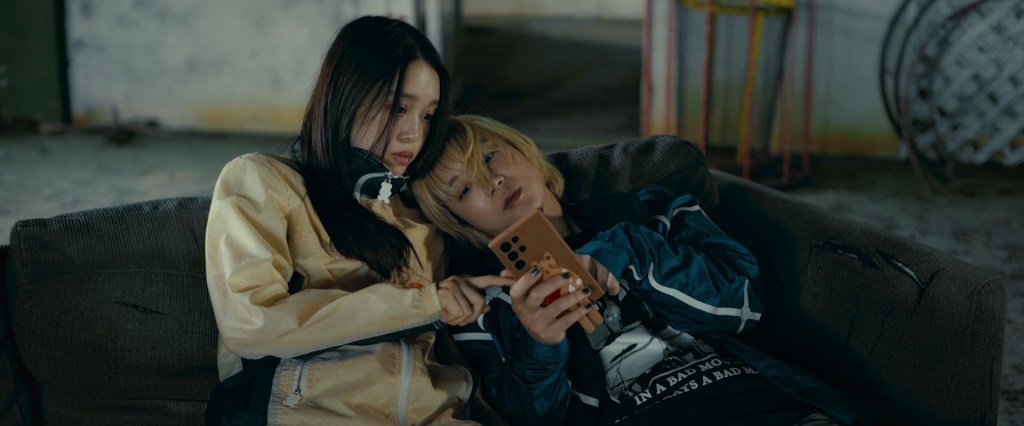
Spoilers for Baby Assassins: Nice Days
My understanding of Baby Assassins was that it was, if not “a big deal,” then at least “known.” Using this very website as a record, my earliest awareness of the series dates back to 2022 (see: “Hydra review”), one year after the first movie released, and even by then, I felt late to the party. Note, in that review, I reference the movie without disclaiming that I hadn’t seen it, which might lead readers to incorrectly assume I had. Garsh, I just can’t let myself get away with anything, can I? I’m such a humble guy! I’d learned about it from an entertainment website like Polygon (which it wasn’t, as their earliest coverage is 2024), in an enthusiastic review or discussion. I suppose this is my mistake, thinking that such writing is somehow indicative of the national (or international) pulse. No, outlets like that are pretty small-time, despite all the damage wreaked by unethical games journalism. Regardless, I then assumed that there were tons of people out in the world whom I could chat with about Baby Assassins, or at least pose this burning question: “Who’s older?”
Alas, there is no Baby Assassins subreddit even, and aside from the daily crush of Reddit discourse, I have seen some shit on that platform. Namely, they make subreddits for everything! They made a subreddit for the movie Weapons, when those discussions could’ve easily been filed under the “movies” or “horror” threads. Like, you guys are arguing about not wanting a Weapons follow-up, so obviously, this very sub has an expiration date! Anyway, this would be my question if a Baby Assassins subreddit did exist: which of our two leads is older, Mahiro Fukugawa or Chisato Sugimoto? This seems obvious at first, with the almost ten-year age gap of their respective actors – Saori Izawa being the elder and Akari Takaishi the chan. However, the first movie has them graduating high school and rooming together, on the cusp of adulthood. I don’t suppose they’d be in this situation if they came from separate grades. Okay, so they’re both about 17 or 18 in the original Baby Assassins. In the third movie, Baby Assassins: Nice Days, we get a specific number: 20. It’s Mahiro’s 20th birthday, which means she can have her first legal drink.

This is where it gets interesting – yeah, right; it’s been interesting all along! – because Chisato makes reference to her own birthday, and from context we can assume it was earlier that year (rather than the year before; it’s also summer, for what that’s worth). What we can’t assume from context is that it was definitively her 19th or her 20th. We don’t have enough information, to my knowledge, and therefore, we don’t yet know who is older. At the midpoint, we have Mahiro’s improvised birthday party in Fuyumura’s tent during the overnight stakeout, where the girls share noodles and seemingly their first beer. Chisato makes references to not having drank recently, and although the cans are warm, by their reactions, it appears as if they’re tasting beer for the first time. By the end, of course, they’re downing big mugs at the hallowed barbecue place.
This presents two scenarios. If Chisato is 19, she’d be having her first beer early – illegally. I realize that she’s committed countless murders, but if Mahiro is waiting till 20, why wouldn’t she be? It’s more about the ritual, I think, in keeping with the series’ vague coming-of-age theme. If Chisato is 20, does that mean she waited for Mahiro’s birthday and did not drink on hers? That would be really sweet. Either way, it’s kind of a continuity error in a movie chock full of them. To wit: why does the cleaning crew think the scene at the mall will still be there to clean after they’ve driven to and from the safe house? How could Fuyumura kill 150 civilians and get away with it? How does the farm assassin survive getting his neck snapped? How would Chisato even know about Mahiro’s headbutt if she hasn’t witnessed the last two? And most importantly, if Iruka’s idol is Ai Haibara from Cased Closed, why does she look like Doll, the Hotel Detective?

I assume the answer is that Chisato is 20, and she waited for Mahiro’s birthday so they could have their first drink together. That’s more in keeping with the character. Unfortunately, it does make Chisato older, if only by a few months, and that’s a problem. Not for the reversal of the actors’ ages, but that – in my headcanon up to this point – they had such a great little sister/older sister dynamic. I mean, not only is Chisato taller, which is a very real sister thing, it’s also interesting that she’s the more socially put-together of the two. Unless something sets her off, she can fake it through most conversations with normal people, though her patience will visibly wither. Mahiro, on the other hand, truly cannot. She needs Chisato to guide her, and I found that role reversal to be endearing. The emotional thrust of Nice Days is Mahiro’s dark night of the soul, and Chisato gives her a lovely pep talk before the final battle. I think that’s more powerful coming from the chan, though of course, the age difference would only be a matter of months anyway.
Since Baby Assassins: Nice Days released late last month, I haven’t been able to stop thinking about it, leading to crap like this post. I had a lot of fun watching that movie and even writing the review – I took my time with it. The inevitable withdrawal has been rough, because it isn’t like after a K-drama, where you can just fire up another K-drama. There aren’t a lot of movies like Baby Assassins, even if there are plenty of action movies and even woman-fronted action movies out there. Still, I’ve got my eye on the ball. Knowing fully what to expect (down to a note about a horse), I’m looking forward to the new Red Sonja, and even more so to the new Deathstalker, with Daniel Bernhardt. Also of note is Tony Jaa’s return with Striking Rescue, and out of TIFF there’s The Furious, directed by Kenji Tanigaki, who’s worked as a stunt coordinator on movies like – get this – SPL, Flash Point, Twilight of the Warriors, and Blade II!

The Furious has an all-star cast, including Joe Taslim, Yayan Ruhian, Jeeja Yanin, and look at that, Joey Iwanaga, who played Yuri, the older brother in Baby Assassins: 2 Babies. How come we knew which of those two were older, but not Mahiro and Chisato?! Also, and I didn’t think to mention this in the earlier movie preview, but Shu Qi had a movie premiere at Venice – like, a movie she directed, called Girl. Speaking of Venice, I also found out about a movie written and produced but not directed by Park Chan-wook, entitled Uprising, which is on Netflix. And it looks like No Other Choice releases on Christmas Day here. Did you know I saw Decision to Leave with my family? I don’t know why that happened. Anyway, I have to go and try not to watch Nice Days again. Got the Blu-Ray in the mail. No special features on the disc.


My question regarding the two’s relationship is how long have they known each other? I got the sense in the first movie that they were classmates and co-killing partners, but their surprise and reticence at the prospect of living together suggested they weren’t as close in the beginning as they grew to be by the end. And in Nice Days, Chisato mentions that Mahiro went through an L phase. But Death Note would’ve been popular when these two were either babies or toddlers. Reruns and past tankoban of the manga could easily explain that, but it might also suggest that they’ve known each other for most of their lives. 🤔
LikeLike
I like to think that Mahiro’s L phase took place at a time when Death Note was decidedly out of fashion. She’s reading a Durarara manga at the end of the first movie, too. (The pop culture references in this series are already all over the place — Ocean’s 8??). But I could see them having been BBFs for life but still stricken by the prospect of living together. I swear, if Yugo Sakamoto was a more disciplined writer, he could’ve really explored that idea, like maybe they were starting to move on from each other and had to come back together but NOPE! Save all the character work for the third movie
LikeLiked by 1 person