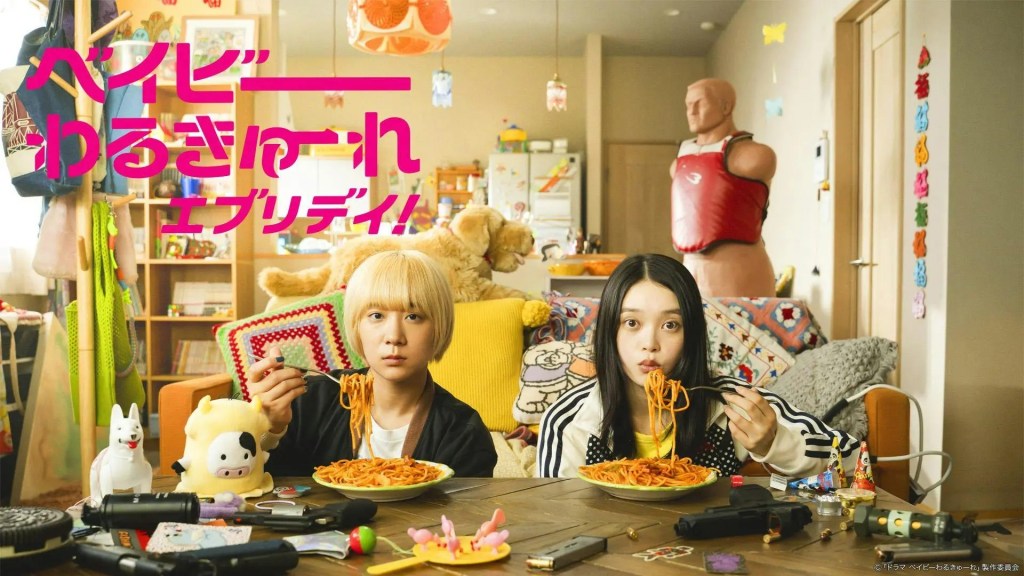
Hey, everybody, I have an announcement to make. We’re expecting!
Donovan, my Baby Assassins partner-in-crime (the Miyauchi to my Tasaka, if you will, though maybe there’s a better duo to be), informed me a few days ago that the TV show, Baby Assassins: Everyday!, was eminently streamable on Hulu and HBO Max, and has been since October 16th. I was late. How could I not have known sooner? Where was the YouTube trailer? Where are the outlets meant to warn me? So, I’m here now to pass it along, realizing that perhaps I am one of those outlets. Not really, but seriously, what the hell happened?
I won’t go into too much detail here, but I’ll just say that despite being in a different medium, Everyday! is no side project. This is very much the next part of the story, and it does a lot to contextualize what’s come before to actually shape the whole thing into a story. If Nice Days felt like an emotional climax, Everyday! is a thematic ending — with more than enough room for a future. That being said, it isn’t without problems, namely a three-episode arc toward the beginning that feels like a Yugo Sakamoto action movie with a Baby Assassins cameo — like A Janitor, I guess. Your mileage may vary, but I found it kind of excruciating.

And that’s pretty much it for problems. Everyday! is a good balance of standalone episodes and a long arc, culminating in a four-episode finale that feels, for all intents and purposes, like Baby Assassins 4. Almost all of our favorites return, including my girl Miyauchi and, to my great surprise, Iruka Minami in a limited role, teasing developments to come. It’s lighter on the action overall, as expected, but a lot of the old classics are reused and even remixed in interesting ways. There’s a hallway fight that feels like the end of the first movie but with the meat shields from Nice Days. Chisato gets a slasher villain moment that’s shot like Fuyumura’s massacre of The Farm. And even the Sonomura special makes better use of the environment this time, with plenty of prop work. This team just keeps getting better.
Thematically, also, this is a coming-of-age, in more direct terms than even Nice Days. We take a look at almost every aspect of the premise and Chisato and Mahiro’s lives to deconstructive, satirical, and bittersweet ends. It’s yet another astonishing addition to a series that could’ve skated by on being unique (and sort of charmingly inept), a sequel so good it makes what came before even better.

More to come…
 With Eyes East