

Directed by James Wong
Starring Jet Li, Jason Statham, Carla Gugino
“Yeah, the Chinese guy was tearing the place apart.”
Partway on the timeline between Demolition Man and Everything Everywhere All at Once, behold The One, a blend of science fiction and martial arts to suitably harebrained ends. Far from an expert on all things Jet Li, this first-time viewing was spurred on by its relatively recent coverage on The Greatest Movie Ever! Podcast, in which shameful secrets were revealed about past fondness for musical acts like Drowning Pool and Papa Roach (believe me, I understand). Indeed, this movie is from the year 2001 the way that people from Boston are from Boston, and as I’m currently reading/listening to two examples of popular literature from the mid-1980s, I’ve had occasion to reflect on how often not timeless movies and television are. Those books, Blood Meridian and Stephen King’s It, are both set in the past. By contrast, it’s the rare genre film from the 1980s that doesn’t feel Totally ‘80s! and thus subject to modern nostalgia-driven filmmaking. Will we have a cultural resurgence one day of movies like The One and XXX and The Scorpion King? No.
It was two things inspiring the watch, then; three, if you count “currently streaming on Netflix.” For one, I like the idea of movies like The One. Aside from striking a notable VHS box at Blockbuster Video alongside the memorable visages of Mortal Kombat and Critters 2 (horrifying), it’s that razor-specific vibe of Eraser and Equilibrium and the poster for Ballistic: Ecks vs. Sever and whatever else floated about during the time of The Matrix – almost cyberpunk, and trashy enough to be interesting. Not Dark City but maybe I, Robot? For some reason, I’m tempted to include Final Fantasy: The Spirits Within in this curious pantheon, and I think it’s that genre-defying pastiche which seems to remember other movies but in failing to follow their example, does its own weird, bad thing. In other words, The One has futuristic guns and HK G36s both, and they all make laser sounds. There’s set dressing that looks more fun than convincing, and it’s all coated by very dated visual effects. For the most part, these ingredients add up, but there are shortcomings (in this already compromised design). It’s not actually a one-star movie, I should say, but what other rating could I give to The One?
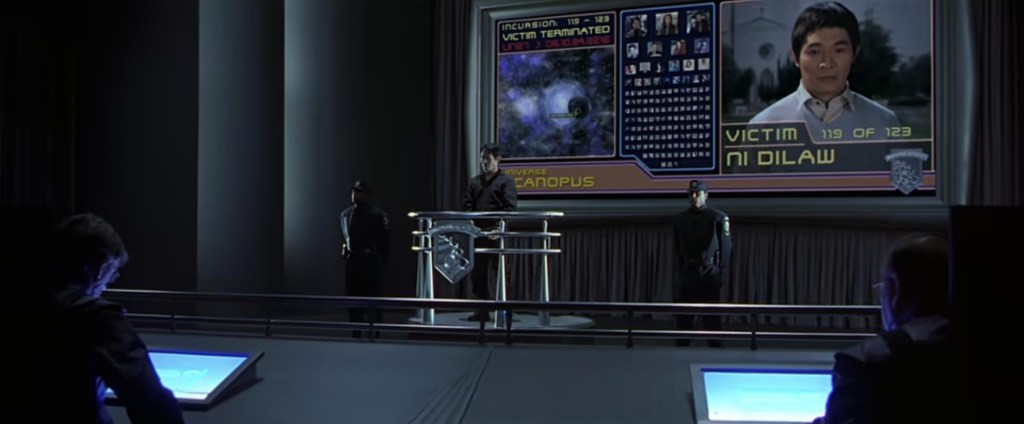
We have an almost clever premise that nonetheless violates a basic tenet of science fiction, learning from an apparently studio-mandated opening lore dump that we’re in a multiverse, and people can hop from ‘verse to ‘verse, including the time cops Roedecker and Funsch, played by the mind-bogglingly overqualified Delroy Lindo and an American-accented, hair-having Jason Statham. What the hell are these names? “Funsch”? The opening sequence perfectly introduces these sci-fi elements in a “whoa, we’ll explain later!” sort of way, like Trinity’s run in The Matrix, and knowing ahead of time how everything works certainly takes the air out. So, Funsch and Roedecker are chasing Gabriel Yulaw (!), played by Jet Li, who’s been going around parallel dimensions murdering his parallel selves. Each time he does so, the remaining parallel selves become stronger. He wants to be the titular one, the last version of himself who’d be godlike with power, and he’s already close, with only one Jet Li to go, our ostensible hero Gabe Law. Okay, so according to the rules, you can ask me to accept “multiverse” and I will, but you can’t then ask me to accept “killing your parallel dopplegangers sucks out their life energy.” I mean, of course I will accept it, because honestly? I think it’s a good idea, not even just a “fun” one. We know that Jet Li moves too fast even for the cameras sometimes, so if he’s gonna fight anyone, it ought to be himself. Let’s bend quantum reality to make that happen.

Part of what I appreciate is how much the premise feeds into the character, that it locks this Gabriel Yulaw into a limited set of motives and behaviors, and they’re all interesting choices. What kind of person goes around murdering their alternate-dimension copies? Probably a vain, evil guy, and that’s exactly what we see. Yulaw is obsessed but having fun, an agent of chaos like Simon Phoenix before him, and he wreaks his PG-13 havoc on a multiverse of cops, including one played by – you guessed it – Dean Norris. The problem, however, is that Yulaw becomes the driver of the movie’s plot, rendering Gabe entirely reactive. On paper, this is screenwriting 101 stuff and might sound like a useless gotcha like that science fiction rule, but in practice, it leaves The One with a protagonist vacuum, as well as an unmooring lack of subjectivity. Gabe is so simple and boring and we always know what he’s doing so we never need to access his headspace. Why is he doing this? Because of Yulaw, and on and on. To jump to the end, Gabe and Yulaw teleport to the police station of the future wearing identical clothes, and we don’t know who’s who, but Funsch deduces that they’re about to execute Gabe because of the wedding ring mark on his finger. This is an exact description of the scene and all its emotions; there’s no suspense, no feeling of impending doom or a frantic need for Gabe to prove his identity. We’re not with him.
And of course, they weren’t gonna execute Yulaw, which would make Gabe the One and possibly destroy the universe, but teleport him to a penal colony in the “Hades Universe,” where he’s gonna fight fellow inmates forever in an awesome epilogue that, again, rounds off his character more compellingly than Gabe’s ending. This final scene is also the perfection of the movie’s uneasy blend of sci-fi, martial arts, and nu metal, somewhat clearing the low bar of “Down with the Sickness” by Disturbed hitting when a mouse blows up (“Oh, ah-ah-ah-ah”). This is what the whole movie should’ve been, if not plot-wise than at least in spirit. Because I have to say, what we’re left with – putting aside the above technical criticisms – is a moviegoing experience that filled me with surprising incredulity and even a remote sadness.

Like its failson derivatives to come, usually courtesy of European filmmakers like Andrzej Bartkowiak and Luc Besson, The One is an alternate-universe glimpse of a leading Asian man in a Hollywood movie – and it’s awful. Uncanny, even. But this is the second reason I finally got around to watching the movie, the note from the podcast that Gabe’s wife T.K. (!) is played by Carla Gugino. I really thought I was past this, the weird sense of validation that comes from the romantic pairing of an Asian man with a non-Asian, American woman, especially since this blog ended up being all about how Asian women are the greatest thing since sliced bread. Of course they are, and the politics here are so knotty and problematic, but nevertheless, I needed to see it. Asian-American guys like me carry in their hearts odds and ends like Selfie with John Cho and Karen Gillan, and Cinderella with Brandy and Paolo Montalban, as well as Crazy Ex-Girlfriend and arguably Unbreakable Kimmy Schmidt. What if someone of this face type was just, like, normal? A part of society?
To my horror and slight amusement, there is nothing normal about Gabe in the society of The One. Action movies are tough for this. Often little more than male wish-fulfillment, they posit a singular awesome guy offset by lesser men reacting in awe, and that never works unironically, which is why it works so “well” in Steven Seagal movies. The problem with Seagal, of course, is that he’s a black hole of charisma, so it’s funny when the rest of the cast is blowing smoke. The problem with Jet Li is that he’s horrible in The One. Like, downright, unambiguously, horrendously awful. He doesn’t deliver lines so much as wrestle with them, unenthusiastically, and if I’m gonna laugh at Gal Gadot for her torturous readings, I can’t turn around and give Jet Li a pass. Granted, Jet Li brings other things to the table, and he fulfills on that end, enough to fill the Nile. The superpowered fight at the climax is great, taking place in an almost literal fireworks factory with sparks and water and several floors of grated metal and metal cabinets to slam into. Despite the effects challenge of fighting himself – an impressively seamless illusion – he’s fast and powerful and the camera loves him. No doubt, he’s one of the canonical action stars (so canonized by his inclusion in The Expendables cast).

He’s just so unconvincing as Carla Gugino’s husband, with T.K. and their home even dressed up with Chinese decor, and also as “one of the guys” alongside his police buddies, including one played by James Morrison, to the point that he feels unstuck from the reality of the film. Maybe appropriately, given the subject matter, but the movie is so damn earnest – the way T.K. and Funsch and the guys talk about Gabe, like he’s the most important thing in the world, but then he’s so passive and strange and unreal. It’s all unreal, because Jet Li’s appointment as a leading man in American movies wouldn’t last the decade, pretty much ending with War in 2007, also featuring Jason Statham. The feeling with The One, then, is that these non-Asian actors are obligated to contextualize themselves around the Asian guy, which they wouldn’t normally do, and they’d never have to do again.
If I had to diagnose this, I’d probably say that we tried to fit Jet Li into an existing American framework, and that he doesn’t make sense with nu metal. Compare and contrast to the global reaction to Ip Man, whose titular hero wasn’t an MTV-style badass but a quiet, gentle soul and yet, we all understood “Don’t fuck with that guy.” It’s also interesting that American martial arts movies of this era are like The One and The Matrix, with their insane world-building to justify what’s pretty normal over in Hong Kong, or there’s a magic tuxedo or a magic medallion. We didn’t really understand kung fu movies back then. “How come Chow Yun-fat can fly?” The ironic part is that the director of The One is Asian. But like Justin Lin or Dean Devlin, he was simply making movies at a time long before Asian or Asian-American stories were fashionable. And in this friendlier environment, a movie like The One would never be made, for better or worse. There’s just something precious about a scene where Delroy Lindo and Jet Li reflect on their shared past – it was the promise of something that was never truly meant to be, and I am Yulaw! I am nobody’s bitch! You are mine.

 With Eyes East
It’s literally been almost 25 years since I saw this in the theaters, wish I’d watched it again with you!
LikeLike
Ah damn. I should’ve thought of that
LikeLike
This was definitely a good, interesting review that I enjoyed reading. For whatever it’s worth, I think that Final Fantasy: The Spirits Within (2001) gets a lot of undeserved hate. While I can understand complaints of it being boring and/or failing to grab someone, I enjoyed the deeper themes involving a human’s soul… and the villain having a surprising amount of depth — he wasn’t just an evil character to be evil, and that was something I appreciated. The motion capture looks surprisingly good also!
I actually saw The One a few years ago, and generally enjoyed it. It broke even upon its 2001 theatrical release. I’ve never finished The Matrix (1999), which is something I plan on doing someday. The plot of that movie was consistent and understandable, so I wouldn’t call it insane or crazy.
I’m unsure on how to end this comment. This review was a good read, and your points interested me, so I’ll give you props.
LikeLike
Thanks! I have some fondness for The Spirits Within, especially not having grown up with actual Final Fantasy. I was more into Halo, so the military/SF aesthetic was appreciated.
LikeLiked by 1 person