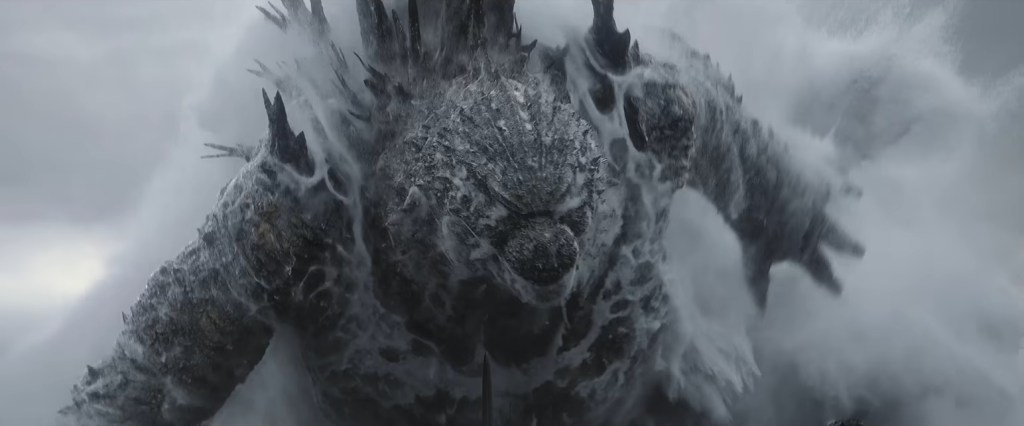

Directed by Takashi Yamazaki
Starring Ryunosuke Kamiki, Minami Hamabe, Min Tanaka
Light spoilers (plot summary)
In the days leading up to Godzilla making landfall at my local multiplex, I was doing two things: dodging spoilers and, despite that, wondering vaguely why I wasn’t super excited. Browsing back through everything I’ve ever written about Minus Zero, it wasn’t reservations but resignation. Of course I’m gonna love the movie. Of course I’m gonna cry. There’s no mystery, no reason to speculate or even think about it. Given that it was the Internet’s project to spoil King Ghidorah’s appearance in Minus Zero, it didn’t even occur to me until this week, “Wait, how the fuck is that gonna work?” Somehow, the pending sequel to the best Godzilla movie never occupied my thoughts. It was only when finally sitting down and watching it that I understood why. Godzilla Minus One is perfect. Its premise is perfect, its execution is perfect, and its conclusion is perfect. It is not, however, replicable. If a sequel must be made, it would have to do something completely different. Like The Bone Temple, trade the tears for mayhem. Otherwise, what exactly is on offer? Minus Zero follows the apparent formula of its predecessor down to the structural level, thereby promising the same experience only more so. If my sadness level was at 100% the first go-around, I guess we’re shooting for 105% this time. That is not a compelling pitch.
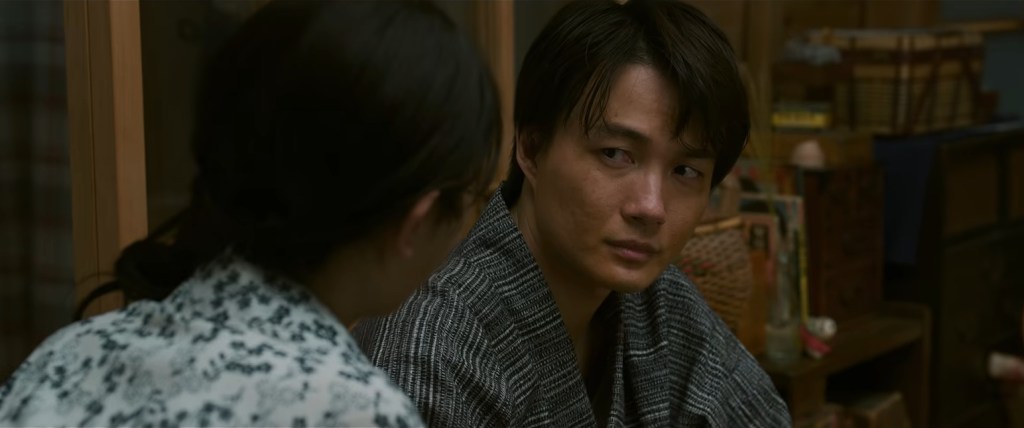
The very notion of a Godzilla sequel is a time-honored creative challenge, one that’s spawned a wide spectrum of ideas and tones, of which even Minus One qualifies. The somber, prestige drama take on the King of the Monsters was as boldly experimental as the freaky body horror and bureaucratic satire of Shin Godzilla and the anime-inspired mania of Final Wars. Only, its entry into the canon perhaps compounded the challenge for writer/director/FX man Takashi Yamazaki. Surely, Godzilla Minus One 2 can’t be “Godzilla attacks again,” but would its haunted world contain the genre largess of an additional monster and the accompanying monster brawl? Take King Ghidorah, for example, a likely candidate given its enduring appeal as Godzilla’s archnemesis as well as its appearance in Yamazaki’s 2021 Minus One prototype Godzilla the Ride. In the original incarnation, Ghidorah the golden three-headed dragon is an alien. Later versions included mutant (time travel was a factor) and even benevolent Earth spirit aiding humanity against Godzilla. None of that works in the Minus One framework. I mean, can you imagine the scientist character, Noda, lecturing about a space dragon while we blink through Akiko-borne tears?
So, what does Yamazaki do to solve this problem? Nothing, really. I don’t know if it’s a spoiler to say that Ghidorah in this movie has no origin story. And that makes sense, because once again, we’re constrained to the perspectives of 1940s scientists and soldiers who have no earthly idea what’s going on. Now we’re left with the other conundrum: the battle. Part of the genius of Minus One was relating Godzilla to the humans, revising a typically non-interactive movie character to surprising and affecting dramatic ends. But how in God’s name do you do the same for two monsters bashing each other? Here as before, the solution involves moving the human characters into the field of fire. Yamazaki has crafted enough narrative rationale to escort our ex-kamikazee pilot Shikishima and even his “wife” Noriko to the front line. It’s all sound and logical, but dramatically flat.
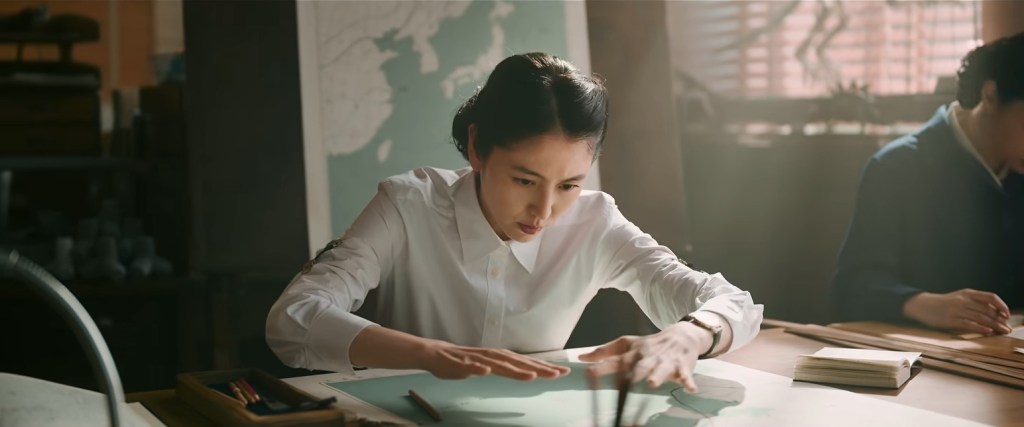
And it’s specifically “flat” in the sense that there are no character arcs in this story. There are big decisions made, but none of them especially interesting or moving. Certainly nothing as satisfying as the construction of the family in Minus One, a microcosm of Japan’s own postwar reconstruction. One of the two major new characters, Aoyama, provides an illustrative example. She’s cut from familiar cloth, being traumatized by an earlier tragedy which indicts some institution, in her case, Japan’s weather forecasting. Giving in to the optimism of her peers rather than listening to her gut, she failed to adequately warn the public about a typhoon which went on to claim several lives. She’s introduced with the belief that Ghidorah follows lightning storms, and she can therefore track the creature or possibly even kill it. The theory leads into the film’s standout set piece, a dragon dogfight which finally delivers on the promise of Reign of Fire and D-War all these years later. It is so tense and thrilling, built upon sufficient character work (for a couple of terrified pilots) and even international intrigue. Spoilers: America is the bad guy. Damn!
From there, Ghidorah’s “evolution” into its golden, three-headed form and the reemergence of Godzilla from the ocean depths together form a crisis with a built-in resolution. Yes, it is “Let them fight,” as delivered by the resident mad scientist. That’s the other major new character, Murakami, who emerged from the flesh-melting aftermath of Hiroshima with more than survivor’s guilt: a mad desire for revenge. It’s with his character that Minus Zero earns its R certificate in the States, while simultaneously gifting us a feral performance that glides above even the melodramatic overwork of his fellow cast. The problem, then, with Aoyama is repetition. We learn that she feels guilty about her past and this informs her current work, and then each of her following scenes reiterates that point. There’s a pivotal moment late in the film when Noda entrusts her with a big responsibility, and the music is swelling and I’m feeling something, but it’s illusory. He’s always trusted and encouraged her, so the big decision is yet another moment on our static line. What if he had instead distrusted her from the start because of the typhoon? What if she had to earn his trust? And man, don’t even get me started on where Noda’s character goes.
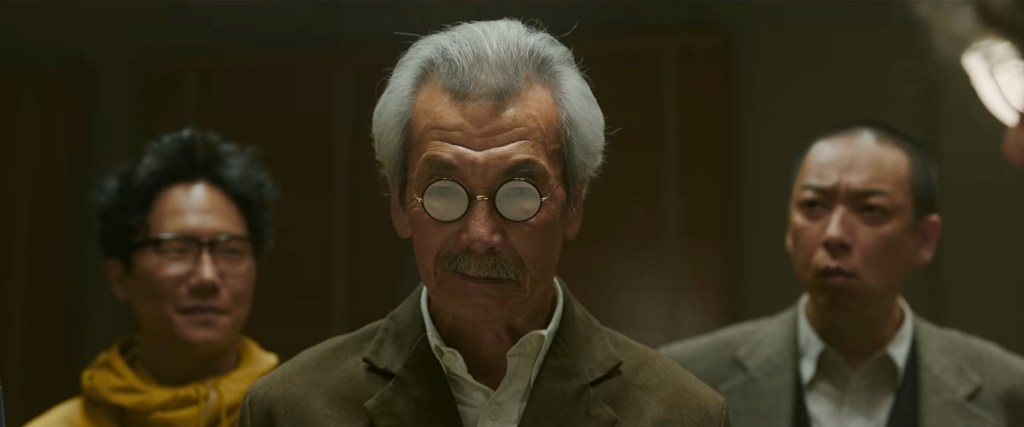
And it’s not like Godzilla Minus One was perfect. I mean, come on. Well, okay, I may or may not have made that claim at some point, but there were technical shortcomings mostly to do with pacing. Maybe one scene too many of Shikishima freaking out in front of Noriko. Having rewatched Minus One a few times (I’ve even watched multiple YouTube reactions), these “flaws” are easily papered over. By comparison, Minus Zero is noticeably sloppier. In order to join Godzilla and Ghidorah in their decisive battle (loser gets finished off by the military, to me actually justifying the harebrained scheme), Murakami wants to affix a resonating machine to Noriko, the sole survivor of infection by Godzilla cells as seen in the previous movie. She survived that shockwave because of Godzilla’s regenerative properties and, again, that’s pretty brilliant. It’s also batshit, and Yamazaki is gleefully steering us into Showa/Heisei waters with a mutant wife, a “Resonance Wave” and its mad scientist, and a big monster smackdown (where one of the monsters is a fucking dragon).
Of course, when Shikishima hears this plan, he wants to take Noriko and flee, fearing her exploitation as a weapon of mass destruction. Much like atomic bombs, the ability to attract Godzilla could alter the global balance of power (and kill lots of New Yorkers). And so, Shikishima picks up Akiko from the orphanage where she hangs out – because Sumiko works there, but it is awfully cruel to be constantly picking up your daughter in front of a bunch of war orphans – and our found family takes a train to wherever. However, Noriko sees the destruction left in Ghidorah’s wake and decides to join the fight. At least, that would’ve been a logical sequence of events, but in the middle, there’s a weird interlude where she gets off the train and tries to volunteer at the overloaded hospital, just in time to witness two parents lose their child and be asked to grieve quietly. It’s as oppressively melodramatic as Pachinko, but without that story’s quiet dignity or richness of character. There’s a scene where Akiko cries so forcefully and for so long that it’s almost a taunt to the audience: “You crying yet?”
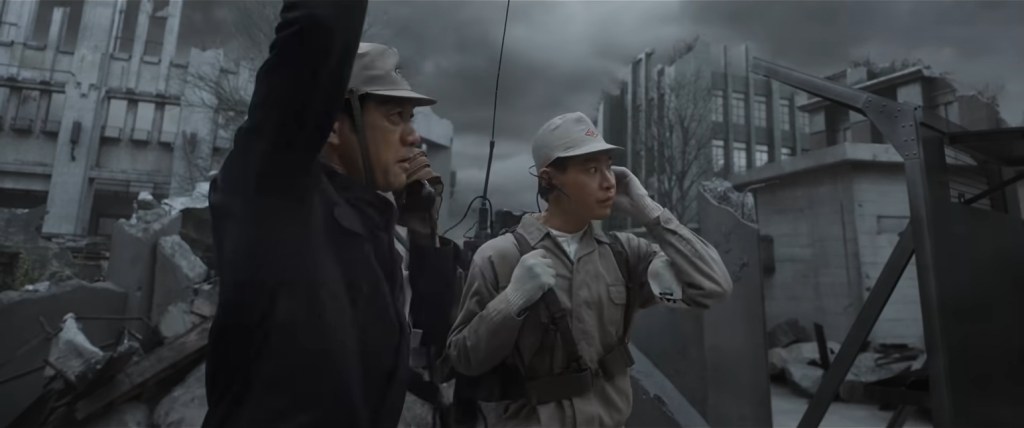
The final battle is an appreciably lengthy sequence, like Operation Wada Sumi before it, only this time taking place in the ruins of Ginza. Surprisingly, though, the actual monster thrash is only a small bit of it, with the big G himself taking a reduced role in this sequel (scheduling conflicts, I assume). For a point of comparison, he has the proportionate screentime of Deckard in Blade Runner 2049. Apart from a flashback and a dream sequence, he only shows up in the third act. Regardless, his climactic tangle with Ghidorah is spectacular, with a couple of literally jaw-dropping moments. They aren’t kung fu fighting like Ultraman or pro wrestling like back in the Showa days, and it isn’t a beam duel like in the ‘90s movies. These are animals, and they’re grabbing and biting each other and tearing bits off. It’s vicious and gross and lots of fun. Another highlight, if you’re able to put aside that it’s basically the second of two set pieces. Most of the movie’s protracted runtime is table setting.
The reveal of Noriko’s mutation at the end of Minus One was a perfectly thematic conclusion, and its follow-on here is equally inspired. Literally, because she effectively becomes this movie’s Oxygen Destroyer. In the quest to destroy the monster wrought from super weapons, do we always create more super weapons? While Minus One explored new territory, I was pleasantly surprised to see Minus Zero revisit the series’ oldest concern. So much to say, Yamazaki has a knack for writing his way out of considerable challenges, but the problem is that I don’t know why he writes himself into them in the first place. Godzilla Minus Zero is a needless sequel that doesn’t, unfortunately, do anything new or better to justify its existence. And what a world, where a Godzilla movie needs justification. I’d be perfectly happy to just shut up and enjoy the still novel experience of “extremely self-serious monster movie,” but the formula’s grown stale. It wasn’t a formula to begin with.
And oh, my God, that ending went on forever.
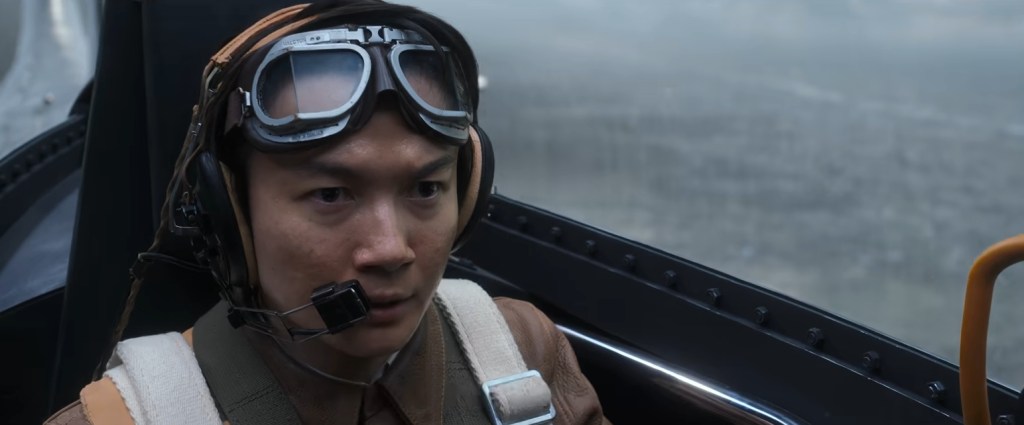
PS. I may not have spotted Hideaki Anno’s cameo, but I was certainly tickled pink by Jun Kunimura’s appearance as a doctor. For those keeping track, this is his third appearance in a Godzilla movie, after Final Wars and Shin. But wait, that’s only a tie, as Aoyama’s actress Masami Nagasawa played one of the twin fairies in both Tokyo S.O.S. and Final Wars. She was also in Shin Ultraman and Shin Kamen Rider, in the latter case alongside Minami Hamabe.

