Mr. Sourpuss strikes again
A bit of table setting before the finale. With this episode, I finally realized the ideal shape of a “faithful” adaptation of the manga. Science Saru’s The Ghost in the Shell is great, but comics and television are two different mediums, no matter the success stories of, say, the Sin City and 300 movies, or whatever popular anime which goes panel by panel. Instead of needing new scenes to fill in the gaps of these later episodes, I wish they’d have taken that necessity as a founding design philosophy. I don’t know that each manga chapter needed to be a single episode. In fact, I’m pretty sure that one of the defining characteristics of comics is compression, and when that pace is translated to screen, in this case, the resulting anime feels rushed. Why can’t we see what was compressed? In strictly commercial, or logical or cynical terms, what’s the point of preserving Shirow’s The Ghost in the Shell in this way if it already exists in print, widely available and translated into multiple languages?
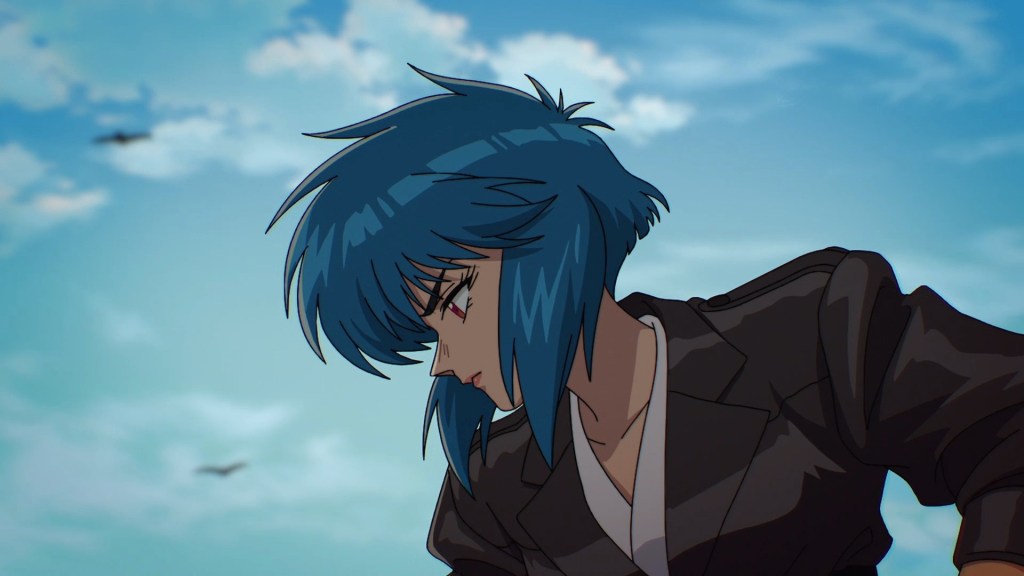
From the start, there was no point. To me, it just seemed like, “Why not?” Everything else had been done, or so it seemed, and the Ghost in the Shell brand needed rejuvenation. Why not go back to the source? Why not do something that had pointedly never been done before? And to that end, I’m happy to have The Ghost in the Shell, both for completionist’s sake and as an entertaining television show. I’ll take the Major in almost any form (which is actually more often than I’d like, given Innocence, Man-Machine Interface, and whatever the Hollywood movie was doing), and she’s amazing here. Funny and scary, professional and violent, and as unapologetic about her sadism as she is prone to the slapstick inherent to the world around her. And while the ideas and stories presented don’t feel particularly fresh some 37 years later, they nonetheless feel vital to our modern dystopias, and execute with wit and sometimes breathtaking animation.
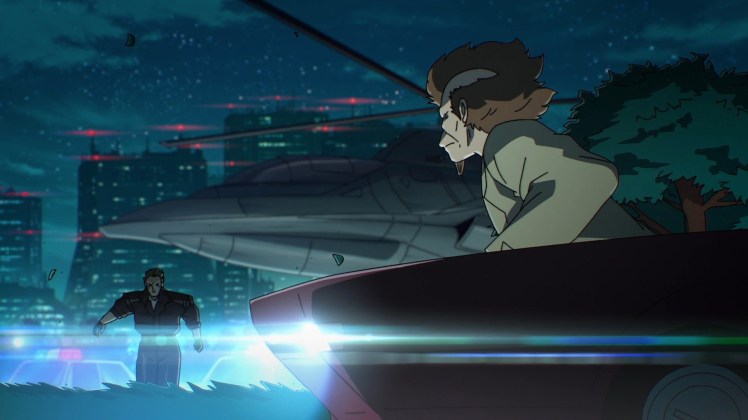
Still, an episode like “Brain Drain ii” is another opportunity for expansion, specifically because the source material is so strong. This one is possibly the most human glimpse of these characters ever. Hearing Togusa tell the Major, “We’re worried about you,” is like catharsis. That kind of standard but often essential dialogue never comported with the language established in the Oshii movies nor the work of his understudy Kenji Kamiyama with Stand Alone Complex, nor the busy, confusing world of Arise. “Worry about yourself,” the Major replies. “If you don’t want to leave a grieving widow, that is.” Even more crucially, and as part of a surprising thread running through this foundational Ghost in the Shell, is the relationship between the Major and Aramaki. Hinted at in the Stand Alone Complex continuity, it’s much more integral here that these two are partners who have created Section 9, and their authority relative to each other is fluid. If the Chief chews out the Major, she might simply not care.
In the previous episode, there’s a great moment that I have to believe is slightly altered from the manga, where the Chief is yelling at the Major for blowing the operation and, hanging her head, the Major doesn’t look up, softening the Chief’s expression to concern. I mean, I love Stand Alone Complex, but the one missing ingredient was the sense that these are all people who might have normal conversations. The drama of the series was different, hewn more from the tension of a mystery or a thrilling, dangerous situation. It’s ironic, because Kamiyama’s follow-up, Moribito: Guardian of the Spirit, is one of the most beautiful, human television shows I’ve ever seen, anime or otherwise. So, I’ve been holding onto this “If there’s one thing they could’ve fixed” for twenty years, and seeing them get so close but ultimately defer to this literal adaptation project, it’s frustrating.
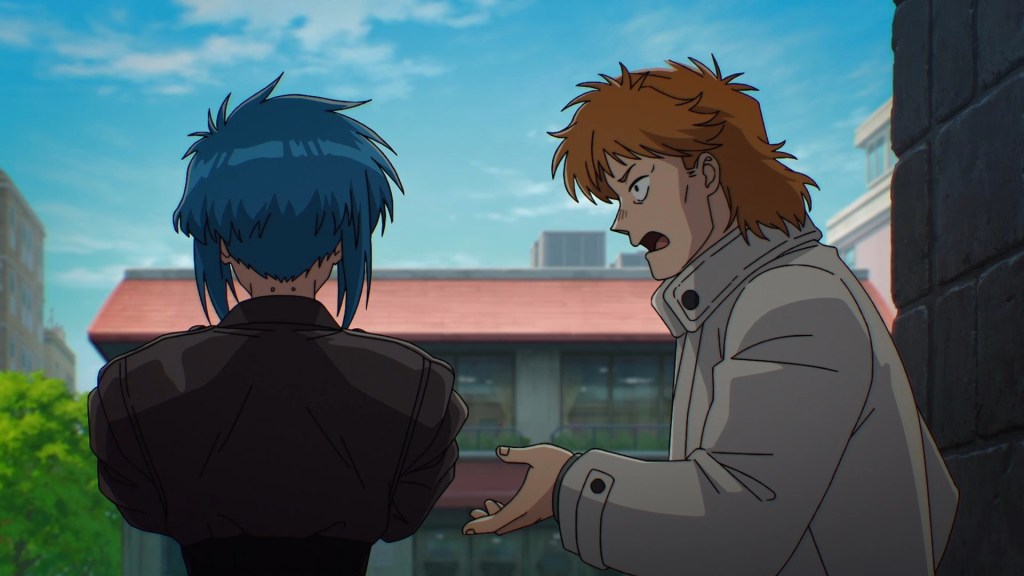
The other consideration with this is the complex plot. I’ve been spending these last few episodes more than anything trying to puzzle out the big picture, unfolding bit by bit. I know why Shirow laid the plot out this way in the manga, especially for the dramatic irony teased at the end of this episode, but I wonder if there was a way to optimize it for the new medium. Not as extreme as the recap episodes in Stand Alone Complex, but the unfortunate byproduct of this lightning speed is reducing the characters’ emotional investment in the conflict. I expect and welcome Batou to be chipper no matter the circumstances, but I’d also welcome more interiority from the Major. She’s fully prepared to sacrifice herself, which sounds like Point B on a character arc. Why is she making this decision? Is it for the team? Is it something more abstract and philosophical? Or is it because she knows everything’s gonna work out in the end?
As to the relationship with the Chief mentioned earlier, it’s especially compelling because he’s decidedly not okay with the Major’s sacrifice. His contact in the Ministry of Justice recommends cutting her loose, given the firestorm kicked up by the media – and even the opposition party in the National Assembly (over a terrorist suspect? Okay, politicians) – and Aramaki reacts with anger. “Sacrifice someone whose talents are even rarer than a psychic?” Either do so, or risk legislation regulating special forces. It is odd, as a member of the audience, to be asked to finally sympathize with the black ops commando unit who didn’t even care about a little kid’s Dickensian woes in the premiere, so maybe this is why the episode is at an emotional remove.
So much to say, I’m genuinely struggling to follow the plot. It’s more like The Matrix Reloaded than The Wire, for example, where both are dealing with complicated ideas, but the former isn’t addressing the natural “whys” – Neo begins the story saying he doesn’t know what to do next – while the latter teaches you how to watch it. Based on what I’ve gleaned from this and the previous episode, the new foreign minister is trying to make a deal with Ghorantl concerning micromachine plants, with hundreds of trillions of yen on the table. I assume this means that Ghorantl, a country in the Middle East, is trying to get in on radiation scrubbers to advance their own military agenda, and Japan wants to be a player on the global stage again, or this one guy wants a big payday. Already, that’s not super clear, but how then does that connect to setting up the Major and exposing Section 9? The Ghorantl trade representatives and their allies describe Section 9 as a thorn in their side. From when? And what’s this about “Mesamia,” or the Foreign Ministry’s own vendetta?
Heading into court, where Aramaki tells her a guilty plea will get her eight months of hard labor (in a cyborg body?), the Major says that even if she dies, to leave her paging channel open. On the stand, she’s cool but dour, and describes the incident as “cruel, both for him and me.” And then, possibly possessed, she gives a chilling monologue about the abstraction of life itself. Did she kill anyone at all when the boy was no more than hardware and software, when he was only a weapon himself, wielded by the true killers? We don’t find out if this musing is enough to get off, because the Chief and the Major put a plan into action, coinciding with a possible conclusion to the investigation. The Major kidnaps a face sculptor and ties him to a tree in a park with a bunch of explosives, and the police maneuver a sniper team into position. I thought this episode would end on the cliffhanger of an apparently dead Major, her head blown off, but I suppose Stand Alone Complex already did that.
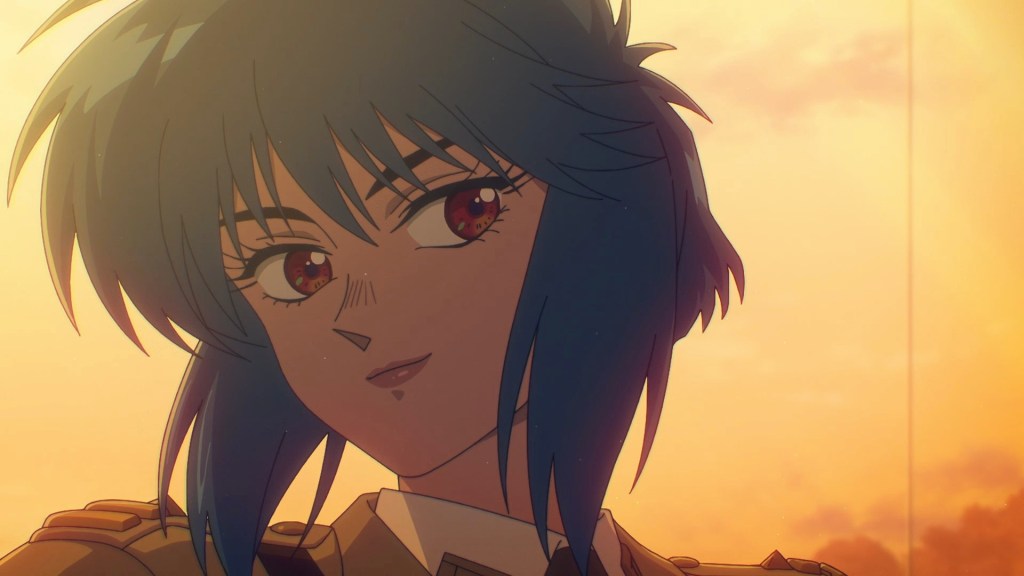
Episode nine is slower paced (and more somber in tone) than what’s come before, with interstitial glimpses of the city accompanied by pretty piano music. Effective in itself, it does feel like an artist chafing against what increasingly feel like arbitrary constraints. We already saw what Oshii did with this imagery and these ideas, and while nobody asked Mokochan to replicate that, he’s nevertheless expected to replicate Shirow. When there’s talk of assassinations and there’s a cafe explosion and government bureaus at war, the result is a fun exercise in cyberpunk, horrifically timeless in theme. Indeed, in our age of AI, forced to meditate on the value of art, I’ve concluded as so many have that it begins with the artist. I aspire to the preference of “art,” whatever its quality, to “good product.” At this point, though, my expectations for Ghost in the Shell are fairly single-minded, if you’ve picked up on a theme in these posts. I should be able to accept 2026’s The Ghost in the Shell for what it is, and for the most part, I do. But acceptance in this case is different from exaltation, and it doesn’t seem like that was ever the goal.


I was curious how this anime would approach the ending of the manga, as it’s really bittersweet and anti-cathartic, specific only to the singular storytelling mind of Shirow. For example, the manga (and this series) has Aramaki and the Major paired off as a true duo, but I’m 99% positive this episode is the last we’ll see of him in this series, eyes closed, arms-crossed in a do-it-yourself pose while The Major stares down several barrels of various guns.
LikeLike
That is crazy. Yeah, where we leave the Major here is the last image I remember from the manga, aside from her head exploding (turnabout is fair play, eh). Seeing as the next episode has an unprecedented (3) titles in one, I have no idea how this is gonna wrap up. I guess I could find out :3
LikeLiked by 1 person