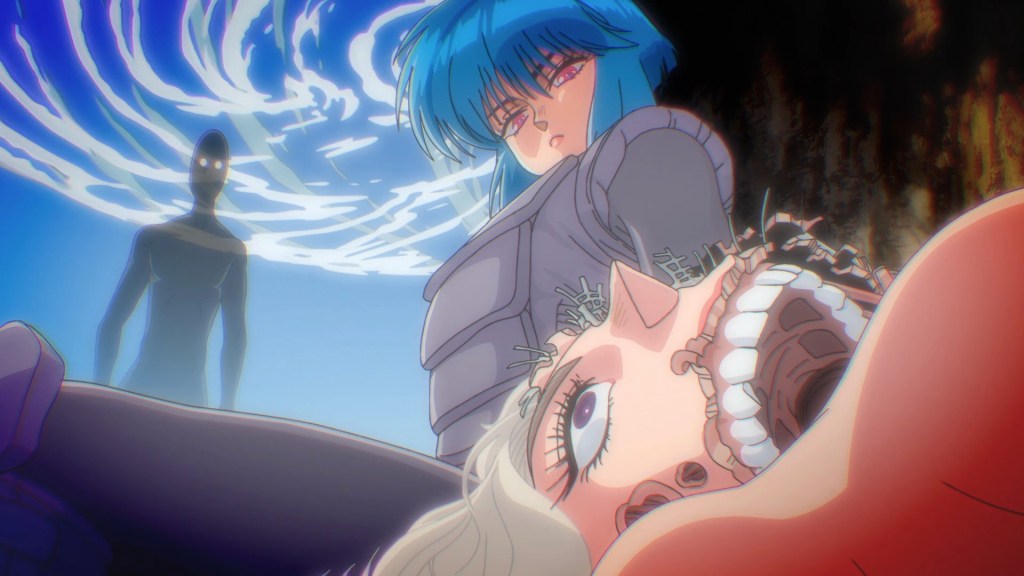
Don’t forget to see GITS ’95 on the big screen, Sept. 18
Once upon a time, I decided to do write-ups for every episode of Ghost in the Shell: Stand Alone Complex, 52 in all, and I believe they came out in as many days, one after another. A testament, perhaps, to how little I applied myself in college, but I think the experience gave me an outsize confidence when embarking on the same journey for The Ghost in the Shell. “I know this franchise like the back of my hand!” I boast, and then comes episode seven, “Bye Bye Clay.” As it’s been more than a week since the original broadcast, I’ve had time to puzzle over how to approach this one, whose second half forgoes plot for a thrilling, abstract sequence highly reminiscent of Neon Genesis Evangelion. And in case it isn’t obvious, I fall back on plot recaps when unsure of what else to say, which is quite often with this 2026 edition. I briefly considered taking this space to discuss some of the aspects which have fallen to the wayside, like Maaya Sakamoto’s performance or the radioactive online discourse. Either way, this is what happens when even the plot is too difficult to summarize. But why else do I love Ghost in the Shell? It keeps me humble!
With this and the next episode, director Mokochan and his team at Science Saru have finally had to fill in the gaps with original material, either by imagining a backstory like in the upcoming “Intermission” segment, or translating extremely dense panels into a sequence of film. I was only recently reminded that the writer of The Ghost in the Shell is Toh EnJoe, a contemporary and friend of the late Project Itoh, and best known for a scifi novel entitled Self-Reference ENGINE – sounds like a Ghost in the Shell subtitle already – though for the streaming audience, it’s probably his script for the wackadoodle Godzilla Singular Point. In other words, he has the career I’ve always desired, working in Japanese science fiction and getting a call out of the blue to come write Ghost in the Shell. So far, his job on the new anime has been David Hayter’s in adapting Watchmen, plugging the right lines into the right places, but even this must have been a significant challenge. I can only see the instances where the translation falls short, like stretching out Shirow’s comedic punctuation into cinematic language, but it’s with this episode that I’m realizing the entire project is kind of a miracle.
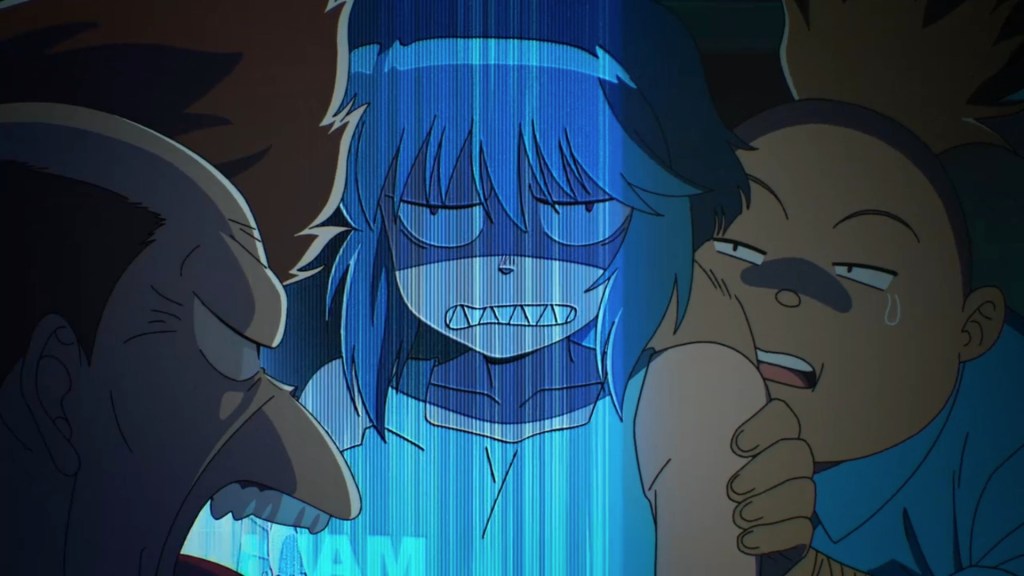
We’re thrown into the action from the very beginning, with the Chief and the Major visiting Megatech to investigate the mysterious activation and escape of a military-grade cyborg body – no Black Magic-style robo rampage? – but we may find that this story has been unfolding all along. Yet another otaku mistakes Kusanagi for a sexy android, to which the Chief shouts, “That’s one of my team members, and she’s government property!” Oh, so quintessentially Shirow, blending comedy and vague techno-horror, and even poking fun at the audience without staging an all-out assault like the aforementioned Evangelion. Shirow is a man without shame, potentially complicating the appreciation of his work. I’m too old to feel weird about anime and manga – unlike in K-pop, these sexualized machine people aren’t even real – but this does throw Oshii’s famed adaptation into greater relief. Transmuting the Major’s sex appeal and the manga’s philosophical musings into the Major being naked half the time is a little uncomfortable when the character is so comparatively humorless.
This episode effectively takes another slice from the 1995 movie, the Puppet Master’s embodying (?) and subsequent destruction, with a chase through rainy night streets in between. However, if the Puppet Master, who’s inhabited Megatech’s runaway shell, is fated to be hit by a truck, it’s a lot more awkward to see him wait to cross the street, then run across at the very moment of the truck’s screeching arrival. He ends up at Section 9, apparently as intended, and the operators detect a possible ghost barrier. The Major wants to dive immediately. There’s an interesting exchange, like a lite version of Innocence, where Togusa scoffs at the idea that this robot might have wanted a child and therefore went crazy, which the Major dismisses anyway, and Batou says that even dolls can have souls. It’s as if, in each of these incarnations across our series of series, we’re meeting these characters at different points in their existential crises. Sometimes the Major is okay with her sense of self and sometimes it freaks her out, and sometimes Batou sees ghosts in all sorts of things. Either way, I like it best when they’re all together.
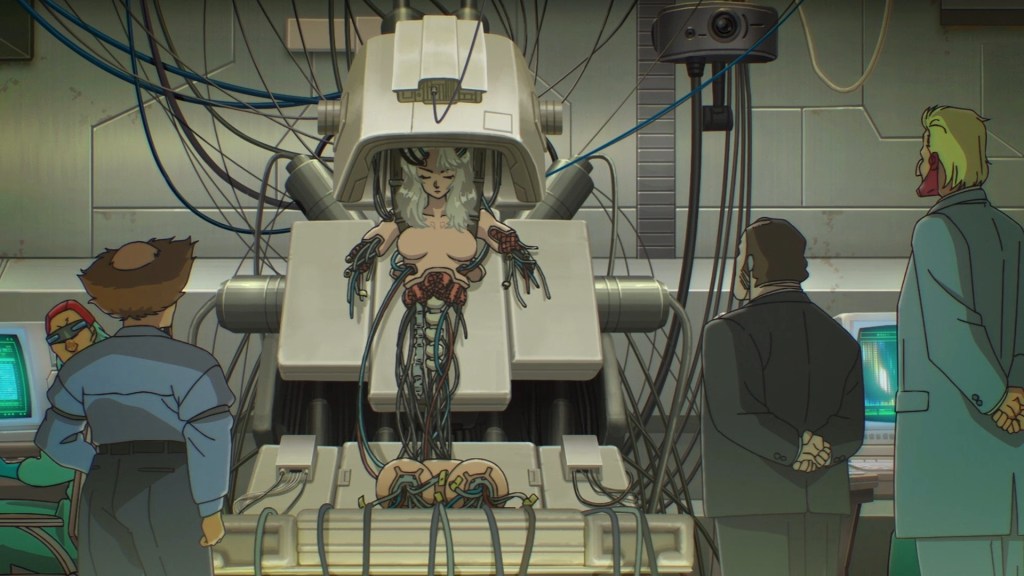
Foreign Ministry Treaty Counselor Nakamura turns up to take custody of the Megatech body, which he identifies as the Puppet Master. The Major explains that this guy, whom Oshii also used in his version of the “Prologue” chapter and appears in Solid State Society, is head of Section 6, and when Section 9 works abroad, they have to let him know. He’s joined by a Dr. Willis from “Neutron, Inc.,” who with blond hair and pointy nose is presumably American but is actually from the MAG Union, and regardless is the guy whose fingers split apart to type faster. Another classic piece of Ghost in the Shell iconography, but honestly, RoboCop had this right two years earlier, with the data spikeTM. A computer wouldn’t need to interface with a computer like this, but then again, who’s to say? Technology doesn’t arrive all at once. I drive a 2009 Honda, so I burn discs if I want to listen to music, and the latest was a compilation of Rescene, whose youngest member was born in 2008. I don’t really know how that demonstrates the staggered nature of technological development, but any chance to shout-out Rescene, I guess. Talk about a lifeform born on the sea of information…
All hell breaks loose, and the Chief performs an act of physical comedy by tripping and narrowly avoiding gunfire. An explosion goes off, and the Puppet Master is suddenly gone. Turns out, the Major anticipated this little deception by Section 6, and put trackers on Nakamura and the Puppet Master before invisibly maneuvering the Chief out of harm’s way (giving us an insta-replay). After Batou rams the getaway car and the Puppet Master’s body explodes, the Major dives before it whites out. Now, the Puppet Master had claimed he wasn’t an AI but rather this “lifeform,” and for the first time, I’m wondering what that actually makes it. Sometimes science fiction will go in the opposite direction, like Mass Effect with “virtual intelligence” to describe positronic brains dumber than AI, maintaining the latter term for its explorations of humanity and race. Well, what do we know so far? In this episode, we learn that the Puppet Master was created in the MAG Union, in a Neutron lab, for use by Section 6 to do something with platinum mining (mentioned back in episode two), and it became self-aware. It then entered the Megatech body to resist Section 6’s attack barrier, and is now requesting political asylum as a living being. “Modern science cannot define life,” he states in his female-sounding voice. That’s true; we can’t even define vegetables.
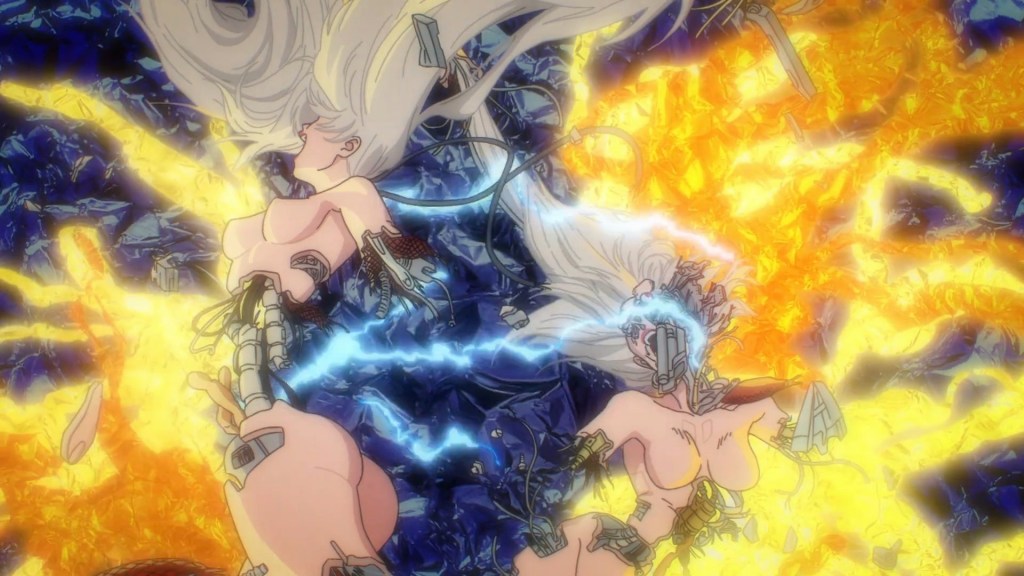
There’s a funny scene where Batou, who’s been channeling Homer Simpson from the very start, calls Section 9 to report a car theft and then says, “It was me!” He gets serious when the Major dives, though, which is a risky proposition even for a wizard-class hacker (in one of her cooler outfits, too – and just to sit in a car!). She gives the Puppet Master access to her speech functions, so it can speak with her voice, but begins to whiteout, or die, resulting in an explosion of celestial imagery. “If you dive too deep, your memories and the nets themselves will fuse!” Batou warns, in a nonstop stream of technobabble. There’s stuff about signal boosting and electrons, and the problem is that this is a 1989 understanding of computer technology which was, I believe, heavily based on metaphor (“information superhighway,” am I right?). And so, what’s going on here is layers deep in esoteric science fiction, and it’s only my knowledge of the 1995 movie that I understand this to be like the advent of a posthuman organism. Certainly, that’s consistent with anime of the time and earlier, as Pyramid Inu points out on his own video about this show, the new age mysticism of the ‘70s which influenced Mobile Suit Gundam, for example.
Which part is technology, which is metaphor, which is speculation? And most importantly, what’s the Major’s part in all of it? In the movie, this sequence is the climax. And goddamn, is it such a brilliant interpretation of the source material. In the beginning, she’s rocked into existential malaise by the Puppet Master who can remotely insert false memories into unwitting cyberbrains, calling into question the legitimacy of her own memories inside government-owned hardware. By the end, she fuses with the Puppet Master, a new lifeform born on the sea of information, because it makes sense to her, and she achieves selfhood as the posthuman organism. All the heady techno jargon is similarly confusing, but so much more rooted in character terms. It is, in fact, subordinate to the Major’s arc. Here, she has what feels like a religious experience, believing at one point to be touching the electrons which give rise to life itself. The difference is that she doesn’t have a starting point – this is it, as we’ll see in the coming episodes. An interesting flip. The Major is more like Guts at the bonfire of dreams, doing this job only to fuck and kill, and maybe soon she’ll find something more to live for.
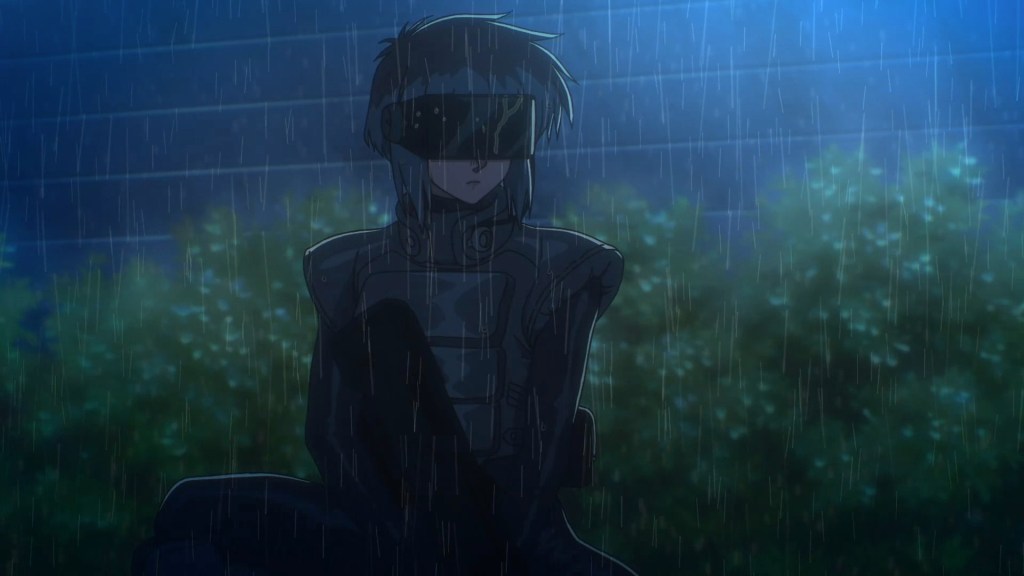
No, Major, don’t do it! You’re so good at fucking and killing!

