
Original Broadcast: 2 July 2026
Written by Yeon Sang-ho and Ryu Yong-jae, Directed by Shinzo Katayama
Starring Shun Oguri, Yu Aoi, UTA
As the first part of this post is a recommendation, like “I give Human Vapor two thumbs up!” I ought to try for a hook. Perhaps a description of the gory opening scene, a live broadcast where our journalist heroine Kyoko Kono watches her interviewee lift in the air, smoke swirling into his nose and mouth, and explode. A sensational set piece punctuated by Kyoko splattered with blood, it was not, however, my introduction to the show. Once again, I’m honor-bound to acknowledge the algorithm. Scrolling on whichever one it was, I recognized the term “Human Vapor” as the title of an old Toho movie, and my curiosity about the prospect of its reimagining for Netflix was piqued by a neat-looking teaser trailer. Hazmat suits and journalists and the military in secret labs and boardrooms and underground mines, it was so much of what I love about Japanese monster movies. A dash of gooey body horror with the vapor transformation, and the only piece missing was the loud, brassy score doubtlessly inspired by the work of Akira Ifukube (the trailer was auto-playing on mute). Altogether, it looked like an exciting, rare new series, with surprising implications behind the scenes.

For something that’s gone largely under the radar, Human Vapor is one of the most interesting stories in television this year. According to The Hollywood Reporter, Netflix had been knocking on Toho’s door for years, only managing to claw out puzzling anime renditions of Godzilla. A remake of Ishiro Honda’s 1960 toku-horror film, The Human Vapor, is the first big-budget, live-action streaming series of its kind, infusing a Japanese production with the level of funding that helped propel South Korea to the forefront of international pop culture. And indeed, one of the key creatives on this project is Yeon Sang-ho of Train to Busan fame, providing the screenplay with Ryu Yong-jae (who also cowrote Peninsula and Parasyte: The Grey). A-listers like Yu Aoi and Shun Oguri star, alongside newcomer UTA as the Human Vapor, blended with visual effects by Shirogumi, the Oscar-winning team behind Godzilla Minus One. Much like The Furious was the year’s action movie Super Bowl, this is another rare international collaboration only possible in the streaming age; when literally everything is produced and distributed, eventually Japanese and Korean filmmakers will unite.
Human Vapor follows JNT reporter Kyoko (Aoi) as she investigates the supernatural killer who’s targeting something called “White Center,” a mysterious organization connected to a meteorite and a children’s peace exposition. She works with Detective Kenji Okamoto (Oguri), who’s brought back from a suspension owing to Kyoko’s journalistic malpractice. As we learn, the two were dating before she used some of his evidence to get the scoop on a story, one involving a degenerate yakuza named Yasutoshi Mori, played by the unbelievably handsome Yutaka Takenouchi (the bespectacled friend in Shin Godzilla) unrecognizable here with long hair, no eyebrows, veneers, and maybe a spray tan (at least, I did not recognize him). Mori ended up committing suicide after Kyoko ambushed him with questions about the case, and as Kenji’s badass detective partner Michiko Abe observes, Kenji was suspended and Kyoko was promoted. “A real go-getter,” she seethes. Michiko, played by rising star Haruka Imou, stuns with her short haircut and constant black leather motorcycle jacket. I was in love with her. Also investigating the Human Vapor are a pair of small-time streamers, brother and sister pair Fujita and Kaho Fujikawa. From the outset, this quirky duo screams “Yeon Sang-ho” the loudest, if you recall the ranting streamer in the first half of Hellbound.

As a work by Yeon, this is another slow burn that rewards patience. Its lows are not as excruciating as those in the first season of Hellbound, nor are its highs quite as cathartic. I’m less familiar with the director, the Japanese Shinzo Katayama, but he demonstrates a kinetic, elastic style. Having come up under Bong Joon-ho as far back as 2008’s Tokyo!, I was actually reminded of Park’s eye from the very opening shots, which recall the uneasy, vertigo lens of Decision to Leave. Tracking the Human Vapor, Katayama’s camera takes us into the sky and speeds along the busy streets of metropolitan Japan, though the moments in between the monster mayhem are comparatively relaxed. In my headcanon, Katayama went through Yeon and Ryu’s script and find+replaced all the exclamation points with periods. You won’t find the “mega acting” expected of a Korean production, outside the yakuza rolling R’s. I’d argue, in fact, that the lead performances are flat and grim. This is, at least, how things appear to be.
Below the fold is a beat-by-beat discussion, and if you’re planning on watching Human Vapor, please do so before reading past the spoiler warning. There is a twist halfway through that reframes the entire show. It’s less of an Oldboy shocker than it is like the reveal late in Hello, My Twenties!, where our apprehension of a key character is proven entirely wrong. This is one of the few pieces of media I’ve ever restarted immediately upon finishing, as the twist is so transformative, I needed to review the early movements knowing every detail previously withheld. Admittedly, the show is more interesting the second time around, and while I can’t call this a “flaw” necessarily, I do hope it doesn’t discourage impatient viewers (like me, usually). Human Vapor is an example of one of my very favorite things, like Midnight Mass and the first season of Stranger Things: a monster movie empowered by a storytelling sophistication and depth of character afforded by the expanded television format. And like those two American titles, it achieves the bloody set pieces as dramatic consequence, making the spectacular surprisingly affecting.
Spoiler Warning! Seriously!

This should come as little surprise to the initiated, of course. Ishiro Honda himself describes the kaiju as a tragic figure, but in the 1960s, when he directed The Human Vapor – with special effects by the legendary Eiji Tsuburaya and music by Kunio Miyauchi, not Ifikube – Godzilla was getting goofy, King Kong looked like a shag carpet, and Gamera would begin his early Z-grade run. As an example of journalistic malpractice on my part – though this isn’t journalism, it’s a blog – or rather, blog malpractice, I confess to having never seen The Human Vapor. Scanning its Wikipedia page, I notice that we’ve borrowed a few character names, like Detective Okamoto and news reporter Kyoko Kono, though the streamers are absent. I cannot say, and doubt, even, that The Human Vapor is as unserious as, for example, Godzilla vs. Megalon. It sounds like a crime thriller with a spooky twist and resonant social themes. Nevertheless, the idea of a “human vapor” was likely acceptable inside somewhat compartmentalized expectations for a genre film in that climate. Perhaps the world of the story was heightened to meet the vapor where he floated. That’s not the case in 2026.
One might then wonder what attracts top talent like Shun Oguri and Yu Aoi to a show about a guy who turns into gas, other than the prestige of a Netflix production. I tell you, the bait-and-switch got me good. Partly because, within this milieu, I expect the journalist archetype. That’s the source of my frustration with the ‘90s Godzilla movies, that there’s this awesome psychic lady, but the main character is always a boring journalist guy, an exposition machine. In the beginning, Kyoko is indeed pretty boring. Seemingly the only wrinkle in her turtleneck-with-pants-hiked-up-to-her-chest outfit is a willingness to bend the rules in chasing down a story. Well, sir, that’s every journalist in a movie or TV show. It’s this derring-do that brings her face-to-face with the Human Vapor, who leaves videos naming his next victim and claims to want an interview at a restaurant called Bunko Ramen. When he’s looking like a no-show, unlike every cop and reporter in the city, Kyoko has the good sense to ask the restaurant owner if there’s a second location. In fact, the previous Bunko Ramen is abandoned, and that’s where she meets the killer and learns about White Center.

From here, Kyoko would appear to be investigating two things at once: the Human Vapor and the White Center, but she isn’t actually investigating the Human Vapor, is she? The deception is properly concealed. The Bunko Ramen owner recognizes Kyoko, but she chalks it up to her recent high-profile, blood-soaked appearance on “These Days with Kono,” not because of her and Uncle Ren’s photo on the wall. She gets in touch with the next victim, Hiroshi Ozaki, an elderly recluse with the trauma-informed habit of wandering off into a lake at odd hours. The Human Vapor demands that Ozaki reveal the truth of White Center’s crimes, and the guilt-ridden old man nearly does, producing documentation on a work camp created to manage the meteorite before it affected the children’s exposition, which led to mass casualties including children. Kyoko works to save Ozaki before he’s silenced by White Center agents, throwing us off the trail that she’d ever harbor any ill will toward the guy. Surely, she’d never even be the one trying to kill him in the first place.
The fourth episode is a breather after the frantic third, which we’ll circle back to, centering on the streaming duo Kaho and Fujita. There’s something pitiful about these two, as they’re adult siblings who live together – their lives have never changed since birth – and their only hope for change is streaming success, unlikely given Fujita’s horror-themed theatrics. Kaho works the camera and stays out of frame, insecure about the port-wine stain birthmark which covers half her face. Fujita is the kind of guy who’s convinced that the viral Human Vapor is their key to fame, but proceeds to lay about on the apartment rooftop after finding a remarkable clue. It’s a DVD of the idol group Dream Succubus, where a freeze frame on a music video reveals the Human Vapor in a window. I’m not the only one who finds those stupid “ghost in the background of this movie” things really creepy, right? The hanging Munchkin in The Wizard of Oz may be debunked, but come on, that was so eerie.
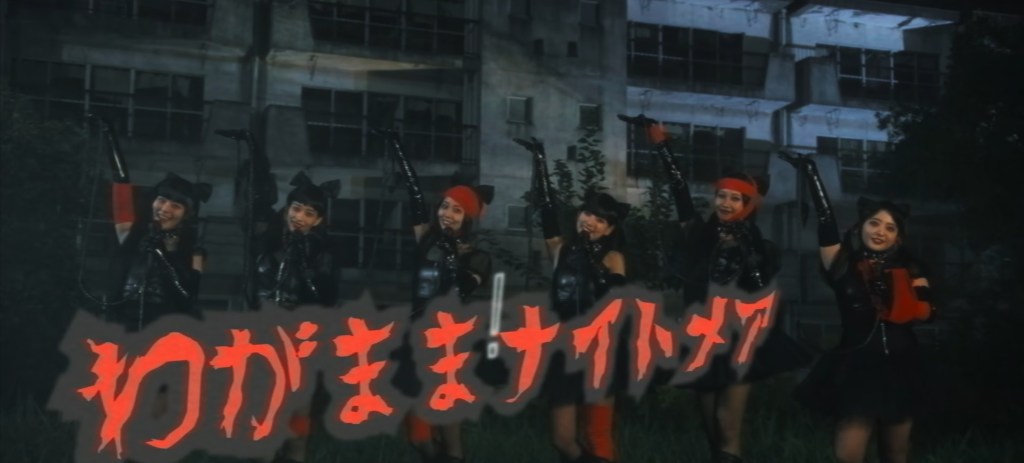
Based on the first two episodes’ cringeworthy depiction of a South Asian immigrant, told by Kenji to simply adjust his attitude and good things will follow (which works!), I was hoping the show would skip over the port-wine stain (which isn’t, as far as I can tell, an offensive term?). Instead, the birthmark is spotlighted when she and Fujita work to identify the music video’s filming location and sell the information to an anonymous buyer who’d contacted them online. With a phone tucked in his breast pocket, camera lens conspicuously facing out, Fujita enters the production studio while Kaho monitors from the van outside. Two teenage girls approach, and she instinctively rolls up the window, nearly sparing herself the passing commentary. We’re trusted to connect this to her school days, which must have been painful enough to cultivate a phobia about being seen by anyone, especially a male escort, to whom the trail eventually leads. The episode is never more affecting than when Kaho is flattered by a man whose job, as the brother reminds her, is to flatter, and she downs the offered drink like she’s been waiting for it her entire life.
I was back-and-forth on these two, and by this point, I couldn’t say if their characterization had been understated or minimal. I think we’re given just enough to be afraid for Kaho in the encounter with the Human Vapor, to urgently understand when she pulls Fujita back from planting a hidden camera in the lair. After speaking with the eccentric music video director – who, among other things, misidentifies orange juice as lemonade as a sort of test, and wears idol clothing – and the male escort, a former production assistant who witnessed the Human Vapor that fateful night shoot, the streaming siblings arrive at an abandoned warehouse and find a creepy statue, a fax machine, and a Rube Goldberg setup that starts a record spinning: “Itoshi no Ellie,” or “Ellie, My Love,” by Southern All Stars. Fujita deduces that the statue is the Human Vapor, and he’s taking orders from somebody. That somebody soon reveals herself as the anonymous buyer, none other than Kyoko Kono. Honestly, I didn’t even understand what was happening. Once I realized that the fourth episode wasn’t cutting from Kaho and Fujita back to our leads, I assumed that the fifth episode would rewind to follow Kyoko’s parallel journey to this moment. I’d been missing her and her turtlenecks. Which is hardly a joke, by the way. I’ve always liked the more conservative fashion of Japan and South Korea.

Whoa!
Instead, the fifth episode opens with a flashback sequence to Kyoko as a young girl, having escaped the White Center in the back of a truck full of dead bodies. Hungry after a long, horrifying journey, she ends up at Bunko Ramen and meets a kind young man named Ren, who bears the likeness of the Human Vapor, or vice versa. Here, we see that UTA – who does bear a resemblance to T.O.P – is actually acting. A model by trade, he makes his debut here with a stiff, muted performance, a slow, droning speech pattern and flat affect. As Ren, by contrast, he’s full of life, giddy when he hears his request on the radio – “Ellie, My Love” – running around trying to get some food into young Kyoko’s belly. He might even be rendered as “too good,” but it’s more like “aspirational.” In the situation where a traumatized little girl is wandering around lost, you prefer to think you’d do the right thing like Ren, even in the face of “変態” suspicions which even become allegations. From this point on, UTA’s performance as the Human Vapor takes on an additional uncanny layer, as if his life force has been drained. We don’t know how much of Ren is left behind that vacant stare.
It’s a fairly unusual twist, to so dramatically alter our understanding of who’s essentially the lead character. Rather than the explanatory “Dick Whitman,” it’s more like the reckless reveal of Katee Sackhoff’s character in late 24, which even took the actress by surprise, if I remember correctly. And I can’t get over how well hidden it was. I’m sure countless viewers guessed this twist from the first frame of the first episode, but I am never gonna be that guy. No, this show weaponized my expectations against me. Kyoko being a journalist, which had me yawning aggressively at the screen, she has an implicit motivation to participate in the Human Vapor investigation. Her transgressive side – not a side, but the whole – is teased by her betrayal of Kenji. The problem with all of this, as alluded to earlier, is that it leaves Kyoko as a character somewhat thin in the first three episodes. She wasn’t a journalist learning the truth, but a vengeful spirit exposing a truth she’d lived, armed with a terrifying weapon.

Despite the bifurcation, the dual roles via misdirection, Yui Aoi’s performance is consistently good. I think she’s one of those actors who’s like a human special effect. Her wide eyes seem to hold worlds inside them. Kyoko’s disaffection in the first half of the show is recontextualized with our understanding of her trauma, that actually, she’s quiet on purpose; tense, frayed at the edges and barely keeping it together. In the first episode’s flashback to Kenji and Kyoko in the car on that rainy night, which we know is around when she learned to activate the Human Vapor, “Ellie My Love” comes on and she asks if he likes it. “My dad liked it,” he says, earning this reaction from Kyoko:

If we’re watching this for the first time, it’s a face we don’t know how to read. She then says, “Well, it’s the same for me,” which is heartbreaking. I appreciate that, with the reveal of her revenge plot, she doesn’t transform into a snickering femme fatale nor a Korean rage machine. These killings have brought her no relief, and perhaps she’s only a vessel – like Ren – for a purpose beyond her reconciliation. She remains sad and fragile, though still composed enough to drag Yasutoshi Mori’s body around to stage his suicide. That glimpse of her screaming at the door could’ve been the “okay, discover the body now, everyone” call or an actual breakdown. It’s hard to tell.
This leaves Kenji the weak link. He’s a good cop forced to rethink a corrupt system, but that’s too grandiose a description. He makes one big choice in the story, which is to run away with Kyoko when she’s wanted by the police, and it may have been a mistake to found that decision upon unresolved romantic feelings rather than a personal transformation informed by the events of the plot. As such, he’s pretty much the same guy as he was in the beginning, though in fairness, we aren’t peeling back as many layers on his past as we are with Kyoko. If anything, he comes in and out of the flashbacks like a piece of a larger puzzle, required only when things need to click together. At his best, he’s a philosophical counterpoint to an emerging theme I’m beginning to recognize in pop culture at large: the ethics of violence in an unjust world.

Kenji, whose father died when he was young, adopts a father figure in the police superintendent, Mamoru Sakamoto (Pierre Taki, also featured in Shin Godzilla). Unfortunately, Kenji learns that Sakamoto’s name is in the documents that Ozaki was prepared to make public before his untimely stabbing death. These documents, which are photographed page by page on a phone and then burned, then printed out in thick copies, are the Epstein files. They’re the physical evidence object destined to tear down all the powerful people specifically linked to an organization which abused children. Of course, the ironic thing about the Epstein files is how much they resembled (resemble?) MacGuffins in fiction already, like Tuttle’s videotape in True Detective. It was (is?) the perfect ending to the reality show of the past ten years and counting.
Against a kleptocratic, authoritarian regime with obvious parallels in history and pop culture, and an increasingly out-of-touch aristocracy, the American left has taken a nonviolent approach, gathering in mass protests while the nonpartisan ACLU fights the worst civil rights rollbacks in court. But every now and again, just like during the first Trump administration with the Nazi punching, there’s a violent episode that irritates the growing frustration about being “out to brunch.” While this describes an American situation, it’s by no means unique. Yeon Sang-ho is younger than Park Chan-wook and Bong Joon-ho, whose very political films are influenced by the student protests of their youths, but the violence of the Gwangju Massacre, for example, is now part of the cultural fabric. I’ve theorized that the Korean revenge movie comes out of historical events like this, which is only consistent with other instances of political murder or the people taking action against their government throughout the country’s turbulent recent history.

What do you do when the seats of power are occupied by criminals? What have those criminals now in power historically suggested be done to others accused of the same crimes? For Kyoko, the answer is bloody revenge. It would seem that her adult life – her career and her relationship with Kenji – is an illusion, that she’s given over entirely to vengeance, but she’d only discovered the Human Vapor six years ago. It’s heartbreaking to think that instead of being born into revenge, like Lady Snowblood, she chose it, knowing the consequences. Then there’s Kenji. Superintendent Sakamoto calls him to confess his role in the murder of his father, Shinya, played by Munetaka Aoki (Tachibana from Godzilla Minus One). Now he, too, has a reason to want Sakamoto dead, along with “Kai,” the last, as yet unidentified target. When Kyoko finishes relaying her backstory, wherein she witnesses Ren’s transformation into the Human Vapor at the meteorite cleanup zone, she muses, “I think Uncle Ren wanted revenge, too,” and Kenji wonders if the Human Vapor truly is Ren, or a monster who looks like him. Crucially, he asks if Ren was the kind of person who would’ve killed people, and we know he wasn’t.
In this final piece of the flashback puzzle, adult Kyoko reunites with Ren in the old warehouse, where they’d lived together for a precious few months. She finds the statue, and upon restoring the record player, watches it come alive. There are leaps in logic here, but it works by dint of its inverted chronology, which is a phenomenal trick in the screenplay. Basically, nothing about the Human Vapor is actually explained. We see that he’s activated by the sound of “Ellie, My Love,” and then asks the “listener” what their wish is, in a cruel mockery of Ren’s old habit which became the glue in his relationship with Kyoko. Upon hearing the request, he goes out and kills the target. Why, though, does the song activate him? Why does he follow commands? There’s clearly an alien intelligence here (purple lights inside the meteorite), but none of the Toho journalists ever even see it, never theorize about its meaning over tea. This could only have been presented to us backwards: first, the statue and its activation, and second, the discovery. If we’d seen the discovery first, we’d distractingly wonder how Kyoko put all the pieces together. In practice, she figures it out after we do, so we’re only waiting for her to put the pieces together.

Sakamoto promises Kenji that he’ll hold a press conference to confess everything, and like Ozaki before him, is assassinated, this time by police official Norio Yoshida. Yes, the man careful enough to wear gloves to deliver a briefcase of money shoots the superintendent point-blank in the back of a car, then calls it a suicide. I sure hope he gets obliterated by a metal wire. Speaking with Sakamoto’s widow, Kyoko identifies “Kai” as the governor of Tokyo, Takeshi Miura, whose reelection campaign is being threatened by the upstart Kazumi Kirishima. While Miura brushes his teeth in the back of a car, his aide mentions that his approval ratings had been flagging before the advent of the Human Vapor, and are now catching up. “I think voters are choosing stability over change.” Monsters are good politics. At the same time, yakuza goons in Miura’s employ have intercepted Kaho and Fujita, and the panicked brother blabs about the mechanics of the Human Vapor’s activation. Miura, naturally, cancels Kyoko’s hit on himself, and sends Ren after the bumbling streamers. In an apparent callback to the climax of The Human Vapor, Fujita douses himself in gasoline and allows Ren to take him before clicking the lighter – a birthday gift from Kaho – which ignites the both of them and saves his sister.
This is, I think, the counterpoint to Kyoko’s reasonable but troubling vengeance, and when historical Korean thematic preoccupations collide with those of Japan. Initially, I wondered if Yeon Sang-ho was taking the piss, filling the script with stereotypes and an unflattering portrayal of Japan: yakuza, racism against immigrants, creepy otakus, and far more damning, a concentration camp with possible echoes of Unit 731. Like in the relatively recent Gyeongseong Creature, it wouldn’t be out of place in a Korean production, just as Japanese science fiction is so informed by the atomic bomb. And so, the Human Vapor now joins the likes of Godzilla and his Monster Island friends as a metaphor for weapons of mass destruction. Kyoko’s desire for revenge isn’t condemned, but we’re made to see that it’s unleashed a power that can’t be controlled. Inevitably, this weapon will fall into the wrong hands: Miura’s. It could be considered a cheat, that Kyoko’s methods are only criticized when they’re no longer hers, but I find the whole of this narrative quite satisfying and possibly cross-cultural. In dramatic terms, it pits Kyoko directly against Ren for the story’s climax. Heading into the final episode, I was almost breathless with anticipation.

The finale is built on two contrivances, though one is better resolved by the end. After Miura orders the Human Vapor to attack his own campaign headquarters, killing three aides, Kyoko, Kenji, and Kaho rush to the warehouse to recover Fujita’s hidden camera. They’re quickly surrounded by the yakuza goons, so Kyoko utters what will become the funniest line: “I have an idea.” While she and Kaho escape to leak the footage, Kenji stays behind in order to get Miura to send the Human Vapor after Kyoko so she can stop him once and for all. Now, it seemed to me that Kyoko could return to the warehouse at any time later and deal with the Human Vapor, and that, actually, leaking the footage immediately might clear the place of yakuza. I had this in the back of my mind while watching Kenji beaten and tortured. Some idea, Kyoko! Of course, if there’s one thing we know about Kenji, it’s that he’s an absolute sucker for this woman, and he’s fallen for her latest subterfuge. Despite what she told him, she doesn’t actually know how to stop the Human Vapor, and plans instead to seal him – and herself – in a vault beneath the old JNT building. She’d already expressed a desire to face some kind of justice for her role in the serial murders, provided her revenge was complete.
The second contrivance is how Kyoko and Kaho decide to leak the footage. Instead of, you know, uploading to “YTube” on the existing Fujikawas’ streaming channel, they stop by Kirishima campaign HQ and ask the gubernatorial hopeful to do it. Because the video can’t be verified, and a fabricated scandal of this nature would end Kirishima’s career, the campaign staff demurs, only for inspiration to strike Kaho: “I’ll leak it myself!” I assume this delayed revelation serves two mechanical purposes: to properly introduce Kazumi Kirishima as a character – assuring us that Miura’s downfall won’t leave the world of the story in open-ended chaos – and to give Kaho a few voices to bounce off of. A straight line to the character endgame, of putting herself in front of the camera, would’ve required a lot of nonverbal storytelling and had no conflict. This is an achievement for Kaho, so it may work better with an audience. I don’t know, though, these still feel like missteps.
Thankfully, the final notes are satisfying, and even bittersweet. Kenji returns to the police station and rallies the troops to arrest Miura, resulting in a seriously awkward staredown. Given that this was a roving one-take, I’m wondering if Shun Oguri actually forgot his line:

The notion of arresting a politician without a warrant is pretty serious, but not enough to be gyrating with anger like this dude on the right. On the upside, Michiko’s back, and she gets her big showcase after saving Kenji from being shot in the back by Yoshida. Aside from being the rare genre stalwart in Korean filmmaking, I appreciate Yeon Sang-ho for his female characters, especially in Jung_E and Hellbound. I wasn’t too concerned about Michiko, who moves fast and efficiently in tangling with Yoshida. It was only close because her first duty was to public safety. As a side note, Haruka Imou costarred with Rina Takeda in a 2021 action movie entitled I’m a Cat, directed by Nozomu Kasagi (who did a remake of Species, in 2012?), and I can’t find any information about it, beyond a trailer. I would watch that movie in a heartbeat.
Kenji successfully arrests Miura, despite the disgraced politician’s suicide attempt. Meanwhile, Kyoko barrels toward the old JNT building with the Human Vapor zooming behind her. Shattering the glass door triggers a blaring alarm and red lights, giving Kyoko’s descent the flavor of Ripley’s escape from the Nostromo. There are also shades of Godzilla Minus One here, with natural questions arising out of the protagonist’s potential self-sacrifice. “Are they really gonna do that?” I mean, a definitive television ending, in this day and age? Or ever? The final unknown recalls Kenji’s earlier question about the essential nature of the Human Vapor. Maybe Ren will recognize Kyoko and be unable to kill her. The ending compromise is another leap in logic, but as a fan of the “monstrous-feminine,” I certainly enjoyed the implications.

Still, I wonder if that question about Ren and the Human Vapor could’ve been more foregrounded. I guess this is what happens when you don’t have a journalist exposition machine. A little touch of Saga of the Swamp Thing might’ve helped make the Human Vapor, and not just Ren, feel more tragic, but I’m nonetheless brought pretty close to tears by this particular creature feature. To my mind, Human Vapor is the monster movie perfected, with all the joys and limitations that suggests. Each formulaic step is preserved, but now tuned for emotional response, whether genuine thrills or heartbreak. The monster itself, though? Feels kind of arbitrary. I understand it’s a transplant from existing material, but the original Human Vapor was a bank robber; form and function. The new one has stronger thematic resonance, but I didn’t feel the overwhelming dread of a killer who can strike at any time, anywhere. The world of Human Vapor never felt so rattled, like the city under pressure in The Dark Knight. Ren could’ve been the Human Fire, the Human Swarm of Bees, the Human Wolfman, and the events would’ve played out roughly the same. The important part is that he was interactive, and linked to the heroine in stronger terms than “subject of investigation.” It was, in the end, a father-daughter story, and one that moved to the melancholic notes of “Ellie, My Love,” when it wasn’t the big and retro, almost theremin-sounding score.
Effective overall, but not what I’d anticipated, any more than I saw the twist coming. There are enough idiosyncratic flourishes throughout to gesture toward a stranger, wilder ride. Yoshida bowling to save his life is the perfect example, from the Big Lebowski imagery and funny/sadistic gangster shtick to the slow-motion victory dance, ending with the yakuza keeping their word. The entire third episode is a peak of franticism the series never attempts to recover. After two episodes of everyday settings like offices and cafés, we’re brought low through the interior of a yakuza operation, complete with a gambling den and its bizarre turtle roulette, and even deeper, an organ auction, where wealthy men bid on a live human, bound and gagged and juxtaposed with a chipper female auctioneer. It’s surreal, even borderline Terry Gilliam with the saturation of fluttering nonsense in the frame.

A chase between the Human Vapor and the head yakuza Otomo, played by Hideo Nakano (the bro of bros in Takeshi Kitano’s Outrage movies), begins in this strange place and tears through streets and over a bridge, with Ren trying and failing to enter the car. “It’s bulletproof glass, you idiot!” Otomo shouts at the panicking driver. “It is, right?” Finally, Ren decides to come up from below, the logistics of which don’t hold up to scrutiny – how did he know when the car would pass over the manhole, why couldn’t he go under the car without it, does Ren even make tactical decisions on his own? – but it’s all happening so fast. Otomo, assuming the threat is over, declares his intention to retire and open a pancake café. Specifically, for Hawaiian pancakes, which means coconut. And maybe drugs, too! Then the Human Vapor strikes, and there’s a dreadfully stylistic shot of the slow-motion van falling toward the earth in the background of a yoga class. I think I squawked with laughter.
Many of the highest-profile filmmakers of both Japan and South Korea are known for extreme imagery and ideas, so it’s hard to say if Human Vapor was a crazy Korean story stifled by reserved Japanese filmmaking or a milquetoast Korean story spiced up by crazy Japanese sensibilities. I’d believe either, but I’m leaning toward the latter. One of Yeon Sang-ho’s talents is in grounding the fantastical, inhabiting genre largess with people who are anxious and earnest and discovering their inner courage or fatherhood. I’d put money down that Shinzo Katayama did his best to make things weird, but there was only so much to work with. Imagine if Kyoko was pitched more toward that femme fatale. I think Yu Aoi would devour a venomous revenge speech, face-to-face with her prey. But would she have been as painfully sympathetic? For all his depictions of brutal violence, Yeon ultimately has a good heart, and this is both a strength and weakness. I share his optimism about the human condition, but I don’t require it in escapist entertainment. I want jerks and people who do things I’d never dare, just to see what it’s like. And yet, I can’t deny the results. Yu Aoi’s staring eyes linger even now like vapor in my mind…


One thought on “Human Vapor | Monster Movie Perfection”