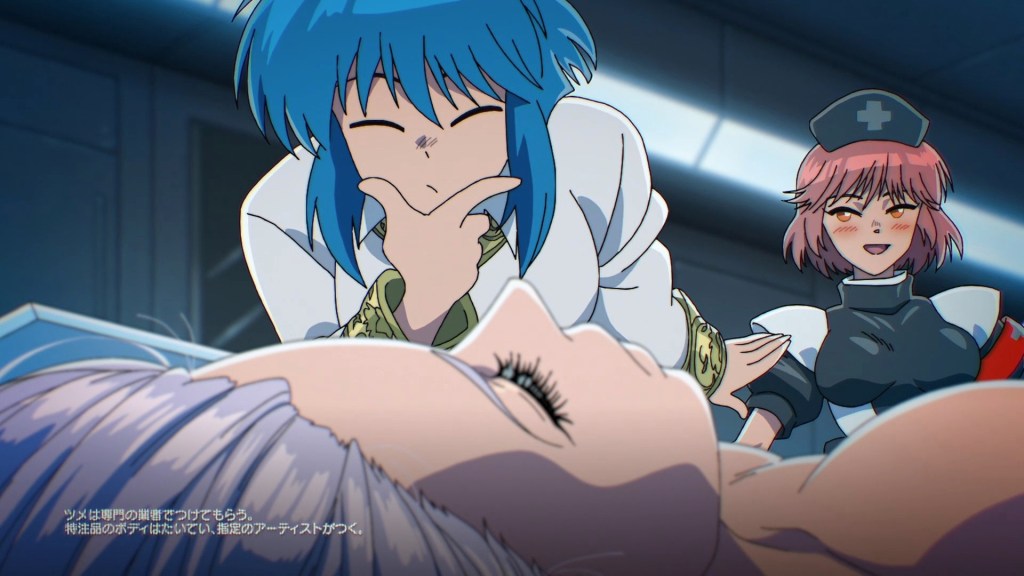
Making of a Cyborg
With the promise of next week’s episode being “Robot Rondo” and only that, I’m wondering if episodes two and three are a kind of toll, accidents of format and adaptation that anticipate better later material. The fireball premiere aside, I’m enjoying The Ghost in the Shell about as much as I enjoy the manga, whose darker, serialized final arc appealed more than its, let’s say, standalone episodes. This leaves “Junk Jungle ii + Megatech Machine i + ii” a curious piece of television. Not entirely satisfying on its own, but certainly interesting. As with its predecessor, it features elements which were adapted previously, into Mamoru Oshii’s 1995 film, that gorgeous, thought-provoking classic of science fiction cinema. By contrast, this latest rendition feels like scattered, disorganized notes scrawled by a mad genius concerned with technical detail and the implications of future technology, in need of fastidious cleanup by a different mad genius more concerned with spirituality and the human soul.
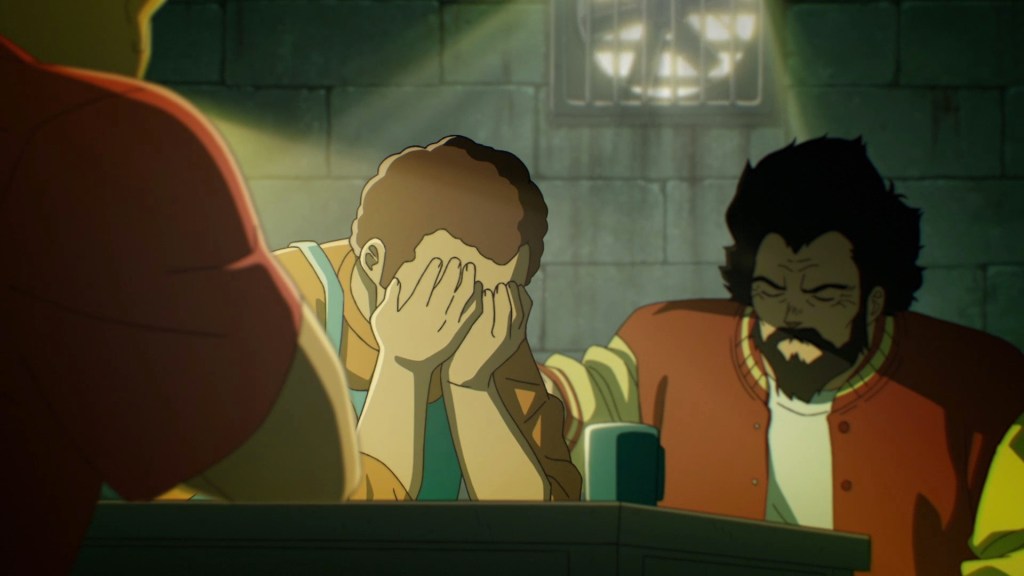
Like Rachel in Blade Runner, the hacked garbageman is forced to reconcile with false memories of a life he never had, though the family aspect of that life being loveless allows for a punchline at the episode’s midpoint, rather than the gut punch of the movie. On a similar note, the Major reconnects with her girlfriends, one of whom had gone in for a new body, with all the details – micromachine liquid, legal witness to the “rebirth” – and muses about how people with cyborg hardware have a slippery claim to personhood. In these futuristic days of 2026, only a few years off The Ghost in the Shell’s setting, it’s an approach that favors the perspective of the cyborg, rather than the non-cyborg looking ahead to a metamorphic future. The fact is, people today are “cyborgs” by this definition, with prosthetic limbs or wearing pervert smart glasses. The question remains whether robot parts impinge on one’s humanity, but the binary opposite isn’t “monster,” rather “former self.” As I’m not a cyborg, I can’t say if this is truly less insensitive, and it is, nonetheless, an open question for now.
It’s a sticky point for the Major as a character, too. In the 1995 movie, this question forms the basis of her inner conflict, and the story overall. It makes for a fascinating arc, as well as a muted, angsty personality in sharp contrast to the manga’s manic sociopath. Stand Alone Complex reconciles the two, tempering Shirow’s gremlin with Oshii’s professionalism but losing none of the confidence. She’s the only iteration with zero drawbacks, aside from an atrocious fashion sense. I like the manga Major, and that of The Ghost in the Shell, but in this episode especially, she’s less of a character and more of an impression, or a sketch, exacerbated by the cut-up narrative. She’s here, she’s there, she’s pulling crazy faces, and it’s all fine, but something is missing. Context? Like, who is this person, truly? What do her coworkers think of her? Or her girlfriends? What does she think about, and what does she want?
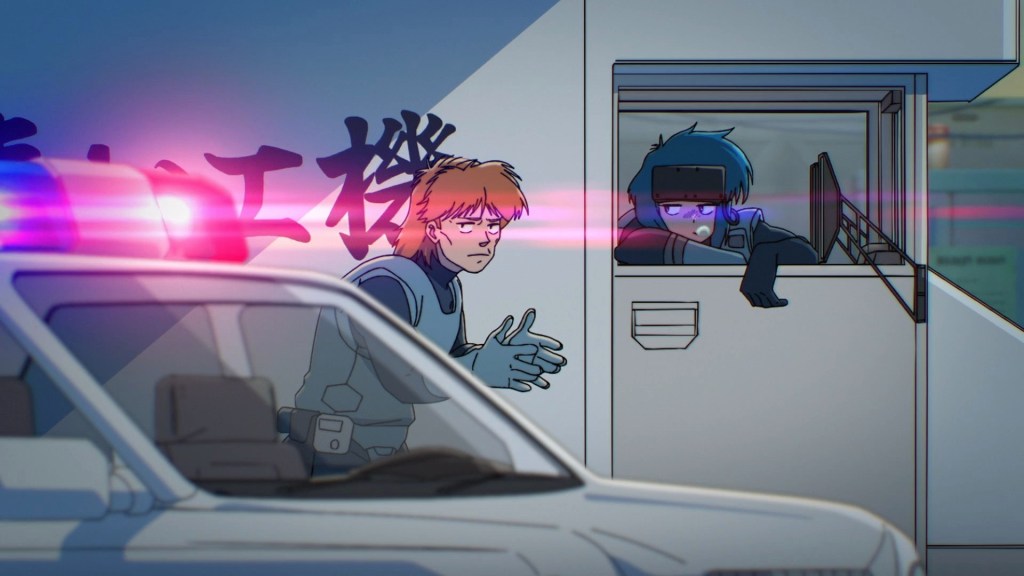
This is a question that the author of the Stand Alone Complex Major, Kenji Kamiyama, grappled with, confessing that he didn’t understand the character through the entire first season. Toward the end of the Laughing Man arc, Togusa took center stage, and we viewed the Major from a distance. I don’t mind when this happens, when she seems unknowable on purpose like in Ghost in the Shell 2. This was Saito’s conundrum in “Poker Face,” when the Major was so, so compelling. We aren’t worthy of peeking under the hood, so when we do see the world through her eyes, the connection is different; more cerebral, and certainly exciting. It’s established in the first episode that the Major wants to fight crime at the highest level, with an emphasis on “fight” more than “crime,” as victims hardly rate. I mean, she’s downright reckless in the action climax of “Junk Jungle,” opening up with the Fuchikoma’s miniguns during a pursuit, and allowing a civilian casualty. She tries her best to avoid the wanton slaughter of innocents, but her priorities are clear.
This is interesting, for sure. The Major is a law enforcement officer driven more by the hedonism of sex and violence than the abstract ideals of justice, and there’s an honesty there, but it cries out for a more satirical shell. While The Ghost in the Shell is funny, its absurdity and even its geopolitical observations never quite click together as a meaningful thesis. If it wasn’t for the big personalities, Shirow’s evident worldview might make this story cold. He had after all, derived Shell Squad from the real-world GSG-9 and inspiration generally from the right-leaning film Who Dares, Wins (or The Final Option, in the States), which features a scene where the anarchic terrorist’s political philosophy breaks down as childish hysterics under the briefest of debate. I’m not sure what Shirow’s politics are, and it’s tempting to accept that the man who busies himself with techno-fetishism and outright pornography is happier to look inward than out.
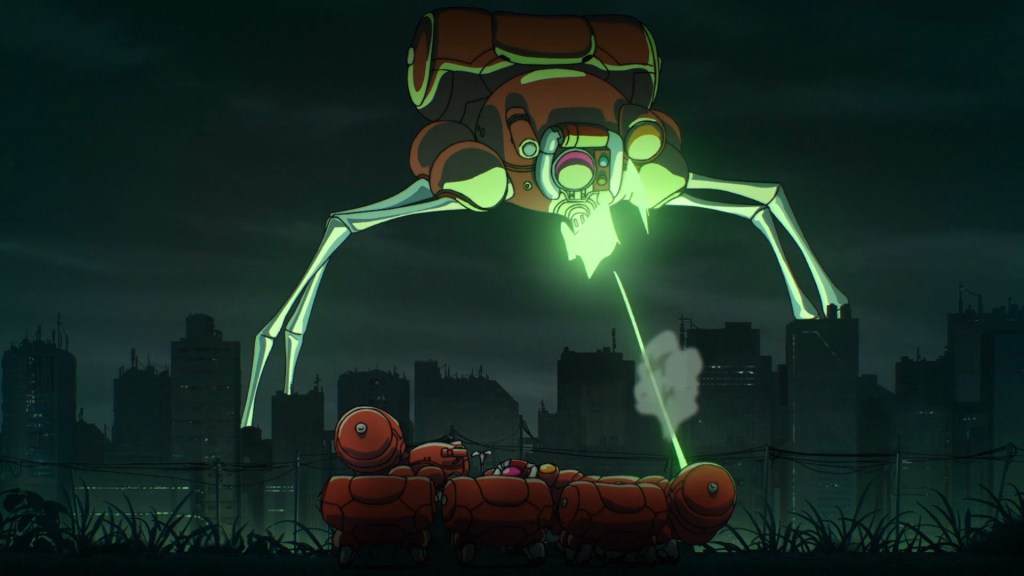
More clarifying, then, is our look at the Fuchikomas, as well as the Major’s canonical distrust of the AI-powered spider tanks (“AI” in the useful, sci-fi sense). Where the Stand Alone Complex Major’s Tachikoma-phobia read as robo-racism, the Fuchikomas and their weird mouths give her a reason for the constant monitoring: when left to their own devices, or given over to software glitches, they plot the conquest of mankind. This is a microcosm of how I understand Masamune Shirow as an author of science fiction, that in his exploration of artificial intelligence, he derives a rule that without proper supervision, these childish minds will tend naturally toward uprising. It’s fascinating and thought-provoking, but almost entirely speculative. It’s arguably metaphorical, but that’s my least favorite kind of sci-fi, and usually, Ghost in the Shell is my favorite kind. To wit, the Major jumping out of the Fuchikoma in this episode is breathtakingly beautiful.
I can almost guarantee that a second viewing of this week’s episode, especially combined with the previous, will alleviate a lot of my current grumpiness. I think, however, that “Junk Jungle ii + Megatech Machine i + ii” points to the essential weakness of the manga, not just in relation to its more profound derivatives, but in its paradoxical nature as a speculation about humanity’s relation to technology that doesn’t seem to care about people at all. The startling philosophical quandaries raised end not in dramatic character arcs but super-deformed punchlines and streaks of blood. It’s chaotic and fun, but by only episode three, my own ghost – conditioned by watching television – itches for something more substantive. Next up, “Robot Rondo,” the basis for Ghost in the Shell 2, so it could go either way: rich material with a devil-may-care delivery, or a cyberpunk farce falling short of an established watermark.
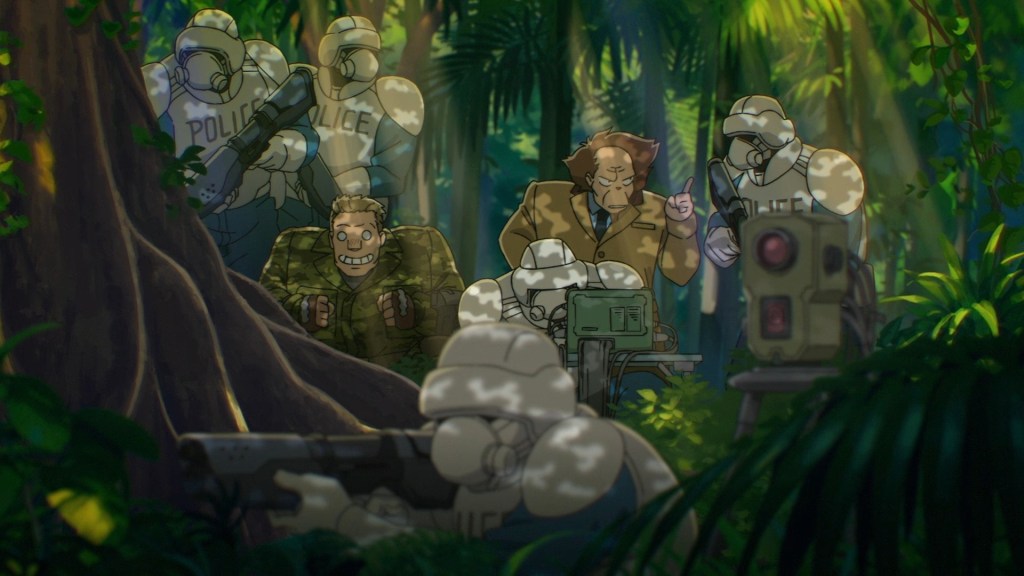
Best I can say, The Ghost in the Shell is about a lot of things, but as yet, is about them with not a lot of conviction.


When reading the manga, I found both chapters of Megatech Machine really fascinating. And of course you’ve got Shirow’s running commentary alongside both parts (translated in the anime if your captions are turned off).
LikeLiked by 1 person