But will I cry?
Mark your calendars, folks, for a new Ghost in the Shell on July 7th! “Ghost in the Shell?!” I hear you erupt, indignant, “You mean the Japanese cyberpunk media franchise which hasn’t been good in over ten years, being generous?” “Ah,” I say, with scholarly poise, “Japanese postcyberpunk media franchise.” How clever indeed. The plan was to totally play it cool and wait to write about Science Saru’s The Ghost in the Shell only upon its release, theoretically doable as I haven’t been trapped in a hype cycle (hype psyop) in what feels like ages. And frankly, the first two teaser trailers weren’t doing much for me, beyond providing excellent music samples – the second like something out of Metroid Prime – and selling the concept of animating the artwork of Masamune Shirow with a budget larger than, say, the Appleseed OVA. So, what happened to turn things around? The third trailer. And so, I want to tell you a story in three trailers, and it’s my favorite one: the story of the Major.
Once Upon a Time in New Port City
For a brief history lesson, this is how the source material, Shirow’s manga, looks:
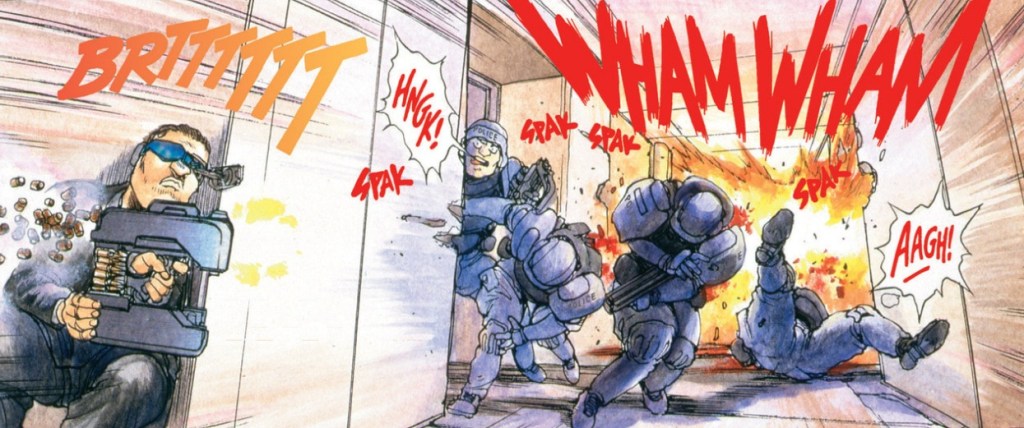
This is a shot from the second teaser:
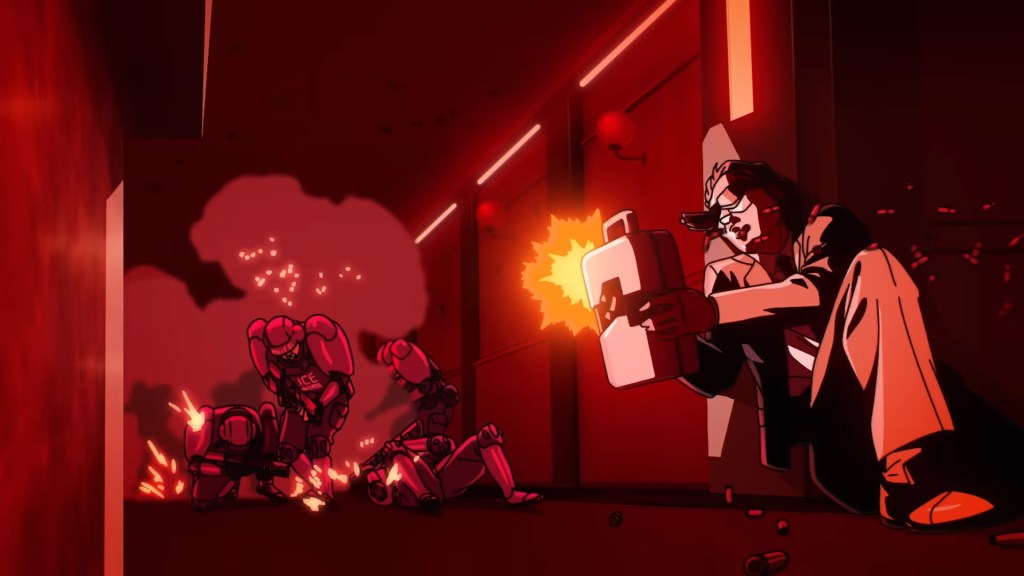
I’m pretty sure the digital edition of the manga I have is “flipped” for baby Western readers like me, so in reality, the composition of both images should be an exact match. This is the same scene from the 1995 movie, across two shots:
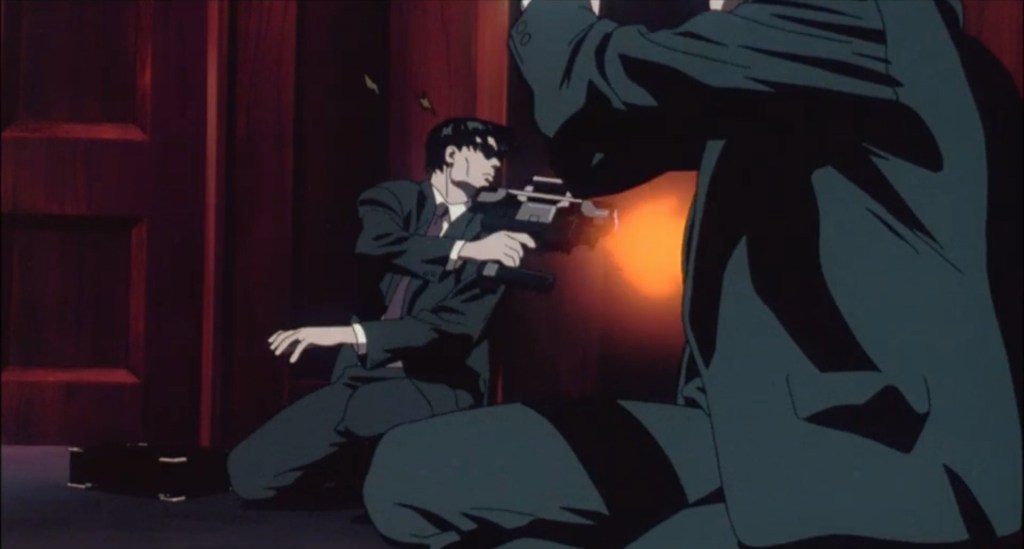
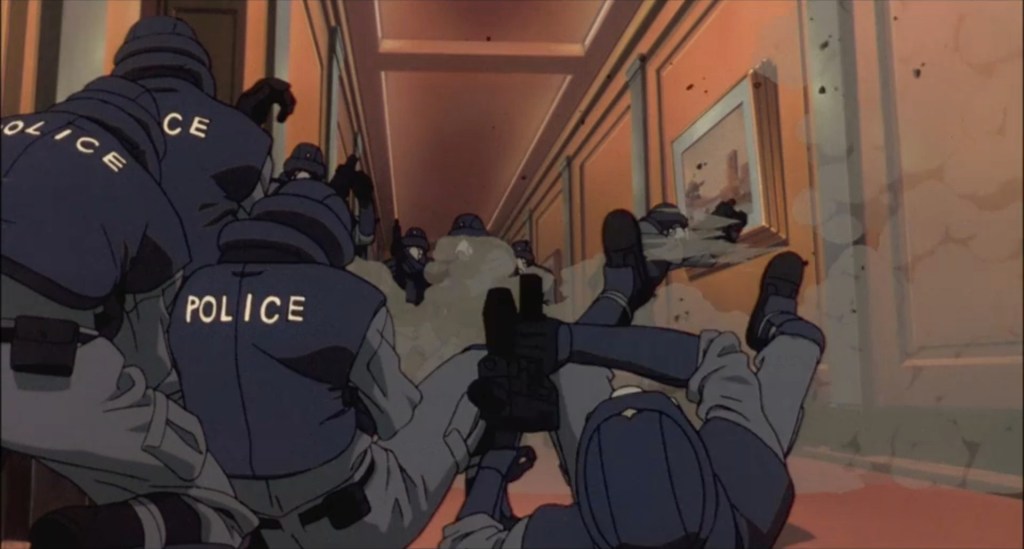
Steady color and camera angles, realistic-looking characters. Which isn’t to say there isn’t humor; the supremely confident nod given by the one suitcase-gun guard to the other is hilarious. Anyway, directed by Mamoru Oshii who was, at the time, no stranger to comedy himself (his most acclaimed work to that point being on the Urusei Yatsura anime), and with realistic character designs by Hiroyuki Okiura (who’d later direct Jin-Roh: The Wolf Brigade), 1995’s Ghost in the Shell was a radical departure from the original work, but would eclipse it in popularity and prestige. The first anime film to enjoy a simultaneous global release, it arrived in foreign markets as the next big thing after Akira. Or as the narrator in the English-language trailer growls, as “the leading edge in the new animated entertainment genre, and marks a milestone in the future of feature-length animated filmmaking for young adult audiences.” In terms of the brand, the movie decentered the manga as a reference point, freeing later adaptations like the television show Stand Alone Complex and even the American adaptation to pursue their own styles – obviously, to varying degrees of success.
And so, the 2026 edition promises to do what hapless filmmakers on press tours for remakes of movies themselves based on earlier works are forced to say: go back to the source material. We’ve seen Ghost in the Shell in all sorts of styles, from 3D CG to live-action, and even the hybrid 2D/3D of the 1995 film’s sequel, an approach derided at the time but which anticipated modern anime moviemaking, if Mamoru Hosoda and Makoto Shinkai are any indication. It seemed like the only thing left was to animate the panels and pages of Shirow’s manga, though this would necessarily require a more frenetic, cartoony feel than exhibited by the films’ heavy, philosophical dread or the grounded procedural tone of Stand Alone Complex. Cards on the table, Ghost in the Shell 2: Innocence is one of my all-time favorite movies, and the second season of Stand Alone Complex is my all-time favorite television, so never once have I thought, “Damn it, when will they do a truly faithful adaptation?” When the franchise started flagging through the 2010s, I opted instead, however half-consciously, to simply drift away. I’ll be your deadwood, Ghost in the Shell.
Unnatural Po-lice
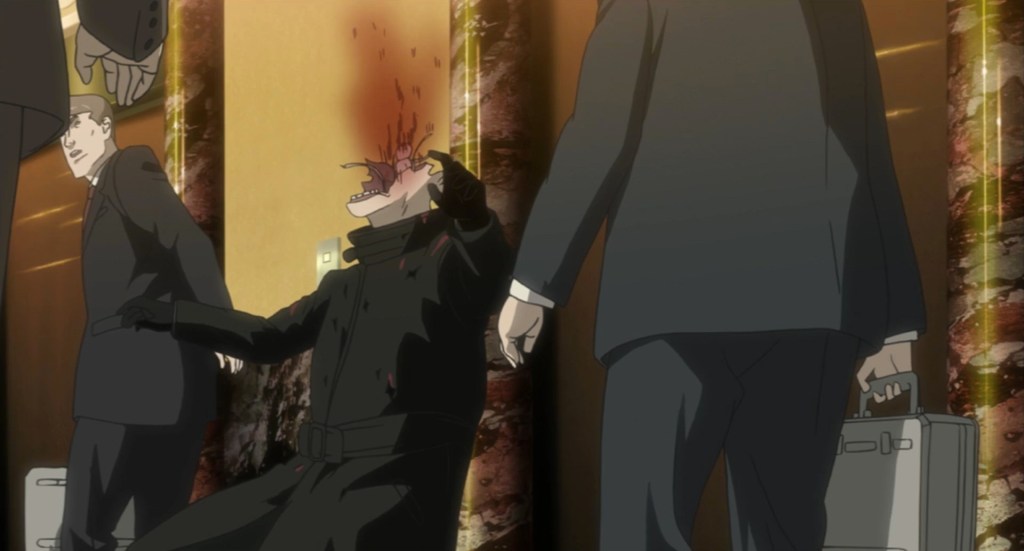
Gee, what a cryin’ shame
Every now and then, I’ll have occasion to reflect on why I loved Ghost in the Shell so much, like in a QNA episode last year. The answer? The Major. The series protagonist, Major Motoko Kusanagi, is the best, and I’ve only ever embarrassed myself trying to explain why, so I’ll just say that she does cool things, like assassinating people deemed inconvenient by the state. I mean, that sounds pretty uncool, but I don’t have to agree with a character morally in order to think she’s pretty neat! And to be honest, Stand Alone Complex especially skirts around the grey zone of fictional police by setting her team – Section 9 – against truly bad people. In the first season, it’s the corrupt politicians and businessmen profiting off of a treatment for a deadly futuristic disease when there’s a cure available, and in the second, it’s a rogue intelligence agency trying to return Japan to its imperial glory by literally weaponizing an island nation of immigrants. Therefore, when the Major executes the snooty intelligence officer whose machinations almost led to World War V, so hard with a machine gun that his head bursts like a grape, well, it’s okay to laugh.
Part of what set this deadwood adrift on the heartless sea was the gradual change in the Major’s character design. Chiefly, that they kept making her smaller. In the 2013 edition, Ghost in the Shell: Arise, she had the look of a teenager, and the attitude to match. It was a prequel, though this apparently means that the Major isn’t ready to be awesome yet. She loses a lot of fights in that show, and that I do not abide. I’ve almost never not abided anything with more conviction. Then there’s the Hollywood edition in 2017, where the Major was white and also didn’t do anything cool. One of the more headscratching things to ever happen, honestly. Finally, there’s the latest, 2020’s Netflix show Ghost in the Shell: SAC_2045, set up as a sequel to Stand Alone Complex. I never saw this one. Along the way, there was also 2015’s Ghost in the Shell: The New Movie, in which the Arise Major finally started taking it to the paint, so I’d say we parted on good terms.
Add the “The.” It’s Cleaner.
Okay, we can all take a breather. That was a lot of history! Someone should write a book about all that and throw it in the garbage! The Ghost in the Shell was announced some time ago, and I paid it little mind. As you can see, it’s a lot to go back to. I don’t need the headache, and I’m tired of being a “fan” anyway, as an expression of consuming modern entertainment (I’m more of a gamer). Surely nothing will come along to defrost this cold heart like the frozen dinners I consume every morning. In January of this year, the first teaser pops up online, and opens with this image:
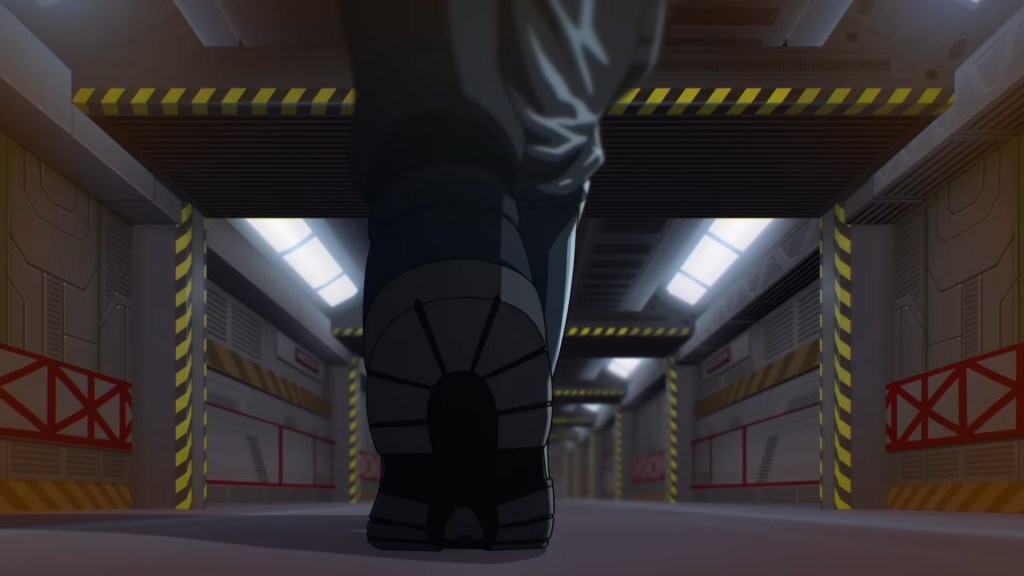
Notice anything? I immediately thought this was – more on the part of the trailer’s editor – a wink to Stand Alone Complex, whose two OPs (credit sequence) open with these images:
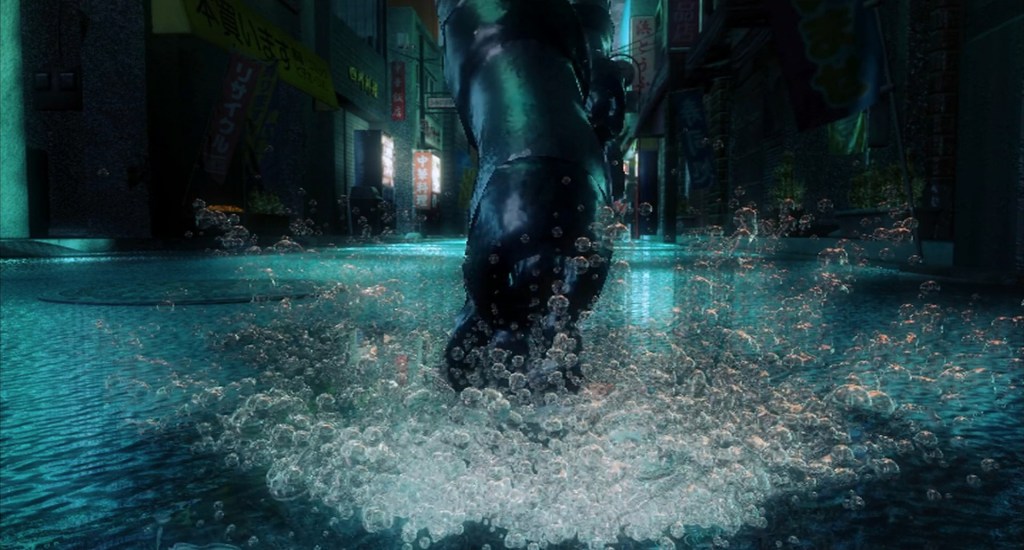
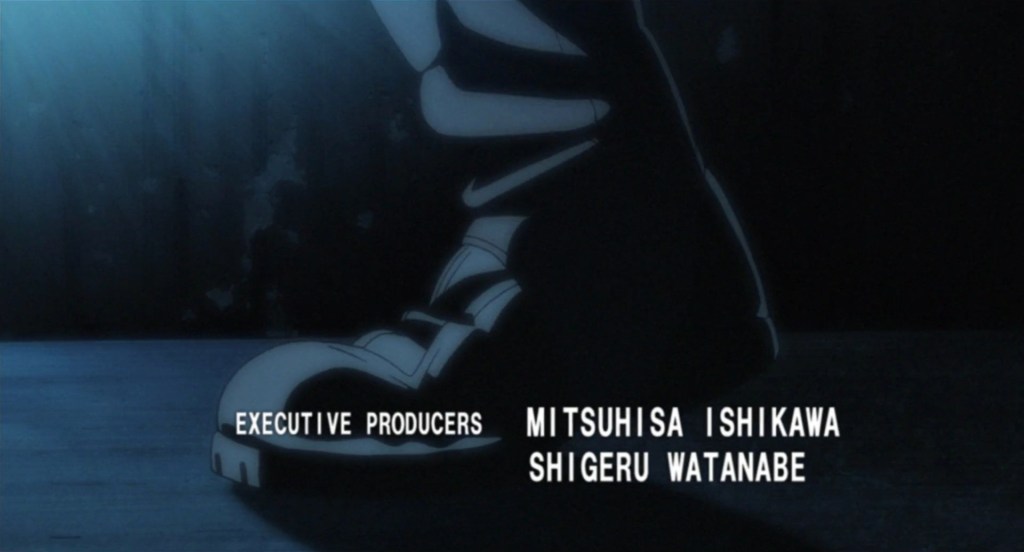
Not to make things weird immediately, but I always thought it an appropriate starting point with the Major, if not Ghost in the Shell itself, which is typically announced by helicopters over a city skyline. Oh, how I wish there was a discrete genre term for science fiction that was like “robots and helicopters.” Not full-on mecha, nor military SF, but this sort of stuff, you know?
The second teaser continues teasing, flashing glimpses in what appears to be painstakingly smooth animation and a comic-accurate style:
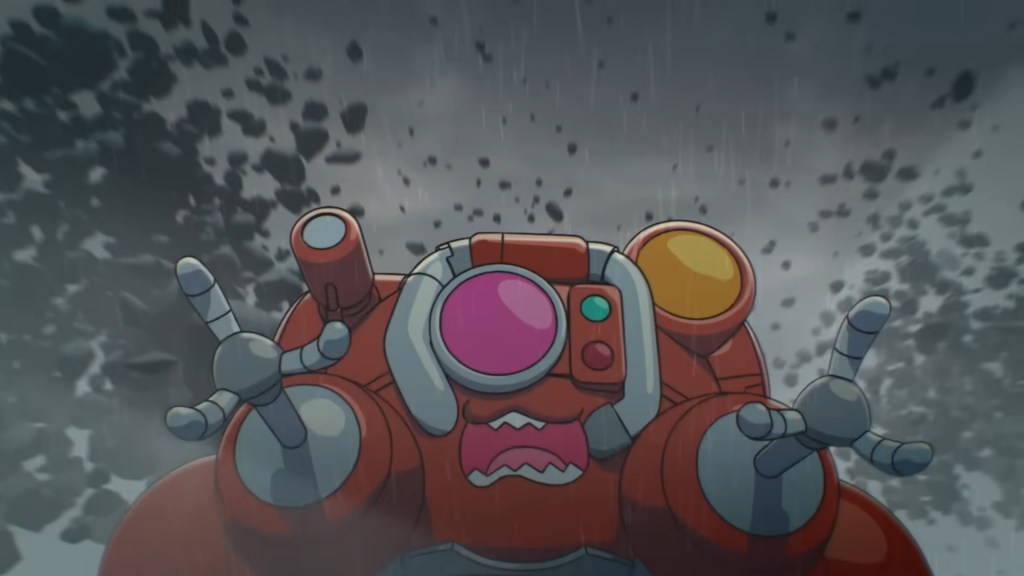
I haven’t gone through the original manga to verify which of the three varieties of spider tank this is, whether Fuchikoma, Logicoma, or Tachikoma, but it doesn’t really have a mouth like that with, you know, a tongue and teeth. The manga’s cartoony style is made all the funnier by its depiction of sometimes brutal subject matter, usually spearheaded by the Major. I won’t go so far as to call it a “tension” in the story, but Ghost in the Shell typically thinks the Major is a heroic-type hero, while in truth, she’s a huge dick. Here’s my go-to example, where she’s staking out with her pal Batou and an android:
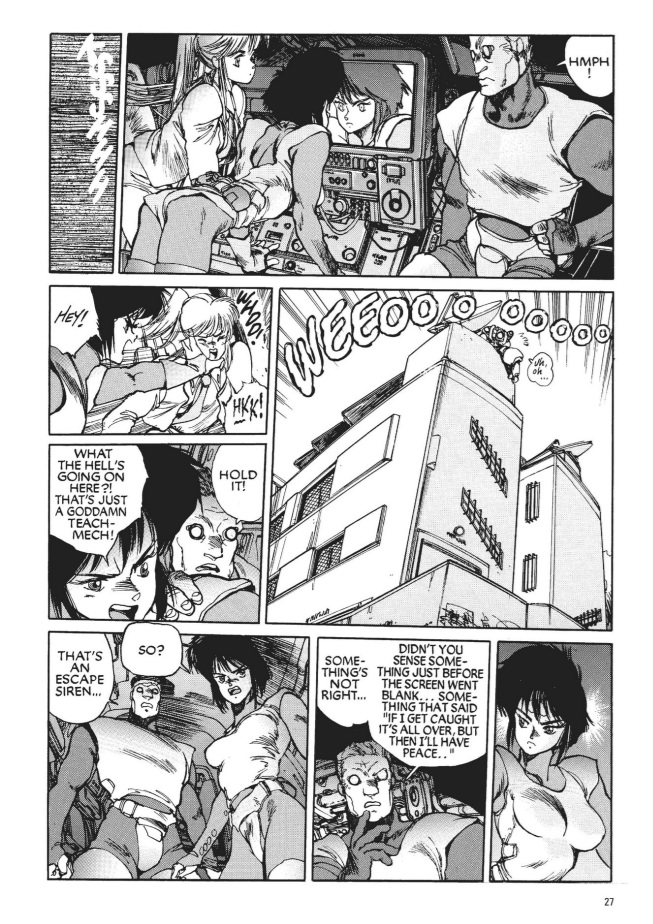
Why, out of nowhere, does she smush the android’s head into a wall?! Here’s another Major classic:
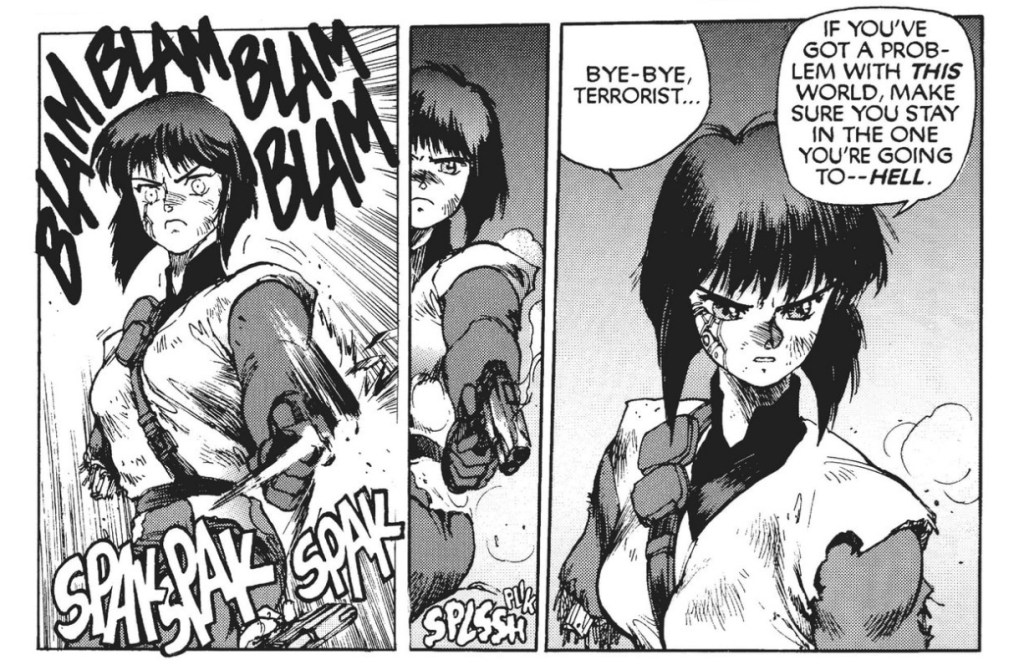
As you can see, her arm got torn off, so she’s pretty peeved. In this issue of the manga especially, she’s getting tossed around during a chase and making goofy faces. But in the end, it’s always the Major on top. This moment was famously recreated in the first season of Stand Alone Complex, when she one-hands a comically large sniper rifle to shoot at a downed mech suit, crushing the pilot inside (just to scare him).
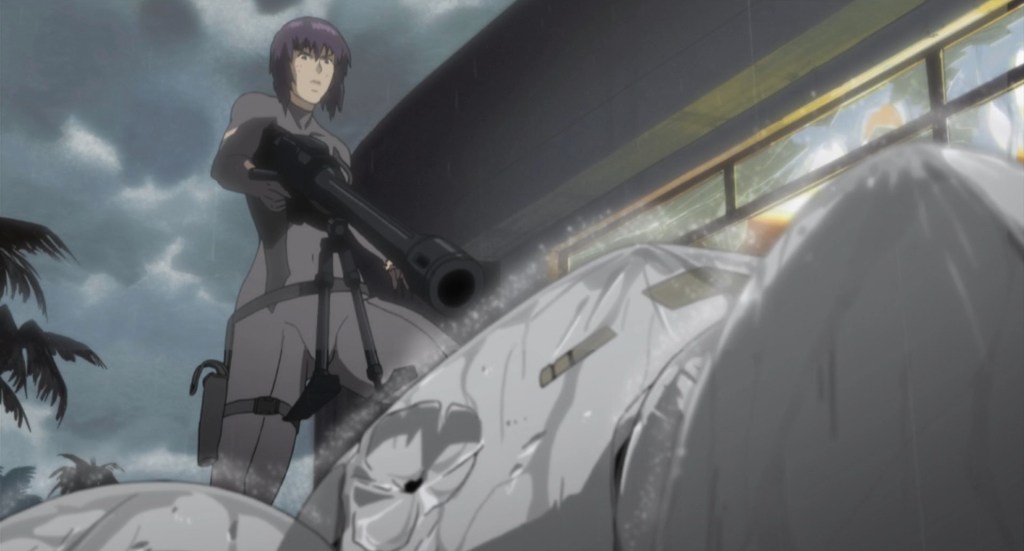
This is the face she made when she regained consciousness after the mech was crushing her head, the very embodiment of “waking up and choosing violence”:
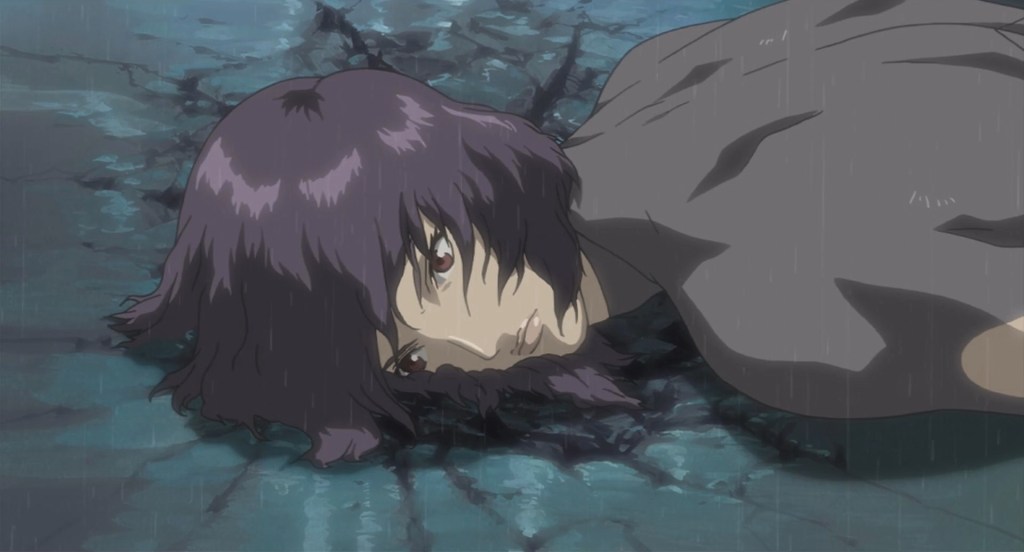
The full trailer for The Ghost in the Shell arrived earlier this month, and the big difference is that we see the Major in action, and we’ll get to those moments soon. First, though, we have this image, which looks pretty close to the one above:
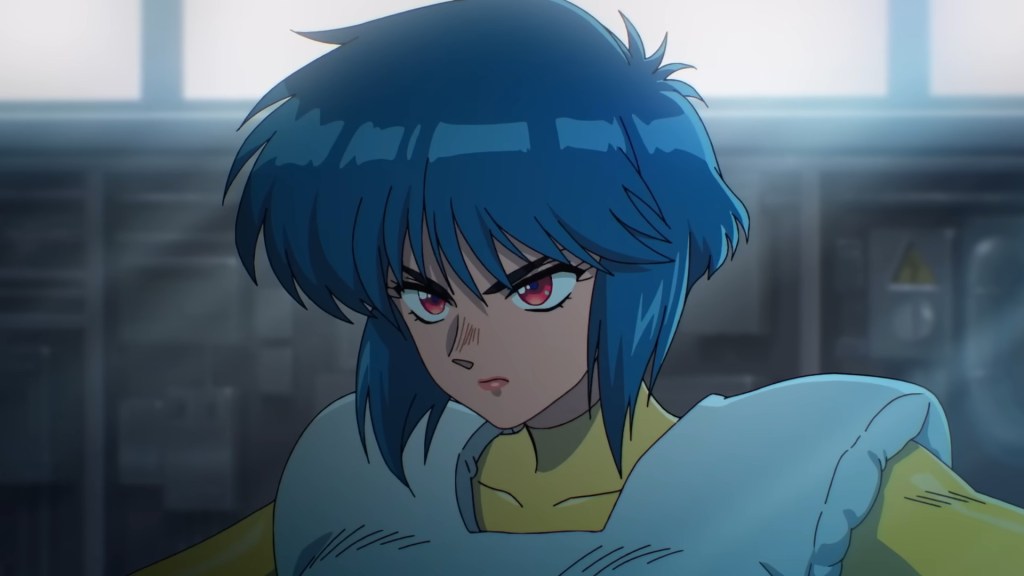
Look at how angry she is already. She’s getting tac’d up for the mission just thinking about how badly she’s gonna bust some skulls. By contrast, here’s Batou:
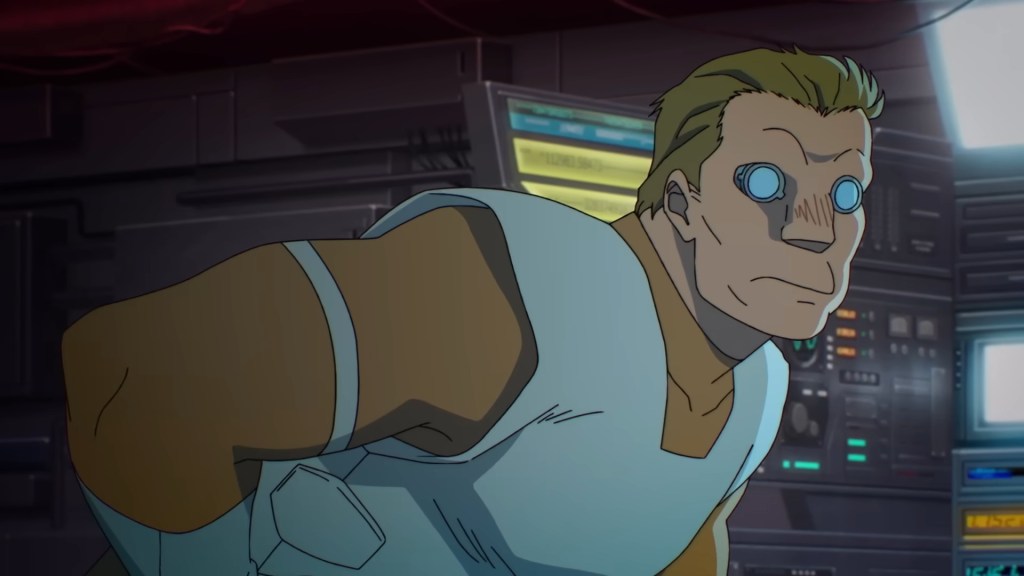
He always thinks he’s gonna, like, date the Major. But God, do I prefer this hairstyle to the ponytail of Innocence and Stand Alone Complex. Like, I get it, you got to separate him from the military background (the reveal of the Rangers at the end of 2nd Gig! My heart), but it’s better this way, it’s better.
Next, we have an iconic Major image, where she’s googling porn on her VR headset:
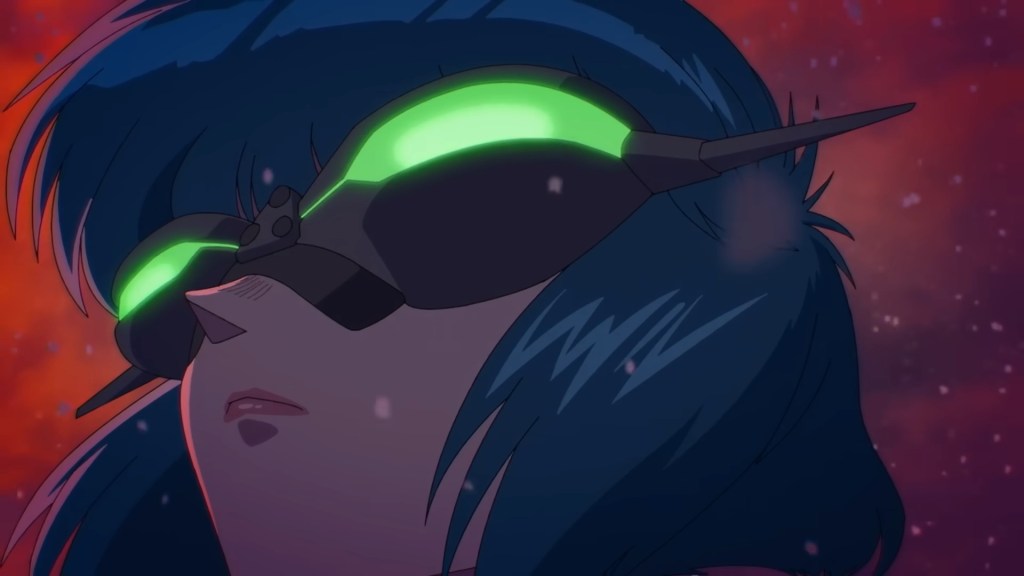
It may sound silly, because it’s so close-up that there really isn’t a lot of “composition,” but I love the composition of this shot. The low angle, again, is correct, and somehow, she looks so imperious. Looking up and away, her mind elsewhere, an indifferent god.
This carries forward into a scene where she’s even more explicitly unbothered by the pleats of mortals:
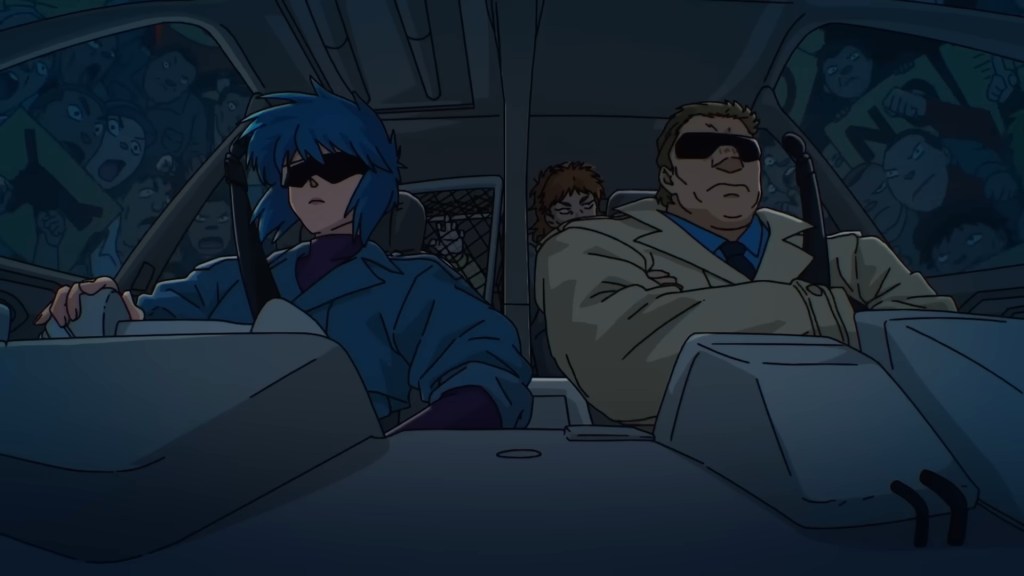
You can see that the angry crowd is agitating Batou a little, but not the Major. And the shades are a classic look. She’s always got something to obscure the windows of the Ghost, though the rectangle will always be my favorite, as featured in the next moment I want to highlight. This one’s a bit difficult to capture in still frame, but she’s coming down hard on a vehicle, which shatters beneath her:
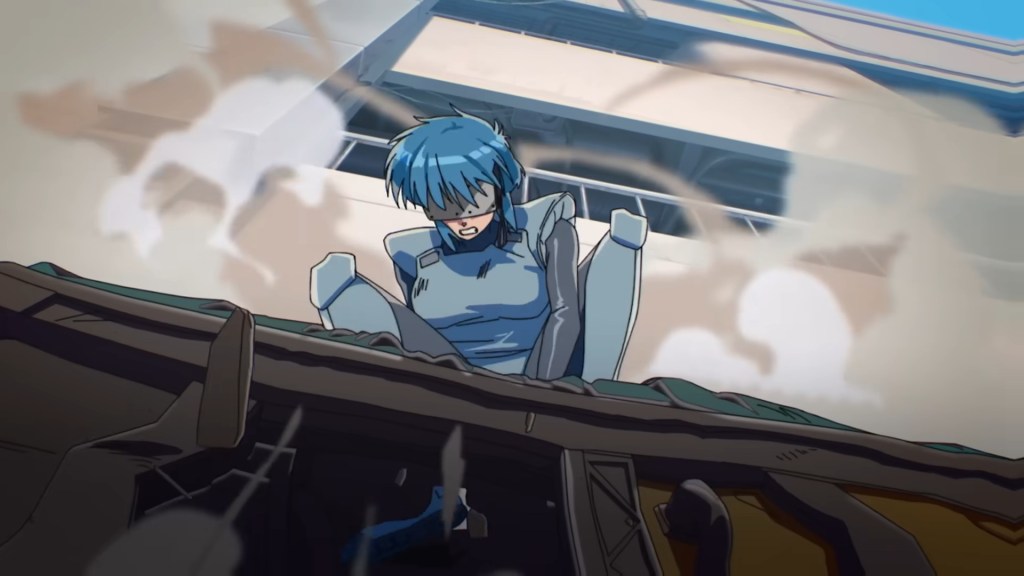
This is exactly what I was missing from the two teaser trailers: a reminder that the Major is heavy and made of metal, and that she loves to leap from tall heights or helicopters.
I should also take a moment to note that the music in this trailer is phenomenal. Another legacy of the 1995 movie, which featured a haunting but mostly indescribable score by Kenji Kawaii, followed up by the legendary Yoko Kanno on Stand Alone Complex. This piece is even jazzier to match the anything-goes feel of the action on-screen, but with a bracing string accompaniment that’s like a jolt.
In this wide shot, where the Major is a series of squiggles for most of the frames, she’s tossing out a wire of some kind. Maybe a grappling hook, but purveyors of cyberpunk know that wire is often used for severing yakuza limbs, so who knows. What I especially love here is the body language. She might be flipping through the air, but she’s in total control, and the throw looks so casual:
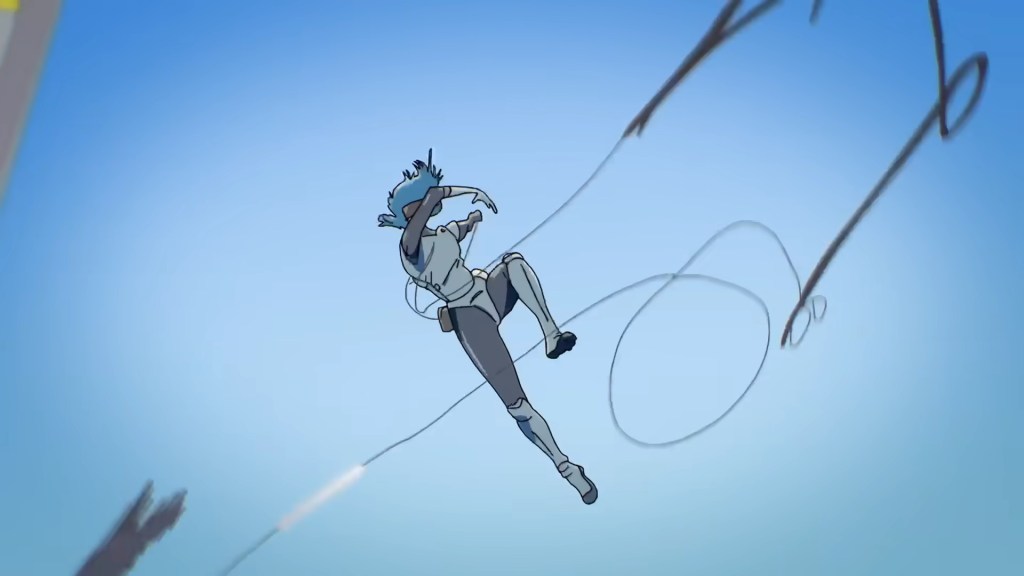
The animation, again, is super smooth. It’s moments like this that scream “the Major,” and that’s been a constant through the series installments which are good. It’s like the “Major flipping through the air” litmus test. If she doesn’t do that, my confidence is already shaken.
Next, another look at the eye rectangle:
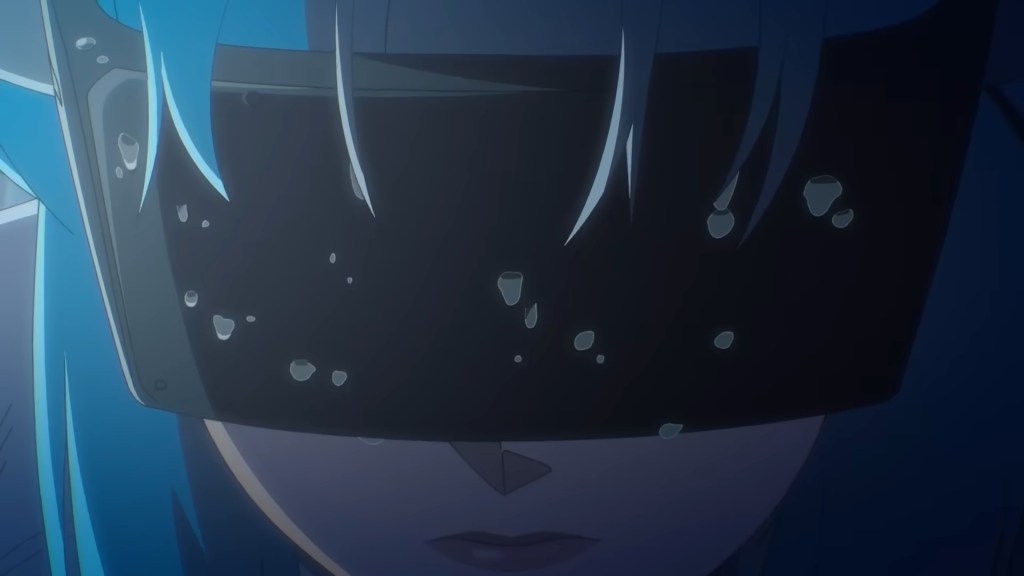
Stand Alone Complex may be my favorite Major, but I can’t deny that blue is her color.
Okay, for this next one, I have to break out the frame-by-frame, which is one of the best features on YouTube. I can’t think of a single other player (Netflix, HBO, Hulu, Amazon) with frame control:
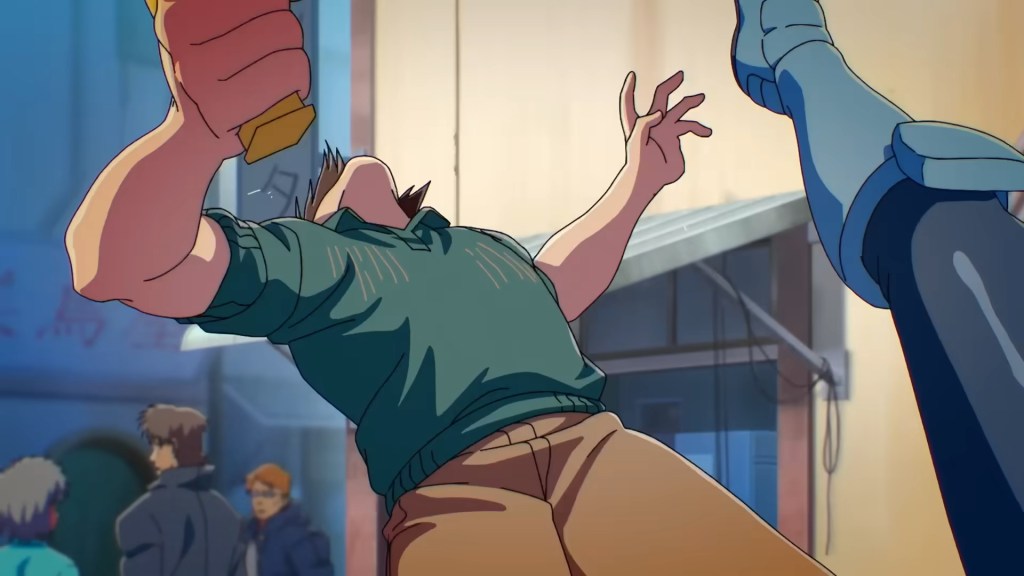
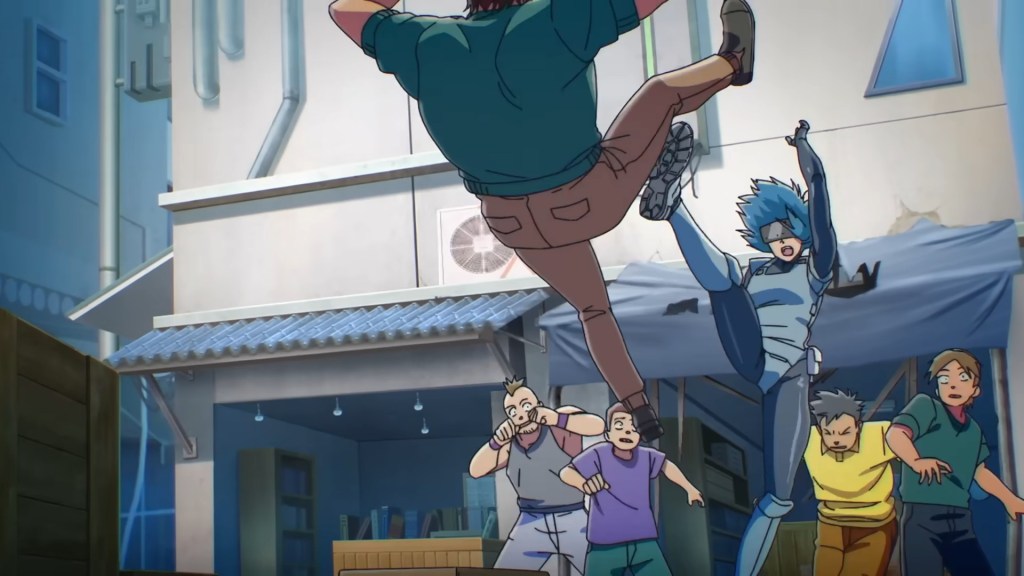
In this final image, I can see what the wire is for. It’s the equivalent of handcuffs in the dystopian year of 2030, where the Major plugs a device onto the ports in your neck which disables the cyborg body. Only this time, it looks like she’s whipping it around like Michelle Yeoh in Magnificent Warriors:
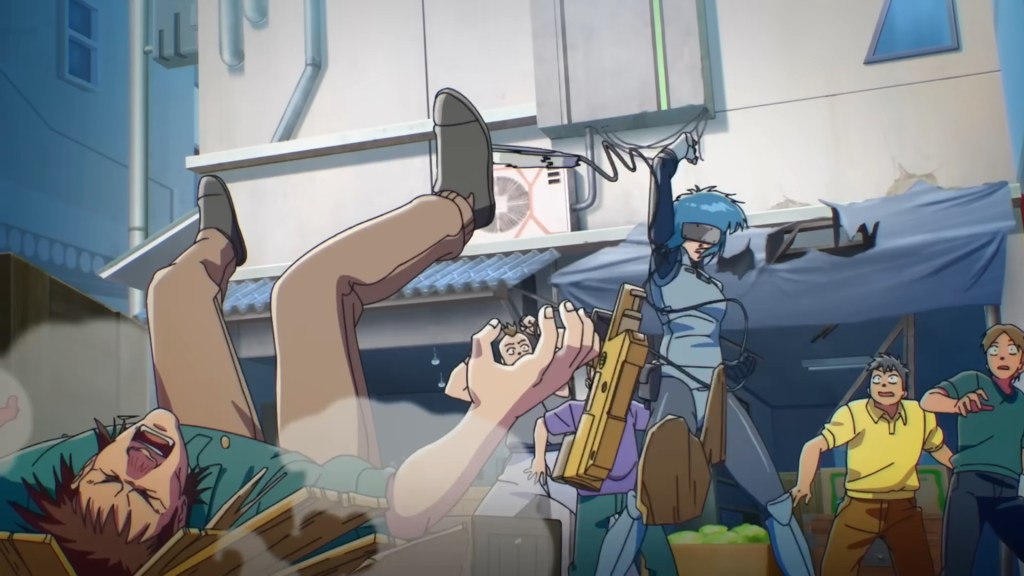
How delightfully devilish. It’s also a great shot, with a bit of camera shake as we move backwards to track with the guy as he flies away. Few things are more exciting than the moment when the Major squares up with some guy who’s completely outmatched. Think the knife fight in the 1995 movie, which ends in the most glorious spinkick in film history.
From here, we have quick glimpses of the Major off the clock, expressing the one thing she almost never does: emotion. The 1995 movie is a special case because she’s having an existential crisis, and I think the Stand Alone Complex Major was a little too cool for this sort of thing, but I’m not complaining about it here:
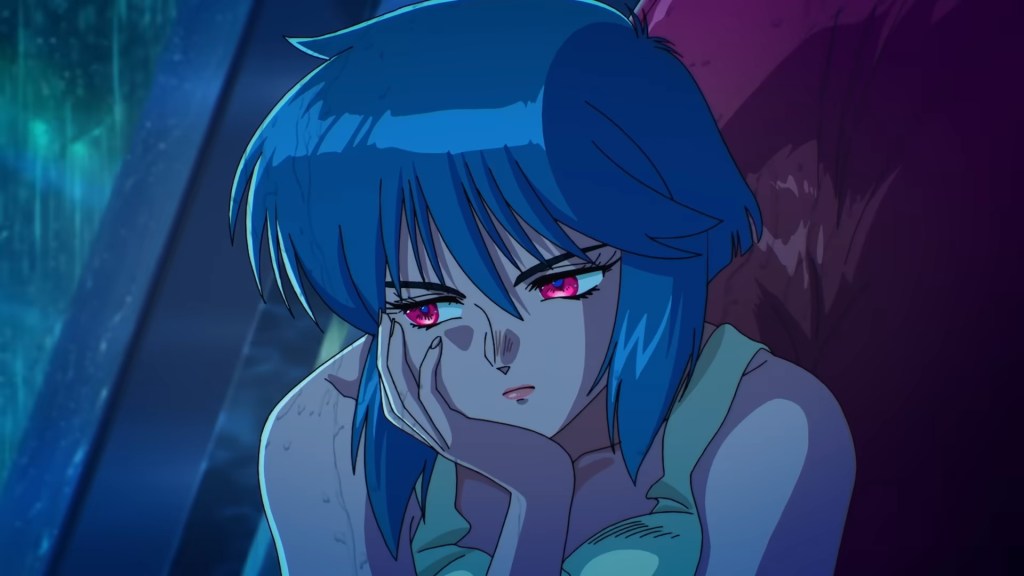
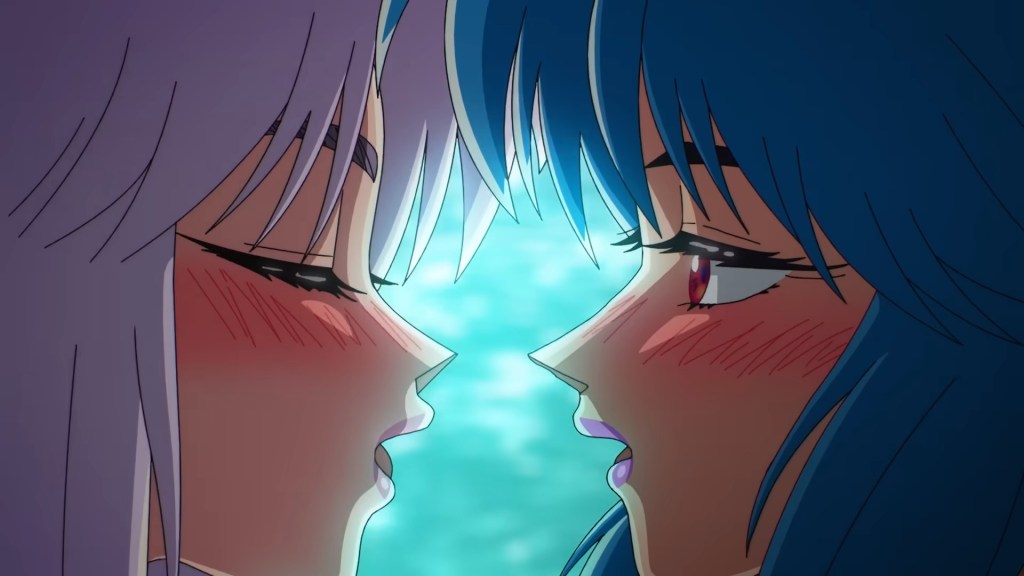
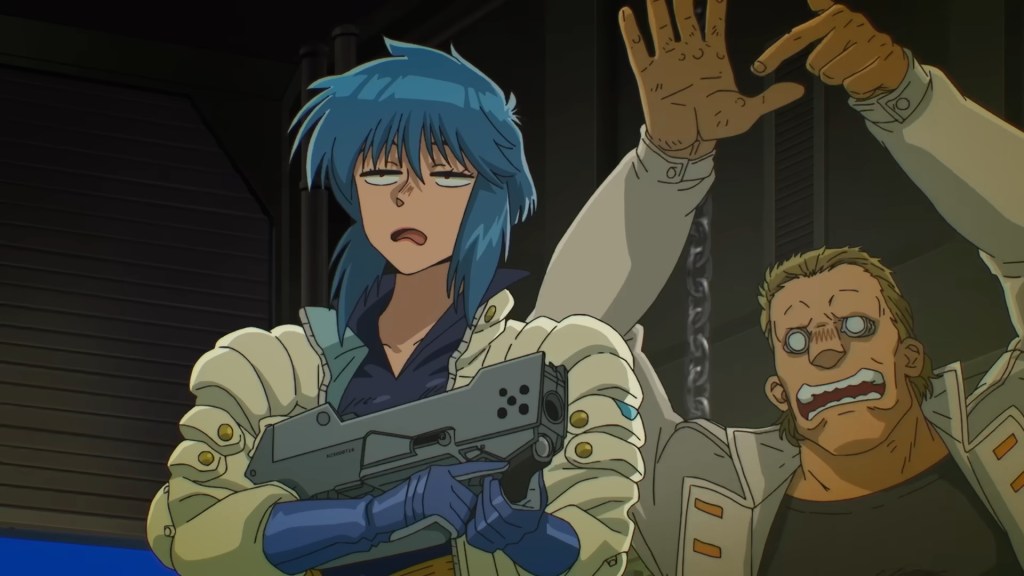
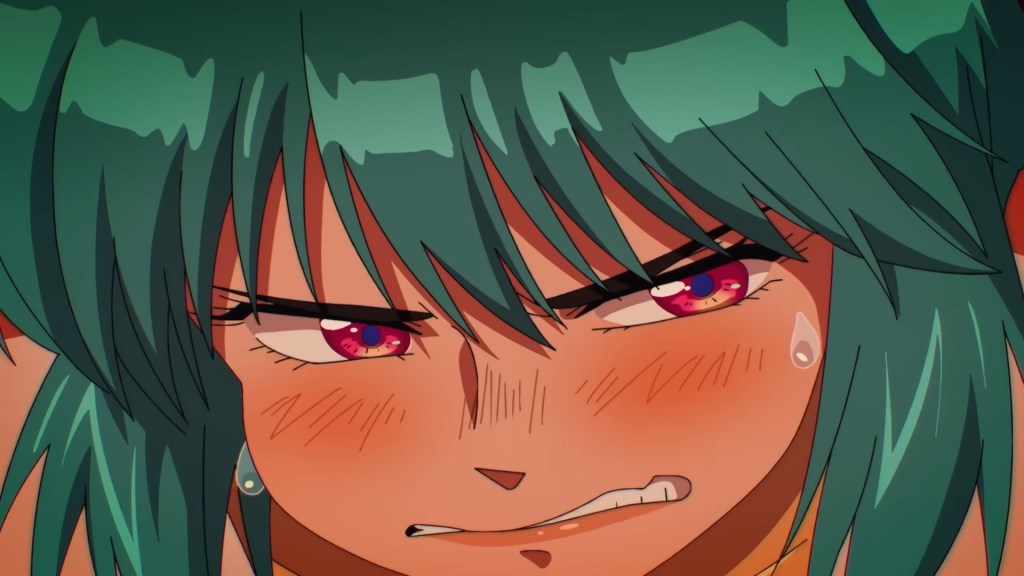
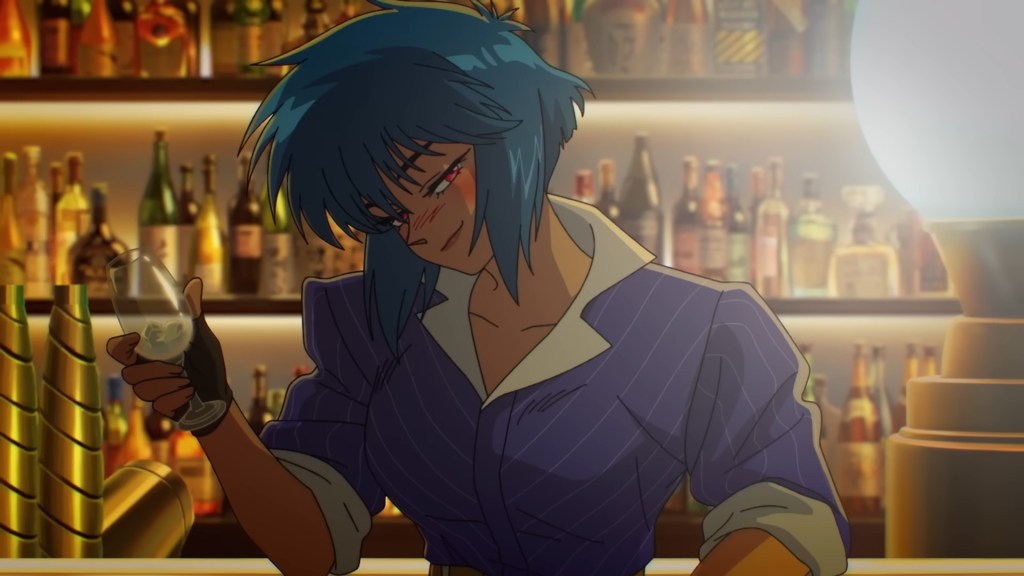
This last one has gone viral, constituting perhaps the first Ghost in the Shell meme. I mean, if they never made a meme of the giant butt from the second episode of Stand Alone Complex…
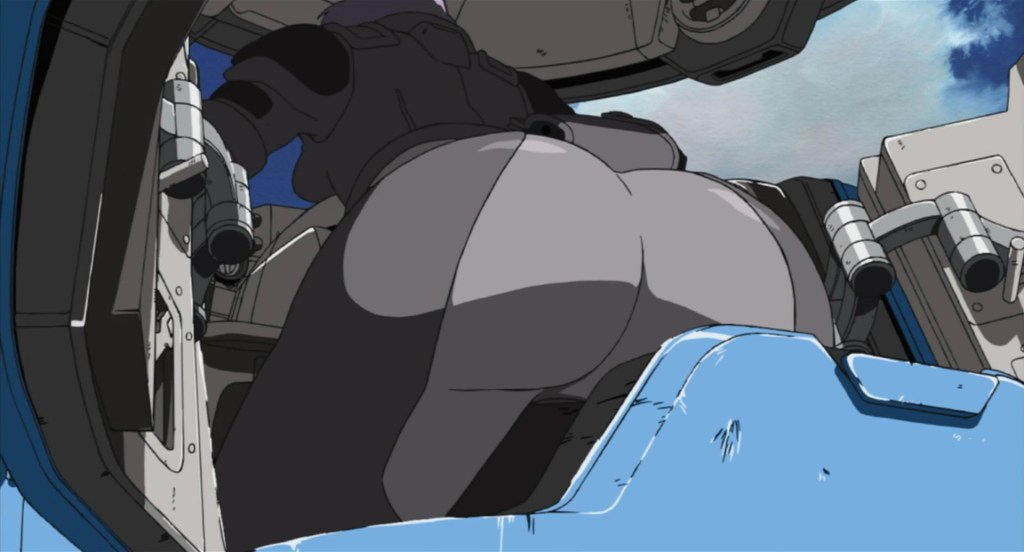
I had not seen this in a while, so when I landed on it, I just about died laughing.
Next, the Major takes a surf on the information superhighway:
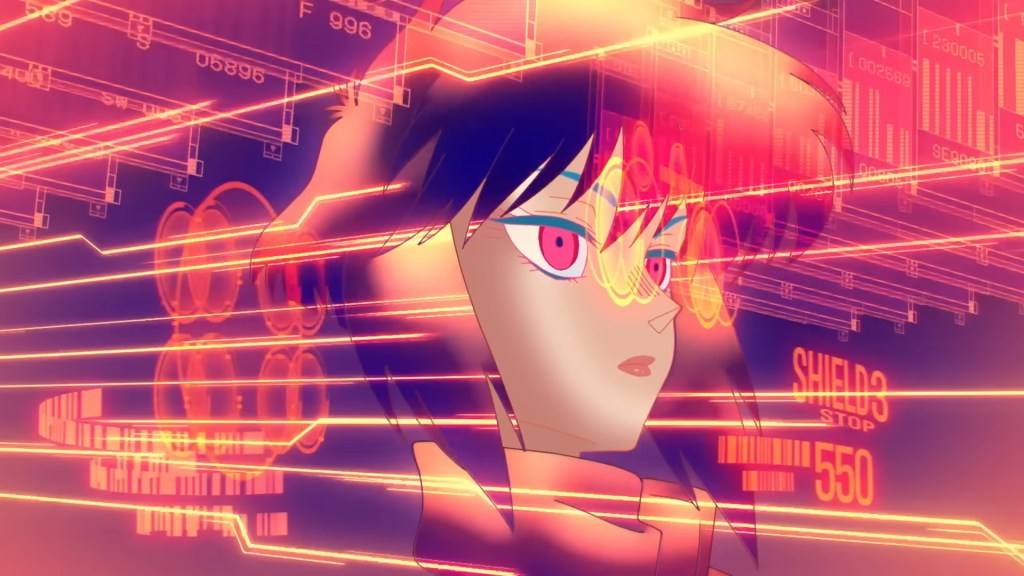
Maybe she’s trying to find the image of her giant butt so she can scrub it from the Internet. The original manga is from 1989, only a few years after Tron, when this is what we thought the inside of computers looked like.
And that brings us to the finale, an image that puts the complicated legacy of the Major front and center, or thereabout:
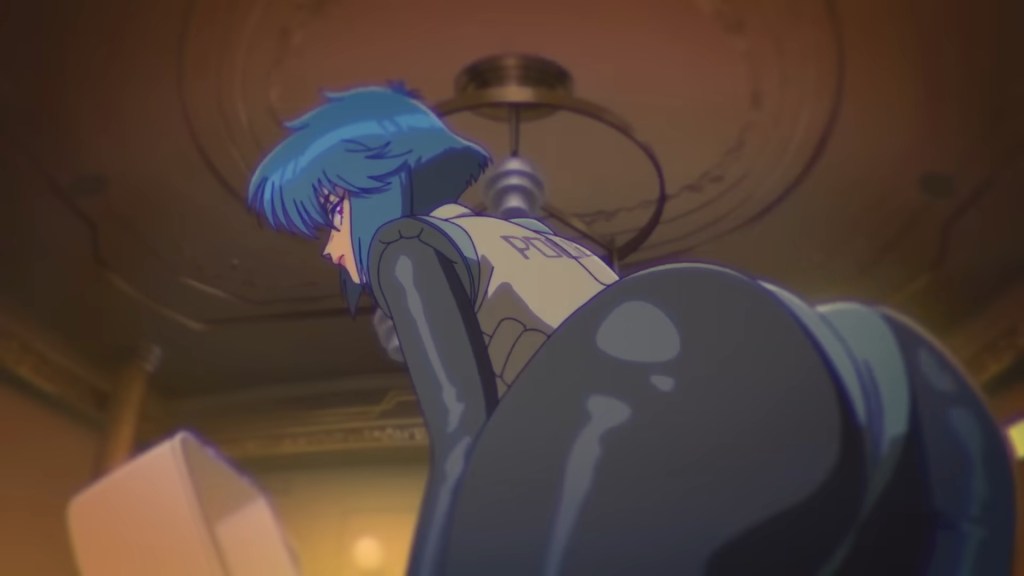
Look familiar? The more things change, the more they stay the same. Still, I might argue that her sexualization here is subtly different than in the earlier version of this shot. For one, she’s looking directly at the viewer, rather than it feeling like the spider-tank commando equivalent of an upskirt. Of course, a fictional character doesn’t have agency, as she’s being literally drawn to invite the Gaze, but at the end of the day, it’s the Major. If she’s inviting you in, it’s likely because she’s gonna kill you.
For far more thoughtful writing on the Major’s body, I can’t recommend “The Major’s Body” by Claire Napier highly enough. A few years ago, she also wrote a follow-up, which I didn’t know. Brilliant work, as always.
Shut Up About Ghost in the Shell
My cyberbody is ready, and July is only next month, if you round up! I’ve watched this trailer too many times, and finally had to exorcize it with this post. However, I fear doing so has only made matters worse. There’s just something about the Major. As a kid, learning about Ghost in the Shell by way of The Matrix, the character was a true revelation, because I’d never seen anything like her. So physically powerful, so scarily violent, so dominant and even domineering. It’s the word “police” on her vest in the image above — she’s the final authority. And now it’s been a few years, of course, and I’ve fallen in love with countless similarly tough action heroines, like Iria and the Baby Assassins. The Major may not be unique anymore, but she’s still special. A five-tool player, the Shohei Ohtani of black ops and extrajudicial murder. Man, I can’t believe she’s coming around again.


In the third middle image among the montage of emotions, she’s giving Leela with Batou as the complaining Fry right behind her.
LikeLike
XD
Hard to believe of the two, Fry was more successful in his courtship
LikeLike