Life is a highway
One of the questions I’ve seen raised among viewers of The Ghost in the Shell is over the likelihood of a second season. The 2026 anime has promised to cover the entirety of the original manga, to which there were a couple of direct follow-ups: Ghost in the Shell 1.5: Human Error Processor and Ghost in the Shell 2: Man-Machine Interface. Perfect, right? The problem is that 1.5 is as advertised, a half-step made up of four standalone chapters, and Man-Machine Interface is a wild departure whose density recalls From Hell, in that I gave up reading it. The best and most interesting approach to a second season would be original material. Imagine, The Ghost in the Shell pulling from the broader franchise which itself pulled so much from The Ghost in the Shell. Whoa. I can, however, sympathize with the inquiry, because the manga and this anime feel so precious. Ideas and characters and relationships are introduced which serve various purposes, whether plot-related or for gags, but don’t always exist for themselves. I need more! And for my money, the sixth episode is the series’ best since its premiere. In only 24 minutes, “Dumb Barter” manages to be quintessentially Shirow and the most constructively transformative adaptation yet.
Of course, the desire for more Ghost in the Shell is borne out by the broader media franchise, though as reimaginings, each piece is also limited in its exploration of, say, Batou and Togusa’s detective partnership, Togusa’s family life, all the other members of Section 9, and most crucially, the Major’s backstory. I’m surprised that Batou and Togusa’s relationship here is still so catty, if for nothing more than a dearth of specific dynamics makes each Shell Squad member plug-and-play. Everyone kind of does everything, where there was at least a gesturing at discrete functions in Stand Alone Complex and even more so with Arise. Part of the reason I like Saito, as mentioned in the previous post, is because in Stand Alone Complex, I got it in my head that the Major would, more often than not, choose him for a two-man cell. Everyone else pairs off, like Pazu and Boma or Ishikawa and Boma, and Batou and Togusa. Both Saito and the Major also have the military background, and they’re respectively long and short-range combatants. In practice, though, the Major chooses whoever, but I always like those moments where she’s delegating tasks.
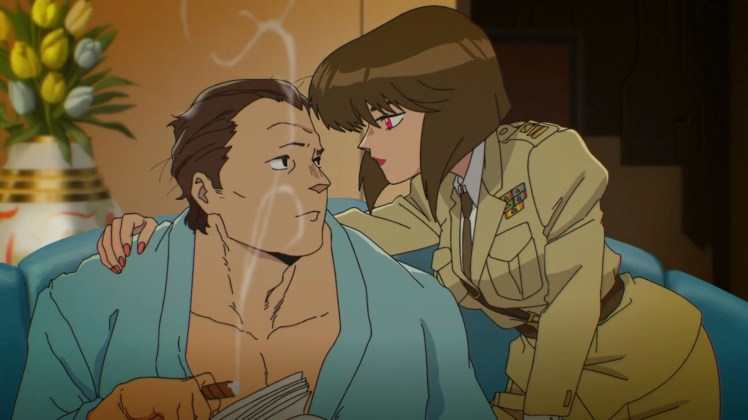
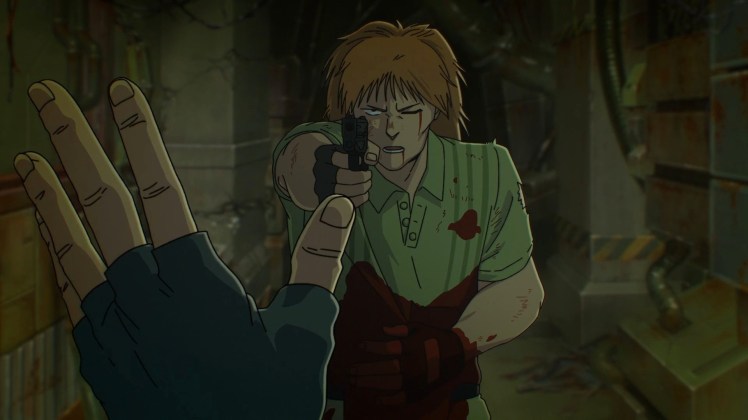
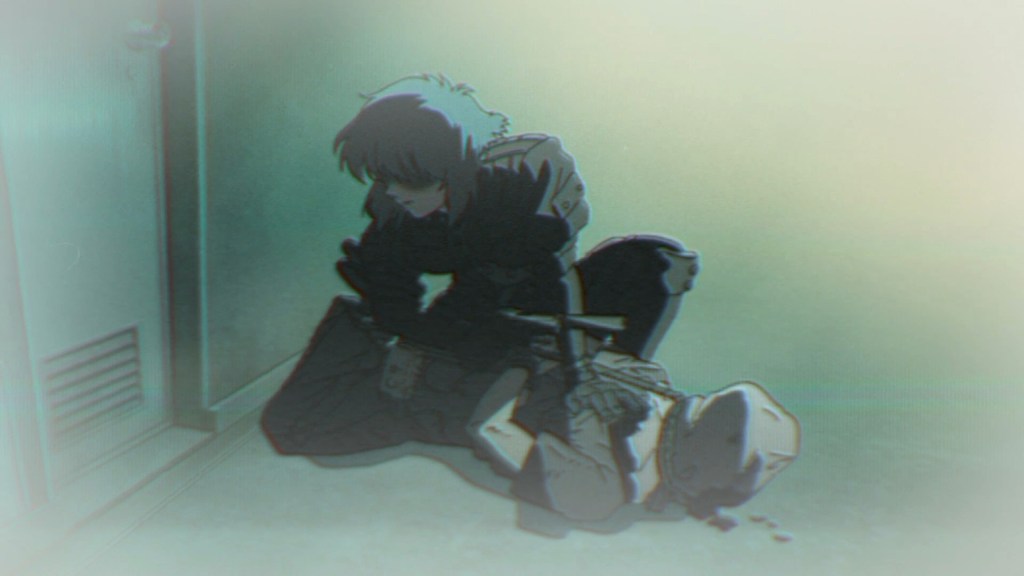
The more arbitrary makeups of The Ghost in the Shell’s team ironically throws Aramaki into the action. After he hears that the Major’s apartment has been bombed, he rushes to the hospital, and frantically orders Batou to the OR. It’s simple, but it makes a big difference. Apparently, he sees Motoko as like a daughter. “At least think of me as a granddaughter!” She pieces together that the culprit is likely Toru Soma, a terrorist she’d failed to kill in her wild days before Section 9. See, the bomb was plan B, as a brown-haired Major in domestic morning bliss with her boyfriend from Section 1 is blasted at through her door by a shotgun-wielding assailant. She recognizes this trick as one she’d played on Soma, though hers was a little different. In retaliation for torturing and killing two of her men, the Major had hogtied Soma’s son and placed him on the other side of a door to be shot by an unwitting Soma. This really neat, bondage-themed backstory is only glimpsed in the manga, and I was hoping for an expansion in the anime. Love a sadistic Major, and apparently my bloodlust wasn’t satiated by the reverse drive-by shooting in “Phantom Fund.”
IT SHOULD’VE BEEN– actually, this one’s kinda fucked-up
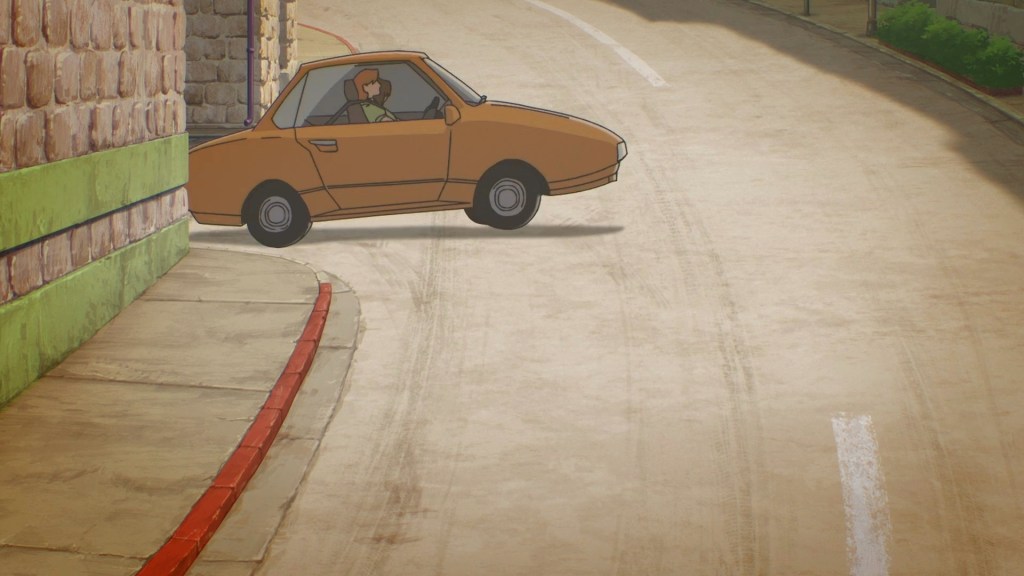
Already in this episode, we’ve got jokes, from Aramaki reaching the hospital room to find the Major was untouched by the explosion to the Major beaning Batou in the face with a mug for a remark about her boy toy to Batou arguing with a paramedic for blocking the ambulance access with a deconstructed car. In a wide shot, the cars themselves appear to be the ones arguing, and man, did the budget for cars plummet in this episode. For all the ‘80s on display, with bad guys wearing colorful shirts and big mustaches, this is something you’d never see in the theoretical OVA of Shirow’s Ghost in the Shell made alongside Appleseed and Black Magic M-66. Animators of the day were otakus about guns, girls, robots, military tech, and cars. These days, assumedly, it’s less of a boys’ club, and, well, I’m not gonna pretend like “cars” was some big sacrifice. I count my lucky stars that this show is even 2D, given that the last contemporary anime show I watched was 2016’s Berserk. I guess that solves the mystery of why I stopped watching anime for a decade.
And so, with these goofy moments – intentional or not – we’re preserving the essential Shirow ingredient, the one usually trimmed out of adaptations. It’s surprisingly effective when paired with an added ingredient: music, which is especially good in this episode. Batou might be super-deformed in the background, but a contemplative Major in the foreground is confronting the nature of her relationship with a fellow intelligence agent – they’ve both run background checks on each other, to start – accompanied by moody piano. It’s a heightened, melodramatic combination, as if the goofiness is the pressure-release valve permitting the drama to be as serious as possible. Like Yoko Kanno’s score for Stand Alone Complex, the music reflects the Major’s headspace, allowing her the privacy of her own thoughts and feelings. Still, “Dumb Barter” threatens to expose what’s behind that steely front…
My Neighbors the Yamadas (1999)
Unlike with “Phantom Fund” the plot here is refreshingly simple, composed of only two big plot beats. The Major notices a tail out of the hospital, and stops off at a warehouse for the showdown. The mustache thugs came prepared, however, packing a spider tank: German hardware, Japanese software. How diabolical. Seeing this, the Chief heads off to the manufacturer’s HQ, ordering Saito to find out how many of these tanks were produced and to whom they were sold. Hmm, that was so logical, I actually followed it! And it only takes the Chief pulling a gun in an office to get the answers he needs. The men with the tank now attacking the Major and Togusa – taking a slashed-open throat for the trouble – are Section 1. The Major and her boyfriend come face-to-face, and she throws a knife into his shoulder before running off. “What’s Motoko doing here?” he wonders. Turns out, Soma had reached out to Section 1 to make a deal: the identity of his alleged partner “Anaconda” for Motoko Kusanagi. There’s also something about a “Benten family” which I did not, in fact, follow.
This isn’t the first or last time the Major has gone up against a spider tank or an arm suit. Her body is usually the only casualty, though her pride definitely takes a hit. Now, if I hadn’t made it clear already, I am by no means a Major/Batou shipper. In most incarnations, he’s a little too clueless, and a workplace romance? That is so cringe, I say, as someone who’s worked from home for five years now. Still, I can’t deny it’s weird for the Section 1 boyfriend to shout “Motoko!” as she’s being crushed by the spider tank, effectively taking Batou’s role in the ‘95 movie. Borma shows up with a standard-issue big gun to disable the tank, and out of it pops Soma, in the endgame at the bottom of the Major’s pistol barrel. She unloads thirteen rounds into his face, liquifying his head. “Bye-bye, terrorist.” And what an image! One of the things I’ve come to really value about the Major is her monstrous-feminine aspects, like her battle-damaged Terminator visage here. So scary, so sexy.
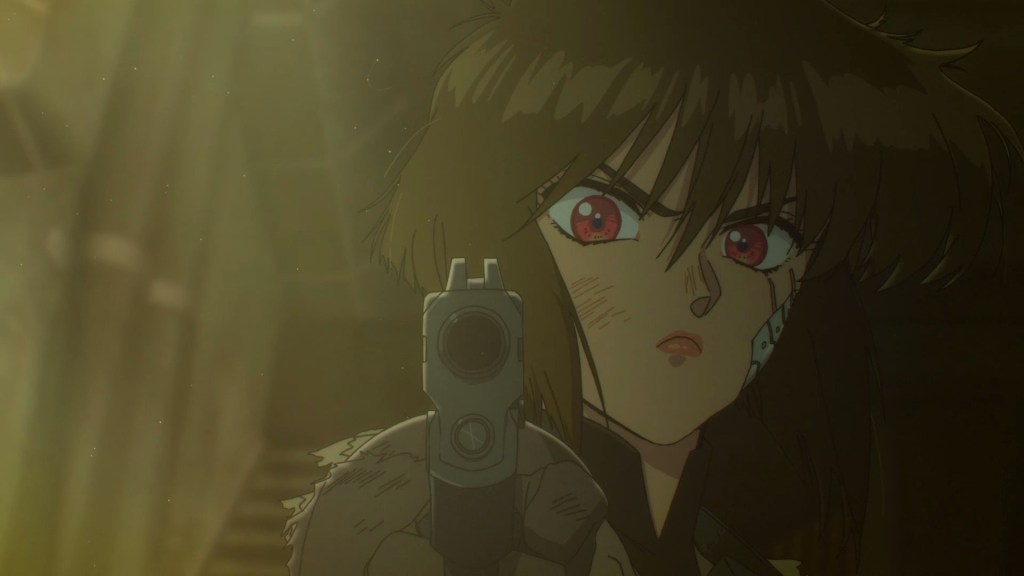
When the dust settles, we learn that Soma likely never knew Anaconda’s identity, and that anyway Section 9 had already taken care of him. That’s why she was dressed so sharply that fateful morning, having toned her hair down from blue to brown. This is exactly why I wasn’t born too early, because if I lived in the age of cyborg bodies, I’d be constantly adjusting my character creation sliders. It takes me forever to finish video games because I’m always trying on different outfits. “Dumb Barter” is only the latest to end on a punchline, that the whole operation was basically a farce, but this one accomplishes at least two things: first, ties the themes of the episode up in a nice bow as a meditation on the blurred lines between military, governmental, and even criminal organizations, and second, sees the Major brush off the day’s seemingly traumatic events with a wink.
Too bad about that one guy, though, huh?
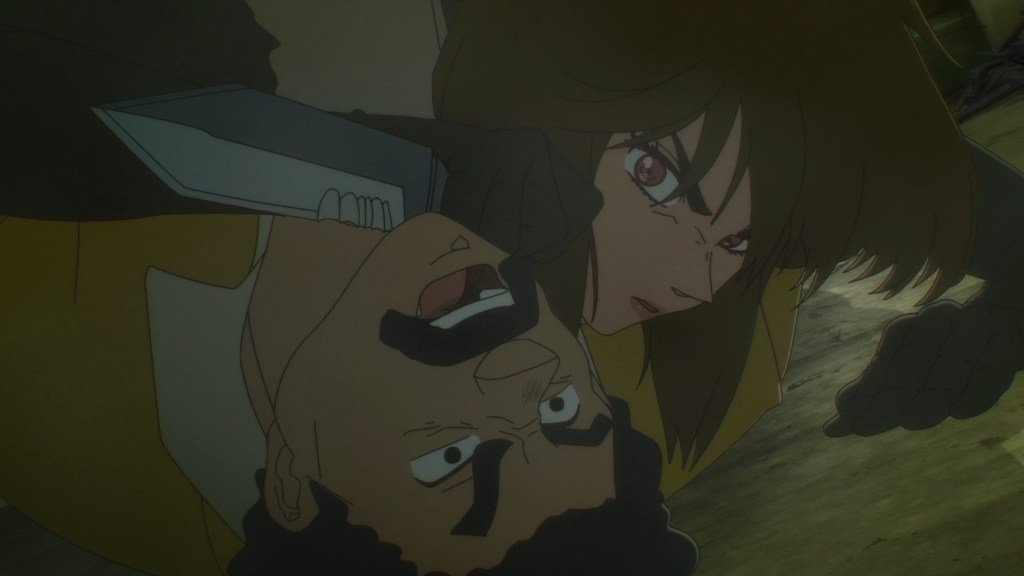
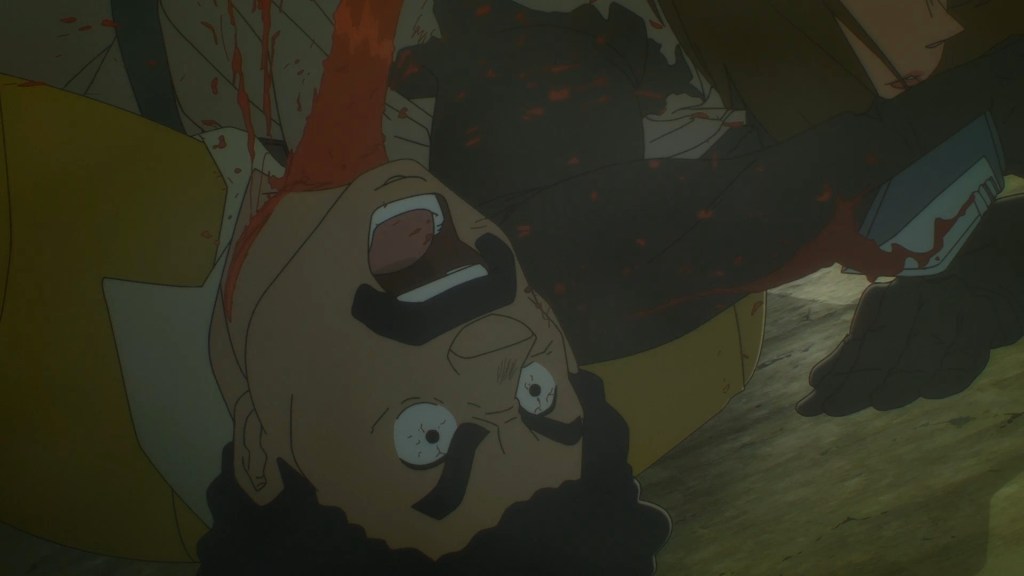
PS. This episode includes a stinger where Batou returns a totaled rental car and we hear a news story that the head of Section 1 was killed in a hit-and-run. When this was adapted for the 2nd Gig episode “Trial,” the victim of Section 9’s vindictiveness was a lawyer. Yes, he was defending a guy trying to put the frame job on Togusa, but… that was dumb, and I didn’t like that episode. Not everything from The Ghost in the Shell survives transplantation to a different tone or style. This murderous coda is perfectly Shirow.


LikeLike
This is the scariest she’s ever looked, and I’m only now connecting her glowing eyes of fire to any kind of Cyborg Rage.
LikeLike
It’s never a good idea to piss off the Major, but especially not this one. I wonder if she can control that glowing effect, possibly with a slider
LikeLike