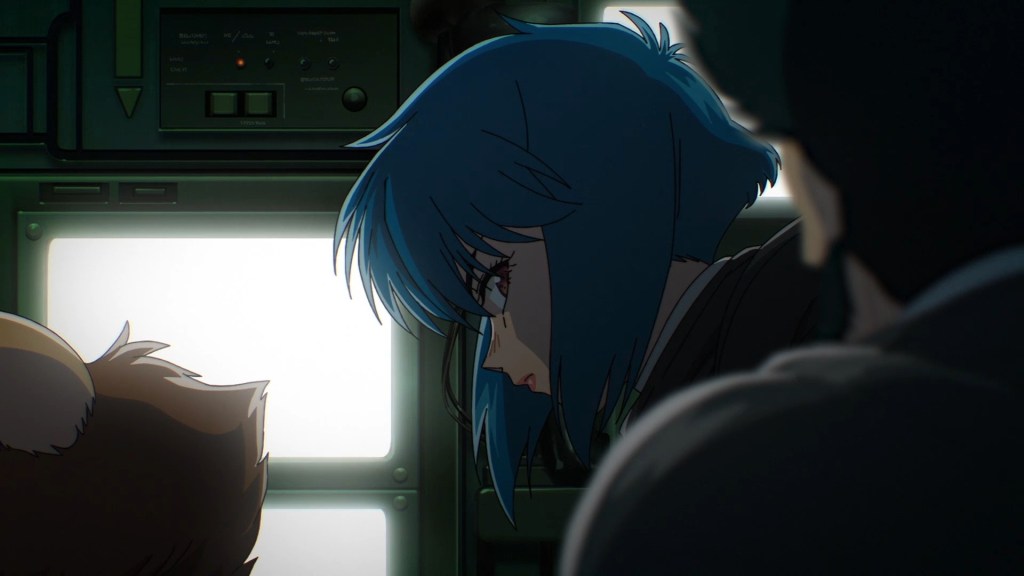
Cyberpunk to the max
I’m back from vacation, current with The Ghost in the Shell but not these reviews, so I can say with some confidence that “Phantom Fund” begins a run of extremely confusing episodes. A few years ago, on a podcast about The Matrix Resurrections, I asked a surprisingly trenchant question related to media criticism, effectively “Can we claim to like something we didn’t fully understand?” A round of applause. Because while “Phantom Fund” is so dense that even two viewings – one with hideously scrawled notes including transcription of entire dialogue exchanges – left me dumbfounded, it also has the Major absolutely obliterate some fucking guy. And as the previous “Robot Rondo” served with respect to Ghost in the Shell 2, it’s another inverse study in adaptation. A lot of what’s seen in “Phantom Fund” will ring familiar to fellow fans of Ghost in the Shell: Stand Alone Complex 2nd Gig, from broad strokes and visual iconography down to incidental lines of dialogue.
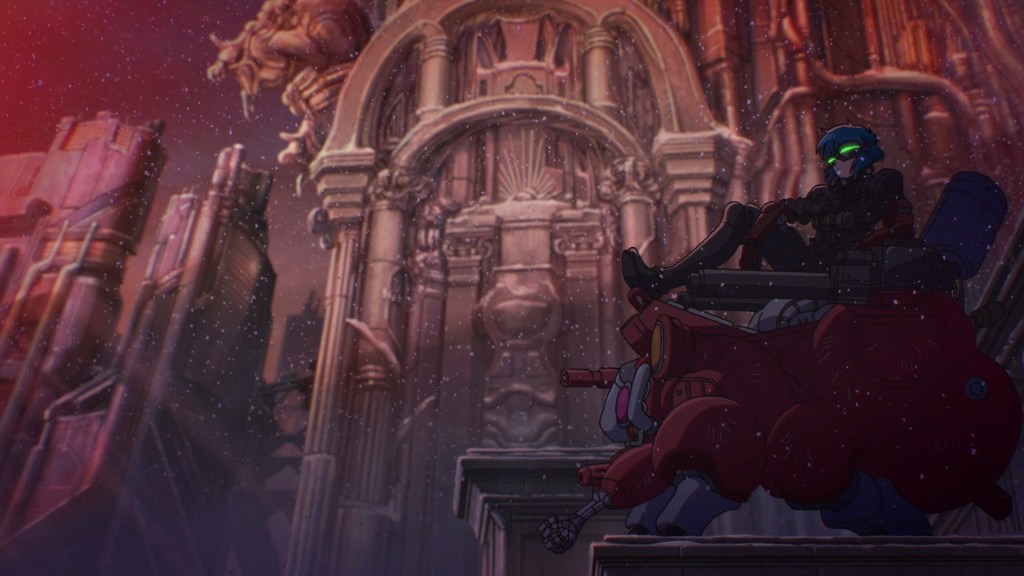
Of course, the “natural oil” bit extends beyond 2nd Gig, and it’s always confused me. In Stand Alone Complex, it highlights the relationship Batou has with the Tachikomas but also portends their eventual self-awareness, climaxing in the haunting “Be Human” by Scott Matthew (and, typically, explosive self-sacrifice). It’s more concise here. The Fuchikomas demand natural oil over the flavorless synthetic variety, and the Major coolly responds, “Denied.” This is one of the things that can hardly be replicated or bettered in live-action, because the Major’s face doesn’t even move as she crushes dreams. For indulging in natural oil, the Major refers to Batou as a “bonehead,” and this had me thinking about their relationship. As yet, it isn’t remotely romantic, which is how it can often be described. Batou from Ghost in the Shell ‘95 doesn’t realize that berating the Major for having an existential meltdown is not, in fact, the key to her heart, and so on. During the episode’s climax, Batou’s Fuchikoma locks up because of the natural oil, and maybe that’s all the payoff we ever needed.
A dangerous cyborg from the MAG Union (obviously, a combination of 1980s Russia and 2020s America – how did Shirow know!?) named Koil Krasnov has entered the country, Hokkaido-bound on the Tohoku Maglev Express. One of those futuristic floating trains of Japan, perhaps? Rookie Yano, fresh from the academy, is currently tailing him. At the same time, Sagawa Electronics Corporation has been expanding their underground factory in Itorubetsu ward in the Far North, which is where the Volgarena submarine base used to be. Aramaki explains that Public Security has been watching Sagawa for some time, but with Koil’s arrival, it’s time for Section 9 to get involved. So, we have two questions at the outset: What’s Koil doing in the Far North, and what’s Sagawa hoping to find by digging up an old military base?
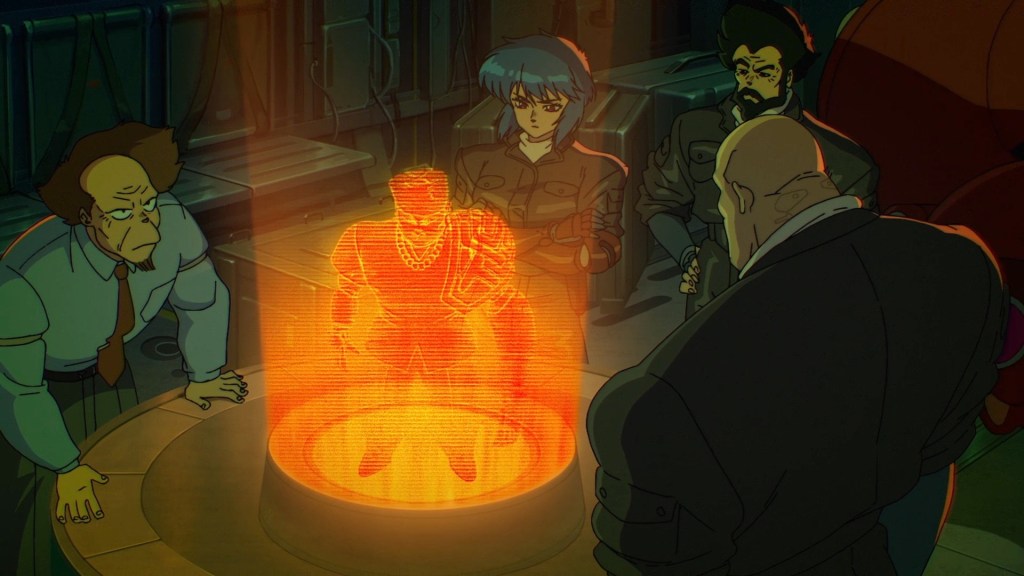
Shell Squad heads to Itorubetsu, an “old-school cyber city” like the “data city” in Ghost in the Shell 2, which happened to be called the “Etorofu Special Economic Zone.” This is a real place, as I discover: “Iturup,” or “Etorofu,” a contested island between Japan and Russia, yet more legacy of World War II. In 2nd Gig, Etorofu was a major setting, where Hideo Kuze hoped to secure plutonium from Koil in a geofront. That’s where rookie Yano was killed in a firefight, though the Major took the blame. In The Ghost in the Shell, Batou rushes from his academy instructor duty to find that Koil has murdered Yano. Within the fiction of Ghost in the Shell, it seems, Yano always dies. Batou calls up the Chief and yells at him for not adequately equipping the rookie for the mission, and then vows revenge. Ishikawa tells the coroner or whoever to “treat the body with respect,” which he also does in 2nd Gig, and a passing Fuchikoma says, “If he’s broken, they should just fix him up.” In 2nd Gig, Saito notes that a ghost can never be retrieved. Sadly, he’s not in this episode.
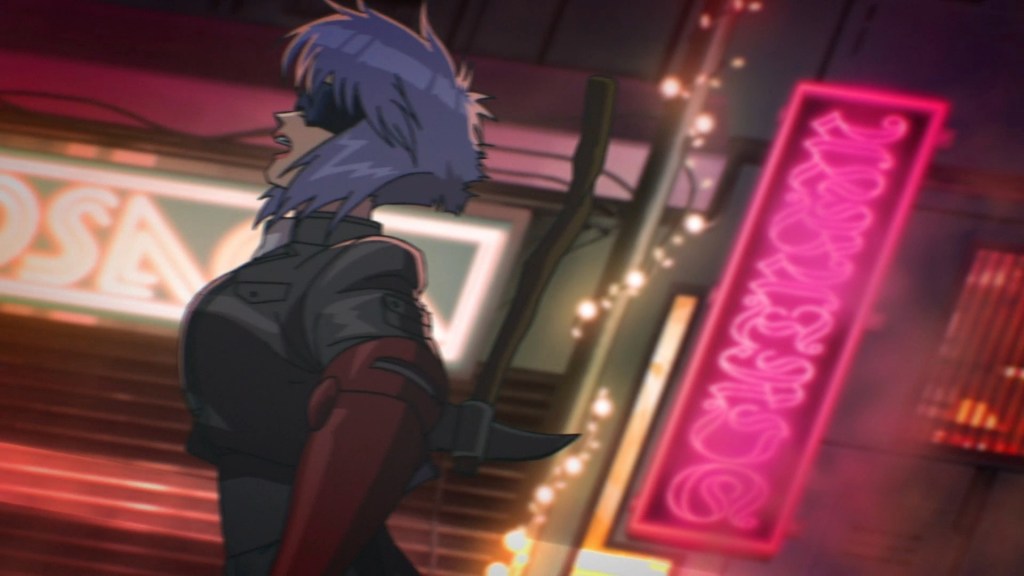
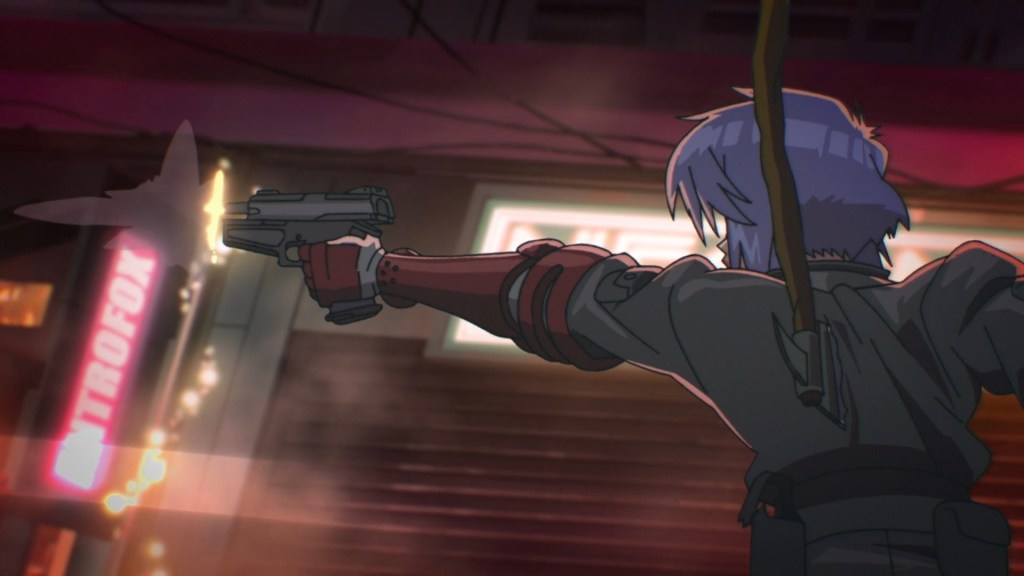
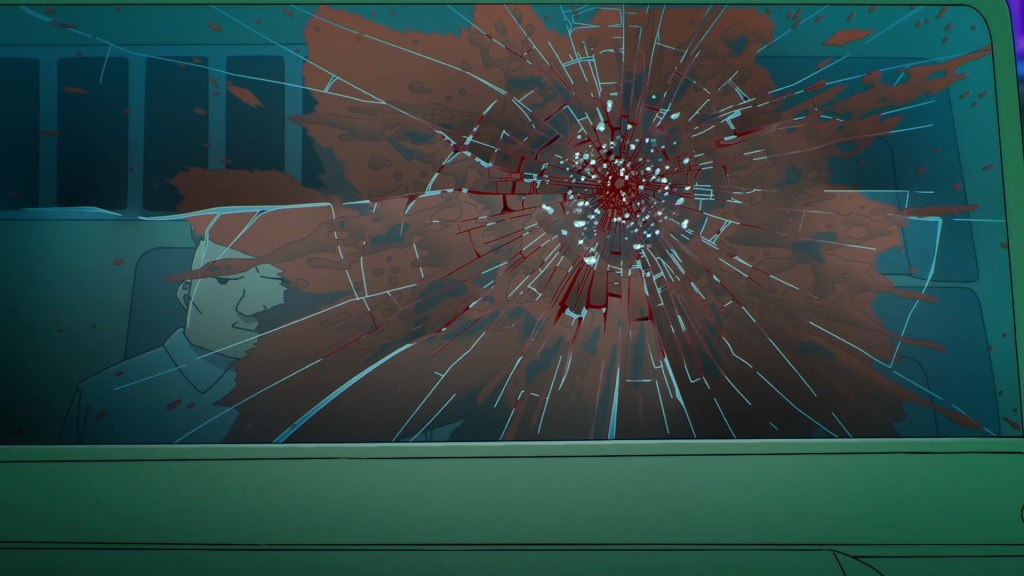
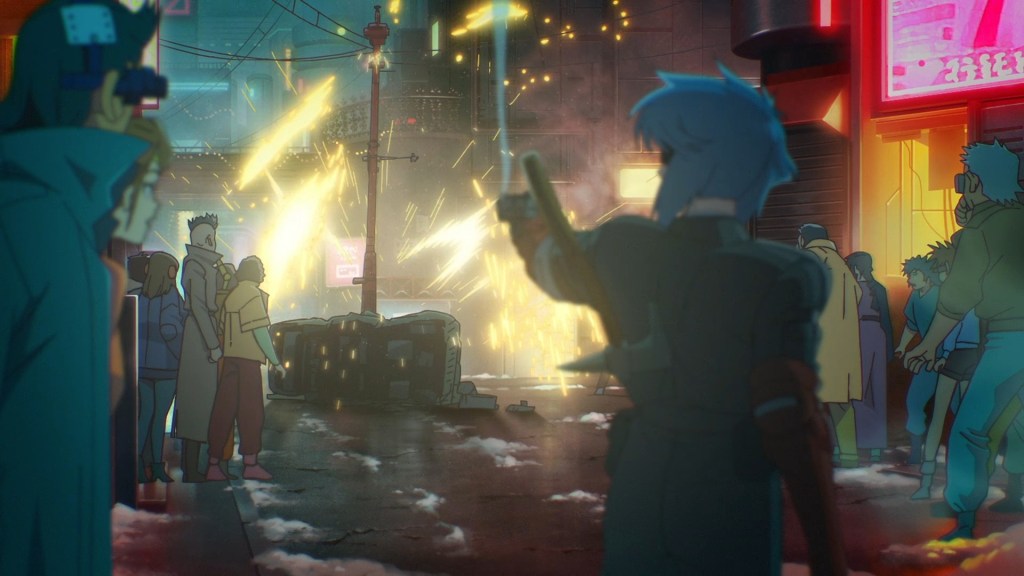
Meanwhile, the Major arrives in Cyberpunk City, with neons reflected in puddles of mysterious runoff, and cameos by the spunky AnnaPuma and UniPuma from Shirow’s earlier manga Dominion, voiced here by the same actresses from the 1993 OVA New Dominion Tank Police. They’re almost ripped off by a curious Fuchikoma, who doesn’t look out of place at the market. It’s a part of town that can’t be described as “bad” if the whole town is bad, where a guy is casually firing a pistol out of the passenger window of a van. The Major is musing about Batou being on edge lately when another van roars up from behind and a guy plants an axe in her back with the shout of “Die, militant!” Without missing a beat, the Major draws her pistol and splatters the assailant against his windshield. No conversation, no shots at the tires, no “Police! Let me see your hands!” A nearby vendor then offers her a skin service, to which she replies, “Get lost, pervert.” This is the dream woman right here.
I appreciate the direct approach, though there are so many great ways to characterize the Major. Sometimes, I prefer it subtle, with the threat of violence. A great example is in 2nd Gig, when she visits an underground-type guy in Etorofu in order to speak with Krolden, a man who loved two things: hacking and sex robots. The guy is introduced roughing up a different guy, but turns servile when the Major darkens his door. Everybody gangsta, as they say…
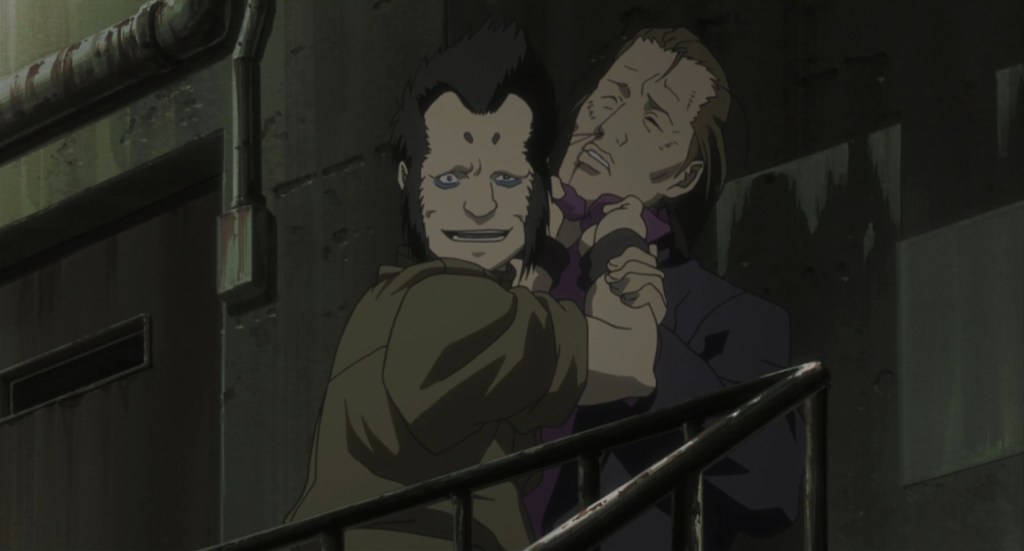
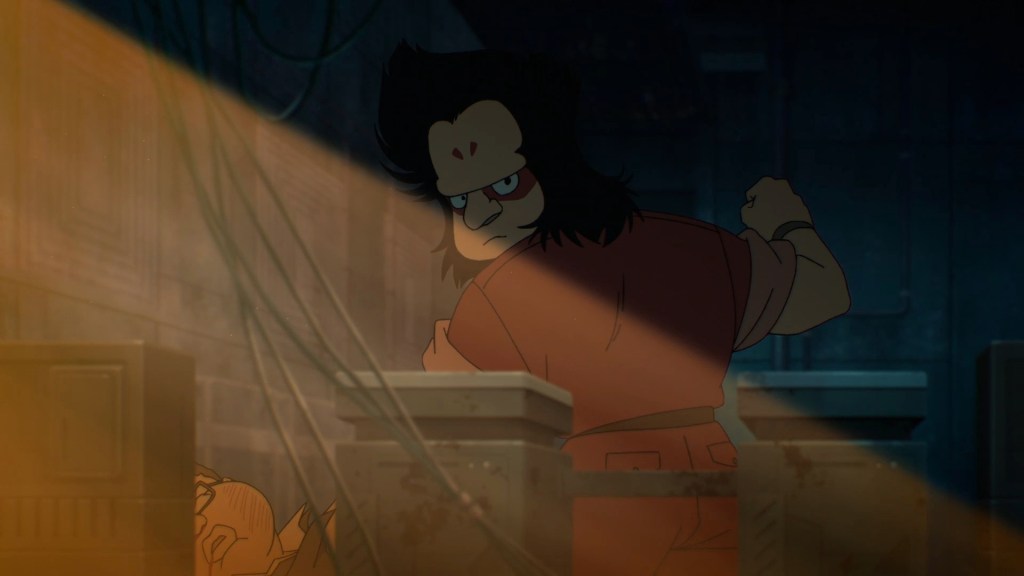
However, you can see someone on the ground in the 2026 edition
She discusses her wariness of people too eager to please, and similarly, in both incarnations, she’s the “lady from the Nemuro landing operation.” Oh, we’ll revisit the military background in the next episode. This time, Krolden is alive and well, and explains that Sagawa has been profiting off of the agreement between Japan and the MAG Union. I assume this means that the Itorubetsu disagreement eventually broke down in a shooting war, which as we know would make a lot of rich people richer. Speaking of cyberpunk (or at least, cyberpunk-adjacent), I recently read an article about how Metal Gear Solid 4 anticipated the blatant profiteering going on with today’s geopolitical conflicts. Of course, it’s just as true that the 2008 game was influenced by the War on Terror; how things change, eh, Snake?
Batou and Ishikawa take their Fuchikomas into the geofront, where the foreman references a previous visitor just like in… guys, check the reports or I’m gonna point at Pete. Finally, after Batou is pinned down by an arm suit, out of the Fuchikoma because of the damn oil, another Fuchikoma opens fire on him, like Saito was almost hit in 2nd Gig. Again, Saito isn’t here. It’s weird to have a team in a show and not have the team in every episode, or most episodes. The eyepatch-clad sniper was always my favorite, and not just because of “Poker Face.” In the scuffle with Koil, Batou twists off his mechanical arm, only the latest refrain of a cyberpunk body horror standby. After shooting a fleeing Koil to death, Batou discovers gold bars at the bottom of the geofront. Apparently, there were stories about gold flowing out of postwar Volgarena. Is this what Sagawa was looking for?
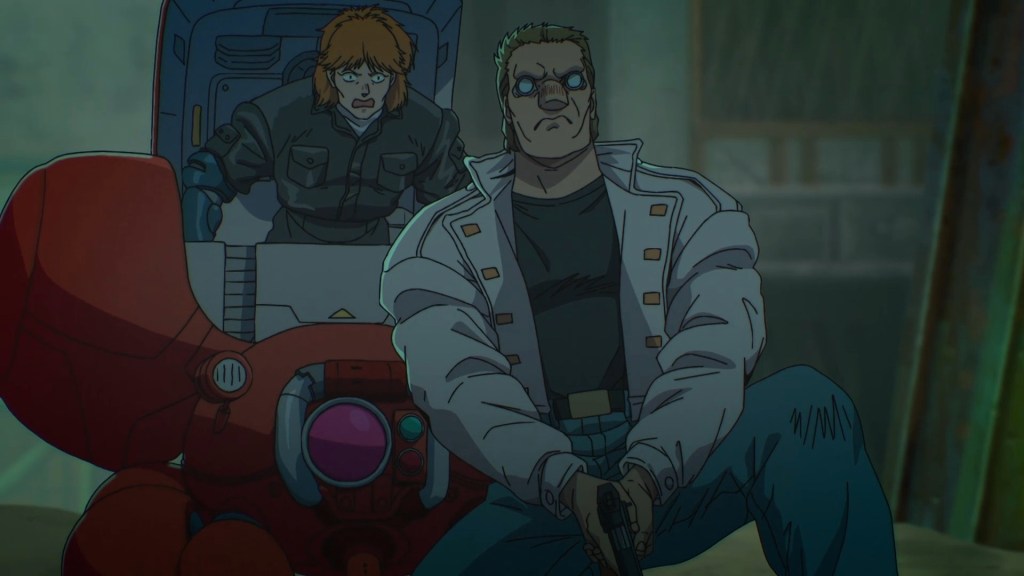
The Major infiltrates the Sagawa HQ, which is entirely automated, almost like that police station in Do Androids Dream of Electric Sheep? but not quite. She’s spotted by surveillance tech, making her wonder aloud why she even bothered getting a full-access pass. It’s okay, Motoko, that’s a classic Deus Ex move: secure all paths to the single goal. In her flight from the security apparatus, it’s funny how she flops on top of the door to the main office, instead of kicking it in. As with the doomed axe guy from earlier, she blows away the middle manager when he reaches for the keyboard instead of the sky. He turns out to be a robot, lying in a puddle of white blood. Just one of those sci-fi traditions, I guess, like how all hologram telecommunications have to be wavy and distorted because of Star Wars. It made sense in that “used future,” but in Mass Effect? And Death Stranding? And countless other examples?
On the data disk the robot was trying to destroy, the Major finds a heavily encrypted file, which turns out to be records of land deals around the Volgarena base. She’s then attacked by one of the manga’s memorable villains – enough at least to feature in the OP – Lt. Col. Sohei Kagasaki, taking the form of a statue whose head is mounted on a wall, leaving a buff torso to chase the Major around. She clings to the walls to neutralize the floor sensors, themselves in place to neutralize optical camouflage. I’m somewhat reminded of Molly’s gymnastics in “Johnny Mnemonic,” but again, not quite. When caught, Kagasaki cries, “I served my country for 20 years up here in the Far North! I think I deserve at least a little something in return!” A public security officer, he’d worked undercover at Sagawa Electronics to get close to Volgarena, helping turn the company into “one tentacle of the Sagawa Group octopus, through cozy business ties and embezzlement.” The MAG Union’s Central Committee was worried about the gold flowing back into the country as funding for General Marlov’s election (who the fuck is General Marlov?). The Major’s response to Kagasaki: “Life’s a bitch.”
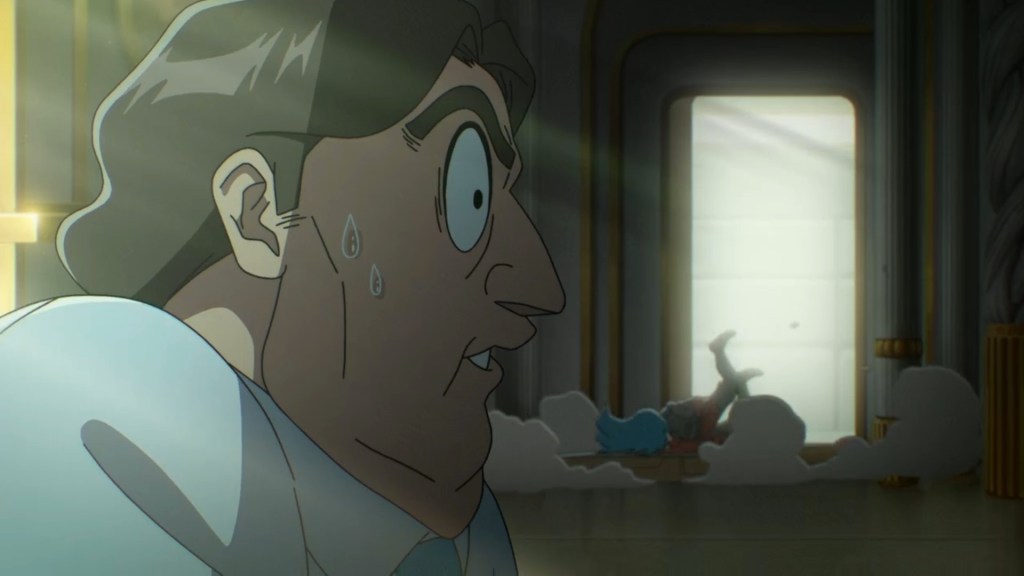
Aramaki suggests that that money might instead go to develop the “Halma plain,” which would be doing his buddy Methuselah a favor. In their conversation at the top of the episode, we learn that her own replacement in, I assume, the Japanese embassy, was maneuvered into position by this Marlov fellow. “That’s the first bit of information I didn’t already know,” the Chief says. “It’s sweet of you to lie,” she responds.
So, what do we make of all this? The episode ends on Batou observing Yano’s brother at the cremation memorial, looking angry and resentful. If I had to take the terms of the episode as articulated above and arrange them in a thematic framework, it’d be pretty simple. I think this episode is about the juxtaposition of war profiteering and the human cost. Aside from the Major killing people with literal extreme prejudice, these are the only two ideas expressed. And so, I’m left more frazzled than affected, like Shirow had dumped a box of puzzle pieces on Mokochan’s lap, and he then dumped them on my head. It isn’t Mokochan’s job to reorganize the original manga in a more coherent, moving way. After all, it took several episodes of 2nd Gig to adapt “Phantom Fund” into its own “Individual Eleven” arc, where these same odds and ends ultimately added up to profundity and dramatic release. In The Ghost in the Shell, there’s joy in “compression,” with ideas and images fired from the hip like the Major merc’ing some poor son of a bitch in a van.
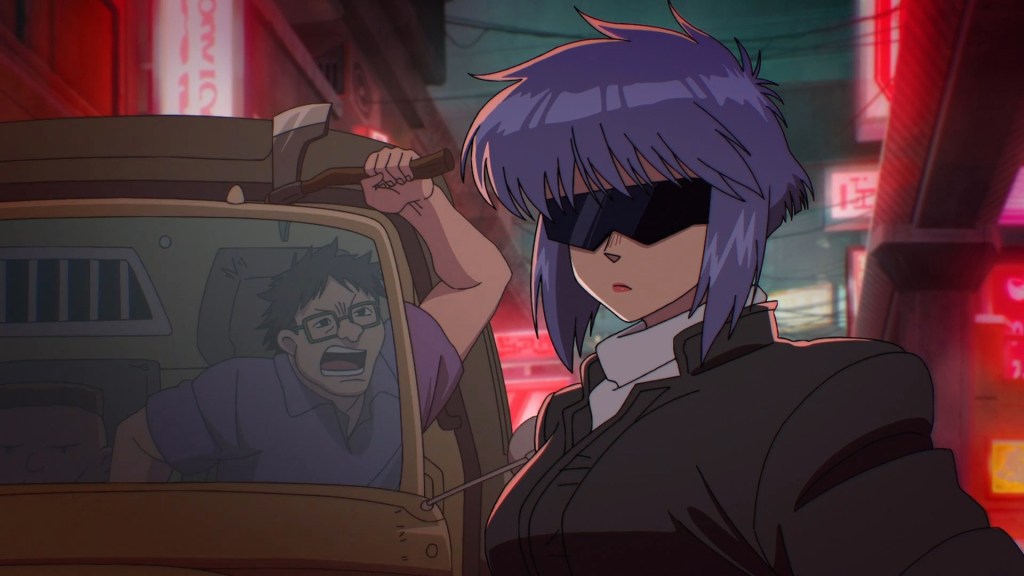
Absolutely zero chill


The quick-draw animation of the Major gunning down the driver scene might be the best realization of manga-to-anime adapting yet. This might be my favorite in the season. The Fuchikoma scene with the Puma Twins was honestly funny, and the general drama landed strong as well.
LikeLike
Yeah, this and the next episode are like the perfect distillations of episodic GITS. By season’s end, I’m gonna wish there were more like them
LikeLike