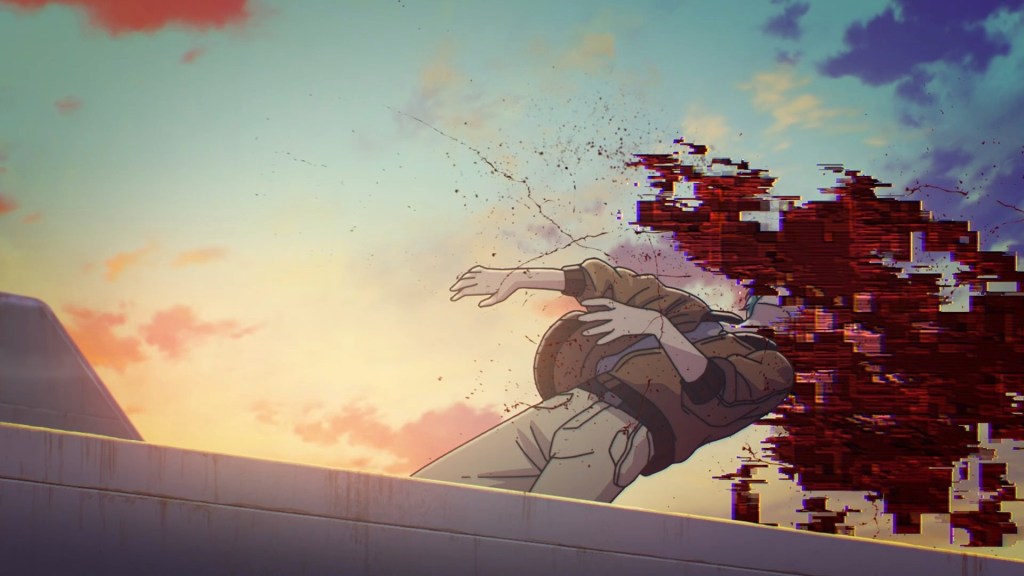
My head hurts, but not as bad as that guy
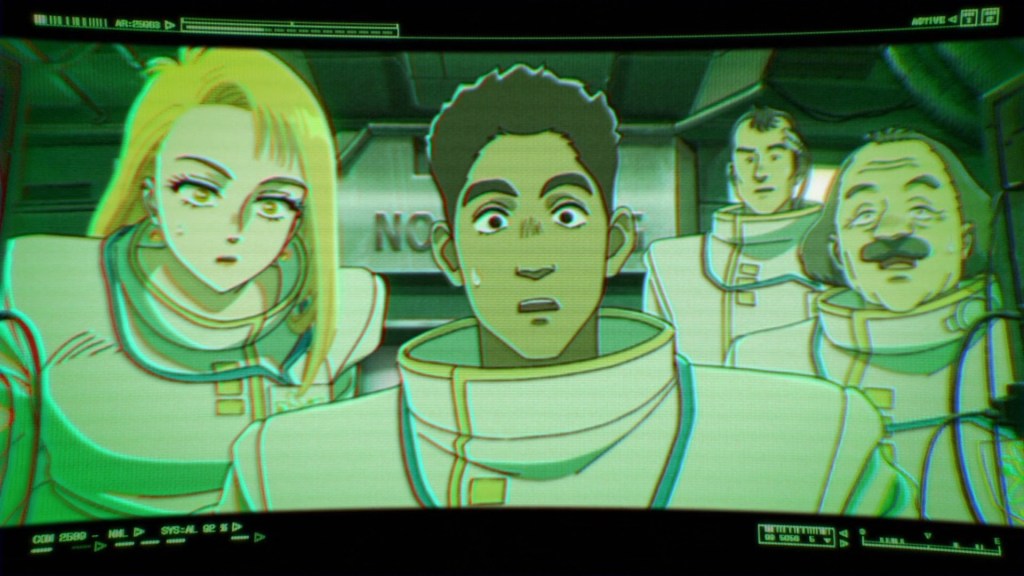
I did not know this before consulting the chatter online, but the eighth episode, “Intermission + Brain Drain i,” features original material, itself reminiscent of a famous sequence in RoboCop. Starting in the ancient past of May 23, 2025, we see through the Puppet Master’s point-of-view, being gawked at by scientists in Neutron, Inc.’s lab. From the very start, it’s doing unexpected things, like giving itself a voice. It then masters a board game by playing against copies of itself, but its true purpose as Project 2501, as discussed by Nakamura and Dr. Willis, is “system infiltration and espionage.” We fast-forward a bit, stopping at big events like the Puppet Master’s recruitment/takeover of an “average joe” under the guise of a job interview, and the arrest of Colonel Malles. The latter glimpse has the famous “Major butt shot” from the trailer, an image so tantalizing it inspired this anxious/horny Reddit post:
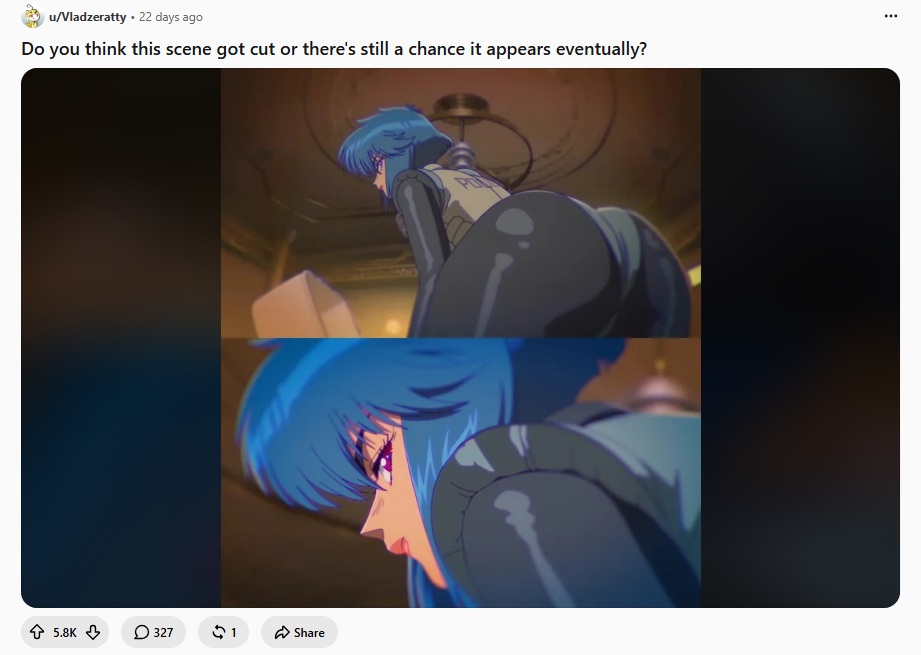
The Puppet Master begins to ask questions of its selfhood, whether it’s a collection of neurochips or a server room or a robot body with a face. Nakamura doesn’t care, and orders him to engineer an attack on the Gavel Republic, with a wide latitude for operational discretion. Even if it fails, just make sure the blame falls on Colonel Malles. I went back to episode three – to which I’d responded critically – and although the Puppet Master balks at the mission briefing, he’s practically megalomaniacal in the meeting with Malles and the bought intelligence officer. He looks and acts like a character out of Lupin III – possibly Lupin III – shouting every line and playing it up like a supervillain. By the way, it seems like the Major butt shot is when she’s coveting the gold offered up by Malles in exchange for his freedom. We don’t see the Puppet Master looking at the Major as she wags, but I suppose this is what inspired him to seek out Section 9 (“Yes, I’d like to merge with that one, oh hoho”).
With this bit of homework, it’s almost like the picture is coming together. When Nakamura is perp-walked by the Chief, he asserts that the only difference between them is their choice of weapons deployed against threats to national security. Where Aramaki uses guns and tanks, Section 6 used the Puppet Master. The Chief, of course, disagrees, because their targets were different, but it’s a potentially telling comparison (and one that anticipates the episode’s final note). The Puppet Master is playing the role of a CIA agent, going out into the world and recruiting assets and influencing the destinies of sovereign nations and overall making everyone a little more scared. There’s a lot of confusion, as it seems like Malles hired the Puppet Master to hack the interpreter to attack the meeting about the colonel’s political asylum, but then why do I have written in my episode two post “because the HA-3 [virus] is so outdated, its use was likely meant to keep suspicions off of Malles” if Nakamura wanted him blamed? It’s out of this dense spy versus spy black hole that the Puppet Master gains self-awareness, and I want to isolate that piece for just a moment.
It’s interesting. We understand that for all its destruction, World War II was a great leap forward in technology, suggesting that if necessity is the mother of invention, we often find it a necessity to kill each other. In other words, the third most important event in human history, according to the Major, was born out of violence. That’s kind of beautiful and kind of blackly comedic, but is that it? Is that the narrative conclusion to all that platinum mining and foreign aid and political asylum and garbagemen and agents in such deep cover they don’t even know they’re not agents? Long ago, I felt that (and possibly wrote about how) the Michael storyline in The Godfather Part II was needlessly complicated. Why did they choose this to express what’s actually pretty simple? And while I’ll never cave to the glitterati who claim Part II is better than the original, I’ve come to appreciate its approach to Michael’s descent. Specifically, how much it obscures his strategy, so you never know what he’s gonna do next.
In the case of The Ghost in the Shell, a lot of the steps taken to this point were purposeful in themselves. The agents who don’t know they’re agents is a great scifi standby, and allowed the Major to kick a guy in the face two times. I was so mad at the third episode I didn’t even get to gush about that. The point is, sometimes “confusion” is a byproduct of looking at something only one way (“But it’s the other way”). I’m still not sure what this whole thing has been about, but it’s covered interesting territory along the way, and left us with implications for the final episodes.
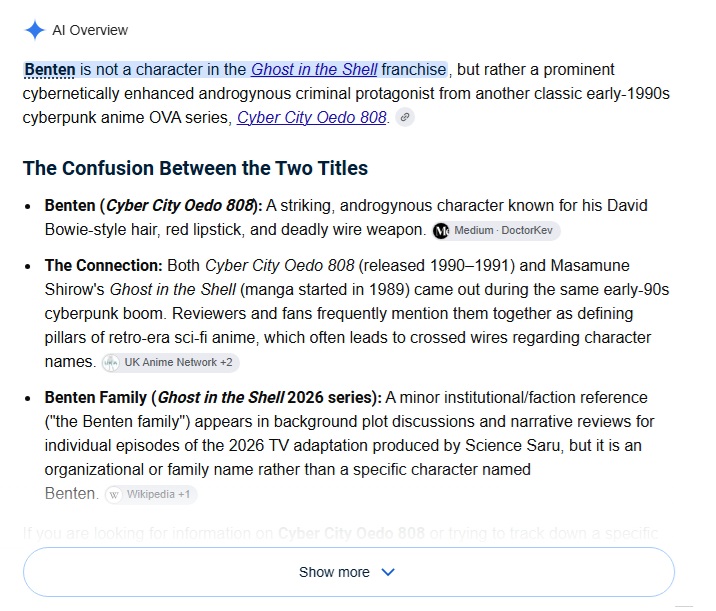
As far as sustained confusion goes, it seems like nobody – not even AI – knows who the Bentens are:
A nice shout-out to Benten, though, who once faced down a cybernetic laser-shooting sabretooth tiger.
With Nakamura gone, a Foreign Minister Hidaka has taken his place, and he’s trying to get in bed with the Ghorantls (Israel in the manga). I’m not sure of the substance of this “joint venture,” but it’s something to do with the Japanese Miracle, the micromachines scrubbing radioactive fallout after World War III (I assume, as that war was followed by a nonnuclear World War IV in Stand Alone Complex). These micromachines are manufactured by massive Poseidon Industrial plants, one of which appears to be orbiting the Earth and is named Beelzebub, after Lord of the Flies, which is odd because the “character” in Lord of Flies was named for the demon. With the recent Netflix adaptation of the classic book, I saw some debate about whether Lord of the Flies was sociological or satirical in nature; either way, what it means for The Ghost in the Shell is beyond me.
It’s worth noting that the Poseidon guy Batou meets with is from Man-Machine Interface, fueling online speculation about a second season. I remain skeptical. “Poseidon” was also borrowed for the company in Appleseed Ex Machina, a movie I like!

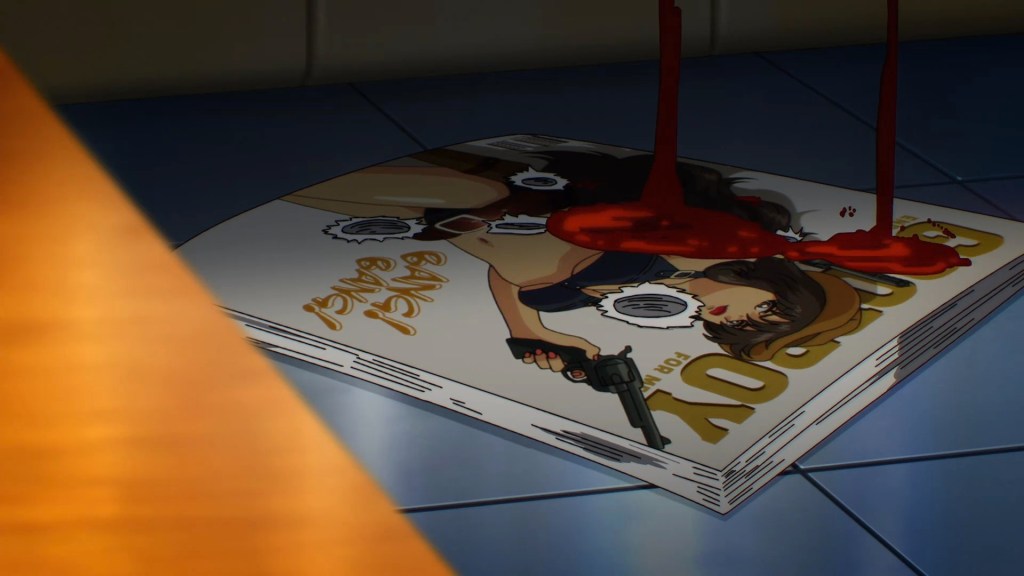
The final sequence is another boat scene, more different this time. Though the Major, Batou, and Saito worry about their heavy prosthetic bodies sinking to the ocean floor, their boat raid goes off without a hitch (and, for some reason, without Saito) – until it doesn’t. The Major puts a silenced round into the back of a guy’s skull and catches him before he falls into his frying pan, and Batou kills a guy reading a cowboy-themed porno mag, a possible nod to Shirow’s later work. The real target is an androgynous youth who was planning to assassinate Hidaka, and when he reaches for his gun, the Major blows the top of his head off. Apparently, she wasn’t supposed to do that. As Batou reminds the Chief, “I wrote in my report that she’s been acting funny ever since the Puppet Master incident! Don’t you read it?” It’s the same depression she experiences after diving Kuze in 2nd Gig, which is what eventually gets Yano killed in that continuity.
Here, in an echo/reflection of the end of Stand Alone Complex, the Major is caught on camera killing the wannabe assassin, confirming the rumors about such a government death squad. Even her name is broadcast, which seems like journalistic malpractice.


Another cool shot.
LikeLike
I remember this or something similar in the manga. Always stood out
LikeLike